The version of Snatcher most English-speaking readers know is the Sega CD release that came out in North America in January 1995 and sold roughly two thousand copies. That release is a port. It is censored, it adds shooting set-pieces Kojima did not write, and he had no hand in it. The version he actually made — completed third act, uncensored script, all-anime voice cast, his name on every reel — came out on the PC-Engine Super CD-ROM² two years earlier and never crossed the Pacific.
That gap is not a translation problem. It is the article. Konami’s most consistent decade — Castlevania IV, Contra III, Axelay, Sunset Riders, the Goemon run — sits in the same seven years that Hideo Kojima was inside the same building turning Snatcher into the studio’s first CD-ROM project. The arcade house style was the visible Konami of 1990 to 1996. Snatcher CD-ROMantic is the other one: a cinematic adventure game on optical media, written by an in-house auteur the company kept in a different room, and finished in the version English players still mostly do not play.
The reason to come back to it now is not preservation, and not Kojima’s later career either. It is that the game itself has aged into legibility. The detective loop is sharper than the genre that has grown up around it. The opening is film. The third act, in the version Kojima signed off on, is short, hard, and final.
The opening credits roll over a slow pan across Neo Kobe under “One Night in Neo Kobe City.” Most PC-Engine CD games used the medium to add Red Book music; Snatcher uses it to assemble a film opening. Snatcher CD-ROMantic · Konami, 1992.
Four Years to Finish a Sentence
The 1988 Snatcher — PC-88 in November, MSX2 in December — was planned as a five-act game. Roughly three hundred hand-painted screens, a presidential-election Snatcher conspiracy, the destruction of Neo-Kobe’s Snatcher headquarters, a Siberian operation, a 3D dungeon under Queen Hospital with branching paths. Konami pulled the rope in halfway through. Acts 1 and 2 shipped; Acts 3 to 5 were cut. The game ends, on the original PC-88 and MSX2, on a cliffhanger the team had no contractual permission to resolve.
Kojima resolved it sideways. SD Snatcher (MSX2, April 1990) is the same world rebuilt as a top-down RPG with super-deformed sprites. It looks like a children’s game. It contains the third-act material Kojima had been forbidden to ship: the conspiracy named, Gillian’s past explained, the Snatcher origin laid out. The Metal Gear 2 team was deployed mid-development when management noticed the RPG was going sideways. The chibi remake was the smuggling route for the ending.
The 1992 PC-Engine release is the round-trip. Act 3, written first for SD Snatcher, is folded back into the original game and given the cinematic treatment the 1988 truncation had denied it. The same story, finally finished, on the platform that became Konami’s first-ever CD-ROM project.
”My projects usually end up having too much content, which gets people angry at me, but this time I could add to my heart’s content without worrying about storage capacity.”
Hideo Kojima, PC Engine Fan #44, July 1992
That CD-ROM choice was strategic and almost happened elsewhere. Kojima told the same magazine the team also pitched the remake for the Sharp X68000 and the Fujitsu FM Towns; the Super CD-ROM² won. They used CD-R writers to author the disc. Nobody on the team had ever used one before. The studio’s first CD-ROM project was a Kojima cyberpunk adventure game, not a Castlevania or a Gradius, and that decision — to put the lab equipment in the hands of the in-house cinephile — is the volume’s hidden inverse on a record.
A Detective Game, Not a Visual Novel
The genre label that follows Snatcher around in English retrospectives is “visual novel.” It is the wrong label. Snatcher is a detective game with a second observation command, and the second observation command is the whole design.
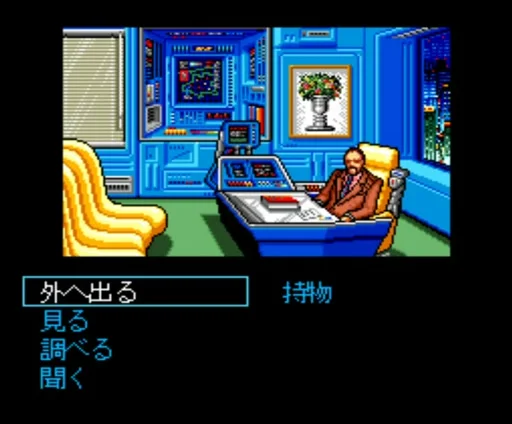
The two-tier interface. Look gets a description; Investigate gets the second one. The whole game is which command you reach for. Snatcher CD-ROMantic · Konami, 1992.
Every interactable object in Snatcher answers to two verbs. Look gives you a description. Investigate gives you a different one. In the JUNKER HQ lobby, the recruitment poster is, on first look, a recruitment poster; investigated, it is a sign of personnel shortfall in the Snatcher conflict. The receptionist’s pod is a pod; investigated, it is heat-and-shock-fitted because the receptionist is what the Snatchers would prefer to kill first. Listen is a third verb, surfacing when the room is worth eavesdropping on; Take and Show Photo exist; but the spine of the loop is the two-tier inspection.
This sounds slight on paper and reads as procedural detective work in play. Most adventure games of the era — Sierra, LucasArts, the JP visual-novel canon — gave you one observation command and used it for inventory, hidden objects, or the next hard-coded line of plot. Snatcher gives you two and uses the second one to put a deeper world behind the first. A player who only looks will finish the game and miss most of it. A player who investigates everything will spend an extra hour per act and rebuild Neo Kobe in the margins.
The action breaks come once per act. The Insector set-piece in the abandoned factory is a 3×3 grid shooter; the player aims an outer square, returns to centre, fires before the bug shears them. As light-gun grammar it is thin — geometry, not aiming — and modern reviewers have been right to call it tacked-on. But in the PC-Engine cut it appears once, and that single appearance is the spike the rest of the investigation rhythm needs. The Sega CD added two more grids in Acts 2 and 3; the dilution is part of what makes the PCE master read as a cleaner cut.
The single Insector grid, mid-fire. Aim outer square, return to centre, shoot before it shears you — light-gun grammar in nine compartments. Snatcher CD-ROMantic · Konami, 1992.
An Anime Cast for a Cyberpunk Robot
The studio that posted Castlevania IV and Contra III with sound-chip arrangements did something different here. Motoaki Furukawa led a Konami Kukeiha Club score that gets to use Red Book audio — actual recorded jazz cues — instead of the SCC or the SPC700. The new PCE-only opening, “One Night in Neo Kobe City,” replaces the 1988 PC-88’s “Twilight in Neo Kobe City” with a brushed-snare bossa number that does most of the work of a film score before the player has touched a button.
The voice cast is the other unrepeatable thing about the 1992 version. Yusaku Yara — the dad in Chibi Maruko-chan — plays Gillian Seed. Kikuko Inoue, who voiced Belldandy in Oh My Goddess and Electra in Nadia, is Jamie. Kaneto Shiozawa, Char Aznable in Zeta Gundam, is Random Hajile. Goro Naya — Inspector Zenigata himself — voices the JUNKER director Benson Cunningham. Marukatsu PC Engine called it “an amazing lineup” without exaggerating; nothing comparable was happening in Konami’s arcade output, and certainly nothing comparable was about to happen on the Sega CD.
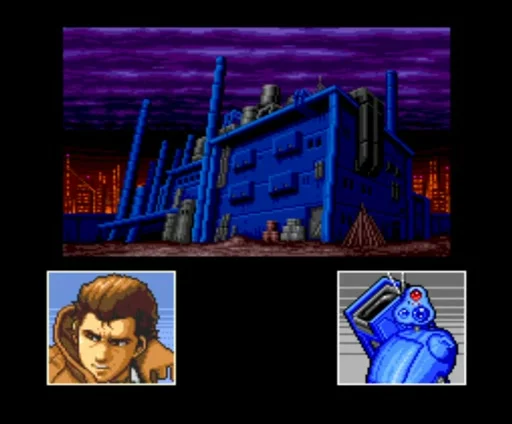
Metal Gear Mk. II reports in beside Gillian at the abandoned factory. Voiced by Mami Koyama in her Arale-chan timbre — sunny Toriyama tone bolted to a surveillance robot. Snatcher CD-ROMantic · Konami, 1992.
The casting move that gives the texture away is Mami Koyama as Metal Gear Mk. II. Koyama is Arale in Dr. Slump and Bulma’s first voice in Dragon Ball; her register is the sunniest sound in 1980s Toriyama anime. She is given Gillian’s surveillance robot — the noir partner, the Voight-Kampff equipment, the device that scans for Snatchers — and reads the role in the same hyper-cheerful Arale tone. The contrast is deliberate. Kojima later named it. A cyberpunk detective game can hold a cartoon voice strapped to the most paranoid piece of equipment in the room, and the joke makes the rest of the surveillance read sharper, not lighter.
The Mk. II’s screen scrolls biometrics while Koyama’s Arale-bright voice narrates what it finds. Konami’s first CD-ROM project also taught itself UI animation. Snatcher CD-ROMantic · Konami, 1992.
What the Sega CD Smoothed Out
The Sega CD version of Snatcher is a genuinely good port. Jeremy Blaustein’s localisation is the same hand that would translate Metal Gear Solid four years later, and most of what English readers love about the prose — Gillian’s wry deadpan, the snap of the JUNKER patter — survives the trip intact. EGM gave it nine out of ten in January 1995. Mean Machines Sega gave it 85%. The reviewer in Die Hard GameFan called it “moving, dramatic, gore-riddled, MA-17, adult,” which is, as a single line of period reception, about right.
It is also a different cut.
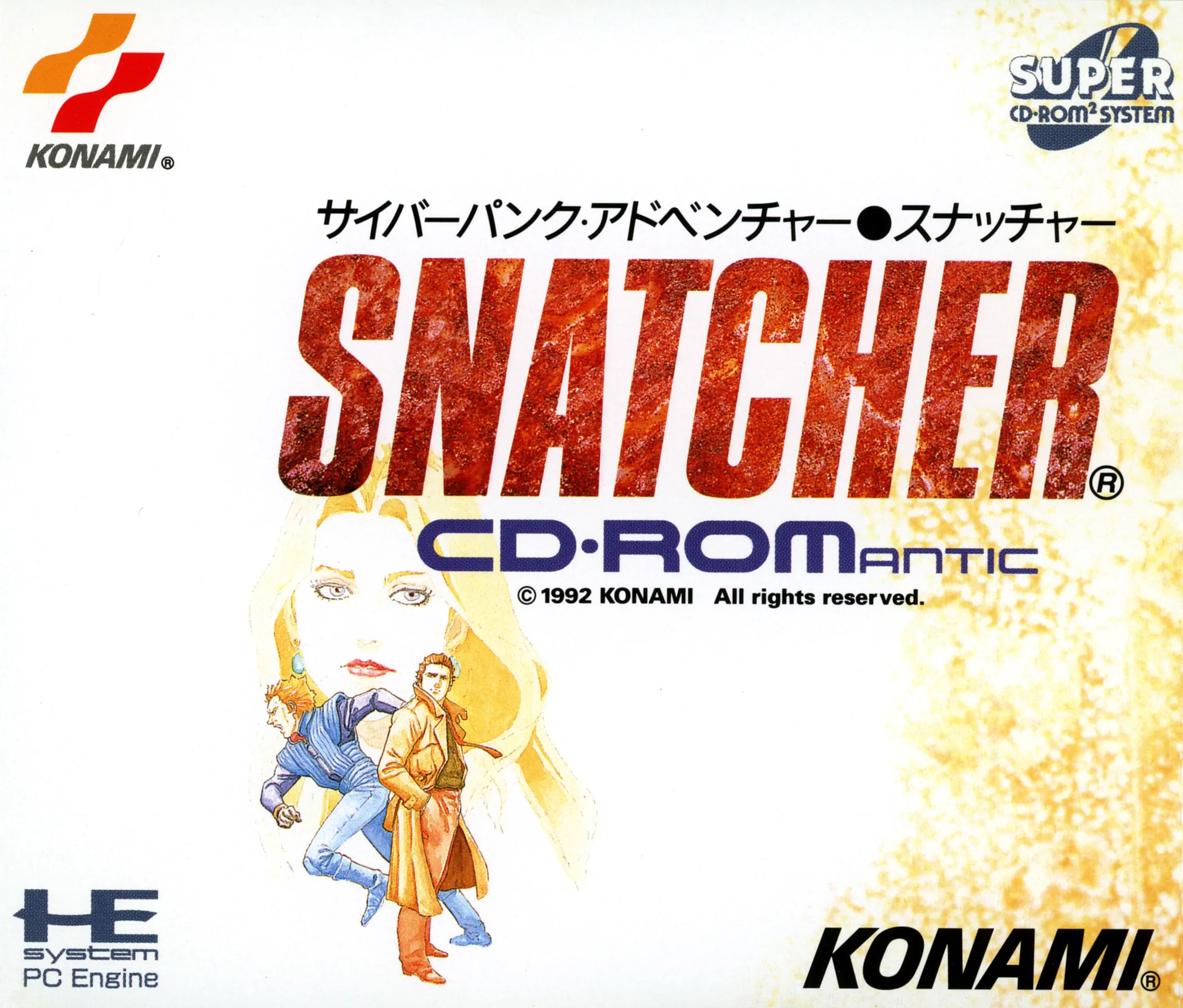
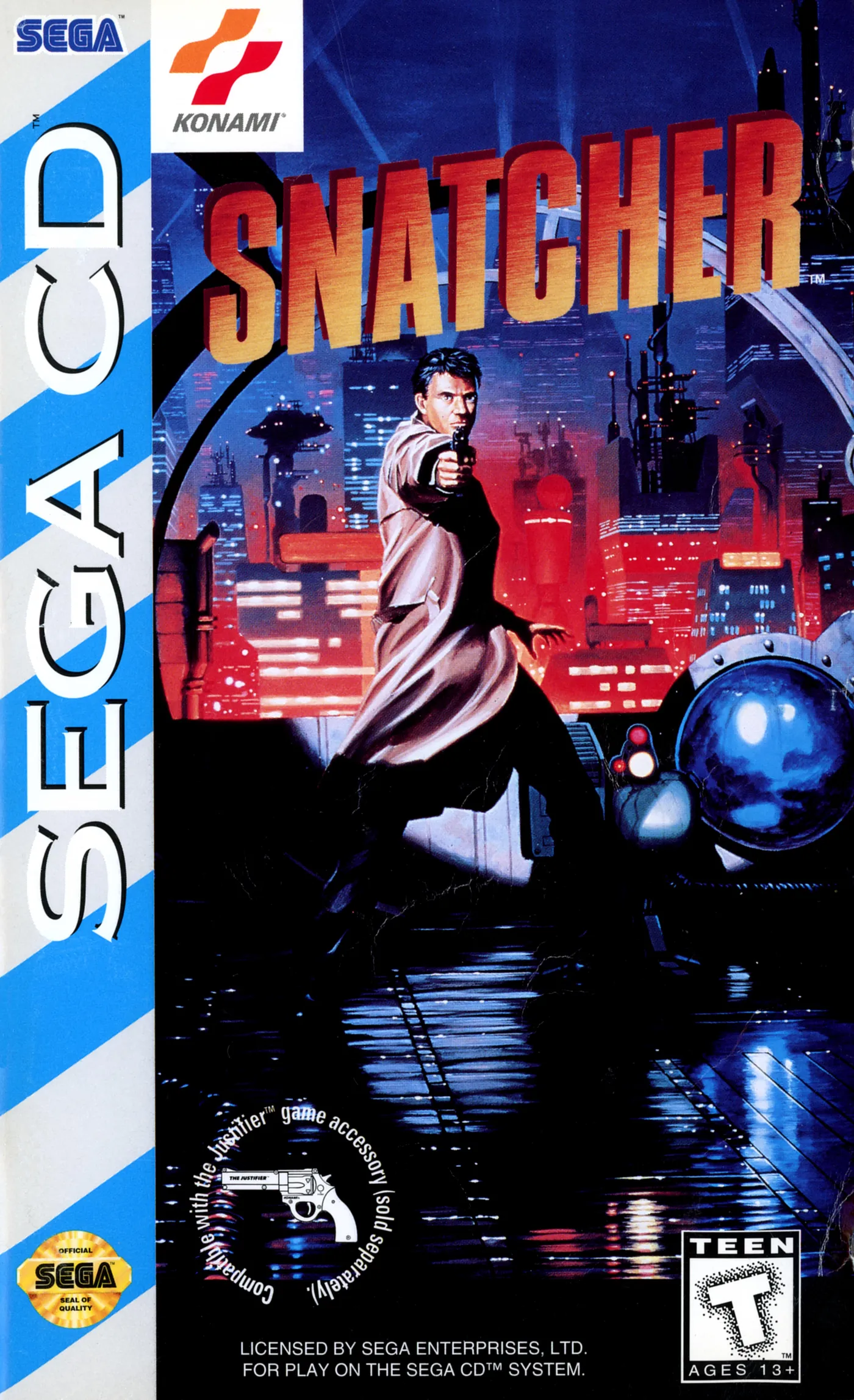
Two covers, two arguments. Left: the Konami CD-ROMantic jewel case — cyberpunk-noir as watercolour portrait. Right: the Sega CD US box — Gillian rebuilt as an action hero against a Blade Runner skyline. The cuts inside the case track the covers. Snatcher · Konami, 1992 (JP) / 1994 (NA).
Lisa Nielsen’s exposed breasts, on her death-scene panel, are covered. Katrina Gibson — fourteen years old in the Japanese script — is aged up to eighteen, and her doorway quiz-question is rewritten from her three sizes to her birthmark. The food in Gibson’s stomach changes from whale meat to buffalo. The Neo Kobe “PACHINKO” sign that read “CHINKO” — Japanese schoolyard slang for penis — has the offending letters unlit. A Predator mask in the Joy Division gift-shop becomes a mummy. The single Insector encounter becomes three. None of this was done by Kojima; he was not consulted.
Kojima’s own line on the later 1996 PlayStation and Saturn ports is sharper still. He called those versions, in a 2003 Dorimagá feature, kaizō sareta gisaku — falsified copies — and publicly discouraged players from buying them. The CG opening is glossy, flat, and sometimes goofy, as Sega Lord X put it in a 2026 retrospective. Whatever the PCE version is, it is the only one Kojima will stand behind, and it is the only one with the watercolour cast on the front cover instead of an oil-painted Gillian holding a service revolver.
The friction in the PCE cut is real. Act 3 collapses sharply into non-interactivity. Kojima knew it.
”Act 3 is like a digital comic.”
Hideo Kojima, Snatcher 1992 Developer Interview, Shmuplations translation
He meant it as design, not apology. A modern player coming off Disco Elysium or Pentiment will recognise the shape; a player expecting late-game expansion the way Phoenix Wright expands will hit a wall. The 3×3 shooting is what it is. Some scenes ask the same Look/Investigate cycle three times in succession, and Gillian’s flirting set-pieces have aged badly — particularly the JP version’s Katrina quiz, which the Sega CD did not censor for nothing. None of these are reasons to skip the game. They are reasons to walk in knowing what it is doing.
Why It Still Argues
What Snatcher still gives a modern player is the loop most adventure games abandoned. Disco Elysium has the prose; Pentiment has the period; Return of the Obra Dinn has the deduction. Snatcher, decades earlier, on a fragment of the same lineage, has the discipline to build a city behind every interactable object and then ask the player whether they want to see it. Two verbs, second one optional.
The opening twenty minutes are the second argument. The prologue, the narrated voice-over, the slow pan over Neo Kobe under the Furukawa cue — they land cold on a modern first-timer because they were always already a film opening. Konami’s first CD-ROM project was the studio handing a small budget for tape transport, voice booth, and animation cels to the in-house cinephile and asking what he wanted to do with them. He used them to finish a sentence the company had broken in half.