Ōkami is a game where a sun goddess repairs a broken world by painting it. Every act of progress is an act of restoration — a sun drawn into a sky, a tree circled back into bloom, a cursed field coaxed into colour. The controller does not just direct Amaterasu through the world. It lets the player briefly step outside the world and mark it.
That is an unusually specific verb for a game to build itself around. Most action-adventures hand you increasing power. Ōkami hands you a brush and asks you to use it to put things back — to revise reality rather than conquer it.
The Pun Hiding in Plain Sight
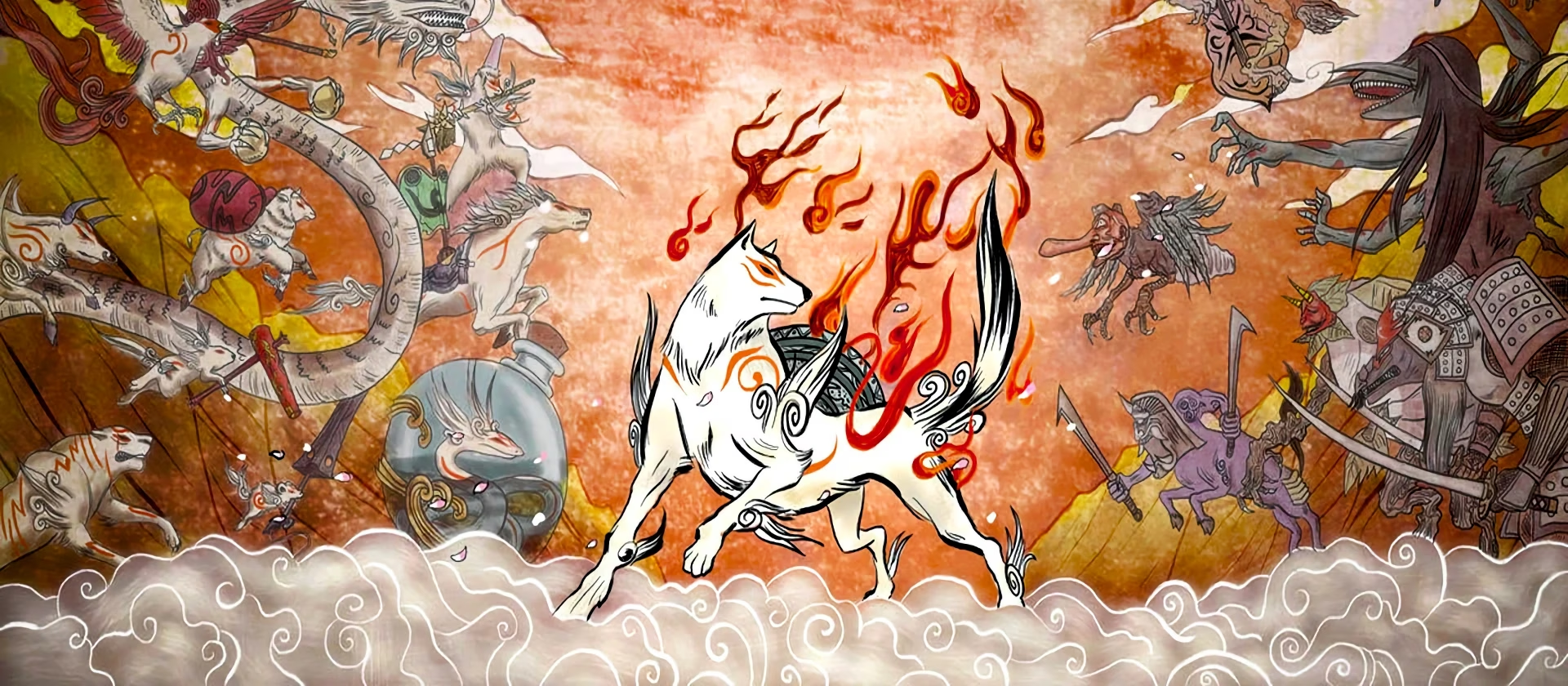
The name is itself a pun: ōkami means both “great god” (大神) and “wolf” (狼) in Japanese. You play as Amaterasu, the Shinto sun goddess in wolf form, tasked with restoring light and life to a world consumed by darkness. The visual language is ukiyo-e and sumi-e — the woodblock prints and ink-wash paintings of Hokusai and his contemporaries — rendered as a living, moving world. Thick brushstroke outlines, watercolour fills, and a faint paper texture across every surface. The gameplay was modelled on The Legend of Zelda, an influence Kamiya, a self-proclaimed Zelda fan, has openly acknowledged. It is one of the finest Zelda games never made by Nintendo.
The comparison is useful, but incomplete. Ōkami has dungeons, keys, companion chatter, bosses, fields that open in layers, and new powers that turn old obstacles into invitations. What it adds is a different emotional verb. Link usually unlocks and conquers. Amaterasu restores. The first time you revive a dead patch of land, colour floods outward, flowers burst from the ground, and cursed grey gives way to gold and green. The reward is not a statistic or a louder weapon. It is the world looking relieved.
The Celestial Brush turns that restoration into procedure. Hold the brush button and the action freezes into a sheet of parchment. Draw a line through an enemy to slash it. Circle a tree to make it bloom. Complete a missing shape to repair an object. Amaterasu is not powerful because she hits harder. She is powerful because she can revise reality.
The brush in motion: ink swirls sweep across the clearing, spirits surface, and lotus blooms rise where the land was bare. Ōkami HD · Capcom / Clover Studio.
That mechanic did not arrive cleanly. Hideki Kamiya and his team had spent months building a photorealistic PS2 engine — a wolf running through a forest, flowers blooming in its wake, technically impressive but, as Kamiya admitted, “incredibly boring to play.” A character designer named Kenichiro Yoshimura, frustrated with the direction, picked up a brush and redrew the wolf in a loose Japanese ink-wash style. Over three days, the leads re-evaluated the entire approach around it. The Celestial Brush emerged from a hardware limitation and a moment of creative frustration — the mechanic that makes Ōkami unlike anything else was born from giving up on looking real.
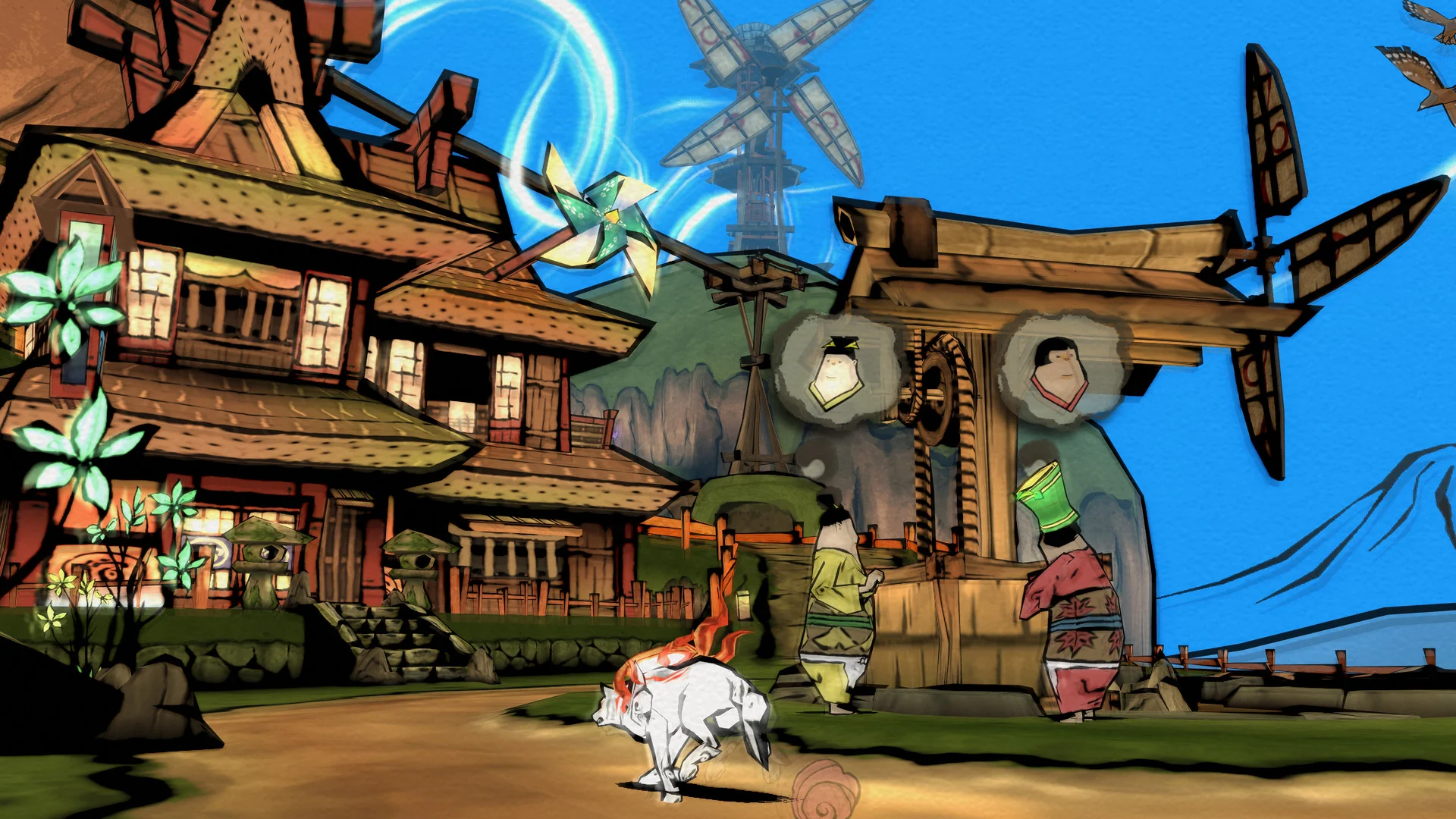
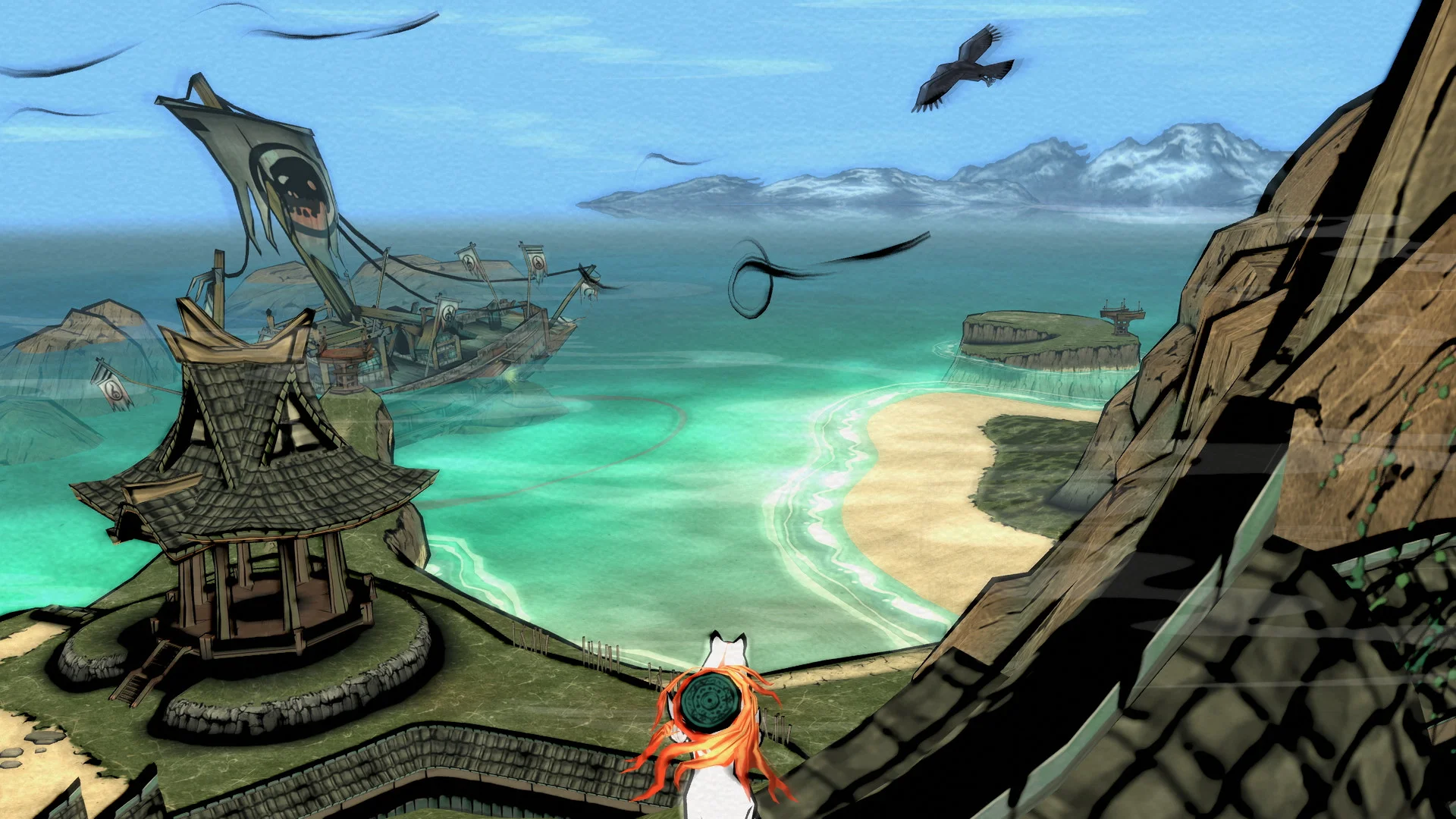
The HD release makes the old PS2 decision look prescient: flat colour, visible ink edges, and paper texture scale better than most period realism ever could. Screenshots: Okami HD · Capcom / Steam.
”The Wiimote is the perfect tool for drawing your shapes on screen. The painting concept works beautifully with the Wii.”
— Nintendo Life, 2008
The Version That Finally Made Sense
The Wii version — ported by Ready at Dawn in 2008, a year after Clover had been shuttered — matters to this series because it is where the game’s central mechanic finally found its most obvious physical form. Where the PS2’s analogue stick built a wall between the player and the game world, the Wii Remote broke it down — swinging your arm to slash enemies, drawing circles in the sky to summon the sun, sketching vines to climb. The Celestial Brush had always been conceived as the act of a god intervening in the physical world. On Wii, for the first time, it felt like one.
That does not make the Wii version perfect. Motion controls bring their own little betrayals: gestures misread, lines wobbling at the wrong moment, combat sometimes turning into negotiation with the sensor rather than the enemy. But the port understood something crucial about the fantasy. The act of drawing needed a wrist, not just a thumb.
The later HD versions solve the problem differently. On Switch, touch input in handheld mode brings the brush closer to the immediacy the idea always wanted. On PC, a mouse makes the shapes clean and fast. On every HD release, the art benefits from being allowed to breathe above the resolution limits of the PS2 and Wii. The paper texture, ink edges, and flat planes of colour were never chasing realism, so they do not collapse under modern scrutiny. They sharpen.
This is why the game keeps surviving ports that might have made a more conventional 2006 production look stranded in its year. Ōkami was already an argument against the race toward glossy realism. Time has mostly made it look wiser, and more deliberate.
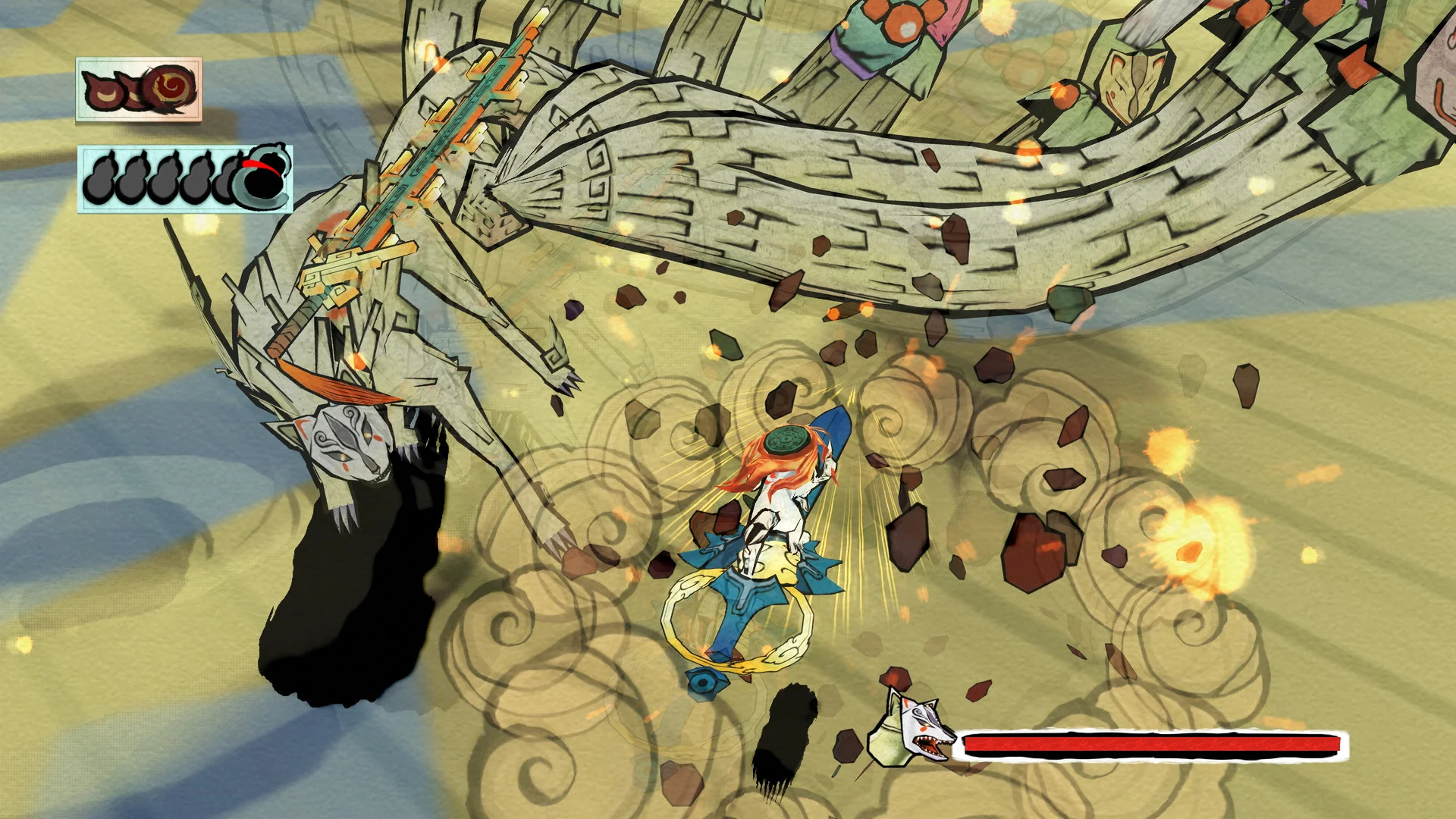
Even combat is drawn as a collision of paper, ink, and theatre: a boss body large enough to become scenery, with damage expressed through smoke curls and scattered brush marks. Screenshot: Okami HD · Capcom / Steam.
A World That Takes Its Time
The price of all that generosity is that Ōkami is enormous, and sometimes too pleased to explain itself. Issun, Amaterasu’s tiny wandering artist companion, talks a lot. The opening is famously patient. Tutorials arrive with the confidence of a game that assumes you have nowhere else to be. For some players, that warmth becomes friction.
But the sprawl is part of the point. Nippon is not just a sequence of arenas between dungeons. It is a countryside full of small recoveries: feeding animals, helping villagers, clearing cursed zones, watching dead spaces bloom after you understand the brush technique they require. The game is at its best when its scale feels pastoral rather than epic, when saving the world is expressed through errands so local they almost seem silly. A dog needs finding. A sapling needs reviving. A village remembers how to be bright.
That is also where Masami Ueda, Hiroshi Yamaguchi, and Rei Kondoh’s score does so much work. The music does not treat Japanese instrumentation as museum decoration. It moves like the landscape: playful, ceremonial, comic, mournful, then suddenly open-hearted. When the world blooms, the score blooms with it. The game earns feeling through repetition. You repair, and repair, and repair, until restoration stops being a quest objective and becomes its moral rhythm.
The tone is stranger than the screenshots suggest. Ōkami can be sacred, bawdy, slapstick, melancholy, and shamelessly cute within the same hour. It makes room for a heroic wolf goddess, a tiny bug-sized artist making terrible jokes, kabuki villains, drunk villagers, tragic spirits, and boss fights staged like theatrical exorcisms. That tonal looseness is not a failure of focus. It is how the game keeps myth from becoming marble. Amaterasu is divine, but she is also a dog who naps, digs, barks, and gets distracted by food. The sacred is constantly pulled back into the physical world.
That matters because the game is about restoration, not purity. It does not imagine nature as something remote and untouchable. It imagines it as messy, lived in, and worth repairing because people, animals, gods, fools, and monsters all share it. The joke and the prayer belong to the same brushstroke.
The Studio That Won and Still Closed
And yet it still sold poorly. Clover Studio — whose name was an abbreviation of “creativity lover”, with the syllables mi and ba hidden in it from the names of Shinji Mikami and Atsushi Inaba — was dissolved by Capcom in late 2006, just months after the PS2 version’s release. The corporate story is messier than a simple “great game killed by bad sales” myth: key creators were leaving, and Clover’s identity had always sat awkwardly inside a larger publisher. But the commercial numbers still mattered. The original PS2 version sold around 270,000 copies worldwide by early 2007. Kamiya said in 2024 that these numbers made the game “a failure.” It had won IGN’s 2006 Game of the Year and scored 93 on Metacritic. Both things are true.
That contradiction has become part of the game’s afterlife. Ōkami is remembered as a masterpiece partly because it was not protected like one at the time. It arrived late in the PS2’s life, looked unlike the market’s idea of next generation, and asked for a long, patient kind of attention.
The cruel part is that Clover had made exactly the sort of game prestige histories claim they want: authored, risky, technically inventive, rooted in a specific visual tradition, and mechanically inseparable from its theme. The market did not know what to do with it quickly enough. Awards could name the achievement, but awards could not buy back the lost launch window.
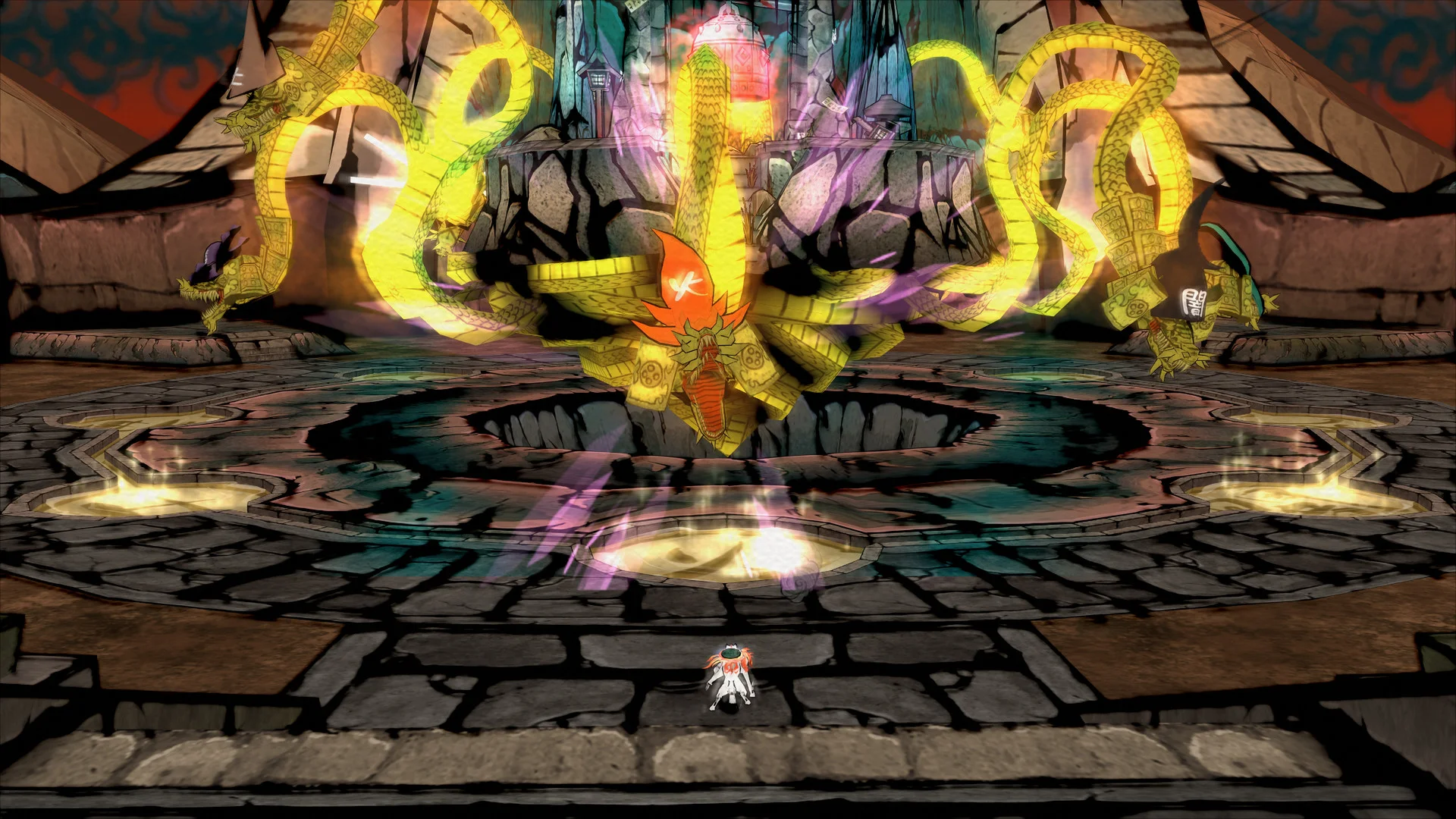
The late-game spectacle keeps the same visual grammar as the quiet fields: heavy silhouettes, theatrical light, and ink shapes doing the work that raw polygon detail would usually be asked to do. Screenshot: Okami HD · Capcom / Steam.
Three lives followed. The Wii port in 2008. An HD remaster for PS3 in 2012. Then HD again for PS4, PC, Xbox One and Switch in 2017 — where it finally found the audience it had always deserved. At The Game Awards 2024, Kamiya announced an Ōkami sequel under his new studio Clovers — named as a direct tribute to the original Clover Studio — with Capcom publishing. He admitted he “didn’t think the day would really come.” Eighteen years of retroactive appreciation had finally compelled the sequel that poor sales once made impossible.
Playing Ōkami today — in any version — is to meet a game that never tried to look like its contemporaries and so never had to survive them. The ink edges and flat planes of colour were chasing a tradition, not a trend. Three generations of display technology have come and gone without buckling the image. The world is vast and generously realised, the puzzle design inventive, the writing warm without being cloying. Its one genuine flaw — an excess of dialogue that can test patience — is a small price for a game about making dead things bloom that eventually did the same for its own studio.