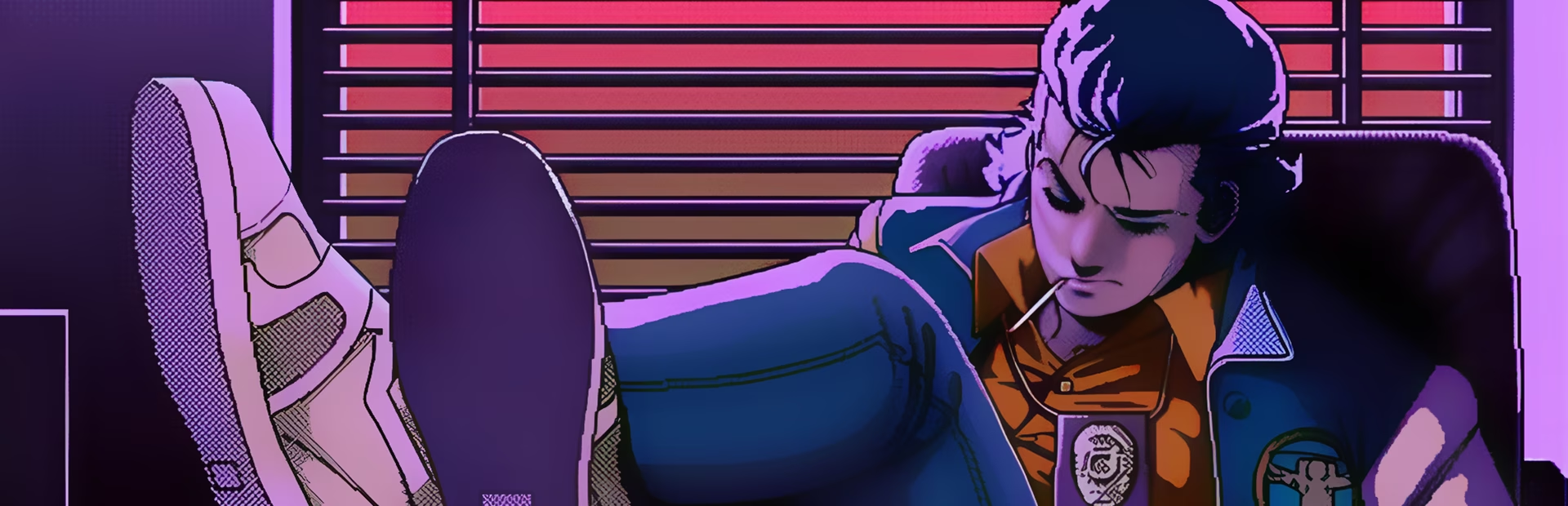
Policenauts is the last project Hideo Kojima made alone. Every fade-out, every voice take, every musical cue across its twelve hours is a choice he made personally — and three years after the PlayStation version shipped, he said as much himself. Metal Gear Solid, the project that followed it, would be where he stopped trying.
The version most modern readers will play is a fan translation. Konami of America cancelled the official English Saturn release sometime in 1996; in August 2009, a five-person volunteer team led from a forum thread at JunkerHQ.net put out a finished patch for the PlayStation version on the night of Kojima’s forty-sixth birthday. Some of the bugs that patch fixes were bugs Konami left in the master.
The reason to come back to it now is not preservation, and not Kojima’s later career either. It is that the design ideas the fan team brought across — the gun that the story holds back until the player has earned it, the voice direction that nobody at Konami would attempt again at this scale, the phrase-based interface that asks one verb of you at a time and means it — have aged into clarity. Most of what Metal Gear Solid would become was already in this room. Most of what made it work was already on the page.
Six Years to Land One Storyboard
The project predates the question. Kojima storyboarded Policenauts in 1989 and 1990, during gaps in Snatcher development — the PC-88 and MSX2 versions of which were running into the same memory ceilings that would force Konami to truncate that game from five acts to two. The Policenauts storyboards were the consolation project. They sat in a drawer for two years while Kojima carried the Snatcher PC-Engine remake to release, then went into pre-production proper around 1992.
What landed in July 1994 was a PC-9821 release that ran 640×400 across six floppies, painted in sixteen colours. Yoji Shinkawa, three years before he would draw Metal Gear Rex, was on bug-checking duty when he asked to touch up the EMPS — the powered suits the Beyond Coast colony police wear for orbital work. The drawings he supplied are the first Konami mecha he ever signed. Most famous mecha designer in Japanese games, in by the back door of an adventure game.
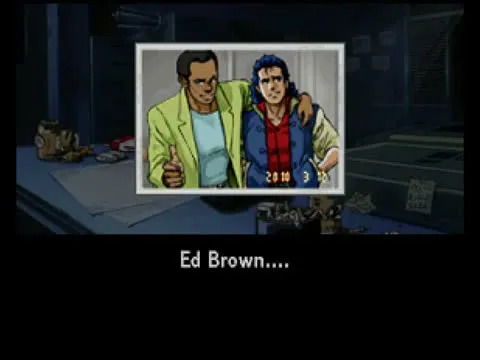
Jonathan and his old Beyond Coast partner in the on-screen photograph the player keeps returning to. The buddy-cop reference Kojima named openly — Lethal Weapon, Starsky & Hutch — shown rather than spoken. Policenauts · Konami, 1996.
The setting Kojima built around the storyboards is its own quiet provocation. The year is 2040; the place is “Old Los Angeles,” now known to its inhabitants as HOME — the planet a colonist would return to if they had to find something they’d left behind. Twenty-five years earlier, the orbital colony Beyond Coast was completed. Jonathan Ingram, one of the five original Policenauts trained to keep order there, drifted in cryosleep for nearly all of those twenty-five years after an EVA accident, and the game opens with him alive on Earth as a private detective, in late middle age, fielding a request from the wife he last saw when she was twenty.
The colony itself was deliberately drawn as a cylinder — a choice Kojima explained at the time. “A cylinder-type colony doesn’t have much of a reality to it,” he told Mamoru Oshii in a 1996 interview, “but visually for today’s generation it’s what they recognize as a space colony from a glance.” He’d considered a torus, considered a sphere; he picked the shape readable to the eye over the shape that would have been physically right. The whole game runs on that hierarchy.
Aim Outer Square, Wait for the Anger
What you actually do in Policenauts is read paragraphs and choose verbs. Each scene presents a painted cel against which dialogue boxes resolve; the cursor moves over a face or an object; you choose between Look, Investigate, Listen, Ask, Show, Take — the Snatcher verb-set carried forward with a single-screen pointer interface that the 1992 game didn’t have. Most rooms reward the second observation command. The recruitment poster in the JUNKER lobby reads, on first look, as a recruitment poster; investigated, it carries the same conscript-shortfall undertone that Snatcher’s lobby did in 1992. The way you build a city behind every interactable object is by clicking everything twice.
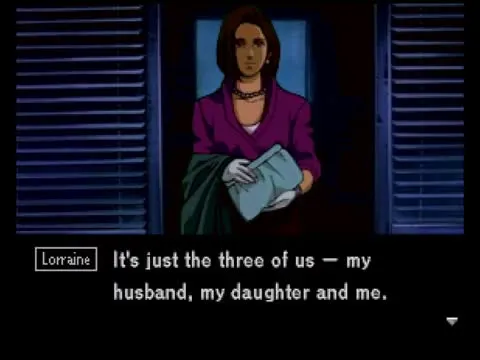
The single-pointer interface that replaced Snatcher’s command menus. One face per beat, one verb at a time — phrase-based dialogue tuned for the directorial pace Kojima wanted. Policenauts · Konami, 1996.
The friction is real and worth naming. Twelve to fifteen hours of phrase-based dialogue is slow by modern standards. The plot is OVA melodrama played straight — organ-transplant conspiracy, decades-cold case, late flashback revelations — and whether the reader buys it depends entirely on tolerance for the register. The female-NPC clicking sub-mode, where the player can grab at the chests of any woman on screen and watch a credited animation play, is a piece of authorial indulgence the article won’t dress up; same hand, same micromanagement, same product.
What the game does that almost nothing else in 1996 did is hold the player’s gun back. The shooting interludes are not light-gun grammar of the Lethal Enforcers kind, where you fire at whatever moves; they are scripted gallery sequences keyed to specific story beats, and the system makes you wait. “Gun games like Lethal Enforcers are really fun, but they don’t really evoke much empathy from the player,” Kojima told Shmuplations in 1996. “In Policenauts, take Redwood for example. As Jonathan comes to see him as a villain in the story, his (and the player’s) anger rises, until it reaches a boiling point and, at the time, Jonathan draws his gun.” Diegetic rage, the design says, as a control input.
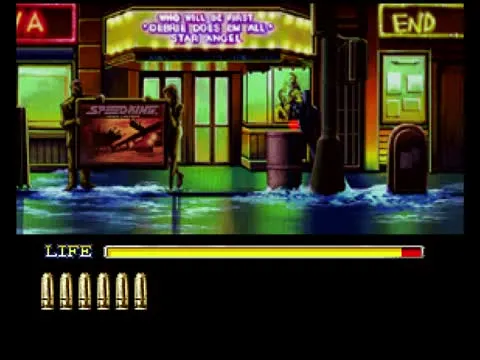
The Old LA shooting sequence with the LIFE bar and ammo counter rolled up from below. The trigger is held back behind paragraphs of dialogue: Kojima wanted the rage earned before it was loaded. Policenauts · Konami, 1996.
You aim with an outer square — a soft pointer that hovers off-centre — and return to the middle to fire, then drop back out to keep tracking. The discipline is closer to a duel than a shooting gallery. By the time Jonathan is allowed to draw on Tony Redwood, the colony’s pharmaceutical magnate and the antagonist Kojima specifically named in the Shmuplations quote, you have spent hours processing his unctuous racial-policy speeches and his hands on women you’ve spent the game trying to find. The light-gun grammar is the same it would have been at the start; the meaning is not.
Voice Acted Like a Dubbed American Movie
The voice direction is the keenest authorial fingerprint of the game. Kojima cast for film, not games. “With Policenauts I wanted the actors to act as if they were dubbing an American movie,” he told Oshii, “so I picked out people who had experience with movies.” He recorded the cast in groups: “I wanted to record the dramatic parts with 4 or 5 actors at the same time but such a thing seems to be rarely done in the game industry.”
It wasn’t. Japanese-language games in 1996 typically isolated each actor at a single mic and stitched takes together in post. Kojima had four or five voice professionals in the same room reading off the same paragraph, listening for breath and overlap, breaking each other’s lines. The result, on first hearing in the patched English release, sounds almost overproduced — too acted, too cinematic — because the medium does not normally do this.
”I created Snatcher entirely by myself. I could control the timing of sound effects, where fade-outs occurred, and pretty much everything. But ultimately, after Policenauts I came to the conclusion that controlling everything myself wasn’t necessarily a good thing.”
Hideo Kojima, 1999 developer interview, Shmuplations translation
The score is the same logic in a different register. Masahiro Ikariko (Metal Gear 2: Solid Snake), Motoaki Furukawa (the Snatcher CD-ROMantic arrangement lead), and Tappi Iwase — Konami Kukeiha Club regulars — wrote a soundtrack that doesn’t sound like a 1990s Konami video game and does sound like Michael Kamen scoring an action film. Synth-funk bass under saxophone leads; cues stacked to film-cue lengths rather than looping arcade phrases. The King Records album shipped in February 1995, between the PC-9821 release and the 3DO port — Konami selling the music as standalone product before three of the four console versions even existed.
The cel animation is the third pass at the same idea. Anime International Company, the studio behind Bubblegum Crisis and Tenchi Muyō!, drew the cutscenes for the 3DO and Saturn cuts at twenty-four frames; the PS1 cut runs at fifteen. Not anime aesthetic — anime craft, hired in to draw the way they would have for a direct-to-video film. The game is a director’s catalogue, fanned across film, score, and dub.
What Six Volunteers Restored in Konami’s Absence
The official English release died at Konami of America in 1996, in unrecorded internal votes. Kojima later cited lip-sync timing problems with the phrase-based dialogue. Jeremy Blaustein, who had localised Snatcher for the Sega CD and would localise Metal Gear Solid, told The Snake Soup there were “no internal plans” to do Policenauts while he was at Konami: “There was no English dialog recorded.” The structural reason was Snatcher’s Sega CD release — around two thousand US copies sold in 1995 — and a twelve-hour adventure game in a 3D-action market that looked like a longer bet on a longer-form game. Konami of America said no. The Saturn version that had been announced for North America was unannounced.
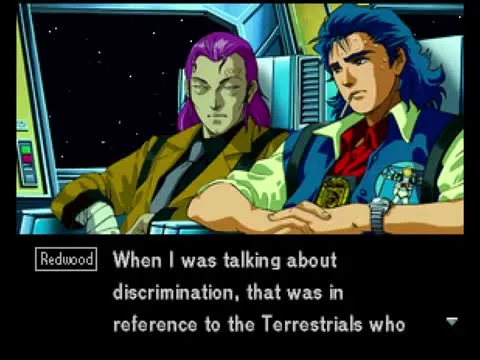
Redwood mid-monologue, deflecting accountability for a racial-cleansing policy the player has spent acts uncovering. The interface gives you no verb here. The lightgun is the next interaction the game permits — but not yet. Policenauts · Konami, 1996.
A second team picked it up. Marc Laidlaw (the translator, not the Valve writer) had started script work on the JunkerHQ forums around 2002 under Artemio Urbina’s project lead. By summer 2007 the script was complete but the project was stalled — the English text was too long for the binary, and Konami’s text engine used hard-coded pointer addresses that would not accept resized strings. In August 2008, Michael Sawyer — slowbeef, then in the middle of running a screenshot let’s-play of the unpatched Japanese version — joined the team and wrote a “Double Addressing with Text-Chaining Hack” that gave them new text pointers and the room to insert.
slowbeef’s eleven-chapter Tales of ROMhacking on the LP Archive is one of the best first-person fan-translation documents in the medium. Two near-abandonments. A late moment in which the patch worked on every emulator but failed catastrophically on real hardware (“It could never, ever work. Except it did. Why?????” — the diagnosis was instruction-pipeline timing). The release at midnight Japan-standard time on 24 August 2009, sequenced to coincide with Kojima’s forty-sixth birthday. Along the way the team fixed crashes and corrupted text routines that had shipped in the 1996 Konami master. The Saturn-version patch followed in 2016.
What the JunkerHQ team gave the West was not a Kojima curiosity and not a Snatcher footnote. It was the game in working order — at the editorial level Konami had once been capable of, recovered on volunteer time. The Konami of today doesn’t make games like Policenauts any more; the Konami of 1996 cancelled the only path that would have let the West read this one on release. The reason a reader can play it now, in English, on a laptop, is that three people with day jobs decided that wasn’t acceptable.
Kojima drew the door himself in 1999. The fan team made it re-openable in 2009. What’s behind it is the only twelve-hour adventure in the catalogue where one person held every dial, did the thing he’d come to Konami to do, and afterwards put the method down.