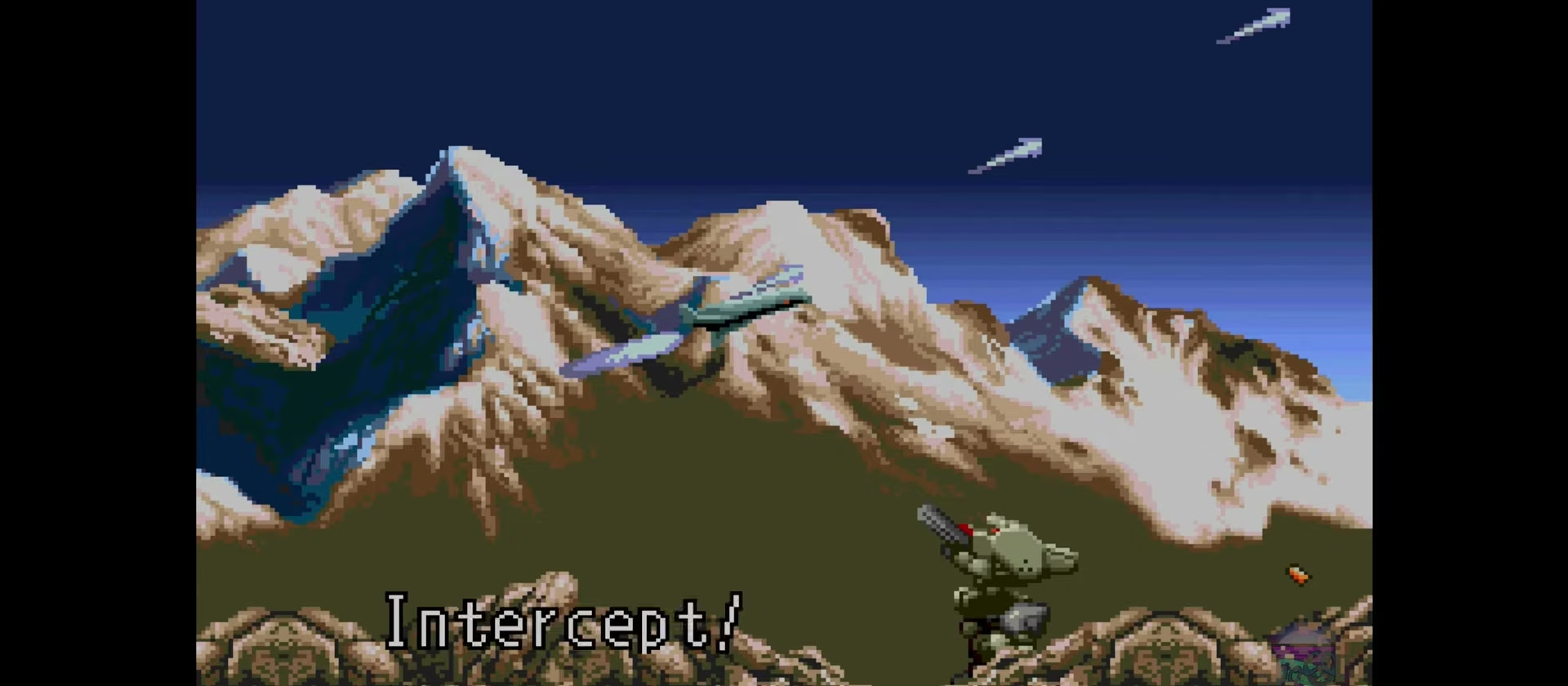
The mech does not run. That is the first thing to understand about Assault Suits Valken, the 1992 Super Famicom cartridge Konami sold the West a year later as Cybernator. Press the d-pad and the suit strides — heel-down, weight forward, the next two frames committed whether you wanted them or not. Shoot a heavy enemy and the world stops for two frames before the round resolves. Get hit and one of your four weapons goes dead until the next stage. Everything is mass, and nothing forgives.
That feel was the work of an artist named Satoshi Nakai, who made most of it by himself, sleeping on cardboard in the NCS office on the cold nights. The producer was Toshiro Tsuchida, who would leave Masaya for Square and build Front Mission. The composer was Masanao Akahori, who treated the SNES sound chip like an anime-OVA studio orchestra. They shipped a cartridge that sold ten thousand copies in Japan, was exported to America with most of its dialogue cut, sat in obscurity for thirty years, and finally landed in English in 2023 — at which point Western players, almost all of whom thought they had been quietly defending it since the nineties, discovered they had been defending half of it.
The 2023 Declassified release, emulated by M2 and packaged by Rainmaker Productions, restores the portraits, an anti-war ending, a moment on the bridge of the enemy capital ship that Nintendo of America’s 1992 content rules would not let through, and a post-credits hook that ties the war to Valken’s Mega Drive predecessor. The cuts were not small. The more surprising thing — once you sit with the uncut original — is that the action game already carried the weight of the story. The stride already mourned. The hit-pause already insisted that violence had cost. Konami’s Cybernator worked because the design did most of the talking, and the talking it did not do is precisely what the restoration adds back.
The Mech Strides, Doesn’t Run
The first stage drops a marine named Jake Brain into an orbital colony being raided by a faction called the Axis Empire. The setting is military procedural, not action splash: distant city silhouette, scaffolding, infantry running between cover, a giant siege walker that has to be circled, not out-shot. The mech itself takes up nearly a quarter of the vertical play area. Movement starts with a half-second of acceleration and ends with a half-second of brake. Jumps are committed; the boost thrusters fire in arcs you have to plan into before you leave the floor.
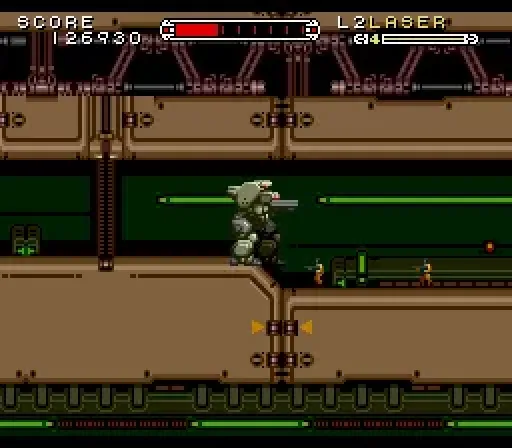
The first stage is a procedural — infantry in cover, scaffolding, conveyor lines. Nakai’s destructible-environment demand reads as material physics: the floor can be shot away. Assault Suits Valken · NCS Corp. / Masaya, 1992.
The trick that holds it all together is destructibility. Nakai pushed for it specifically: “It was also my idea to destroy the floor and other objects by shooting them.” You can see it everywhere once you know to look. Crates explode into the geometry, not off it. Conveyor lines deform under fire. A ledge a soldier was sheltering behind degrades while he is still on it. The world reads as material, not as a sequence of triggers, and the consequence is that the mech feels like it is in the level rather than passing over it.
Four weapons rotate on the right shoulder — vulcan, laser, missile, napalm — each charging to an “S”-mode super-shot that transforms how a section reads. The laser overcharge in late levels is the kind of run-defining tool Cuphead’s loadouts try to be. A hit on the suit disables the currently-equipped weapon until the next stage. It is the Axelay recovery system three years earlier, but here the breakage scales to the dramatic register: you can grind out a stage on a single broken loadout, and the prose of the playthrough is that grinding. The texture is grim. It is meant to be.
Stage 2’s asteroid field — the moment the game becomes itself. Vector-style scrolling on a SNES that has no business pulling it off, and the precise difficulty wall every reviewer cites. Assault Suits Valken · NCS Corp. / Masaya, 1992.
The Stage 2 asteroid field is the filter. Every reviewer cites it, every veteran warns you about it, and it is also where the cartridge stops being a curio and starts being itself. Debris streams the screen sideways while the mech’s jets hold position against a planet curving behind. The first run is brutal. The second is illuminating. By the third you understand that the boost thrusters are not for traversal but for breathing space — the asteroid field is the design teaching you how to use them under fire, and after it nothing else feels quite the same.
The Action That Konami Cut
What Cybernator shipped in 1993 was the mech. What it did not ship was the conversation the mech was wrapped inside. The Japanese original interrupts each stage with cabin chatter — Crea on the comms, the captain pushing back, Mitch with the next contact. The portraits are by Satoshi Urushihara, then a rising character artist whose later bishōjo work would make him one of the strange names attached to a sober military drama. The voices are not narration. They are the cost ledger: who saw what, who lost what, who is still talking.
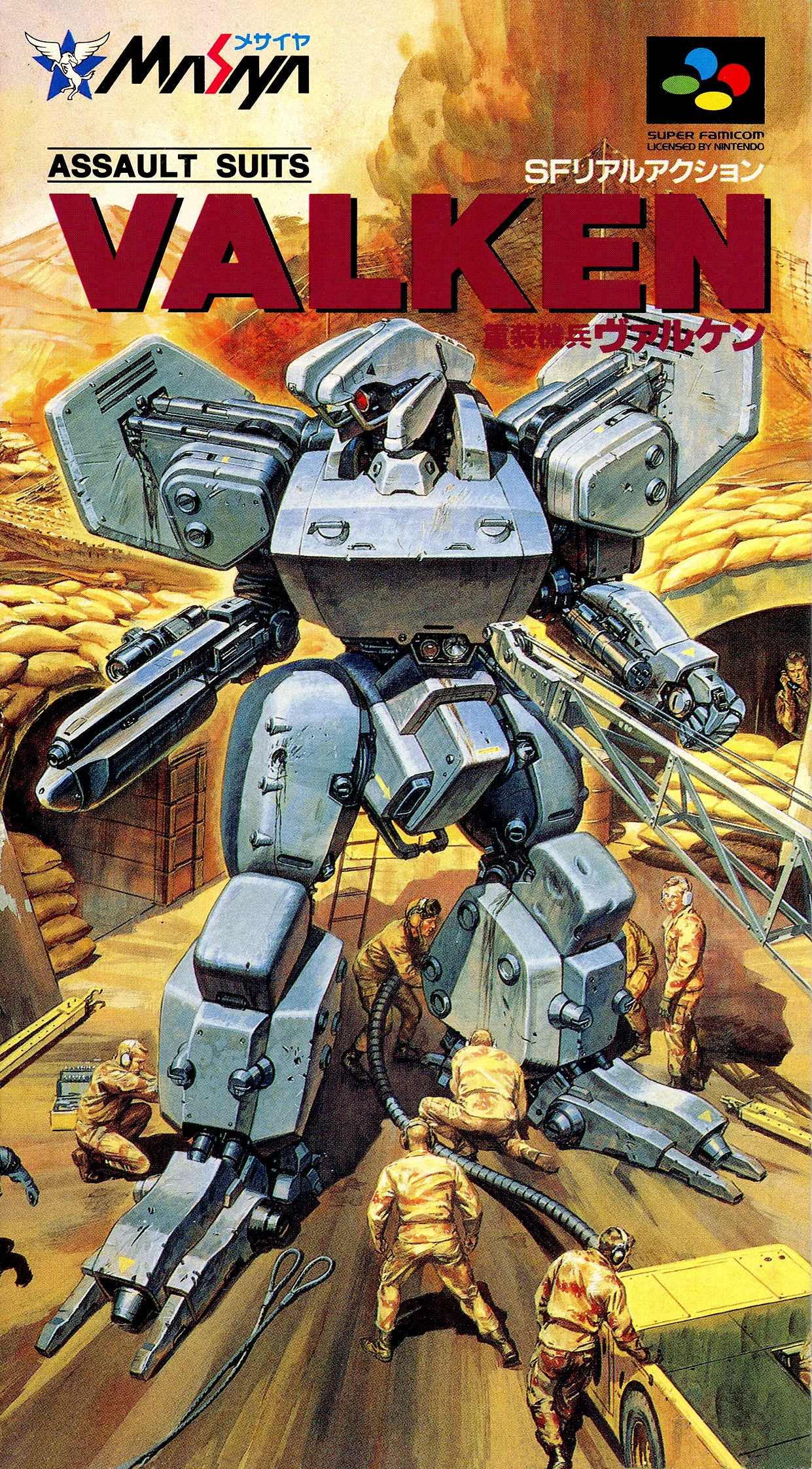
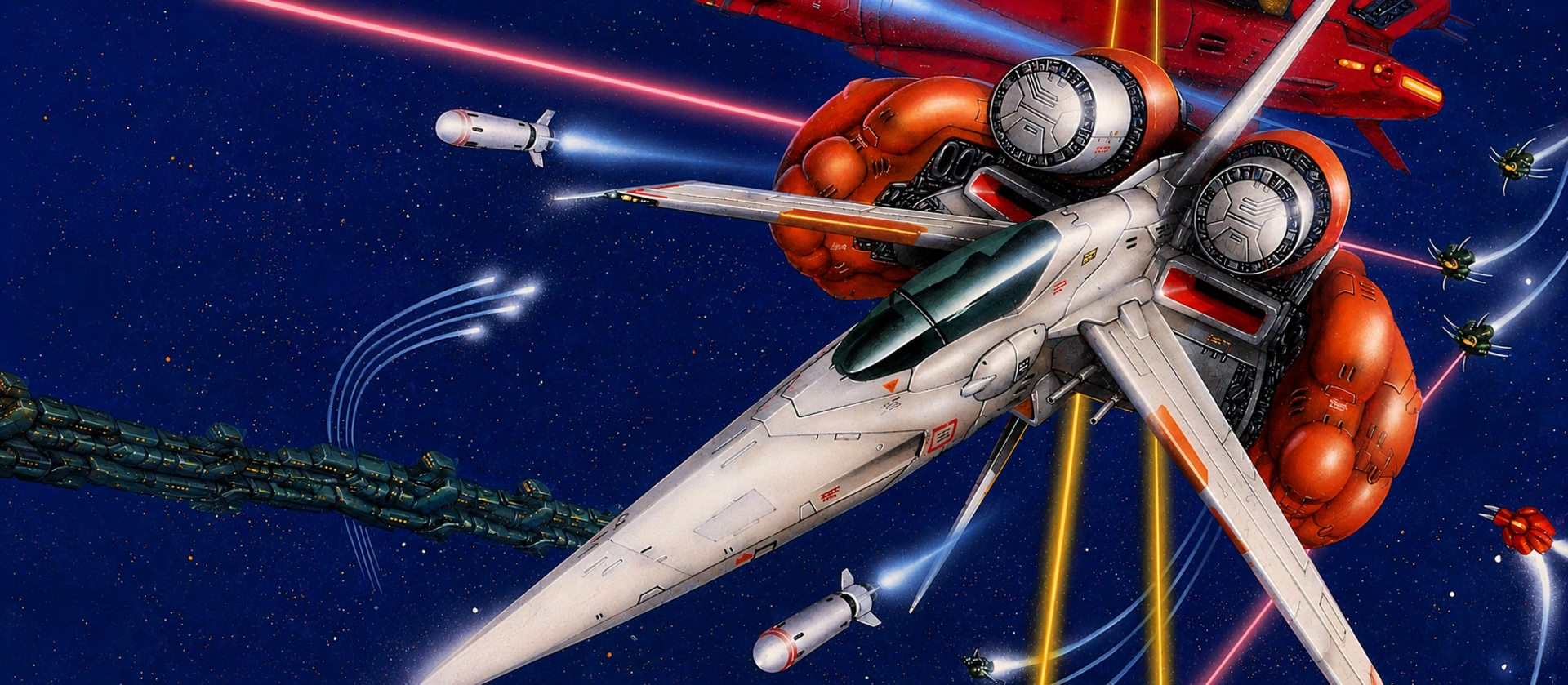
Masaya’s Japanese cover stages the game as a sober anime-OVA still: a sentinel watching its own troops. Set it beside Konami’s North American “five story tall take-no-prisoners” action figure on the header and the cover gap is the game gap in miniature. Assault Suits Valken · Masaya, 1992.
The export changes are documented frame by frame elsewhere, but the structural ones matter most. The portraits were stripped. Most dialogue went with them. The ending lost a sequence in which the defeated Axis commander, on the bridge of his collapsing capital ship under a banner that evokes the European Union flag, chooses not to be taken alive — a decision the script frames not as villainy but as the war’s final accounting. And a post-credits radio transmission, tying the lieutenant’s war to the Mega Drive prequel Assault Suit Leynos, was clipped. Western players in 1993 finished the run, watched the medal ceremony, and were sent home.
It is tempting to read this as a censorship story and stop. But the more careful reading is that Konami’s localisers, working inside Nintendo of America’s 1992 content rules, were not editing a story they disagreed with — they were excising the register Masaya had written in. Valken asks its player to feel the human cost of the stride and the hit-pause. Cybernator supplies its own register from outside: the box copy promised “a five story tall take-no-prisoners Cybernator” with “hyper-space propulsion and 360° firing range.” Players got there themselves anyway. The design did the work.
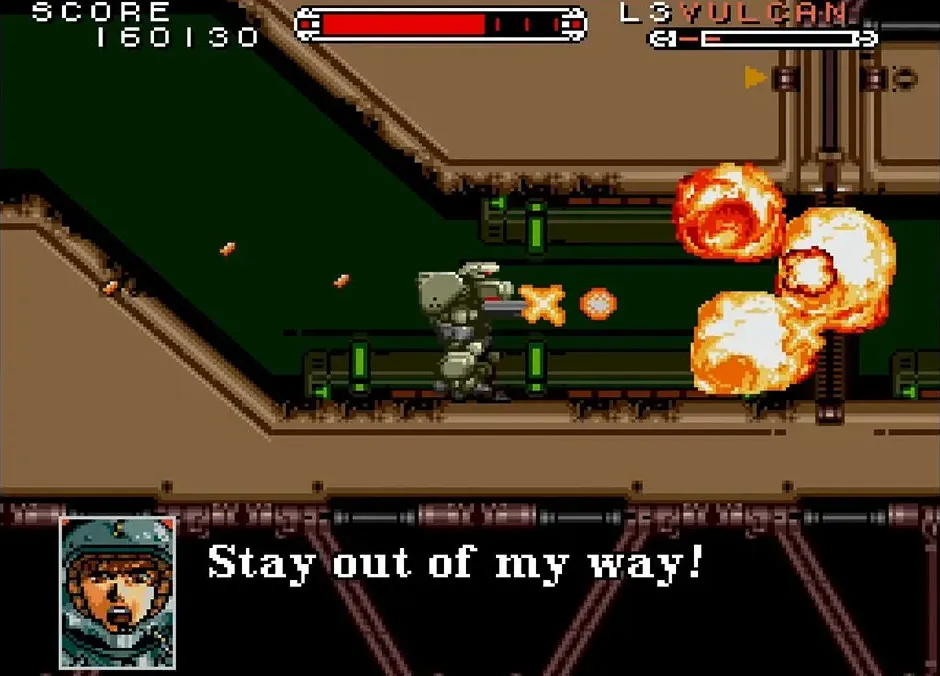
The register Cybernator did not ship. Urushihara’s portrait of Crea sits under live gameplay, the cabin chatter Konami stripped now restored to the only place it ever played from. Assault Suits Valken DECLASSIFIED · M2 / Rainmaker Productions, 2023.
Nakai Alone, On Cardboard
The other surprising thing the Declassified extras surface is how small the team was. Nakai handled mech design, backgrounds, “almost all imagery,” and the world bible. Hideo Suzuki — the programmer who had made Assault Suit Leynos on the Mega Drive — wrote the engine. Tsuchida produced. Akahori scored. The rest was contract help and overnight stints in the NCS office.
”On cold nights, we would spread out cardboard, flat on the floor, and stuff newspaper into our clothes. Back in those days, we’d only have between six months and a year to make a game.”
Satoshi Nakai · Time Extension, 2023
That fact reshapes the cartridge on a second look. The reason every screen is dense with shape and material is that one artist was painting them all. The reason the cut content (a branching X-System campaign, a moon-base stage, a harbour stage with a submarine boss) is so cleanly documented in the Declassified guidebook is that it was finished as art before time killed it. The reason the late stages look like a different game — burning sky, rust mountains, capital-ship interiors — is that Nakai kept moving the world’s palette because there was nobody else to argue him out of it.
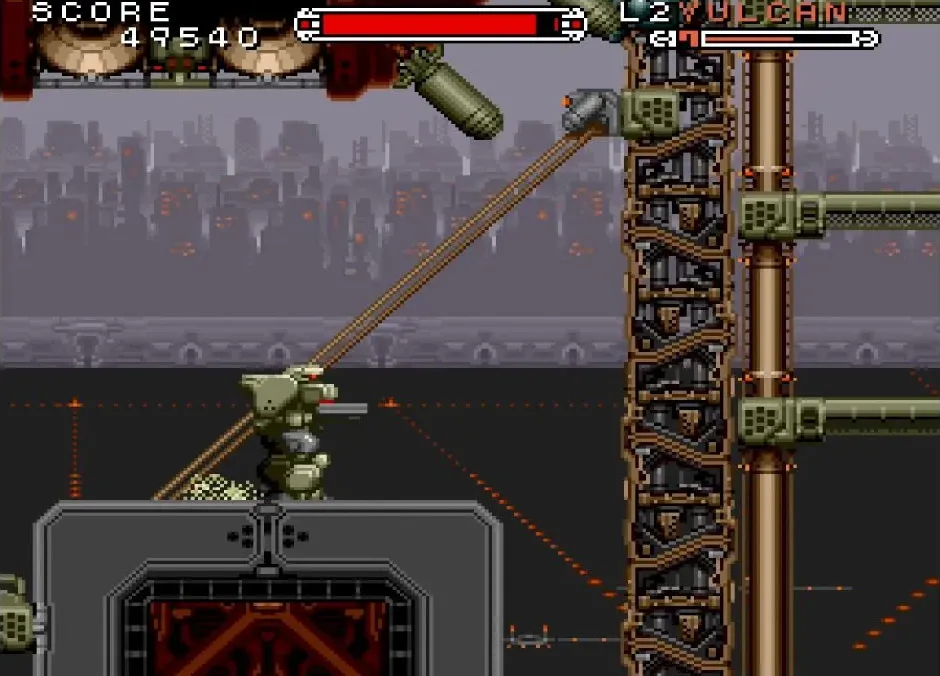
Late Valken is a different game’s palette every twenty minutes. One artist setting every key — violet skyline, magenta industrial canyon, the cooling-tower silhouettes of a war economy. Assault Suits Valken · NCS Corp. / Masaya, 1992.
The team’s afterlife is its own footnote. Tsuchida left for Square inside two years and produced Front Mission and five more entries; Suzuki later co-founded Omiya Soft and was reunited with Tsuchida to make Front Mission: Gun Hazard, a side-scrolling action game inside the Front Mission universe. The unified Masaya plan — strategy and action sharing one fiction — was completed three years late inside a different company. Valken failed at retail (Famitsu’s lifetime estimate is just over ten thousand copies) and scattered the people who could have made the sequel.
Akahori’s Score Under Glass
Masanao Akahori’s soundtrack is the part that travelled well even in the truncated export. Cybernator might have lost the dialogue, but it kept the music, and the music does not narrate — it sets a temperature. The Stage 1 colony cue rides a synth-string pad under a brass-and-percussion line that pulses like a procedural — closer to Macross OVA scoring than to a 1992 SNES action game. The atmospheric-entry cue in the third act drops everything to a piano-and-strings figure that sounds like the score forgetting it is in an action game, then remembering, then carrying on.
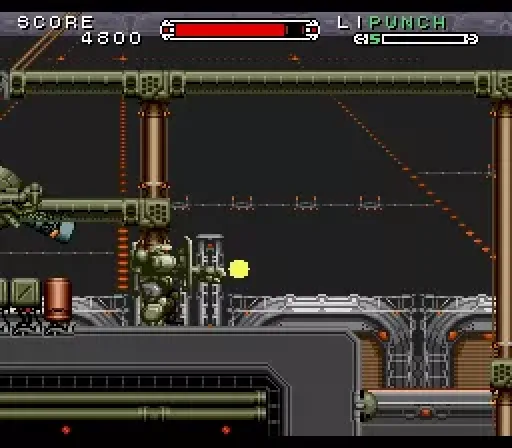
Every clean hit on a heavy enemy freezes the world for two frames. The score keeps moving under it — the only thing in the room that hasn’t paused. Assault Suits Valken · NCS Corp. / Masaya, 1992.
The credits theme is the surprise. It is closer to elegy than to march. Repeated through the Declassified arrange option in fuller live-orchestra textures, it stays a credits theme — but stripped down to the SFC chip it is doing the same work as the cut portrait scenes: marking the cost, releasing the player into mourning before the medal. A soldier looks at the camera. The music does not celebrate. The export played the same notes; only here do they sit under the right ending.
Why the Half-Cut Stayed Loved
It is fair to name what Valken does not give a modern player. Two hours is short. The difficulty is lopsided — the asteroid field punishes a first-time player harder than anything that comes after it, and the Stage 4 capital-ship boss is a documented filter. Cockpit text occasionally runs over the action where it can pull focus. The Declassified package is twenty-five dollars at full price for a runtime Hotline Miami would clear in an afternoon — though the loadout system makes a second run honestly different.
The wider point is that Valken invented a vocabulary the action genre would spend three decades catching up to. Metal Warriors, LucasArts’s 1995 SNES mech, leans heavily on the same controls; Nakai watched it on YouTube and said politely that “the resemblance is even stronger” than he expected. Front Mission took the strategy half. Hardcore Mecha and Furi inherited the commitment-to-the-swing the stride established. None of them carry the hit-pause the way Valken does, because none are saying the same thing about violence with it.
The 2023 restoration is the part that makes the case argue out loud. For thirty years Valken’s defenders, working from the Konami cut, had to gesture at things they could only see in the action — the weight, the cost, the strange seriousness of a SNES cartridge that knew its lieutenant might not come home. The portraits are back. The president on the bridge is back. The post-credits hook is back. None of it is required to enjoy the play. All of it explains, retroactively, what playing it always felt like.