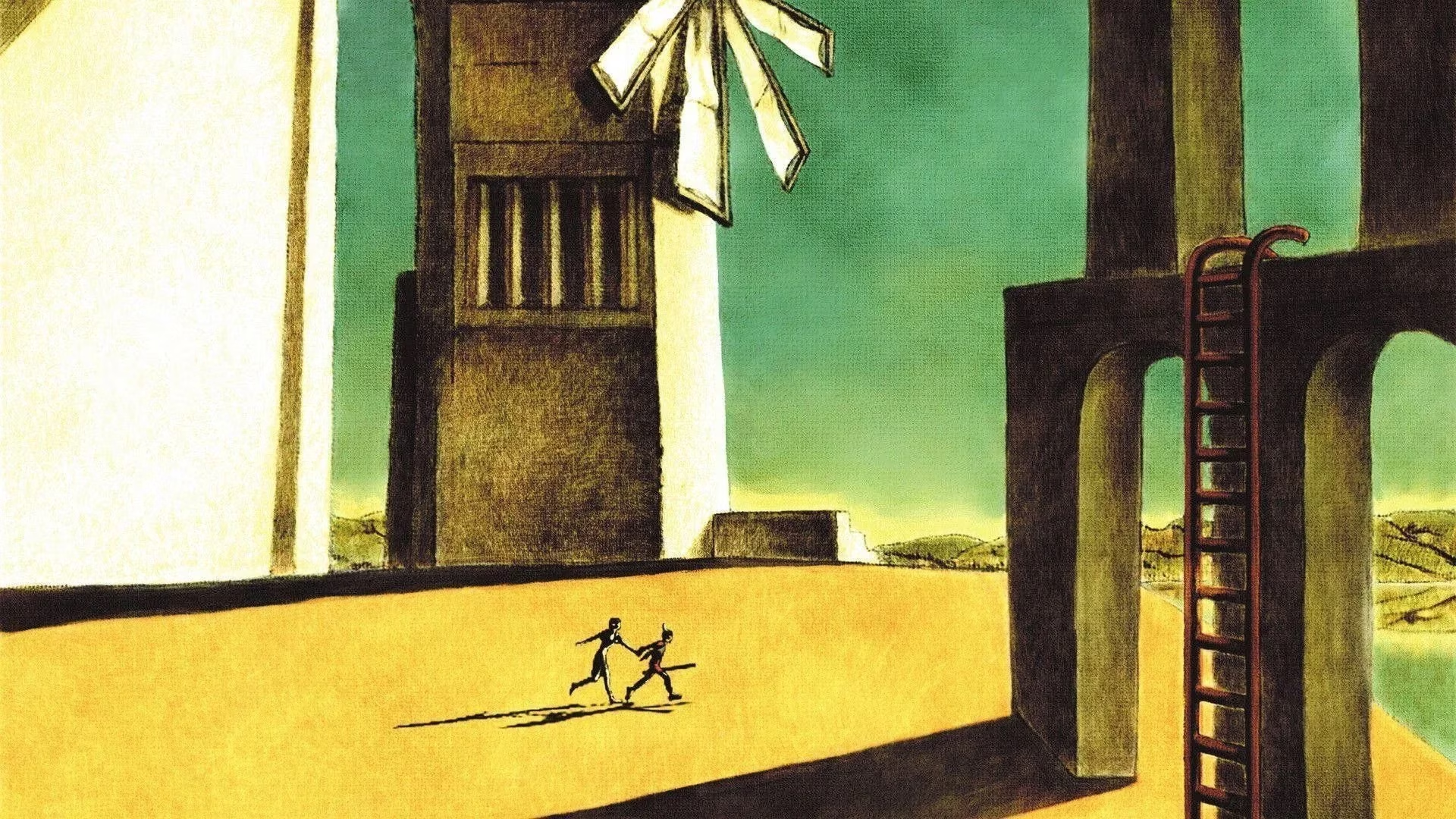
The most important button in Ico is not attack, or jump, or anything that advances you through the castle. It is the one that lets you take Yorda’s hand.
Press it, and the game changes shape.
Your movement slows. Your priorities shift. Progress is no longer about solving the space as efficiently as possible, but about staying connected — about not letting go. Every gap, every ladder, every shadow that reaches for her becomes a problem you cannot solve alone.
This is the entire design, expressed as a single action.
Everything else was removed.
A Game Built by Removal
Ueda would later describe his approach as “design by subtraction” — not minimalism as an aesthetic, but as a discipline. Anything that interfered with the player’s connection to the world was cut.
”Design by subtraction.”
— Fumito Ueda’s phrase for his method
This is not a fantasy of austerity. It is a practical strategy: every visible element had to earn the player’s attention. In most games, objectives organize your gaze; in Ico, the architecture does. The castle’s ramps, ledges, and light shafts become a silent menu of possibility. The player learns to parse the world by movement and by touch rather than by text or icons.
No health meter. No inventory. No map. No objective markers. Long stretches without music. A single enemy type, encountered again and again. Even the script was pared back: of 115 lines of dialogue, 77 were removed before release.
This was not restraint for its own sake. It was focus.
The goal was not to give the player more to do, but less to ignore.
By stripping away the systems that typically mediate play — HUDs, stats, explicit feedback — Ico forces attention onto what remains: space, movement, and the fragile connection between two characters.
Development was slow, uncertain, and nearly collapsed under its own ambition. The project began in 1997 on the original PlayStation, where Ueda and a small team prototyped a prisoner-escort puzzle game in rendered corridors. The PS1 could not hold the castle. When Sony authorised the move to the PS2 in 1998, large portions had to be rebuilt from scratch — new character models, new animation systems, a new engine for the lighting that would later define the game’s silhouette. Ueda has said the project was close to cancellation more than once during those years. The demo that finally convinced Sony to greenlight production was a single room: Ico leading Yorda across a courtyard, holding her hand.
His earliest design impulse came from a television commercial of a woman leading a child through a wood. That image stayed with him through four years of rebuilding, and it determined the scope of everything else. Of 115 lines of dialogue in the original draft, 77 were cut — not because they were bad, but because each one risked explaining what the handhold already expressed. The PAL release, shipped a year after the NTSC version, quietly added what the subtraction could afford: extra puzzles, a second ending, a two-player shadow sequence Ueda had held back. It is the only version where the discipline relents, and only in ways the central argument survives.
What shipped was not a compromised version of the idea, but a distilled one.
It shows in the way each corridor feels specifically chosen rather than generically designed. Every staircase, every gap and every switch is there because it supports that central claim: that the player’s most important work is to stay connected. That discipline makes the castle feel less like a finished level and more like a logic you discover through repeated care.
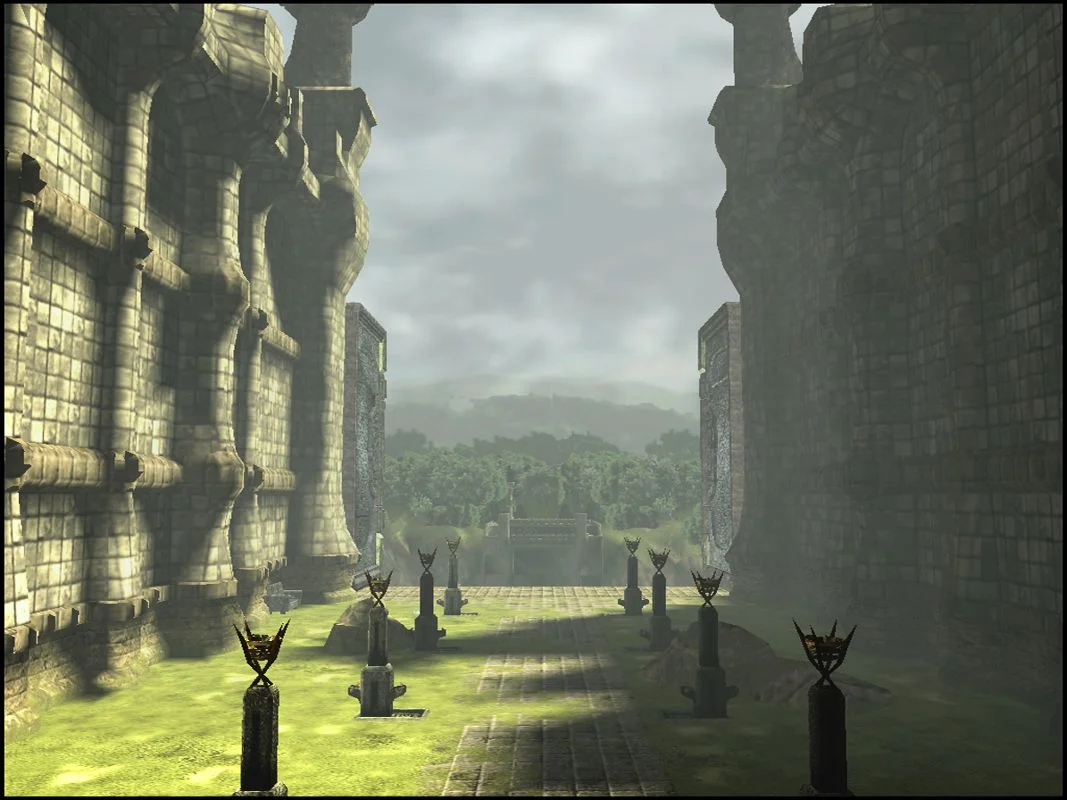
The subtraction is visible in the architecture: no interface clutter, no decorative crowding, just light, stone, distance, and a route you learn to read. Press screenshot: MobyGames.
The Castle as System
Most games use environments as containers. Ico uses its environment as an argument.
The castle is not a backdrop. It is the primary expressive system of the game — vast, indifferent, and internally coherent.
There are no explicit instructions, but the architecture teaches. Light suggests direction. Scale communicates danger. Doors, ladders, and mechanisms form a language you learn by moving through it. The absence of interface does not create confusion; it creates reliance on the world itself.
You do not solve the castle as a diagram. You solve it by walking it. The place teaches through the way it feels. A low wall suggests where you can jump. A shaft of sun suggests where you should go. A heavy door suggests promise on the other side. Those cues are not decoration; they are the only rules.
Once you understand that grammar, the castle’s repetitions stop feeling repetitive. A set of paired pillars means climb with intention. A high ledge and a broken roof mean the shadow can reach you. The world speaks in physical sentences, and the player, by paying attention, becomes fluent.
This is where the design reveals its confidence.
Without markers or maps, the player is forced into a slower, more attentive mode of play. You look, listen, hesitate. You begin to read the castle not as a puzzle box, but as a place — one that resists you, but remains legible.
And because nothing extraneous interrupts that relationship, the space begins to feel continuous. Real, in the specific way games rarely achieve.
Holding On
At the centre of all this is the mechanic that everything else orbits: holding Yorda’s hand.
It is not optional, and it is not decorative.
When you take her hand, the game imposes a constraint. Your movement changes. Your timing changes. You cannot move at full speed. You cannot act independently. Progress becomes an act of coordination.
The central verb is visible at body scale: one held button, two altered silhouettes, and a route that now belongs to both of them. Clip via Tenor.
You climb, then return for her.
That repeated motion makes every approach matter. When the shadow descends or the floor tilts, you are not simply recalling a solution; you are managing Yorda’s pace, anticipating her lag, learning when to wait.
You jump, then catch her.
You move ahead, then stop, turn, and call her forward.
The game does not allow you to abstract her into an objective. She is not a waypoint or a system to optimise. She is a presence that must be managed, protected, waited for.
And this is where Ico does something quietly radical. Most games build emotional connection through narrative — dialogue, cutscenes, backstory. Ico builds it through friction: the small, repeated inconvenience of another being attached to your movement.
Care is not expressed. It is enacted — by waiting in doorways, by turning back for a run, by accepting slower momentum. Over time, something shifts. The act of holding the button stops feeling like input and starts feeling like maintenance — like keeping something fragile intact.
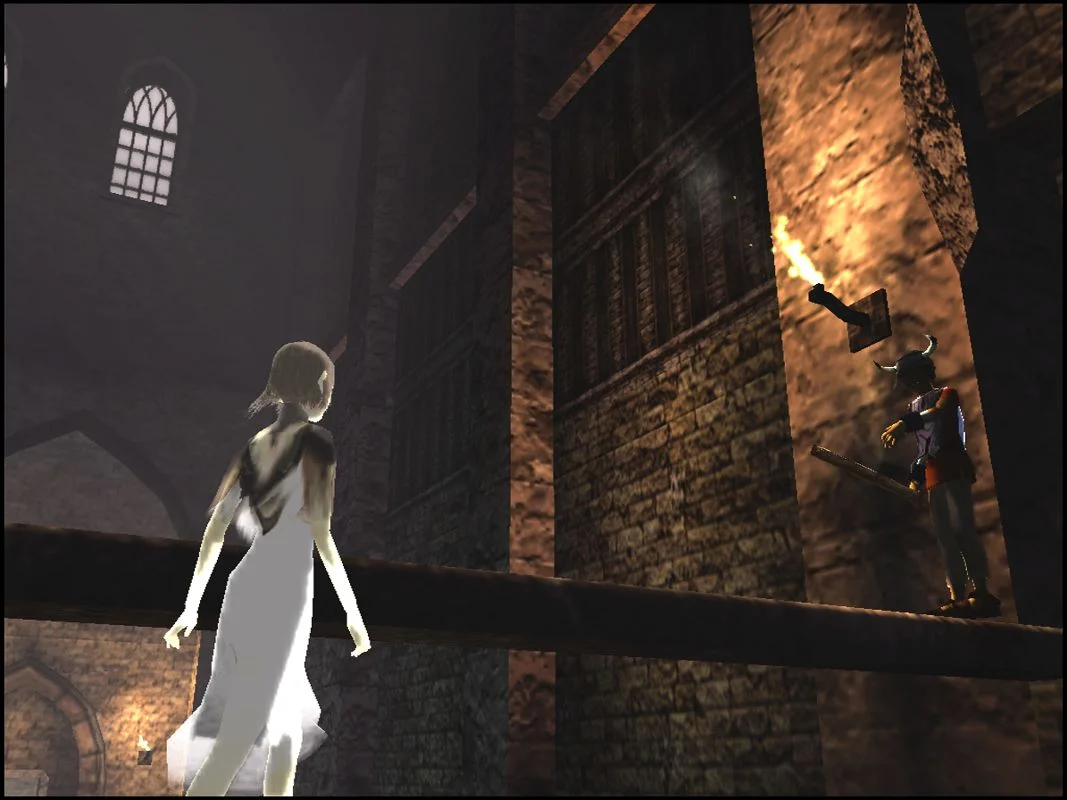
The shadow encounters matter because separation is always spatial first. The castle gets to make distance before the enemies do. Press screenshot: Ico · Team Ico / Sony Computer Entertainment, via MobyGames.
Silence, Space, and Trust
The Japanese concept of ma (間) — the meaningful pause, the space between actions — runs through every aspect of Ico.
There is no constant soundtrack pushing emotion. Many sequences unfold in near silence, broken only by footsteps, wind, and the distant echo of the castle itself. Dialogue is sparse and partially unintelligible, reinforcing the distance between the two characters.
When the sound field thins, the castle’s acoustics become part of the puzzle. A stone slab thumps differently depending on where you step. The echo of a distant door becomes a clue. Those acoustic cues are as much a guide as the geometry itself. The player’s ears learn the space as surely as their eyes do.
Even saving the game becomes part of this rhythm.
There are no checkpoints in the conventional sense. Instead, Ico finds a stone sofa and sits. Yorda sits beside him. The game pauses, not as a system interruption, but as a moment of rest.
That rest is not empty. It is part of the same contract the game asks of you: stay with the world long enough to notice how it breathes. The sofa is a punctuation mark in the same sentence as the handhold. It gives the experience room to settle, and it underscores the quiet care that runs through every design choice.
Saving is not a menu rupture. It is two exhausted figures making room for stillness inside the world. Clip via Tenor.
It is a small thing, but it reveals the entire philosophy: mechanics are not layered on top of the world. They are absorbed into it.
This extends to the story itself. The narrative is deliberately incomplete, delivered through suggestion rather than explanation. Ueda has described his approach in terms of haiku — presenting only what is necessary and allowing the player to interpret the rest.
That trust is central to the experience. The game does not over-explain, and in doing so, it avoids collapsing its own ambiguity.
Why It Still Works
Ico remains playable not because it was influential, but because its core idea has not been bettered.
The castle still reads. The puzzles still resolve cleanly. The pacing still holds. But those are structural strengths, not the reason it endures.
What endures is the relationship — not as a story, but as a system.
Holding Yorda’s hand is not a flourish. It is a limitation. You move slower. You plan differently. You are made responsible for something outside yourself, and the game does not let you forget it.
That decision — to bind player and character through constraint rather than empowerment — remains unusual even now. The closer you get to escape, the more the world thickens around the act of holding her hand. The game slows not because it is afraid of failure, but because it wants you to stay present.
In most games, progress is defined by increasing capability. In Ico, progress is defined by sustained connection. That is the quiet trick it still performs better than almost anything that followed: it turns a verb into a relationship, and then builds an entire game around the cost of maintaining it.
You are not told to care.
You are made to hold on.