Suikoden looks impossible until it starts moving. One hundred and eight recruitable characters. Six-person battles. One-on-one duels. Army clashes. A headquarters that fills with merchants, elevators, baths, vaults, cooks, blacksmiths, and gossip. On paper it reads like the kind of RPG that wants the player to salute its scale. In practice it is one of the shortest, cleanest political fantasies on the PlayStation.
That contradiction is why the first game matters now. It does not ask a modern reader to forgive slow menus, endless exposition, or a world map padded until it feels important. It makes a country feel large by keeping the journey small. Every recruit is a pin in the map. Every room added to the castle is proof that politics has become architecture. The game turns revolution into something the player can hold.
The Epic Refuses to Sprawl
Konami did not build Suikoden like a prestige RPG. The manual sells it as a quest to gather the 108 Stars of Destiny, borrowing its frame from the Chinese classic Water Margin, but the structure underneath is almost shockingly brisk. Towns are close together. Dungeons are short enough to remember as places rather than chores. Random battles usually resolve before the music has fully settled into its loop. The first hours take Tir McDohl from imperial officer’s son to fugitive to rebel figurehead with the bluntness of a folk tale.
That bluntness is a design choice, not a lack of ambition. Yoshitaka Murayama’s later reputation, especially after Suikoden II, can make the first game look like a sketch for a richer sequel. It plays better if you read it as compression. The empire is not mapped through encyclopedia entries. It is mapped through who joins you, who refuses, who dies, who changes sides, and which empty room in the castle becomes occupied because you walked into the right village with the right person in the party.
The game cares less about simulating politics than giving politics a rhythm. A village burns; a friend turns; a general defects; a blacksmith opens shop; the elevator starts working. The sequence is almost comic in its practicality. Revolution means grief, strategy, and someone who can sharpen a weapon before the next march. The practical detail keeps the banner from turning into wallpaper, because the rebellion always has somewhere ordinary to go next.
That was not the way the first English-language reception was set up to read it. GameSpot’s 1997 review called it a “fine, albeit short, RPG” and framed it as a warm-up before the bigger releases arriving around it. The line is useful because it is both fair and incomplete. Suikoden is short. It is also arranged so shortness becomes meaning. The game does not fail to fill the PlayStation disc with more dungeon; it refuses to let the march lose tempo.
”Though Suikoden may not be groundbreaking, it’s definitely good.”
Jeff Gerstmann, GameSpot, 1997
Six Bodies, One Button
The combat system understands the same principle. Six characters line up in front and back rows, but the ordinary battle verb is often one button: attack with everyone. That could flatten the game. Instead it makes party composition legible at speed. Short-range fighters need the front. Long-range characters can hide behind them. Unite attacks reward small bits of social knowledge: friends, siblings, soldiers, clowns, or cooks who share a rhythm because the fiction says they should.
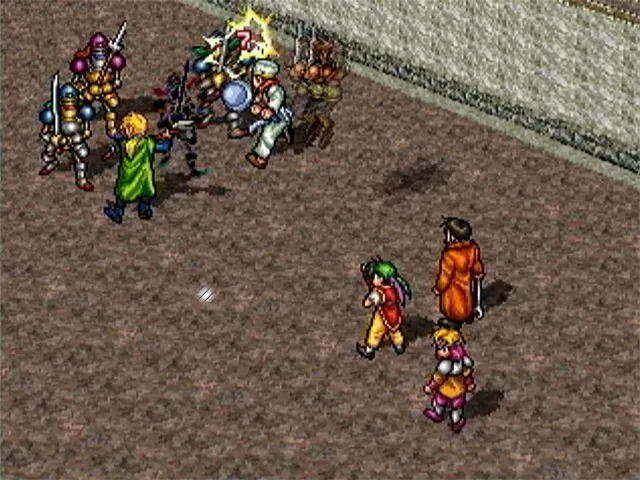
Six-character battles move quickly because the game treats formation as the decision and execution as release. Suikoden · Konami / PlayStation, 1995.
The ordinary battles are not where Suikoden hides its cleverness. Their job is to keep the campaign breathing. The stronger idea is that combat keeps changing scale without changing the player’s contract. A duel turns into rock-paper-scissors theatre, reading an enemy’s line for the tell that says attack, defend, or desperate strike. A war battle turns the same logic into generals and units: charge, bow, magic, spy, hope the forecast is right. None of these systems can carry a game alone. Together they create the sensation that a revolt is not one activity with better numbers, but several forms of pressure arriving in sequence.
The friction sits in the same place as the charm. Some recruits are obscure enough to require a guide unless you enjoy sweeping the world after every plot beat. The inventory is fussy. The translation can land with the hard, flat edge of mid-nineties localisation. Yet the roughness rarely stops the campaign because the campaign rarely lingers. A modern player gets the pleasure before the inconvenience has time to become the subject.
The Castle Is the Argument
The headquarters is where the hundred-and-eight idea stops being a checklist. At first it is a ruin, mostly stone and echo. Then it begins to behave like a community. The inn opens. The appraiser sets up. The vault gives hoarded items a home. A bath appears because someone thought the army should have one. The castle does not merely track progress; it makes recruitment visible in walls and services.
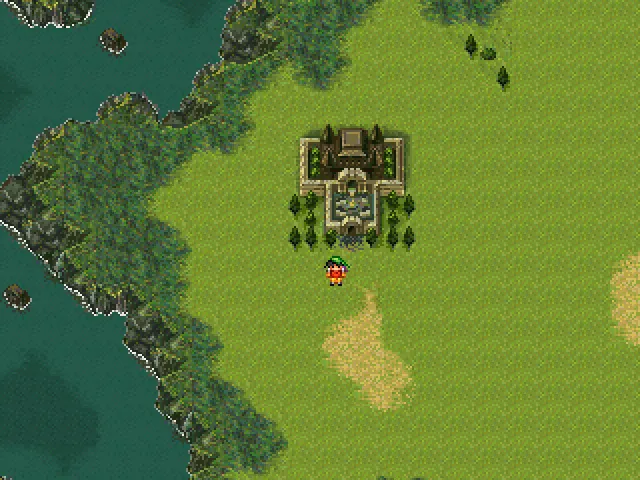
The headquarters turns recruitment into geography. The more people you persuade, the more the castle stops looking like a symbol and starts working like a town. Suikoden · Konami / PlayStation, 1995.
This is the part later games, and many later RPGs, would spend decades expanding into base-building, relationship systems, and collectible labour. The first Suikoden keeps the miracle small. It does not ask you to place furniture or optimise a civic spreadsheet. It lets the base change because people have arrived. The design trusts the player to feel that difference without managing it.
That is why the 108 Stars work. Most of them are not psychologically deep. Some are barely more than a portrait, a weapon type, and a function. The game wins by making presence matter before personality does. You remember the doctor because the infirmary exists. You remember the elevator operator because climbing the castle without her is a nuisance. You remember the strategist because the war map stops feeling like a coin toss once he begins reading it for you. The roster becomes a social machine.
The castle also solves a problem that enormous casts usually create. A roster of 108 can turn into bookkeeping, especially when only a fraction can enter the active party. Suikoden sidesteps that by letting many recruits matter outside combat. Fighters carry runes and weapon ranges; support characters alter the texture of moving through the headquarters. The game never needs every person to be equally useful because usefulness itself has been widened. A revolution needs archers, but it also needs storage, boats, gossip, and someone willing to run an inn inside a liberated ruin.
Miki Higashino Draws the Map
The score gives that machine a weather system. Miki Higashino had been a Konami composer since the arcade years, with Gradius and Yie Ar Kung-Fu already behind her, and Suikoden gives her a different kind of assignment: not one heroic theme, but a map of places that need to feel older than the PlayStation. Drums, flutes, bells, and bright melodic turns make towns feel local before the script has explained them. The castle theme thickens as the headquarters grows, turning administration into homecoming by degrees.
The music matters because the graphics are modest. Character sprites are small, backgrounds are often clean rather than lavish, and the camera keeps the world at a readable distance. Higashino supplies the scale the screen withholds. A town theme can make three buildings feel like a province. A lament can make one death feel like a fracture in the rebellion rather than a required story beat. The soundtrack does not inflate the game; it extends the map.
This is where the first Suikoden earns its political texture. It rarely lectures about liberation. It lets music, geography, and recruitment tell the player what the cause costs. The army is assembled in menu slots and castle rooms, but the feeling of a country comes from sound: folk instruments in one settlement, military snap in another, grief arriving with enough melody to be remembered without becoming operatic.
Listen to the early castle theme after a few recruitments and the trick becomes plain. It does not suddenly become triumphant. It warms. The melody leaves room around itself, as though the stone corridors have started to carry voices from rooms the player has not visited yet. That restraint keeps the whole campaign from hardening into pageant. The rebellion is not glorious because the script says so. It becomes livable first, and the music lets livability sound like victory.
The Remaster Makes the Case Plain
The official remaster changes the practical recommendation. For years, the first game was easy to admire and annoying to recommend: original discs had climbed in price, the PlayStation Network release was platform-bound, and emulation was the honest route for anyone without old hardware. Suikoden I&II HD Remaster makes the simplest argument available again. The first game can sit beside its sequel, transfer data intact, with cleaner backgrounds and modern conveniences that do not slow the core rhythm.
That pairing matters. Suikoden II is the canonised masterpiece, the one with the fuller villain, the sharper tragedy, and the reputation that keeps the series alive in memory. The first game should not have to compete with it on density. Its value is different. It is the pilot light: smaller, faster, stranger in its faith that a political RPG can move like an adventure story and still leave the player feeling they have helped build a nation from rough scratch.
The best reason to play it now is not homework for the sequel. It is the confidence of a game that knows when to leave. Twenty hours is enough for a betrayal, a castle, a war, a full bench, a final march, and the faint ache of names you recruited because someone told you there were 108 stars and you wanted the sky complete. Most RPGs promise a world by adding distance. Suikoden promises one by adding people.