The third best-selling arcade machine in America in 1991 was a Konami cabinet you have probably never owned. The Amusement and Music Operators Association’s Platinum award named it behind only Street Fighter II and the Neo Geo MVS — and of those three, two went home. Street Fighter II arrived on the Super Famicom that summer; the Neo Geo went home in any number of ways. The Simpsons, the third, sat in arcades and Showbiz Pizzas for twenty-one years and then vanished from sale entirely. The mechanism was a single licensing signature, written years before the cabinet shipped.
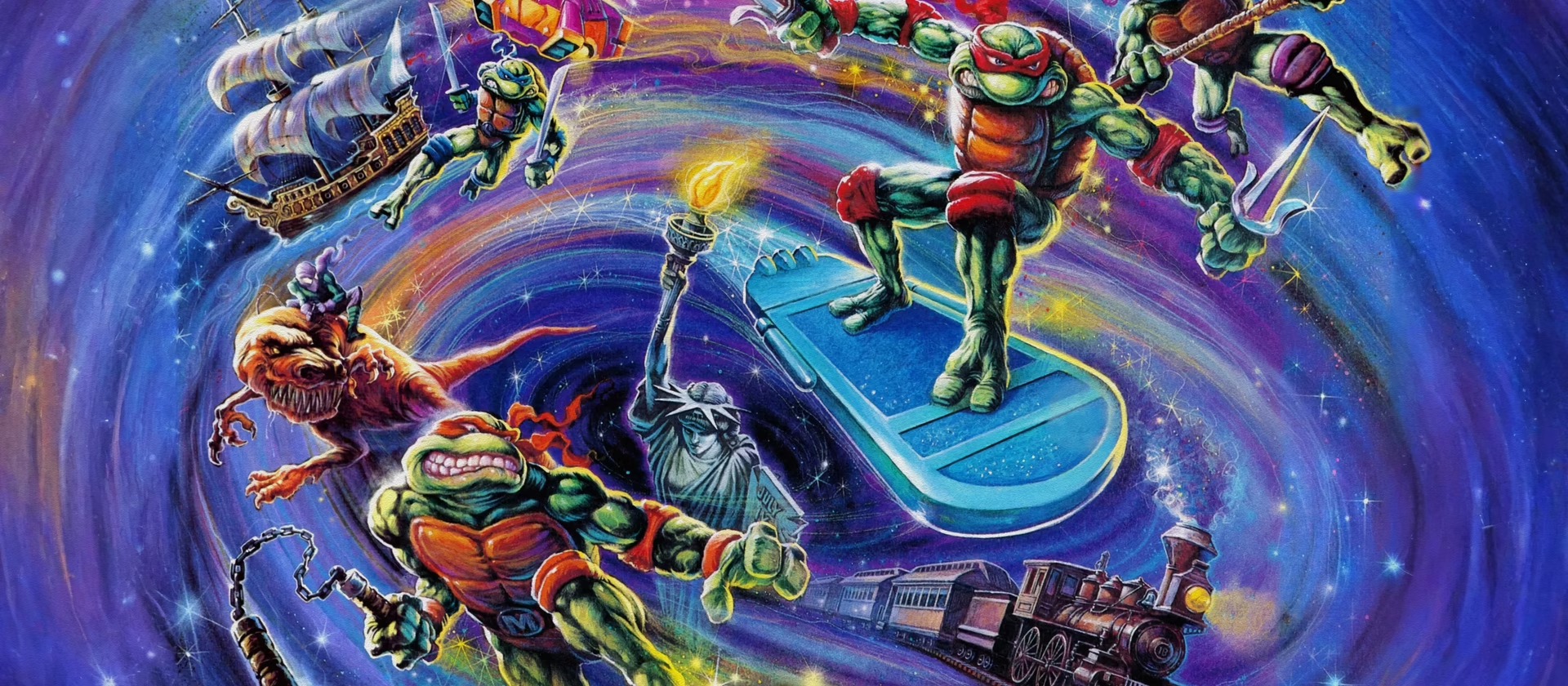
That absence is the article’s spine. The structural twin against which it has to be read is TMNT IV: Turtles in Time — the Konami brawler that arrived eight months later and inherited the entire cultural afterlife of the era. And what most readers remember as The Simpsons isn’t the game that survives. Konami quietly rebalanced it for Japan five months after the US launch, and that build is the one to play.
Two Months, One Signature
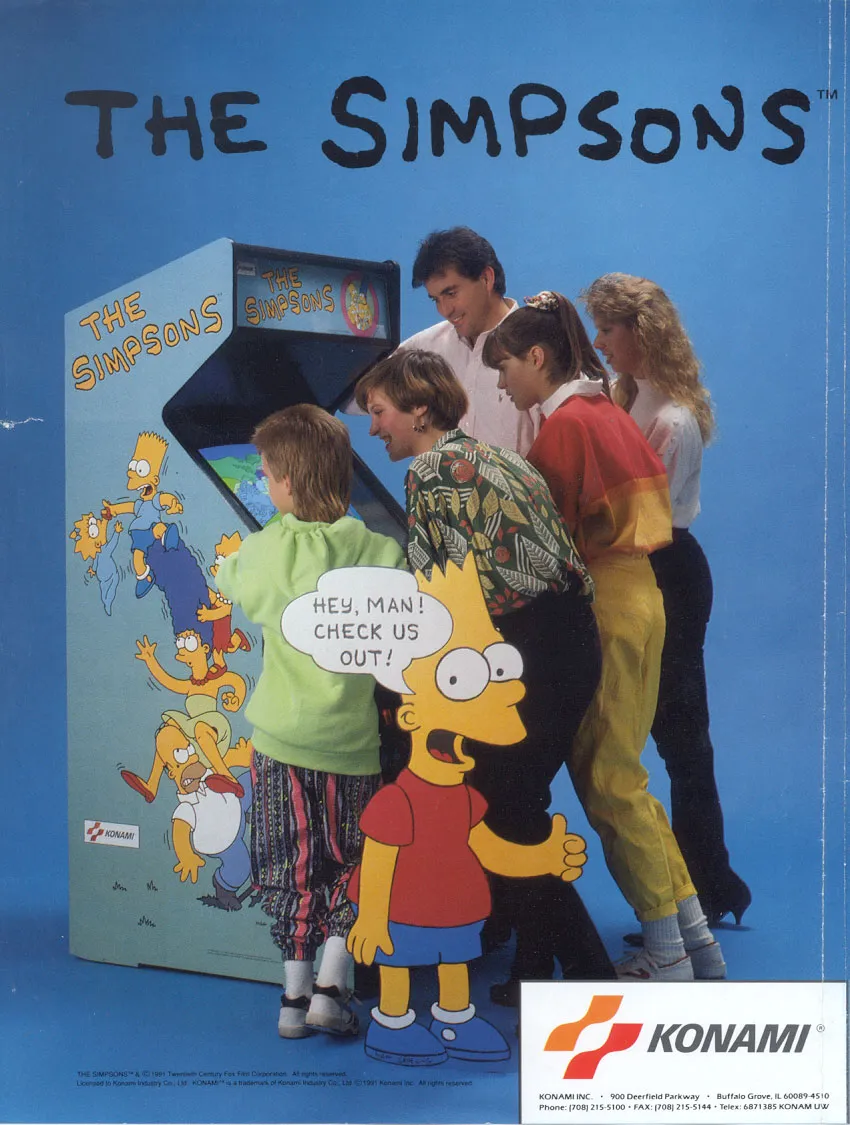
The 1991 US operator flyer — Konami selling the cabinet to bowling alleys and arcades as a piece of social furniture. The Simpsons · Konami, 1991.
Konami started arcade development in February 1990 and ran a location test in the Chicago suburbs that December — three months from the cabinet’s North American debut. The folk-history that puts development at Konami of America’s Chicago office is a misreading of what Chicago actually did. The credit roll is wholly the Japanese arcade division: director Kengo Nakamura, programmer A. Suzuki, composer Norio Hanzawa. The cabinet shipped in the US in March 1991.
Six weeks later, on April 25th, Bart vs. the Space Mutants arrived on the NES. That release date matters because Acclaim Entertainment had signed Fox and Gracie Films for the console rights to The Simpsons in 1989 — eighteen months before the Konami cabinet existed. Konami’s deal covered arcade and home computer only. The Hungarian studio Novotrade did the DOS and Commodore 64 ports under that carve-out. No Mega Drive port, no Super Famicom port, no NES port. Acclaim held the doors, and Acclaim’s idea of a Simpsons home game was the Garry Kitchen platformer that turned Bart into a sprite-jumping mascot. The licensing geometry decided the verdict before Konami started writing code.
“Teenage Mutant Ninja Turtles was already a hit as a comic, as was The Simpsons as a TV show, so we already knew they’d sell if we turned them into video games.” — Masahiro Inoue, Konami (1981–2008), Time Extension
Konami’s other 1991 four-player cabinet, TMNT IV: Turtles in Time, is the clean structural mirror. Same publisher, same year, same arcade-brawler engine family — and Konami also held the TMNT console licence. Turtles in Time arrived on the Super Famicom in summer 1992 with a redesigned campaign mode, a Mode 7 set-piece, and a Mutsuhiko Izumi score the SPC chip rendered in full stereo. The Simpsons got Novotrade’s Commodore 64 port. One cabinet inherited the 16-bit afterlife. The other became a twenty-one-year absence. The difference was one ledger entry in an Acclaim contract.
Four Characters, Two Cabinets
Konami shipped The Simpsons in two cabinet versions: a two-player upright for operators with narrow floor space, and a dedicated four-player upright with one control panel per Simpson. The four-player is the one most readers remember — distinct side art running the family stacked from Maggie down to Homer, four joysticks colour-coded to the characters, the marquee lit yellow over the title’s hand-drawn orange. The two-player let you pick your character. The four-player assigned you whoever was left when you walked up.
Each family member plays differently. Homer punches and kicks with the most damage and the worst reach. Marge clears crowds with a long-handled vacuum that becomes the consensus best moveset within thirty seconds of any new player picking her up. Bart’s skateboard gives mobility — slides, kicks, an aerial that crosses half the screen. Lisa carries a jump-rope that works as a short whip. None of these movesets is balanced for solo play. The game scales by group, the way fighting cabinets and air-hockey tables scale: the mechanical pleasures emerge when there are people standing next to you.
Four unique team-up attacks ship across the four pairings. Homer and Marge interlock ankles and roll across the screen as a human bowling ball. Bart and Lisa link arms and clothesline anyone in their lane. A parent hoisting a child on their shoulders strikes at two heights at once. A parent throwing a child uses the kid as a flying projectile. The team-ups are flavour rather than strategy — wailing on the attack button is more efficient — but they are the cabinet’s most concentrated argument for itself. This is a four-character party game built around a piece of furniture in a bowling alley.
Konami pulled archival voice work from the show’s first season and commissioned new lines on top; Burns and Smithers were voiced by Konami programmers rather than the show’s cast, audible if you listen for it, and the cabinet doesn’t apologise for it. The sprite work and the borrowed-and-supplemented voice track produce a strange double impression: a 1991 brawler that looks and sounds more like the show than any home Simpsons game would for years.
The Cemetery, the Dream, the Roof
Eight stages, each carrying one or two set-pieces strong enough to earn their credits. Stage 1 chases through Downtown Springfield to a wrestler named Professor Werner von Brawn. Stage 3 takes the family to the Springfield Discount Cemetery, where zombies emerge from the dirt and lurch into choreography pointed unmistakably at the Thriller video. The dance reads only as motion — Konami’s animators showing their work, and the prose that describes it cannot do what the sprites are doing.
Dreamland: a single shared hallucination level — flying saxophones, nightmare donuts, Bart-imps, and a giant bowling-ball boss with eyes. The kind of design beat Hardcore Gaming 101 says “so bonkers that players wish they’d done something like that for the whole game.” The Simpsons · Konami, 1991.
Stage 6 is the strangest beat the cabinet attempts. Dreamland is a single shared hallucination — not, as some memories have it, per-character solo vision interludes. The family is unconscious. The floor is a layer of clouds. Flying saxophones, nightmare-sized donuts, and Bart-imps work as enemies; the boss is a giant blue bowling ball with eyes and a mouth, pursuing you across the cloud-floor while a suburban Springfield house sits behind the SIMPSON mailbox. Stage 7 puts the family on the Channel 6 television studio rooftop, where the enemy roster runs through space aliens, robots, ninjas and a kabuki-warrior boss — four arcade-genre callbacks compressed into a single set. Stage 8 is the Nuclear Power Plant, Smithers, then Mr Burns in a mobile battle suit, then the diamond returned and the pacifier handed back.
What the game asks of a modern player and fails to give is real chain timing. Striking attacks lack the rhythm Konami’s own TMNT arcade had in 1989 — moves end with a small dead beat before the next can land — and bosses arrive with on-hit invincibility frames that turn artificial difficulty into a feature. Indie Gamer Chick’s framing is the cleanest articulation: a coin-op designed to grow fat on quarters, the simplistic combat married to frustratingly overwhelming odds. The case for the World ROM is the cabinet and the people around it. The case against it is what happens when you sit down with three other people and discover the boss patterns are designed for a player who hasn’t seen them before.
Hanzawa, in the Cabinet’s Voice
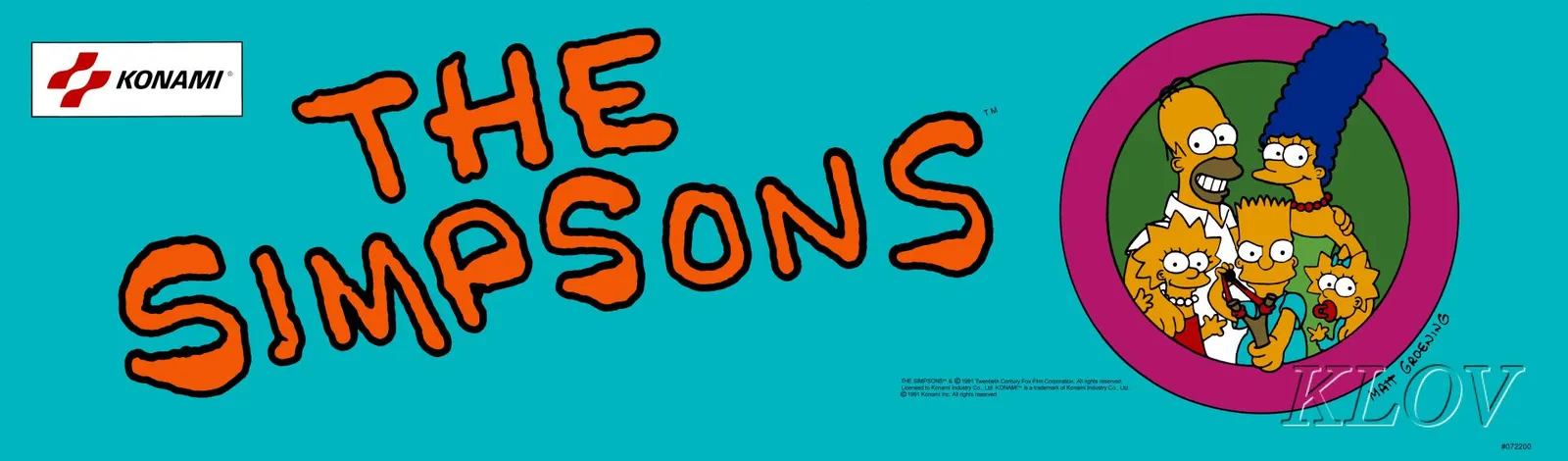
The marquee carries the cabinet’s typographic confidence: Konami’s corporate plate, the show’s title in its hand-drawn lettering, Groening’s signed family portrait. The Simpsons · Konami, 1991.
Norio Hanzawa scored the cabinet before writing any of the Treasure music people now associate with his name. In 1991 he was a Konami staff composer scoring an American licensed cabinet, and what he wrote sits inside the cabinet’s voice rather than performing alongside it. The Springfield town theme canters. The Krustyland cue accelerates. The cemetery procession leans into a minor-key Hammond pulse. The Channel 6 rooftop modulates as the enemy roster shifts from science fiction to ninjas to kabuki, the score doing the work of telling you the genre callback has changed. Hanzawa is using Konami’s K053260 PCM chip and the YM2151’s FM voices the way the Sunset Riders score does — synth-rendered cartoon rather than orchestral pastiche, scaled to the sprite work.
The full-cabinet typographic statement survives in the marquee: Konami logo, hand-drawn show title, Matt Groening’s signed family portrait. That image is the cabinet’s whole pitch in one strip of backlit perspex — an arcade publisher operating at full presentation confidence with a TV licence the rest of the home-games industry was selling to children. Hanzawa’s score is the audible half of the same argument. Nothing about the soundtrack is apologetic. It plays as a 1991 Konami arcade score, with the show’s voice cast layered on top.
Twenty-One Years, Then the Wrong ROM
Konami released a Japanese build of The Simpsons in August 1991, five months after the World ROM. The Japanese cabinet ships smart-bomb pickups across every stage rather than gating them to the final boss, an extendable life bar from food items, fewer boss invincibility frames, lower enemy health on most stages, and a tiered end-of-stage scoring system. Indie Gamer Chick’s split verdict — NO on the World ROM, YES on the Japanese — is the cleanest articulation of what the rebalance does. The same game in the fairer build is a meaningfully better game. The 2012 Backbone Entertainment Xbox 360 and PlayStation 3 port quietly knew this. Complete the World ROM once and the Japanese build unlocks as the second-playthrough reward — a curatorial choice that ratifies the rebalance without saying so out loud.
“Unfortunately, the license on The Simpsons ran out, so if you happen to have this game, consider yourself lucky.” — Hardcore Gaming 101
That Backbone port arrived in late January 2012, timed to the show’s five-hundredth episode, and was quietly delisted from PSN and XBLA in late December 2013. Twenty-two months of legal purchasability in a thirty-five-year lifespan. The Simpsons IP has sat with Disney’s 20th Century Games since the March 2019 Fox acquisition, and Disney licensed Arcade1Up for a 2021 home counter-cade — proof the pathways are open — but no digital re-release of the Konami cabinet has been announced since. The Simpsons is conspicuously absent from Konami’s 2019 Arcade Classics Anniversary Collection. The play-route that survives is MAME running the build Konami shipped to Japan in August 1991.
The play argument isn’t that the World ROM holds up against Turtles in Time. It doesn’t, and saying so is the point. The argument is that Konami shipped the version that does, the West never played it, and the cabinet written out of the Konami canon is also the cabinet whose better build has been quietly waiting in the ROM tree for thirty-five years.