A coin-op is a contract written in seconds. You step up, you put in a quarter, and the cabinet promises you about three minutes of brawling before something kills you and asks for another. Konami’s 1991 four-player Turtles in Time cabinet honoured that contract beautifully — Foot Soldiers thrown briefly toward the camera as a wow beat, bosses that punished proximity to push players toward another insertion, four uprights so the social heat of a Friday night could pay for itself. The 1992 SNES port carried the same sprites, the same stages in broad outline, the same Mutsuhiko Izumi soundtrack. Almost nothing else.
What Konami’s home division did, in roughly fourteen months, was rebuild the central logic of a coin-op into the central logic of a cartridge. The throw animation that flashed past in the arcade became a player-triggered mechanic the final boss exists to test. The autoscroll stage became a Mode 7 pursuit. Insert Coin became Continue From Checkpoint. Turtles in Time is one of the rare home conversions of the 16-bit era where the home version, by almost every measure that matters to a first-time player today, is the better game. Both versions ship together on the Cowabunga Collection now, so the comparison is a sitting, not a historical exercise.
The Quarter Slot the Cabinet Wanted
In 1991, Konami’s arcade division was running the most consistent four-player cabinet line in the industry. Teenage Mutant Ninja Turtles (1989) had proved that a licensed-cartoon brawler on a Motorola 68000 board with four uprights could turn a Friday-night high-school clientele into a recurring revenue stream. Turtles in Time sat in the middle of that run — same producer (Masahiro Inoue), same board family, same year as Sunset Riders and a year before X-Men. Director Gen Suzuki’s cabinet was built for the floor.
That meant specific design choices a home version had no reason to keep. Bosses lead with proximity attacks that interrupt approach — useful when you need the player to fumble a credit, friction-as-feature when there’s a cabinet to lean on. Continue means Insert Coin: you re-spawn where you died, no checkpoint, no campaign arc. The throw-foot-toward-screen animation, the cabinet’s signature wow beat, is scripted into a few specific encounters — Foot Soldiers tossed at the camera at the moments the floor manager wants new players to gather behind the watchers. The whole thing is a contract priced in three-minute increments, and on a Friday night in 1991 it is brilliant.
On the Cowabunga Collection today, that’s about twenty-five minutes of free-credit play before the credits roll. The cabinet has lost its cabinet. What’s left is a tight, generous, beautifully-sprited brawler with no real reason to be replayed — and the Famitsu cross-review staff in early 1993 noticed, handing the SNES port a 26/40 against EGM’s 36/40. The cart is what had to do the work outside the cartoon’s hype field.
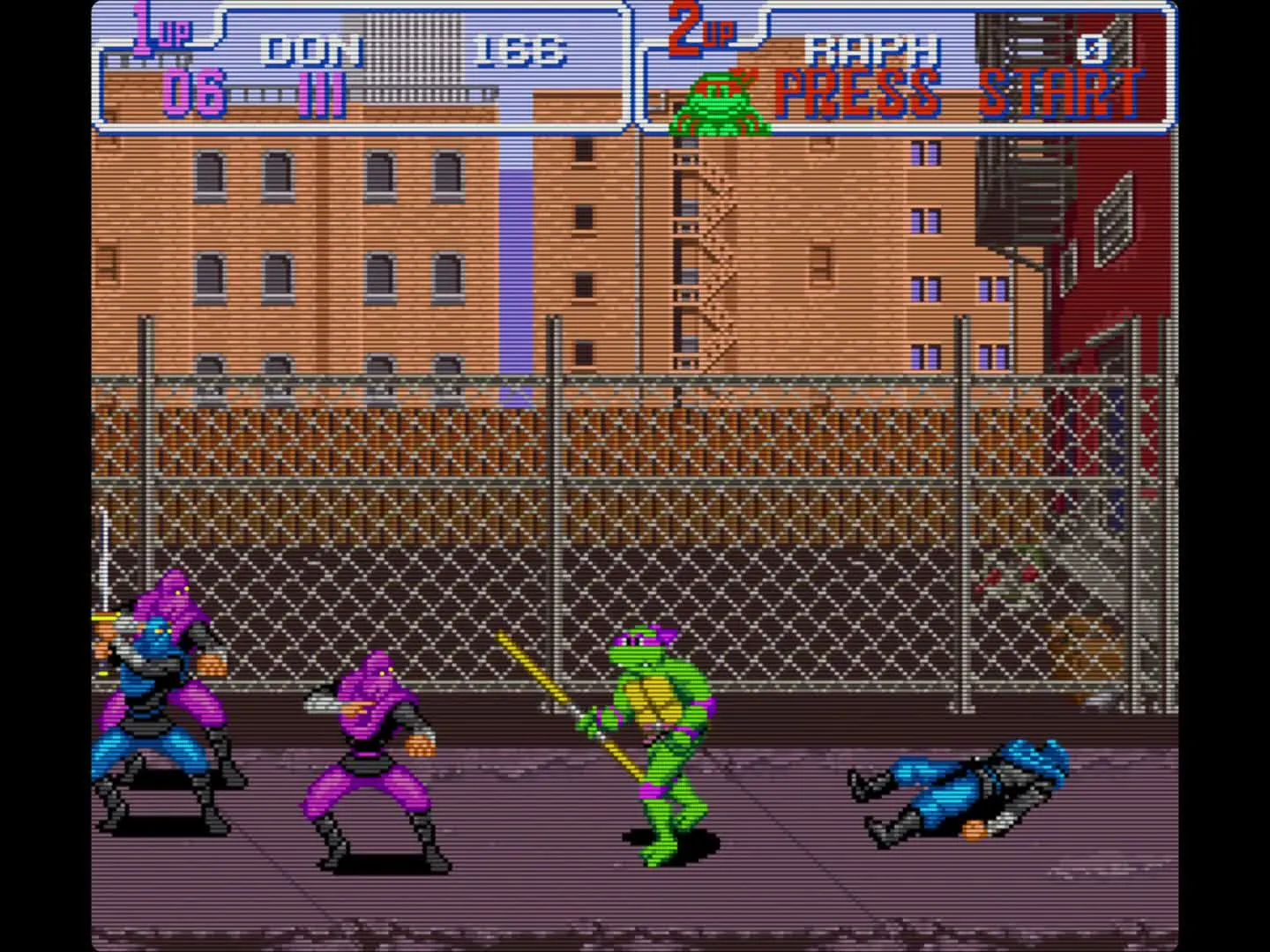
Alleycat Blues at the second stage — the cabinet’s social object kept intact even at half player count. The SNES caps at two-player simultaneous; what survives is the cabinet’s brawling rhythm, not its uprights. TMNT IV: Turtles in Time · Konami, 1992.
A Verb Trained on a Foot Soldier
The SNES port keeps the throw-toward-screen animation and rewires what it is. In the arcade, the throw is scripted; in the cart, it is a player input — hold the opposite direction and press Y on a grabbed Foot Soldier, and Donatello or Leonardo or Raphael or Michelangelo hurls them across the foreground, where they hit any enemy in their path. That is a small interaction-design change with structural consequences. It is now a verb the player practises hundreds of times before it matters.
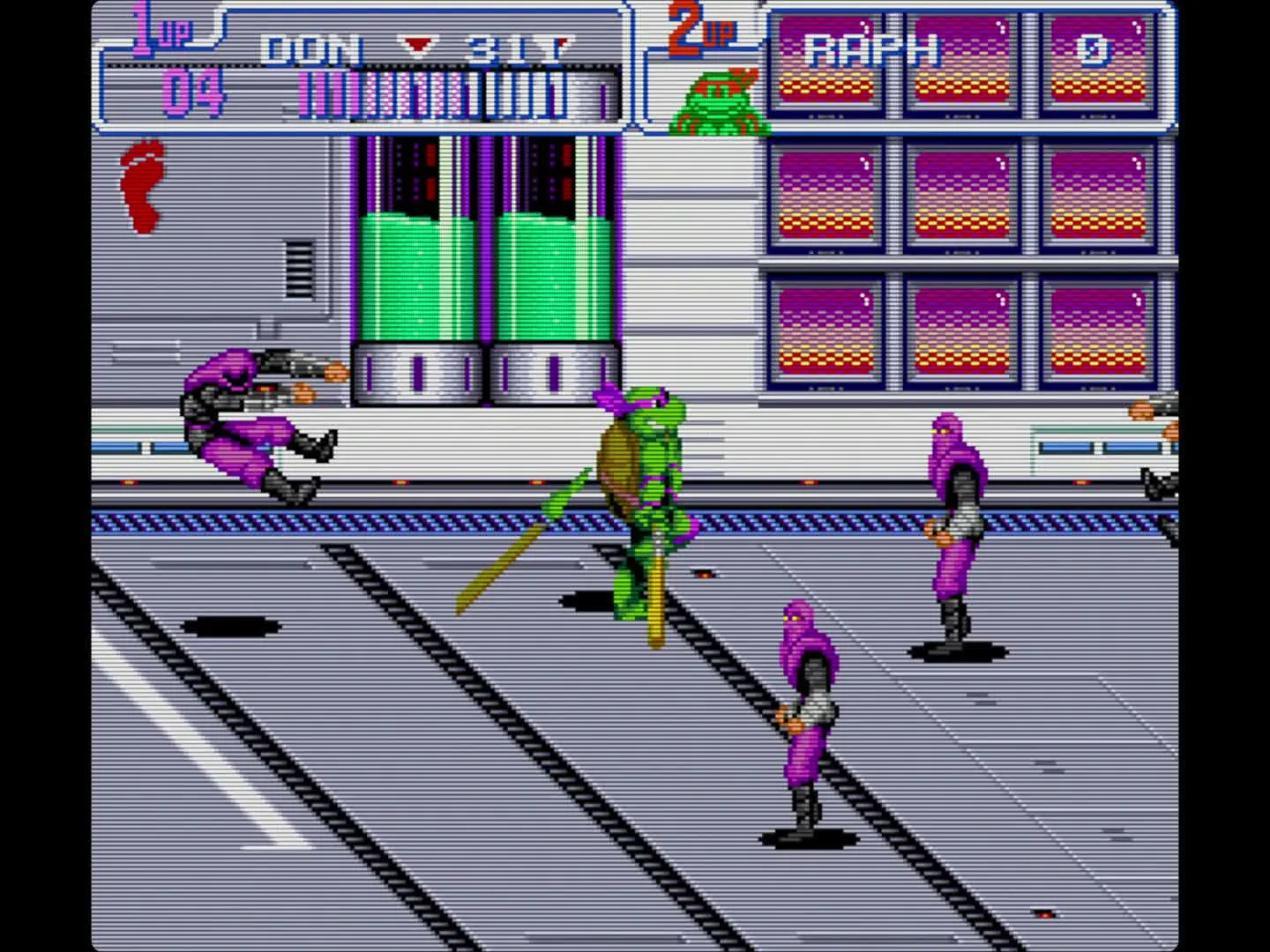
The throw verb in mid-execution against a Technodrome Foot Soldier. The same animation the arcade used as a scripted spectacle is here a player input — the boss at the end of the stage is the verb’s exam. TMNT IV: Turtles in Time · Konami, 1992.
It matters at the end of Stage 4. “Technodrome: Let’s Kick Shell!” is the SNES-exclusive fourth act — a stage that does not exist in the 1991 cabinet — set inside Shredder’s mobile fortress, where the entire level is built to make the player feel the throw verb as a weapon. The Foot Soldiers in the corridors are designed to be picked up and hurled at the next Foot Soldier; the mid-stage boss pair, Tokka and Rahzar, take grab-and-throw damage cleanly; and then, at the close, Shredder appears in a Battletank parked at the lip of the camera, and the entire boss fight asks the player to throw Foot Soldiers at him.
The Battletank Shredder fight — Mode-7-scaled enemy chassis in the foreground, the playable plane in the middle distance, the throw verb cashed in as the boss’s only weak point. The cabinet’s wow beat promoted from spectacle to gameplay. TMNT IV: Turtles in Time · Konami, 1992.
The fight is unmissable: a foreground enemy the player can only hit with the verb the rest of the game has been practising. Each thrown Foot Soldier cracks one of the three pips of Shredder’s health. The shot is the same one the arcade was using as a wow beat — Foot Soldier flying at the camera, foreground enemy taking the hit — except now it has been promoted from gag to gameplay, from cabinet flourish to the verb the climax exists to test. The boss is the player’s input lesson, cashed in.
That kind of design rhyme — a small repeated mechanic finding its biggest possible payoff in the final encounter — is how cartridge games build replay value. Rice Digital, looking back at the pair of releases years later, put the case more directly than most period reviewers did:
“The SNES version was properly redesigned as a game for the home… continuing resets you back to the beginning of a stage.” — Rice Digital, Turtles in Time for SNES still beats the arcade version
That single sentence is the whole pivot. The continue economy, the boss pacing, the throw verb’s promotion to climax — they all serve the same shift from coin-priced encounter to replayable campaign. It is the move almost no arcade-to-home port of the era bothered to make.
Mode 7 in Service of a Verb
Stage 8, “Neon Night-Riders,” is the other place the redesign shows. In the arcade, it was a horizontally-scrolling autoscroll where the turtles surf the streets of the year 2020. On the SNES it becomes a Mode 7 over-the-shoulder pursuit — the road racing toward the vanishing point, a futuristic Manhattan skyline parallaxed behind, Foot Soldiers and helicopters appearing from the depth of the screen rather than the right edge.
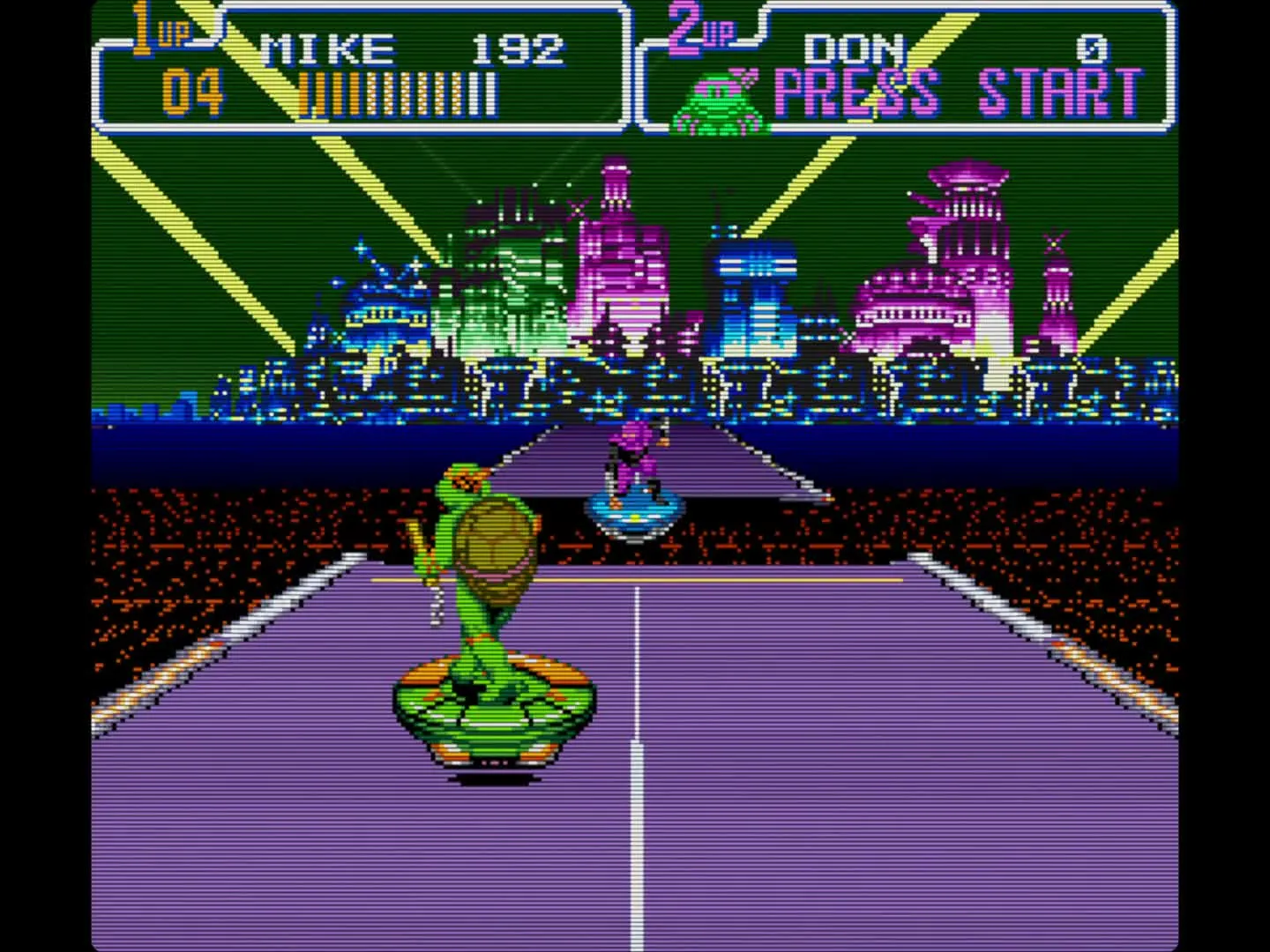
Neon Night-Riders rebuilt as an over-the-shoulder Mode 7 chase. The arcade stage was a brawler with a moving floor; the SNES stage is a chase. Same world, different game. TMNT IV: Turtles in Time · Konami, 1992.
Most 1992 SNES games used Mode 7 as ornament: a rotating title screen, a stage-transition fly-around, a boss pattern that needed perspective scaling for one beat and reset to 2D after. Konami’s team used the mode twice in Turtles in Time, both choreographed for argument rather than spectacle. The Battletank Shredder fight is the obvious one — perspective is the difference between a foreground boss the player can only hit with the throw verb and a flat 2D boss they would walk up to and whip. Neon Night-Riders is the subtler use: the arcade asked the player to keep moving against an autoscroll camera; the SNES version asks them to hold a centre while the world races at them. Different input pattern entirely.
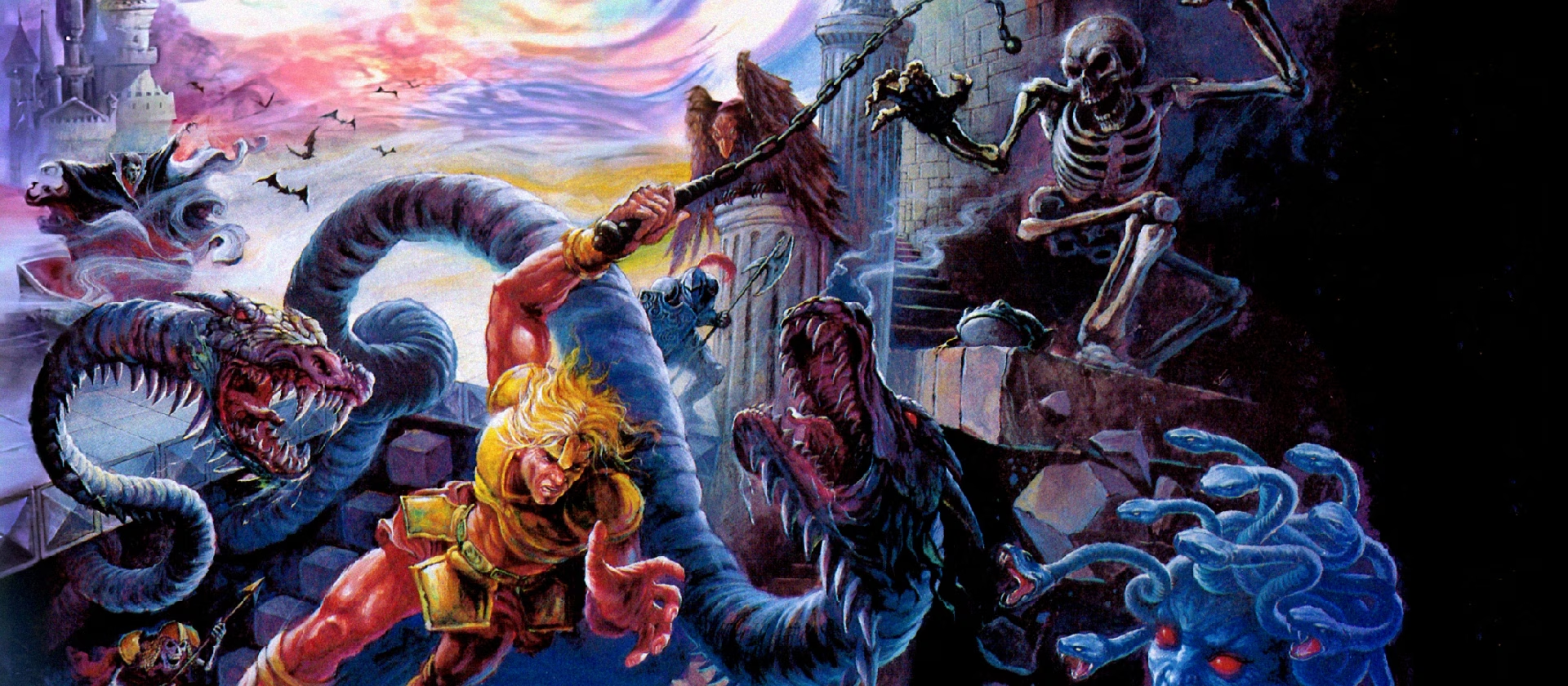
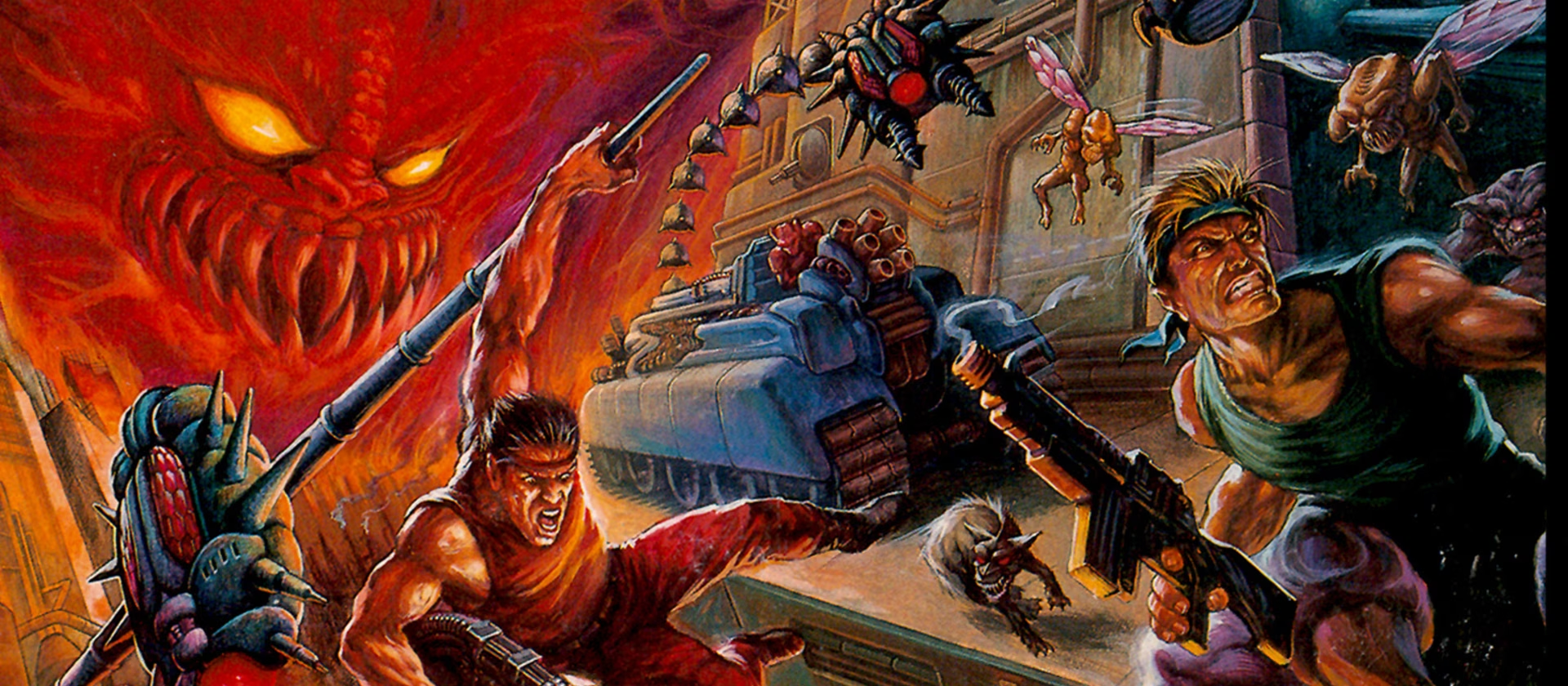
That divergence shows up on the box too. Konami of America commissioned a Tom duBois painted cover — the same illustrator who painted Sunset Riders, Rocket Knight Adventures, the Contra boxes — for a wraparound landscape image of the turtles flung through a time vortex, with the hovercraft and pirate ship and Wild West locomotive and Statue of Liberty’s torch all visible at once in the swirl. The Japanese cover is a tight cartoon group portrait, four turtles in front of a sunset Statue of Liberty, smiling at the camera. Two regions, two readings of the same cartridge, two markets the publisher had already decided wanted different things.
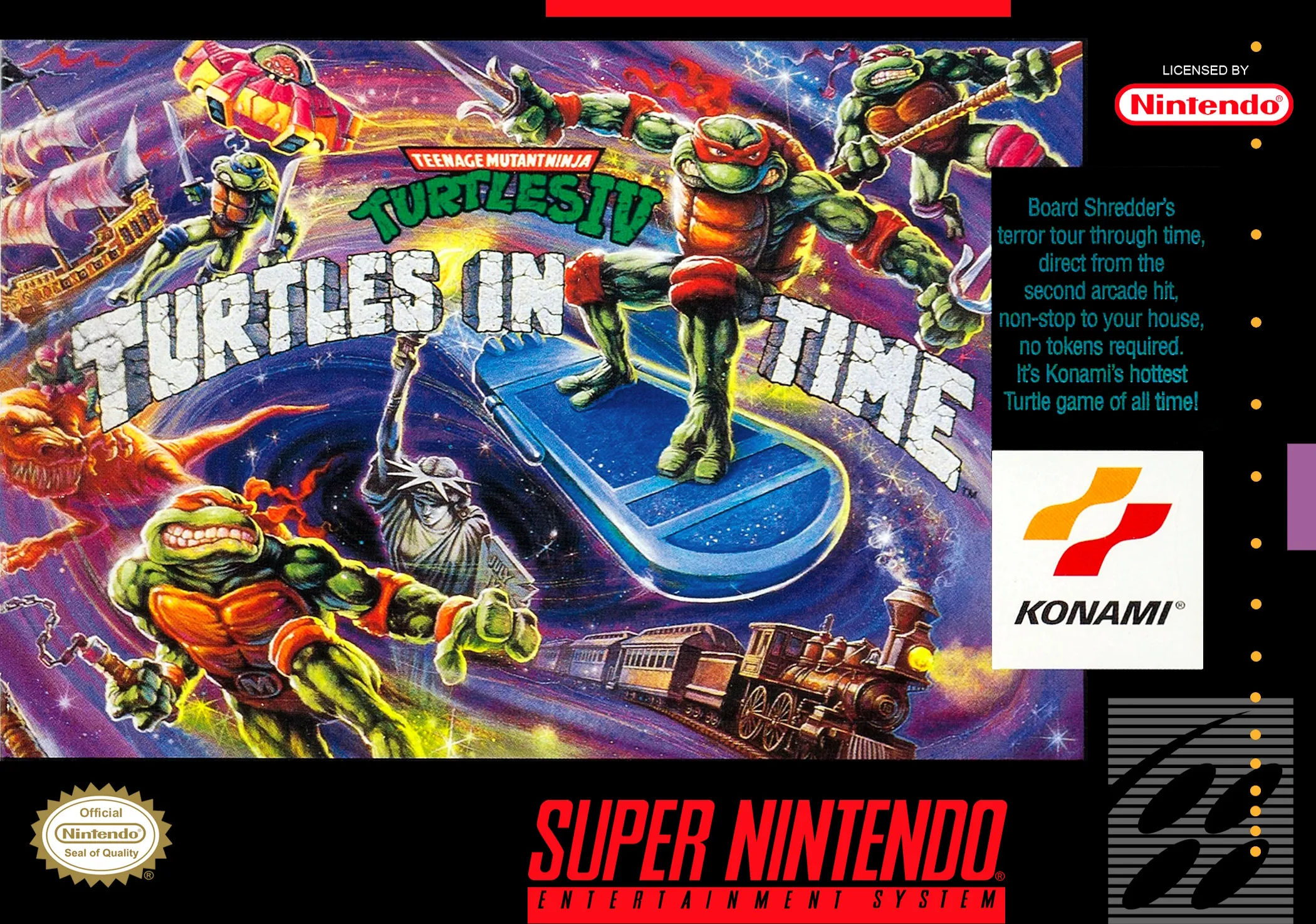
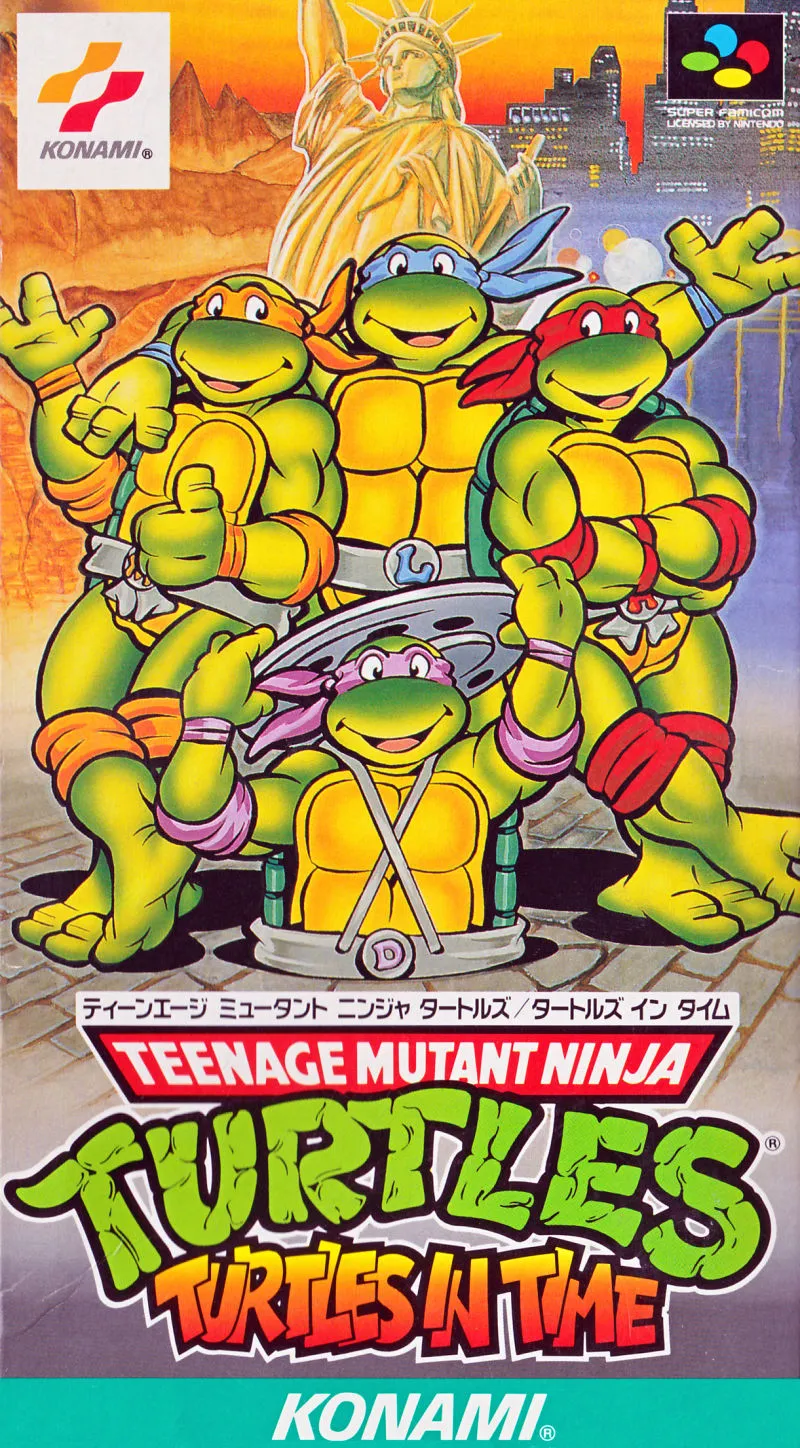
Two markets, one cart. Tom duBois’s American time vortex on the left — the spectacle the brand was sold on — and Konami Japan’s cartoon group portrait on the right, scaled to a kid’s bedroom shelf. The cover divergence maps onto the gap between EGM’s 36/40 and Famitsu’s 26/40. TMNT IV: Turtles in Time · Konami, 1992.
Izumi’s Score, Twice
Mutsuhiko Izumi scored both the 1989 Teenage Mutant Ninja Turtles arcade cabinet and the 1991 Turtles in Time arcade — the line’s sonic identity, fast funk-rock with his signature use of orchestral string samples over a syncopated bass, is one person’s signature. The SNES port hands the arrangement off to Kazuhiko Uehara and Harumi Ueko, both later prolific Konami composers, and the tracks that result are not a port of Izumi’s score so much as a translation: the same melodies, retuned for SPC-700 dynamics, looped differently for cartridge-length encounters.
The cabinet’s attract loop plays “Pizza Power,” a song from the 1990 Coming Out of Their Shells live tour album — Konami licensing the franchise’s strangest cross-media artefact for the cabinet floor. The SNES port drops it for a cartoon-style title sequence sung by no one. The cabinet sold itself to a 1991 walk-by; the cart sold itself to a kid’s living room. The cuts in the score map onto the cuts in the design.
What carries across is the funk. The Alleycat Blues theme on SNES is as much Uehara’s track as Izumi’s — the cartridge sound chip is doing things the cabinet’s Konami hardware could not — and the loop works inside a brawler’s much longer per-stage residency. Period reviewers split on whether the move was an upgrade or a thinning. The honest reading is translation: a soundtrack rebuilt for a different room.
What the Cart Could Not Keep
Praise for the redesign should not be praise for an even trade. The cart sheds two players. The cabinet’s social object — four uprights, four kids, the Friday-night choreography of a Foot Soldier going down to a hit none of the players threw — is not in the SNES port and could not be. The hardware caps at two-player simultaneous, and what the cart gains in replay arc, it loses in cabinet heat. The Cowabunga Collection’s 2023 patch put online co-op back into the SNES port thirty-one years late — a partial answer to a real loss, not a denial of it.
There is a real arcade-superiority case on sprite count and frame rate, too. The cabinet’s hardware is doing more on screen at any given moment than the SNES is — more Foot Soldiers spawning, smoother animation under load, sharper sprite work. A first-time player on Cowabunga who plays the arcade first and the cart second will see this clearly, and the right read is that the SNES port traded resolution for redesign. Konami’s home team could not match the cabinet’s spectacle. They built a different kind of object instead.
The cart is also short. Story mode runs about two hours; Time Trial and Versus are pleasant but light; the total package is ten levels and a long replay tail rather than a forty-hour cartridge. The difficulty curve asks for memorisation in the last two stages the way the rest of the game does not. None of this is a deal-breaker for a modern player on save states. None of it is invisible either. The redesign is what made the cart worth replaying. Without honestly naming what the redesign cost, the praise reads as advocacy.
The Cowabunga Collection ships both versions on the same release. The right way to test the case is to play the arcade once on free credits — twenty-five minutes, four turtles, a clinical trial of what the coin slot was actually selling — and then start Story Mode on the SNES side. The difference is the article. The cabinet is a contract; the cart is a campaign.