// import gadgetPoster from ”../../assets/images/perfect-dark-2000-gadget-work-poster.jpg”; // deleted
// import lateMissionPoster from ”../../assets/images/perfect-dark-2000-late-mission-poster.jpg”; // deleted
Perfect Dark always seems one feature away from breaking its own spine. A campaign with difficulty-specific objectives is not enough; it needs co-op. Co-op is not enough; it needs counter-op, where a second player becomes the guards trying to stop you. Deathmatch is not enough; it needs bots with temperaments, teams, commands, challenges, statistics, named profiles, weapon sets, unlocks, simulants who camp, simulants who avenge, simulants who punch because the rules allow them to be ridiculous. Rare did not make a sequel to GoldenEye 007 so much as a locked briefcase that refuses to close.
That is why the best way to meet it now is not the original cartridge. The cartridge matters. The cartridge is the miracle. But the Xbox remaster makes the design easier to read because it removes the machine’s panic from the argument. The frame rate steadies, the picture clears, and what remains is not simply a smoother Bond game with aliens. What remains is the strange, extravagant ambition of a studio trying to turn the console shooter into a spy-simulation toybox before the console shooter knew what it wanted to become.
Bond Left a Vacuum
Rare had every reason to make a safer game. GoldenEye 007 had turned a licensed film shooter into a living-room institution, but the Bond licence was gone, Martin Hollis left during development, and several key staff would soon form Free Radical Design. The obvious path would have been a serial-numbered spiritual successor: another suave operative, another set of silenced pistols, another bunker full of men waiting to fall over politely. Rare answered by making everything larger, stranger, and less elegant.
Joanna Dark is not written as an anti-Bond so much as the first employee in a new bureaucracy of spies. She wakes in the Carrington Institute, trains in its firing range and device labs, reads dossiers, tests weapons, and walks to a hangar as if espionage were a campus course. The fiction is trashy in exactly the right way: corporate war, alien envoys, presidential cloning, underwater conspiracies, a laptop that turns into a sentry gun. Yet the game keeps grounding that pulp in procedure. Your briefings change by difficulty. Objectives multiply. A mission that asks you to escape on Agent may ask you to photograph evidence, recover files, or protect an informant on Perfect Agent.
This is the first thing Perfect Dark does better than its reputation allows. The difficulty modes are not health sliders wearing a better suit. They are design commentary. On easier settings, a level sketches the fantasy. On harder settings, it reveals the job. A room that looked like a shooting gallery becomes a workplace with documents, routes, keys, alarms, witnesses, and consequences. The game does not merely ask whether you can survive. It asks whether you understood what you were sent to do.
The N64 Groans Back
The manual makes the scale of the bet plain before a player reaches the title screen. Without the Expansion Pak, it says, only “35% of game” is available: Combat Simulator challenges, one- or two-player multiplayer, and up to eight Simulants. With the extra memory installed, the cartridge unlocks the campaign, four-player multiplayer, co-op, counter-op, cutscene replay, hi-res mode, widescreen settings, and the rest of Rare’s machinery. The most interesting thing about that split is not that Perfect Dark needed the memory. It is that the fallback mode, the one left behind when the machine cannot run the full thing, is already more elaborate than many games’ main course.
”Every weapon that Joanna is able to pick up and use carries a Secondary Fire function.”
— Perfect Dark Nintendo 64 manual
That line reads like an inventory note until the game starts cashing it. Pistols pistol-whip. Rifles zoom, burst, suppress, cloak, scan, detonate, deploy. The Laptop Gun becomes a turret. The Dragon becomes a proximity mine. The FarSight sees through walls and turns the level into an assassination diagram. This is not weapon variety as shopping list. It is Rare’s whole design philosophy in one sentence: no object should do only one thing if it can smuggle a second game inside itself.
The cost is obvious. On original hardware the game often moves like it is thinking too hard. Enemies crowd a room and the frame rate slumps. Hi-res mode gives clarity with one hand and takes motion with the other. Four players with bots can feel like asking a polite kitchen appliance to simulate a small war. This matters because the design is about density. When the machine strains, you can mistake ambition for muddle. When the remaster steadies it, the same abundance looks more deliberate: each system pressing against the next until the level feels less like a hallway and more like a ruleset under stress.
Missions Have Teeth
The single-player campaign works because its best levels are built around pressure rather than flow. dataDyne’s tower narrows stealth into office geometry: lifts, vents, glass, guards, locked doors. Chicago spreads the same grammar into rain and neon, a block of city that feels improbably wide for an N64 shooter because the mission wants you to treat space as evidence. Area 51 turns infiltration into extraction, then panic, then escape. Air Force One converts a presidential aircraft into a moving stack of thresholds. Every level has someone else’s security logic inside it, and the player wins by learning where that logic bends.
The controls are old enough to require a small act of translation. The default N64 layout uses the stick for movement and turning, C-buttons for looking and strafing, and a held aim mode when you want precision. It is not modern dual-stick fluency, and the Xbox version’s right stick makes the body feel more natural. But the old stiffness gives the missions a particular weight. You do not glide through rooms. You commit. Turning, aiming, ducking, and opening a door each feel like decisions made by hands rather than by camera grammar. The friction slows the fantasy down until it becomes tactical.
That is why Perfect Dark survives its pulp. The plot keeps escalating toward aliens and ancient wars, but the player’s attention lives at door height. Is the guard facing away? Is the alarm panel close enough to reach? Can the CamSpy slip through that gap? Do you burn ammunition now or switch to a slower secondary function because the next corridor may be worse? A modern shooter often protects the player’s rhythm; Perfect Dark keeps interrupting it with work.
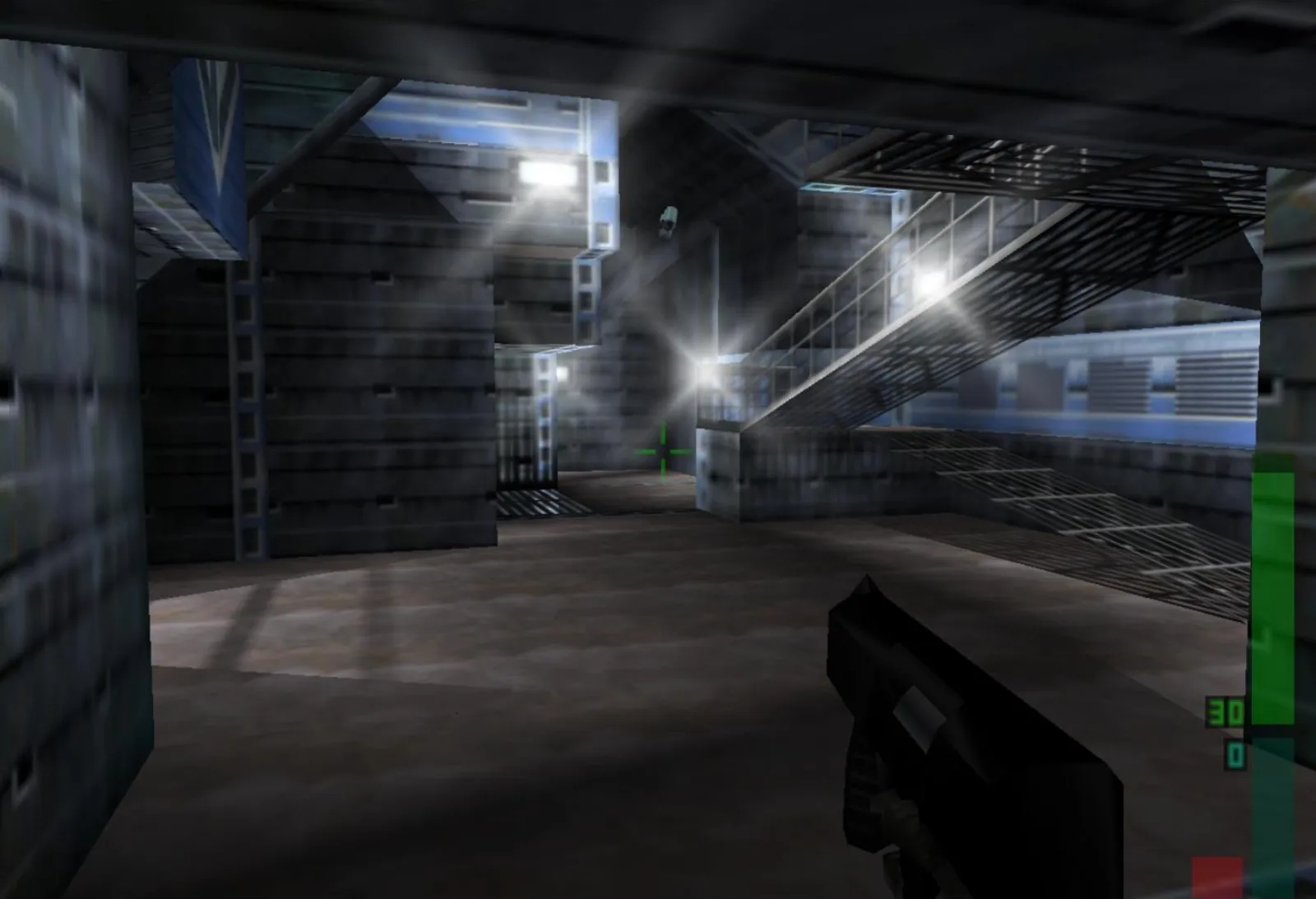
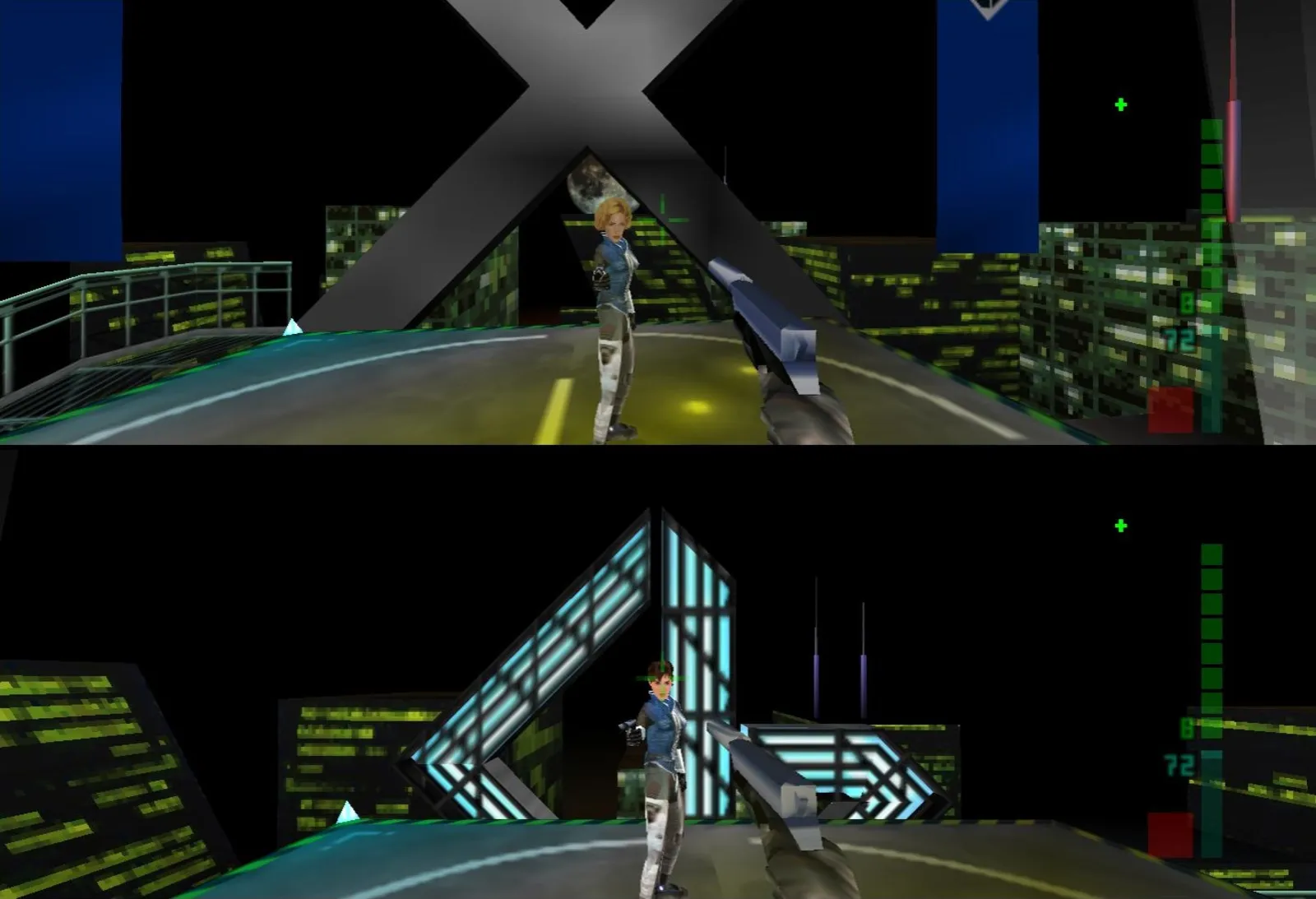
The range of spaces is the point: polished corporate interiors on one side, social shooter rooftops on the other. Perfect Dark · Rare / Nintendo, 2000. Screenshots: LaunchBox Games Database.
The Sound of Overload
The soundtrack understands the same pressure. Grant Kirkhope, Graeme Norgate, and David Clynick do not write spy music as cool swagger. They write it as anxious machinery. The opening dataDyne tracks clatter with compressed drums and cold synth bass, then open just enough brass to remind you of Bond before pushing him out of the room. Carrington Institute is warmer, almost safe, with a training-room pulse that says competence can be rehearsed. Chicago lets its noir surfaces sweat. Area 51 brings in the kind of alien shimmer that turns a military base into a sealed aquarium.
The score is doing a difficult job because the cartridge is already full of speech, gunfire, alarms, and interface noise. It cannot simply sit above the action. It has to thread through the game without making the sensory overload unbearable. At its best, it gives the levels a second tempo: the music suggests elegance while the player’s hands are making a mess. That contradiction is perfect for Joanna. She is the best agent the Institute has produced, but the player is usually peeking around a door with a pistol, two objectives unfinished, and a guard about to radio in the mistake.
There is also a lonely future in the sound. Perfect Dark is packed with modes, but its campaign rarely feels sociable. It feels metallic, nocturnal, sealed. The songs are full of movement without warmth: basslines running down corridors, synth pads hanging over empty hangars, percussion that turns a warehouse into a nervous system. The game is not cyberpunk in the literary sense, exactly, but the music gives it that mood of bodies inside institutions too large to understand.
The Toybox Was the Thesis
The Combat Simulator is where Rare’s excess stops pretending to serve the campaign and becomes the argument outright. You can build a match out of humans and Simulants, assign teams, choose personalities, issue commands, chase preset challenges, unlock arenas, and treat the whole thing like a laboratory for social violence. The manual devotes pages to it because it has to. The mode is not an extra. It is Perfect Dark admitting what it really wants to be: a configurable shooter machine.
Counter-op is the sharpest expression of that idea. One player runs the mission as Joanna. The other player inhabits guards, dies, respawns into another body, and keeps throwing the level’s immune system at her. It is asymmetrical multiplayer before the word became a store-page category, and it changes how the campaign reads. Suddenly every anonymous guard has a future, a perspective, a possible human hand behind it. Rare turns level fodder into a second player and makes the single-player mission porous from the other side.
That is the reason the Xbox remaster earns its place as the recommendation. It does not solve every age mark, and it should not. The voice acting remains gloriously stiff. The alien conspiracy still leaps from espionage to Saturday-night nonsense with a straight face. The levels can be brusque, the objectives sometimes underexplained, the stealth more brittle than a player raised on later immersive sims may expect. But the remaster lets the underlying generosity come forward. It shows a studio spending its GoldenEye capital not on polish alone, but on possibility.
So Perfect Dark is not most valuable as a historical milestone or as a pub argument about which N64 shooter wins. It is valuable because it gives a modern player a kind of abundance that large shooters rarely risk now. Not content volume. Systemic abundance. Secondary functions. Strange modes. Difficulty as design. Multiplayer as workshop. Gadgets as verbs. A cartridge that seems to keep opening, long after the obvious latch has clicked.