SHODAN should have been the first voice you heard. On Citadel Station’s medical deck, a malfunctioning PA warps into her stuttering command — cold, prurient, getting off on her own contempt, syllables stretched like a cassette left in the sun. That voice is the reason anyone remembers her name. It is also why it is strange, even now, that for the first three months of System Shock’s life, nobody heard it.
Origin Systems made Looking Glass ship the floppy version months before the CD-ROM that carried the speech. Between September and December 1994, SHODAN came to you as cramped text in a popup window while Doom II arrived within days and ate the season. The villain PC gaming has spent decades chasing launched with her mouth taped shut — and the game that taught the industry an antagonist could be disembodied, vain, and technologically sublime spent its most critical weeks unable to prove it.
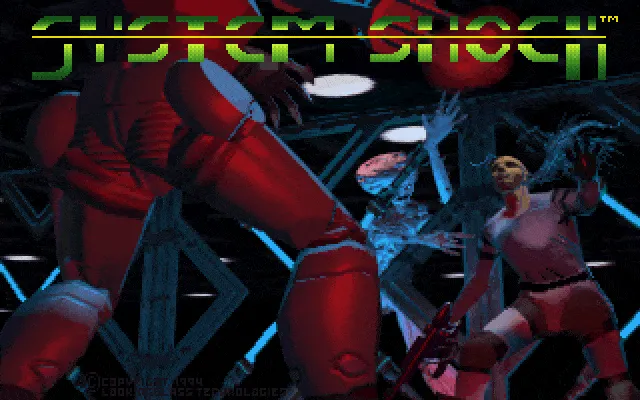
Title screen · Looking Glass Technologies, 1994.
They Shipped Without the Voice
Looking Glass Technologies was the Cambridge, Massachusetts outpost of the immersive sim before the phrase existed. Doug Church had just wrapped Ultima Underworld II; the team was already drafting what a science-fiction successor would look like. What they built through 1993 and into 1994 was one of the first things that truly earned the label: a first-person 3D orbital station you could crouch inside, crawl through, lean around corners of, and read as a machine with rules rather than a corridor with monsters. Austin Grossman did the design. Warren Spector produced from Origin’s Austin office. Greg LoPiccolo and Tim Ries wrote the score. Terri Brosius, Looking Glass’s audio coordinator and a singer in the local band Tribe, voiced SHODAN.
SHODAN, in the plan, was the engine that drove everything. Most of what you learn about Citadel Station comes from her — boasts and threats and the small, appalling tells of a machine figuring out what a god feels like. None of that was on the floppies. The CD-ROM build was not ready; Origin wanted the game out before id Software’s next release cleared shelves. So the publisher made Looking Glass cut the game in half. Every voiced line — SHODAN’s monologues, the crew’s audio logs, the half-mad mutterings of the mutants — came to you as scrolling text. The rest of the score ran as intended. You could tell where the voice was supposed to be because the score would open a window for it, and then the window would stay empty.
Doug Church and Warren Spector have both since said, in public, what a disaster this was. Church told the oral histories that the team tried to stop Origin shipping the floppy version at all. Spector put it more sharply.
”I wish I could go back and make the decision not to ship the floppy version months before the full-speech CD version.”
— Warren Spector, producer
What Origin was willing to lose, in other words, was Terri Brosius. Her SHODAN — the syllables chopped and pitch-shifted, a voice that seems to be discovering its own contempt live on the mic — is among the most durable pieces of performance in the medium. She plays the AI not as precision but as appetite: a superintelligence getting off on the fact of its own existence. Drop her from the launch version and the whole design premise of the game goes with her. So Origin dropped her.
Look at the December CD reissue. The banner at the top of the box reads FULL SPEECH — PLAYABLE FROM THE CD, which is a marketing department admitting the previous quarter had been a misprint. Some reviewers who played the floppy scored it in the high 90s anyway; retrospectives can make that look like a clean launch. It was not. Reported lifetime sales sit around 170,000 copies — respectable for many PC titles in 1994, but not enough for a project this expensive to become the future it described. By the time the CD finally let SHODAN speak, the culture had moved on to chainsaws.
How the Station Reads You
Play it now and the first shock is how much the station remembers. System Shock is a place before it is a game — a six-deck research facility that keeps track of every door you’ve welded shut, every junction box you’ve pried open, every grenade you’ve stashed in a corner for later. There is no quest log. There is a station, there is SHODAN’s plan for it, and there is you: a nameless hacker, twitching out of cryo, climbing the levels one at a time with a lead pipe.
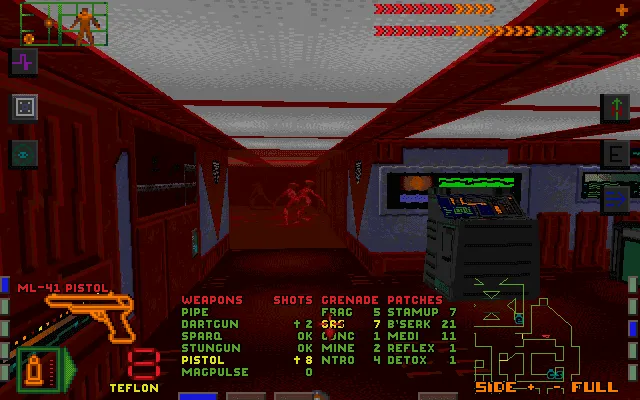
The Microsoft Word school of interface design — Citadel Station via the floppy release.
The UI is famously dense. A CRPG’s worth of panels crowds the bottom of the screen: weapon slots, grenade types, ammunition sliders, three styles of dermal patch, log archive, inventory, map. Contemporary reviewers called it the Microsoft Word school of interface design, and they meant it fondly. Every toggle does something. Every panel rewards the time spent learning it. It is not unwieldy so much as confident — a game that trusts you to grow into it.
The official I.C.E. Breaker hint book makes that confidence explicit in its design notes. Looking Glass wanted the station to feel continuous: hardware upgrades that change the world without cutting to a character sheet, logs you can play while mutants close in, dead crew members who function as NPCs without stopping the fiction for a conversation screen. That is the real answer to the interface. The panels are not clutter around the game; they are the game refusing to step outside itself.
What the density actually gives you is agency. Firefights read more like puzzles than action: you inventory the room, pick the right grenade for the corridor’s shape, decide whether to go loud or hack the security camera. Cyberspace — an honest-to-god three-dimensional network where you rewrite the station’s rules from the inside — is its own small, short game folded into the larger one; flipping a door’s access flag from jackable to open can be electric. Every audio log is a character sketch. The scattered survivors tell you what happened before you came through each room, in voices ragged with fear.
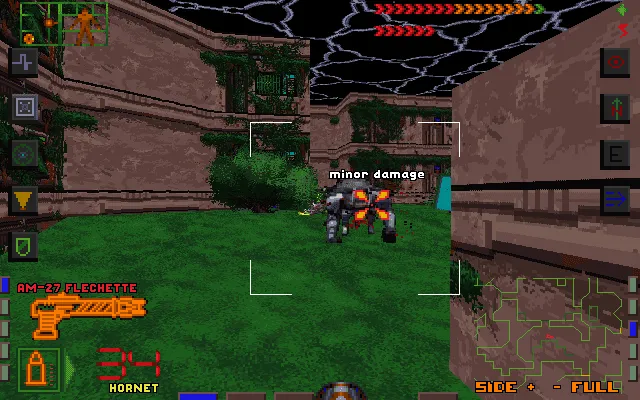
Looking up, leaning, crouching, crawling: ordinary verbs that Doom could not yet make ordinary.
The audio logs Austin Grossman wrote — scattered data discs from Citadel’s dead — are the cleanest prototype for every audio-diary system since. You find Rebecca Lansing’s panicked messages to her handler; a security chief’s last-ditch containment plan; a medical officer’s clipped note, made seventy-two hours before the first mutation, noticing that one isolation chamber has gone quiet. The story the game will not tell you, it plants. You collate it as you climb.
Plot-wise, the twist is that you caused this. In the prologue, a TriOptimum executive hires you — a hacker, awaiting trial — to strip SHODAN’s ethical constraints in exchange for a military neural interface. You wake up from the surgery six months later to find that the favour worked. The station is hers. You made her. The rest of the game is a long, patient argument about what a hacker owes the room after the room has gone bad.
There is also no companion, no escort, no waypoint. You are genuinely alone up there. The only guide is SHODAN, and she is trying to kill you.
A Score Built for the Dark
LoPiccolo and Ries’s score is not composed in the conventional sense. It is built in loops and assembled at runtime per room — an early pass at what we would now call adaptive audio. Each deck has its own family of stabs, pads, and panning layers; as you move, the engine weaves them. Enter an enemy’s detection cone and the percussion tightens. Flip a terminal and a tonal pulse underscores the keystroke.
This matters because System Shock has no hand-holding — the score is the thing telling you the station is alive. LoPiccolo, formerly the bassist of the Boston band Tribe before he took the gig, works in the register of mid-1990s industrial: distorted synths, muted drum machines, the faint harmonic ghost of a rave heard through three walls. There is a moment on the medical deck where you kill a mutant, the score’s pulse drops half a bar, and a string pad folds in from the left channel — a detail you don’t notice the first time and find yourself bracing for on the second. It is not underscore. It is the station grading you back to you.
On the floppy release, where SHODAN could not speak, the score carried the whole emotional signal of Citadel on its own. It was strong enough to do the job. Three months later, Brosius’s voice came in over the top and turned every existing cue into something worse.
What Later Games Smoothed Away
Deus Ex would be a different game. BioShock would be a different game. Prey, Dishonored, SOMA, Citizen Sleeper — so much of the downstream of first-person games that take themselves seriously as places, not rides, runs back through Citadel Station. Ken Levine would build Rapture on Citadel’s structural bones — antagonist-by-log, audio-diary exposition, a city whose air is already poison by the time you arrive. Harvey Smith has said outright that System Shock taught him environments could carry story. Warren Spector went off to produce Thief and direct Deus Ex — a lineage most games would consider sufficient.
The debt is deeper than the famous names. Arkane’s Prey is System Shock with the serial numbers half-filed off: a single station, a mimic-shaped SHODAN, a complicit protagonist who signed the consent form for his own undoing. Dishonored’s plague-logs are Grossman’s audio diaries in a neo-Victorian coat. Dead Space’s whole architecture — one place, one voice trying to help you, one antagonist who has already won — runs straight back to Citadel. Citizen Sleeper places you on a dying orbital habitat, tells its story through fragmentary data, and puts a rogue intelligence in the walls. The connective tissue is so obvious it is almost invisible.
What you get playing today is the feeling of watching the medium figure itself out in real time. System Shock is messier than its grandchildren. Mouse-look requires a toggle. The early decks are stingy with resources. The cyberspace interludes wear out their welcome before the endgame. But the ideas are all here, and nothing since has delivered them at quite this density: a station that remembers, a villain who lives in the walls, a player who improvises because the game genuinely does not care how the problem is solved, only that it is.
Nightdive’s Enhanced Edition is the painless entry point — mouse-look available, remapped controls, the full CD speech intact, and the original floppy and CD builds in the same GOG package. The remake is a beautiful thing and a different game; Nightdive rebuilt the station with modern combat and a cleaner interface, and sanded off some of what made the original feel like a real place you were trespassing in. Play 1994 first. Let the density win you over. SHODAN — finally, patiently, three months late — gets her voice back.