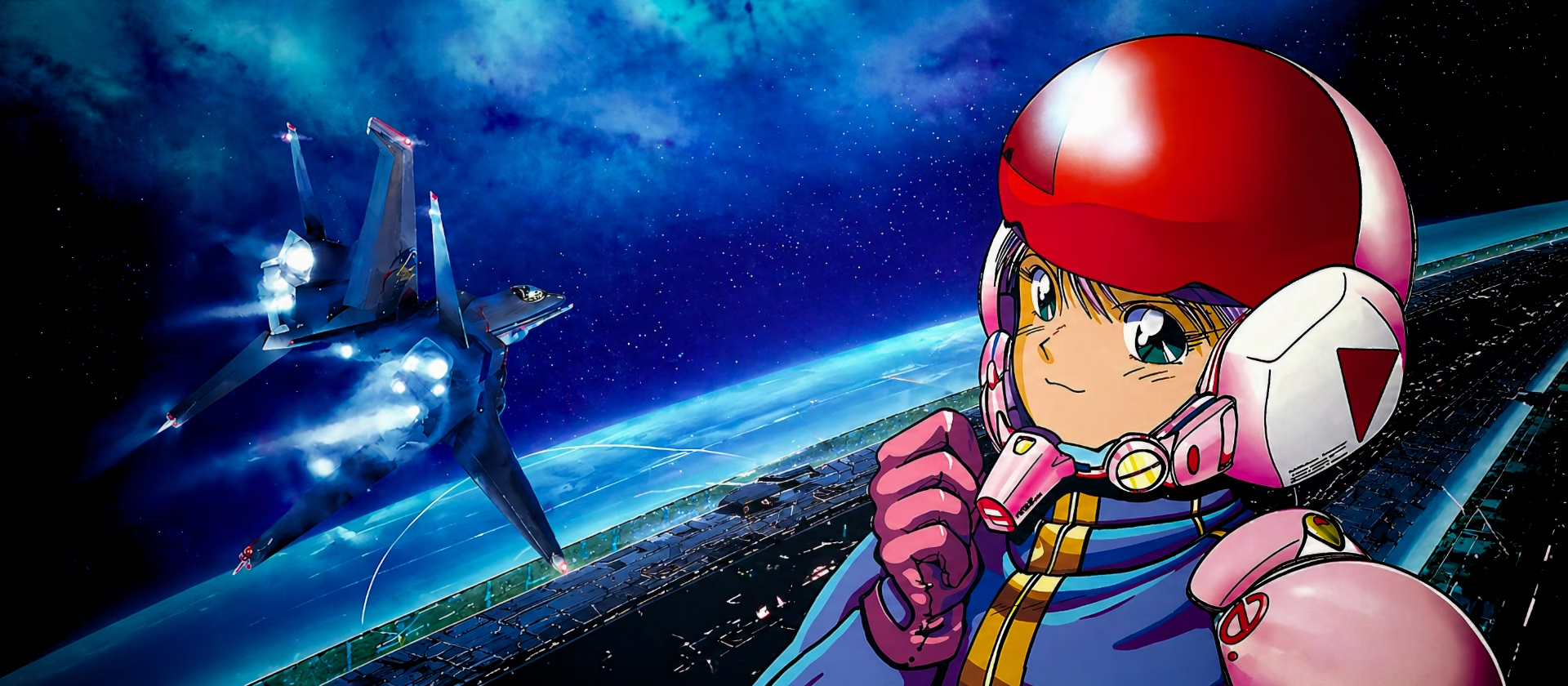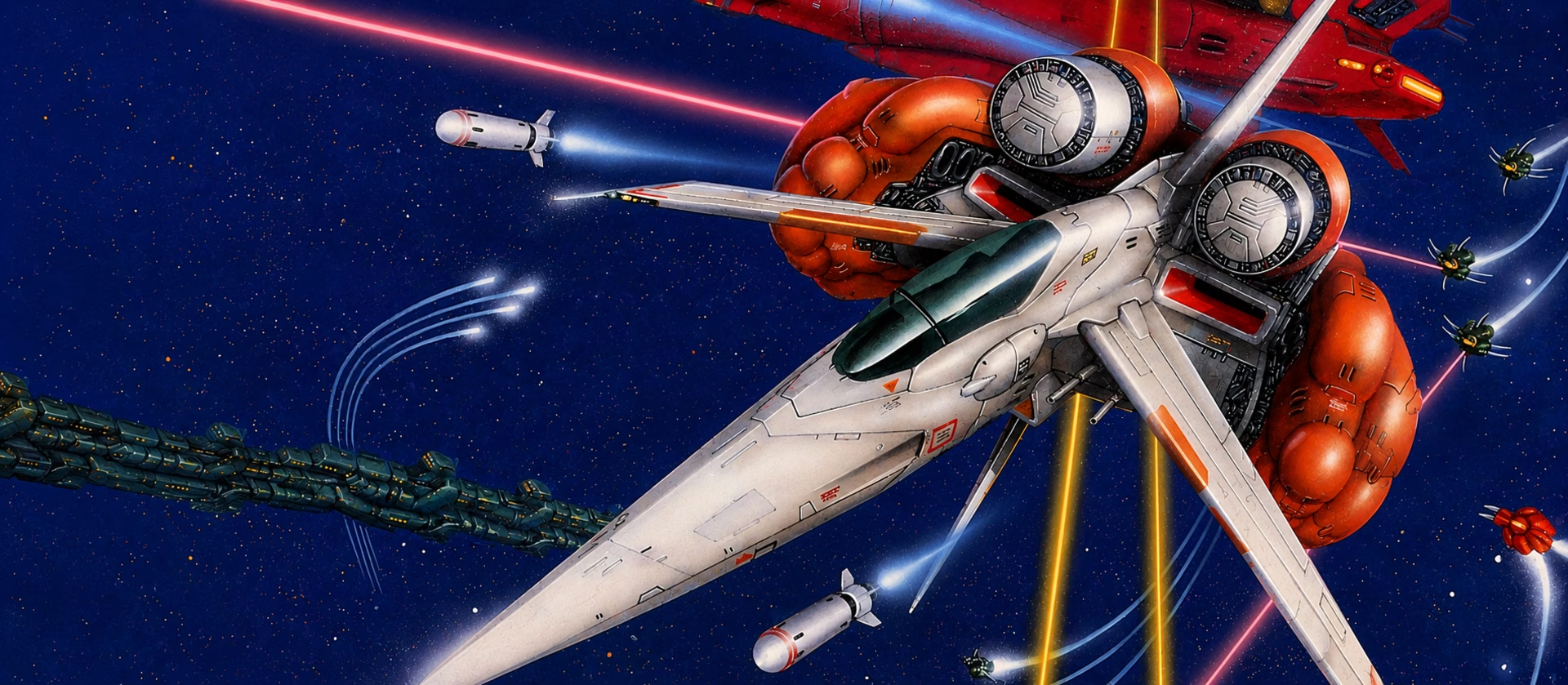
Axelay looks like a brag, and that is the trap. The first stage bends an ocean of clouds under the nose of the ship, fakes height with a vertigo trick the SNES was born to perform, then asks the player to keep shooting while their eyes are still trying to understand the floor. It is easy to mistake that for the whole argument: Konami arrives, shakes the hardware, and proves Nintendo’s machine can host a prestige shooter.
The better reason to play is quieter and meaner. Axelay treats damage as a change in vocabulary. Before each stage you choose three weapons from a growing hangar, one assigned to each button. When a shot connects, the game does not simply pluck a life away and send you back to the start of the sentence. It breaks the weapon currently in use. The ship survives, but the hand that was speaking fluently a second ago now has to find another verb.
That one decision makes a very pretty shooter feel newly legible. A modern player does not need the thrill of discovering parallax, scaling, or pseudo-3D trickery to feel the pressure. The pleasure sits in the moment after a mistake, when the Round Vulcan is gone and the Needle Cracker becomes a desperate second language.
The Brag Is Real
Konami knew exactly how to sell the surface. The North American advertisement practically stands on a table: “For a game with so many brilliant colors, it also looks good in black and white.” The copy beneath it promises a high-speed Super NES ride through “spectrum shattering special 3-D effects,” then keeps naming sights as if the cartridge were a tourism brochure for disaster: fortresses, mobile forts, robot cities, volcanoes, the City of Darkness.
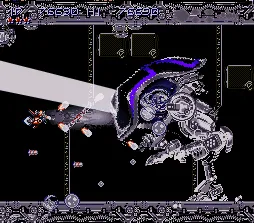
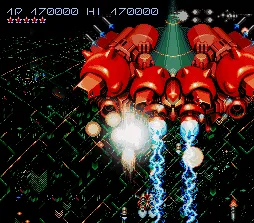
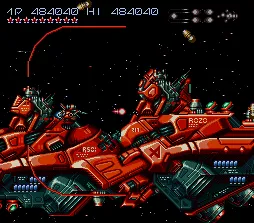
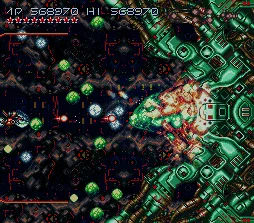
It was not lying. The vertical stages are not flat overhead shooting fields so much as rolling carpets of threat, with the world widening at the top of the screen and pinching toward the ship. Enemies loom out of the apparent distance, bullets thicken as they approach, and the player’s own craft sits at the near edge of a funnel. The horizontal stages switch grammar completely: chunky industrial corridors, ribbed metal, machinery that looks too heavy to be scrolling at all.
This alternation is not a gimmick. It gives Axelay two rhythms without making it feel like two separate games. The vertical stages ask the player to judge perspective, to fire into an image that is constantly swelling toward them. The horizontal stages ask for corridor discipline: height, lane, timing, the small correction that keeps a wingtip out of a wall or bullet stream. Konami built a shooter that changes posture every stage, then bound those postures to the same fragile loadout.
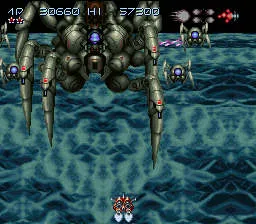
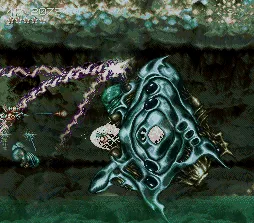
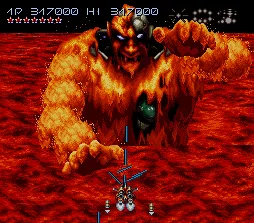
The bosses understand that trick as theatre. They enter like objects too large for the cartridge, then settle into readable patterns: a glowing weak point, a limb that telegraphs its sweep, a cannon that forces the player away from the comfortable centreline. The important thing is not that they look enormous, though they do. It is that they turn the visual boast into a demand on the hand. Scale becomes route planning. Perspective becomes risk.
Damage Changes The Sentence
The setup screen is where Axelay becomes more than spectacle. You do not collect a power-up ladder and hope to keep it. You choose a kit: a forward weapon, a spread, a back-covering shot, a laser, a needle burst, a vulcan that can sweep through a full circle. The stage begins with a thesis about how you intend to survive it.
Then the game edits you.
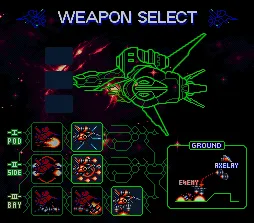
The argument begins before the stage does. Axelay makes the player choose a grammar, then damages it one weapon at a time. Axelay · Konami, 1992.
Most shooters punish failure by collapsing the player back to poverty. Lose the powered state, lose the speed, lose the tools, then crawl through the same pattern with a weaker ship. Axelay does something more interesting. A hit disables the active weapon, so the penalty is specific. If you were leaning on the weapon that made a section comfortable, comfort disappears. If you were smart enough to rotate through the arsenal before impact, you may lose a secondary plan instead of the whole run.
That difference matters because the game keeps asking for different kinds of sight. A vertical boss may demand sweeping fire across a warped approach. A horizontal corridor may make rear coverage suddenly valuable. A small popcorn enemy may be harmless until the weapon that was meant to erase it has been burnt out by an earlier mistake. Recovery becomes tactical rather than theatrical. The player is not simply weakened; the player’s habits are exposed.
This is why the game has teeth without feeling cruel. Its difficulty is not only memorisation, though memorisation helps. It is a test of whether you understand why each weapon is in the kit. A bad player clings. A better player rotates before panic. A very good player learns to think of damage as a resource risk: which button can I afford to lose here?
Konami’s Ghost Crew
There is no neat Axelay making-of story waiting in the usual places, no warm oral history where a designer explains the weapon system in a paragraph built for citation. What exists is more oblique and maybe more revealing: the trail of people leaving Konami immediately afterward. In a 1993 GameFan interview, Treasure president Masato Maegawa described the new studio’s staff as mostly ex-Konami and named previous work that included Castlevania IV, Contra III, and Axelay for Super Famicom.
”Almost everyone is from Konami.”
Masato Maegawa, GameFan, 1993
That does not make Axelay a Treasure game. It does make it part of the same late-Konami weather system that produced developers who wanted motion, risk, and excess to feel authored rather than merely expensive. Maegawa’s complaint about Konami was not that the company lacked talent; it was that a large publisher could make freedom feel scarce. “You cannot create games freely,” he told GameFan, explaining why he left.
Look back at Axelay through that crack and its contradictions sharpen. This is a lavish first-party-style showcase from a corporate powerhouse, but it behaves like a designer’s object. The weapon breakage is too odd to be a marketing feature. The vertical-stage distortion is too aggressive to be merely tasteful. The six-stage length is arcade-brisk, but the loadout gives each run a private argument. It feels like Konami’s production muscle wrapped around a restless design temperament, one already leaning toward the maximalist action games that would follow elsewhere.
The manual, charmingly blunt, frames the ship as a prototype strapped with eight weapons against the Armada of Annihilation. The ad calls it a “stratafighter.” The fiction is thin, but the language tells you what Konami thought it was selling: arsenal, speed, shock. The interesting part is that the final game makes arsenal fragile. It sells power, then designs around power failing.
Taro Kudo Burns The Sky
Taro Kudo’s score understands the same contradiction. The first stage theme, “Unkai,” does not simply pump the player forward; it glides, opens, and keeps a strange brightness under the battle. The SNES sound chip can become woolly in lesser hands, but Kudo gives Axelay hard edges: metallic bass pulses, lead lines that flash like tracer fire, percussion that suggests machinery tightening under heat.
The horizontal stages exchange cloud-show spectacle for weight: huge machinery, narrow openings, and weapons that suddenly need to cover depth instead of distance. Axelay · Konami, 1992.
The soundtrack also helps the stage alternation feel coherent. “Colony” pushes harder and darker, all forward drive and pressure, while “Silence” lets the game breathe without losing unease. The VGMPF credits list Kudo across most of the soundtrack, with Akira Souji on the ending and Masanori Adachi remixing stage two. That distribution fits what the ear hears: one main temperament, then small changes of emphasis as the game moves from sky to steel to biology to flame.
Music matters in a shooter because the player repeats failure inside it. A weak track becomes wallpaper, or worse, punishment. Axelay gives each stage a pulse sturdy enough to survive practice. When a weapon breaks and the run gets ugly, the music does not underline defeat. It keeps the ship moving, as if adaptation were the expected state of play.
That is the whole game in miniature. The visuals announce confidence; the systems admit vulnerability. The ship is over-armed and under-protected. The player is invited to feel powerful, then forced to discover whether that power was understanding or habit.
Axelay is not the deepest shooter on the SNES, nor the cleanest, nor the one with the most generous route into the present. Its official digital life is stranded on Wii U, and original cartridges now ask collector money for a half-hour game. But as a piece of playable design, it has a rare modern clarity. It gives mistakes shape. It makes recovery expressive. It understands that a shooter becomes more interesting when damage does not merely ask whether you can continue, but who you become when your favourite tool is gone.


The ending is almost quaint beside the machinery that precedes it: peace restored, medal awarded, the broken ship’s improvisations folded back into ceremony. Axelay · Konami, 1992.