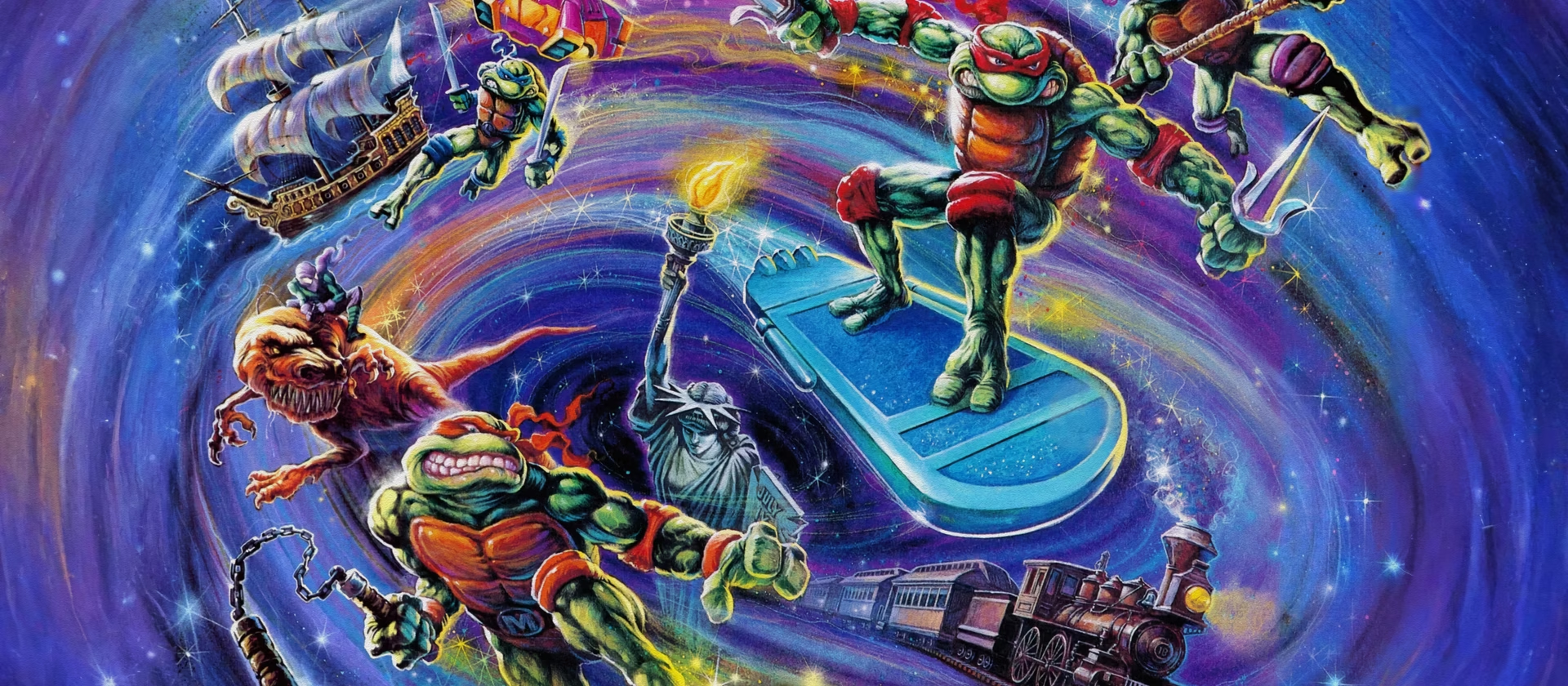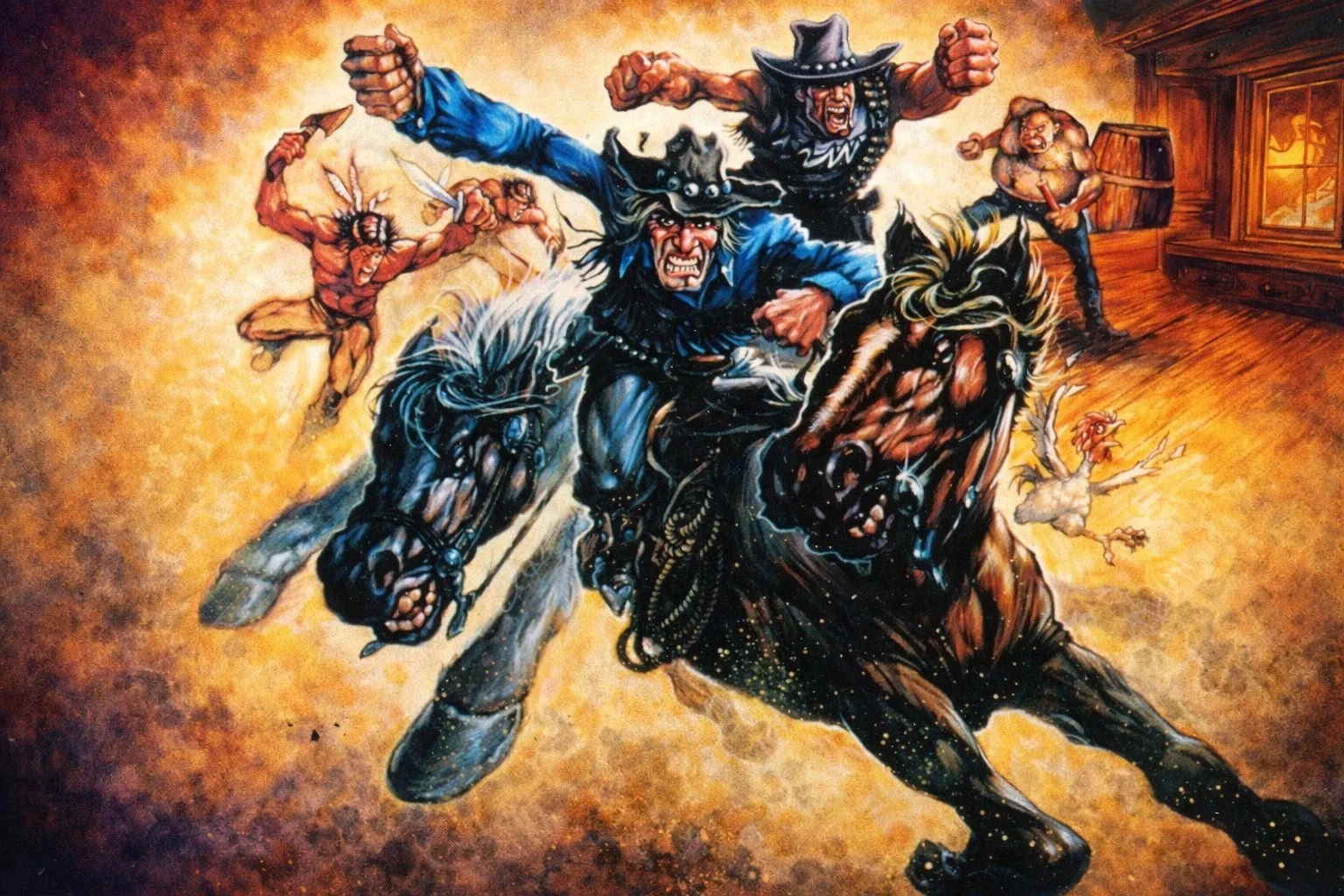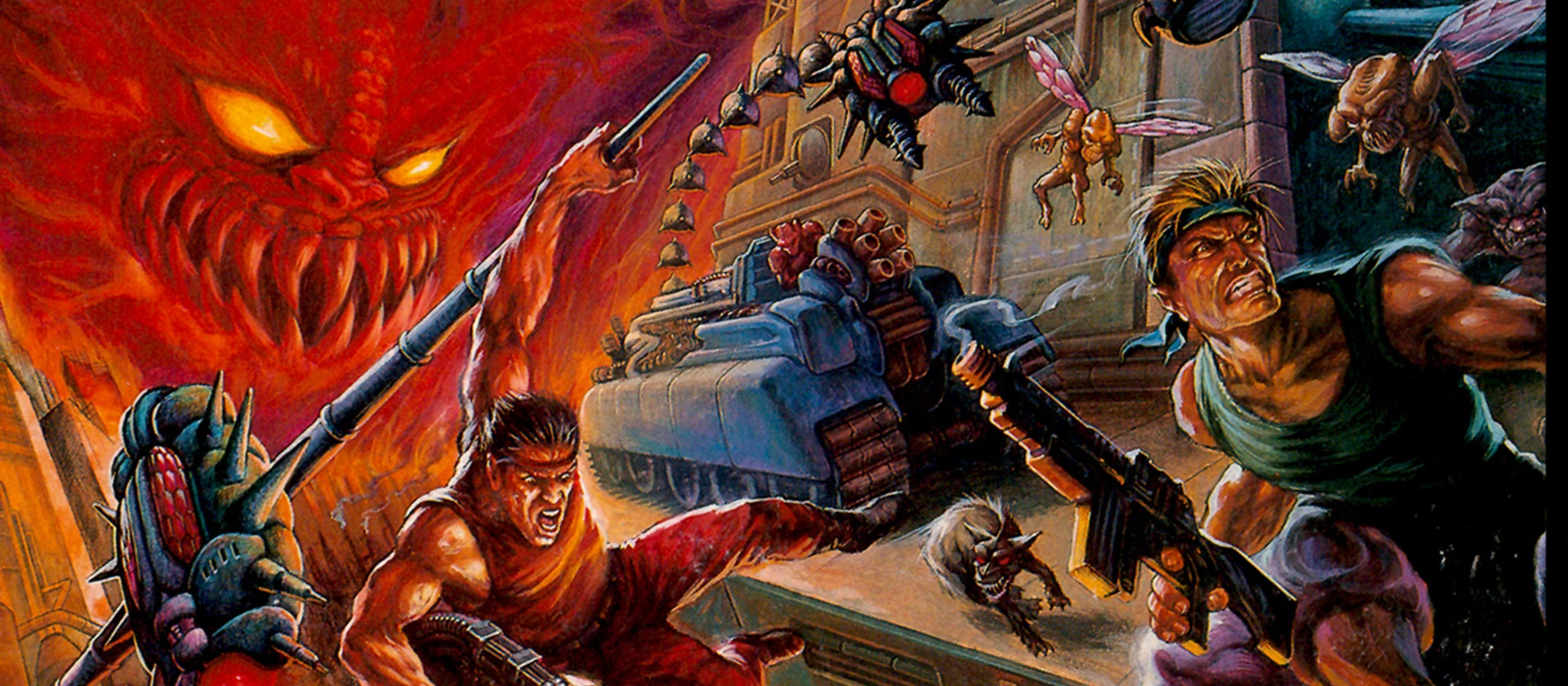
Konami’s signature for fifteen years had been the arcade brawler. Crime Fighters in 1989. TMNT the same year. Sunset Riders and The Simpsons alongside X-Men, Vendetta, Bucky O’Hare, and Mystic Warriors — the four-player upright was the studio’s dominant verb, and the cabinet floor was where its house style landed first. So when, sometime in 1989, Konami’s Masaaki Kukino tried to license Tim Burton’s Batman for the arcades, the play looked routine. Then Atari Games walked in with the licence already signed.
Four years later Konami got the sequel as a consolation, but the prize came on a different format. Warner Bros. attached the home-console rights for Batman Returns without any arcade rider, and Konami’s coin-op division had no way in. The licence went to a SNES action team whose director hadn’t been near the cabinet brawler floor — Rush’n Attack, Life Force, Kid Dracula. What Yoichi Yoshimoto’s group did with it was build the studio’s first SNES-native side-scrolling brawler: a deeper moveset than any Konami arcade brawler shipped, four difficulty tiers built for replay, and Burton’s snowed-in Gotham as cover for art-direction risks a Konami-IP project couldn’t have justified. It’s the volume’s outlier, and the one Konami brawler whose closest peers are Final Fight and Streets of Rage 2, not TMNT IV.
Atari Took the Arcade Floor
The pattern Konami had built across the 80s into the early 90s was simple: cabinet first, cart later. TMNT hit arcades in 1989 and reached home consoles as conversions; Sunset Riders was a 1991 cabinet whose SNES port arrived two years afterward. Every brawler in the studio’s published catalogue started on coin-op hardware Konami designed and ended up as a home conversion supervised by a different team. The cabinet was where the studio’s most distinctive design vocabulary lived: the four-player upright, the syncopated boss telegraphs, the wow-beat thrown toward the camera.
In 1989, Konami artist and designer Masaaki Kukino was looking at the post-Batman licence boom and reached the conclusion every Western publisher reached: a Burton-noir beat-em-up in arcades would sell. Three decades later he told Time Extension what happened.
”I was at one point planning to license Tim Burton’s Batman for the Arcades. I couldn’t do it though because other companies got in the way.”
— Masaaki Kukino, ex-Konami artist and designer
The blocking party was Atari Games. Their Batman arcade cabinet shipped in 1990 — also a brawler, also licensed from the 1989 film — and the exclusivity locked Konami’s coin-op division out for the duration of the film’s commercial life. When Batman Returns opened in 1992 and the next round of licensing began, Warner Bros. split the deal: home rights one way, arcade rights another. Konami took the home half and Atari kept the arcade slot. Three carts came out of Konami’s share — SNES, NES, and Game Boy, three different teams, three different games.
The SNES Team Konami Picked
The director Konami handed Batman Returns SNES to was Yoichi Yoshimoto. His credits before 1993 were not arcade-brawler credits. He’d directed Rush’n Attack in 1985 and Life Force the year after, designed Top Gun: The Second Mission and Jackal late in the decade, and most recently planned Akumajō Special: Boku Dracula-kun — the Famicom comedy spin-off in the Castlevania universe, the deliberately wrong-footed one with the cartoon vampire as protagonist. None of those games are brawlers. None of them are arcade ports. The closest thing in the lineup was Monster in My Pocket for the NES, also single-player. Yoshimoto’s design lineage was Konami’s home-console action track, the parallel pipeline running alongside the cabinet brawler unit but rarely touching it.
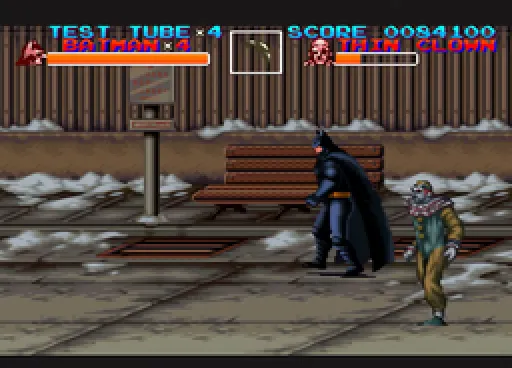
First-stage approach. Yoshimoto’s group designed the encounter pacing without a cabinet template to honour — the player has time to read the enemy before engaging, which a Konami coin-op brawler would never give you. Batman Returns · Konami / SNES, 1993.
The team around him was equally non-cabinet. Tae Yabu and Tetsuya Sato shared the design credit; Etsunobu Ebisu, Toshinori Shimono, and Shigeki Morihira programmed. The “producer” credit reads Team Yoshimoto Entertainment — one of the house-alias labels Konami used in this era, the same convention that gave the SNES Turtles in Time a “Yorozuya Juggling Group” credit. What stayed continuous with the arcade brawler line was the sound: Kazuhiko Uehara and Harumi Ueko, both still arranging Mutsuhiko Izumi’s compositions for TMNT IV the same year, joined by Jun Funahashi for the SPC-700 translations of Danny Elfman’s film score.
The asymmetry matters. Most Konami SNES brawlers of the era — TMNT IV, the SNES conversion of Sunset Riders — were home translations of cabinet designs by teams who’d inherited the arcade source. Batman Returns SNES had no cabinet source to inherit. Yoshimoto’s group designed the entire game without reference to a coin-op original, and the design decisions show the absence: more verbs, deeper difficulty curves, a replay structure tuned to a kid’s living room rather than a Friday-night high-school clientele.
A Moveset Built for Drilling
The clearest single signal is the input list. Crime Fighters, Vendetta, Sunset Riders, TMNT IV — Konami’s arcade brawler line gives the player a punch button, a jump button, and sometimes a one-tap special on a third button. Combos exist but the menu is short, because the coin slot needs the player to die in three minutes. Batman Returns SNES doubles it. Batman punches, kicks, chains into a high kick on the third hit, jump-kicks, dive-kicks, grabs and throws forward, throws toward the background, picks up two grabbed enemies and smashes their skulls together in a two-handed crowd-clear, blocks with the shoulder buttons — a verb no Konami arcade brawler of the era carries — twirls his cape to clear circling foes at the cost of his own health, throws infinite batarangs in standard stages, swings on the grappling hook, and detonates one of three test-tube bombs per stage when the boss runs cold.
The point isn’t the menu of moves; the point is the economics. None of those verbs reward a coin-feed. Half of them — the block, the cape, the test tubes — only matter if you’re trying to clear the game without dying, which is the structure of a cartridge play session, not a cabinet quarter. Above NORMAL difficulty the cart asks you to lead with the batarang rather than the fist, which is closer to a Japanese fan strategy guide’s reading of the combat loop than to the western “Final Fight–style brawler” framing the cart’s reception settled on. The game also ships four difficulty tiers — EASY, NORMAL, HARD, MANIA — and prompts you, after a NORMAL clear, to come back and try Hard. A coin-op never says that. A cart designed for replay does.
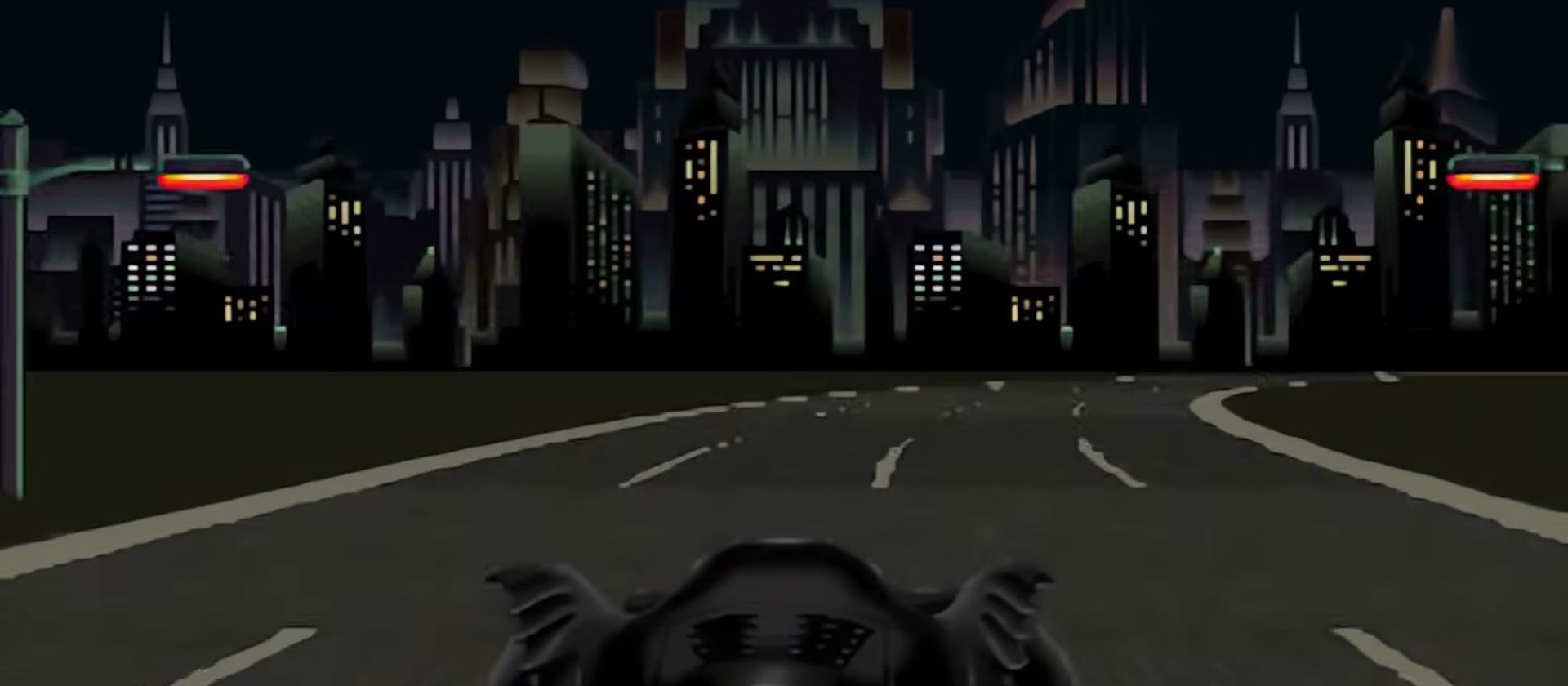
The Mode 7 Batmobile chase as palate-cleanser between brawler stages — not a centrepiece set-piece, just the bar of rest. The compositional move is what a home-design vocabulary lets you do that the cabinet vocabulary doesn’t. Batman Returns · Konami / SNES, 1993.
Between brawler stages, the cart drops the camera behind a Mode 7 Batmobile and hands the player a chase through Burton’s Gotham skyline, motorcycle thugs scaling out of the depth. Most SNES games of 1993 used Mode 7 as ornament — a rotating title, a stage-transition fly-around, a boss pattern that needed perspective for one beat and reset to 2D after. Yoshimoto’s team uses it as a palate-cleanser: not the centrepiece, not the climactic boss, the bar of rest between two brawler stages.
Burton’s Noir as Editorial Cover
What the film licence let the art team do is make a beat-em-up that looks like a Burton film. TMNT IV is saturated; Sunset Riders is high-contrast hot afternoon; Mystic Warriors runs in tropical jungle palette. Batman Returns is dim — wintry, low-saturation, snow piling on every surface, gothic art deco silhouettes cut against a dark sky, lit by amber streetlamps and the occasional muzzle flash. The film was shot on a colour-graded snow set; Konami’s art team translated that grade to the SNES palette and held the discipline. A Konami-IP brawler couldn’t have justified asking the art team to ship a game this dim. The licence was the cover.
The score is the other half of the cover. Elfman’s main theme runs through the soundtrack as motif rather than direct quote — variations the SPC-700 sound team had to reverse-engineer from the film recording and translate to four-channel SNES audio. The orchestral architecture is intact even when the timbre is square waves. The cabinet sound unit that translated Mutsuhiko Izumi’s funk-rock for Turtles in Time did Danny Elfman in the next cubicle the same year. Both arrangements are excellent and both sound like the team they came from.
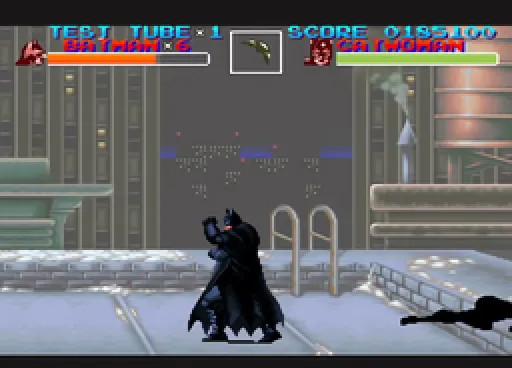
Bat-signal as pixel-dot matrix, projected on the brickwork after the second Catwoman fight. The sound team’s Elfman variations land cleanest in moments like this — atmosphere doing the work no Konami arcade brawler of the era was permitted to do. Batman Returns · Konami / SNES, 1993.
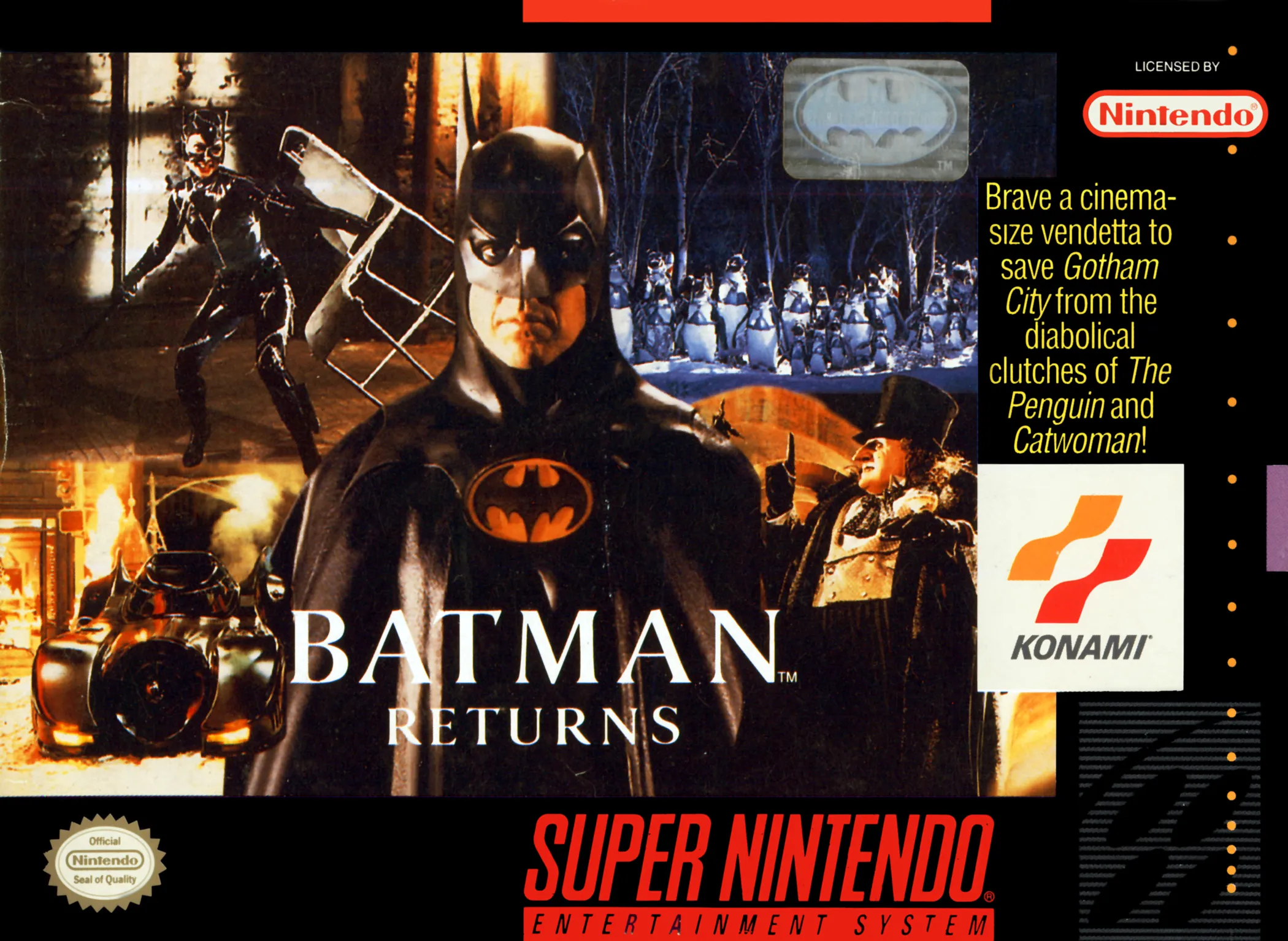
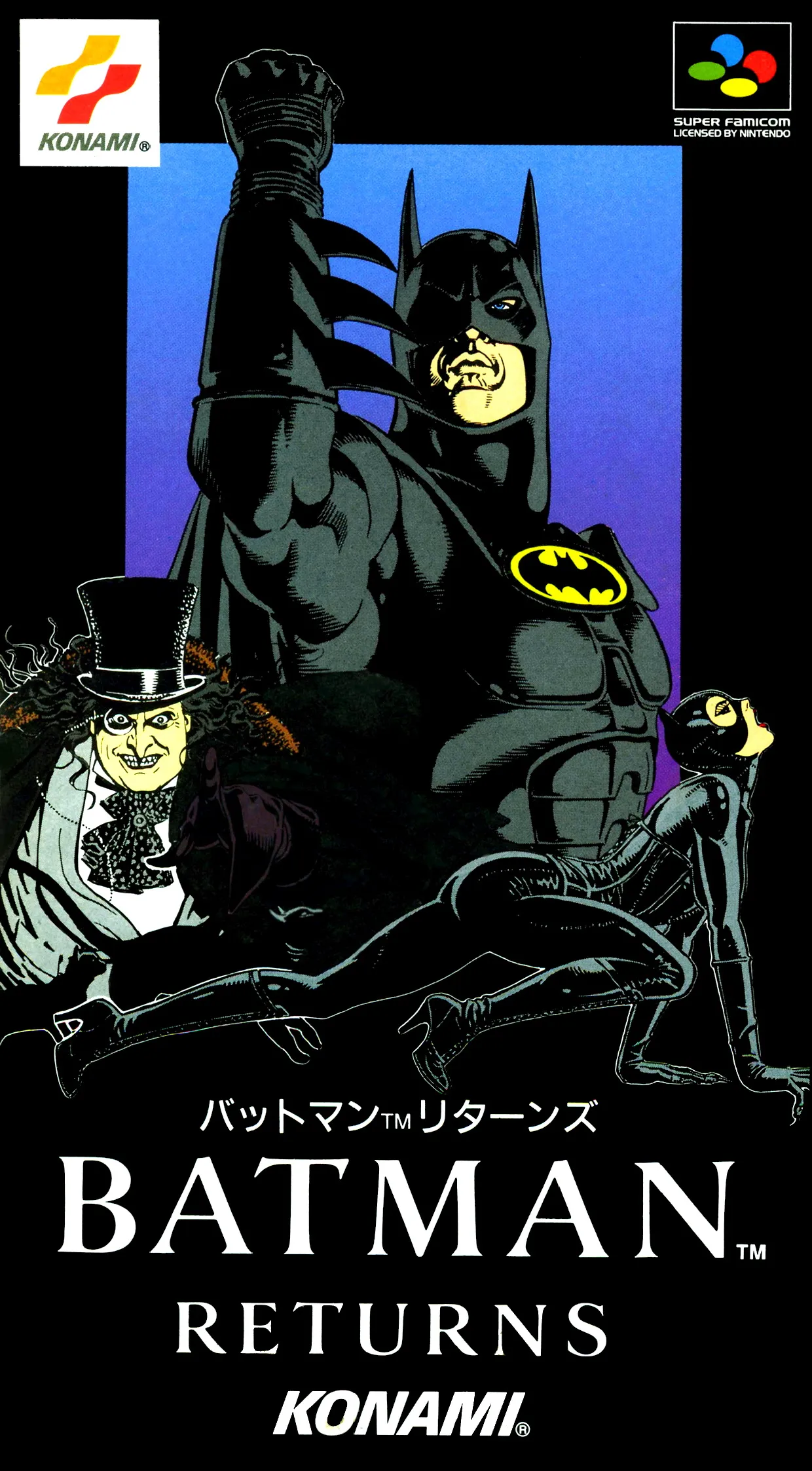
Two regions, one cartridge, two different reads of what kind of object this was. The North American box pitches a Burton film tie-in to American shelves; the Japanese box rejects the photo collage entirely and runs an illustrated cover in the graphic-novel register Japanese readers were used to for American superheroes. Batman Returns · Konami, 1993.
The reach of the licence shows up on the box too. Konami of America commissioned a Burton-photo-collage front — Keaton, the umbrella carriage, the Batmobile, Catwoman on a rope — pitched at a Toys R Us shelf. Konami of Japan commissioned the opposite: an illustrated comic-book composition with Batman’s fist raised and the two villains crouching at his feet, drawn in a graphic-novel register that has nothing to do with the Burton aesthetic and everything to do with how Japanese readers were used to seeing American superheroes.
What the Cart Could Not Carry
The cart’s limits are real and the article that pretends otherwise reads as advocacy. The single-plane platforming stages, where Batman is restricted to left-and-right movement with only the batarang for combat, are the weakest in the game — the sprite is too large for the screen, the jump arc is sluggish, and the encounter waves repeat. Hardcore Gaming 101’s retrospective is honest about it. The enemy roster across the standard brawler stages is also thin: clown variants and knife throwers do most of the work, and the strongman bosses repeat across stages with palette swaps instead of new sprites. The Catwoman fight is run twice across two scenes with different rooftop backdrops; Super Play’s Jonathan Davies, reviewing in 1993, did not like it.
The single-player decision is a cost as well as a choice. A two-player Batman-and-Robin cut of this cart would have been a stronger total object — the moveset is deep enough to accommodate a second character, and Konami’s brawler economy at home depends on the social heat of co-op. Yoshimoto’s team kept it solo by design, and the rationale (Batman alone in Gotham) is defensible. The trade is still a trade. The first-time player should also skip NORMAL. Set the menu to HARD before the first run — the cart is undertuned on its default difficulty in a way that hides what the moveset is actually for.
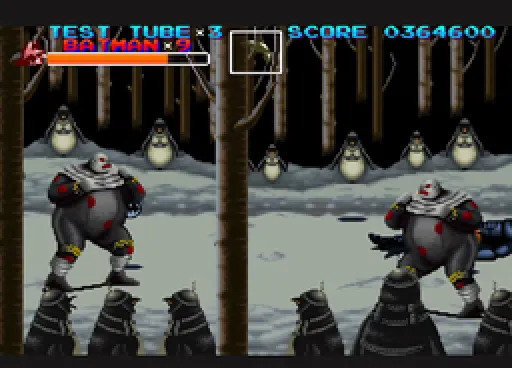
Penguin’s Arctic World, the cartridge’s third-act peak. The reception gap snaps clearest here — Time Extension’s “best beat-em-up ever” reading and CVG’s 1993 67% verdict are both honest readings of the same chained-penguin choreography. Batman Returns · Konami / SNES, 1993.
The third-act atmospheric peak is also where the reception gap snaps clearest. Penguin’s Arctic World — chained penguin troops marching in formation, strongman bosses bracketing a frozen clearing, the Burton zoo set realised as eight-bit menagerie — is one of the most distinctive late-stage runs on the SNES, and the section where the modern Time Extension “best beat-em-up ever” reading and the contemporary CVG 67% verdict diverge most. Both are honest readings. The argument that makes both legible is that this isn’t an arcade Konami brawler trying to fit a cartridge — it’s something the cabinet pipeline never built.