You raise the camera, frame the shot, and wait. The creature turns — slightly. Light catches the angle of its body. For a moment, everything aligns, and then you hear movement behind you. If you hesitate you miss the moment. If you rush it you miss the shot. When the shutter finally clicks, it feels earned. When it doesn’t, you understand exactly why.
This is how Beyond Good & Evil instructs you in its purpose: not through text or tutorial, but through the act of waiting for something to reveal itself. Michel Ancel made a game about journalism, about the particular discipline of watching, and about what it costs a person to keep their eyes open when the world would prefer they didn’t. He placed that argument not in a cutscene or a dialogue tree, but in a mechanic. When you put down the controller, the act of patient looking is what you remember.
The title was wrong from the start — deliberately so, and for reasons that make the work more interesting once you know them. Ancel’s original name was Between Good & Evil: a world where the line between protector and predator has collapsed, where official violence and external threat have resolved into the same thing, where choosing a side is no longer the available option. Marketing changed a single word. “Beyond” sounds heroic, expansive, triumphant. “Between” is precise about what this thing is.
”Between. Not beyond.”
— Michel Ancel, on the title he wanted
The distinction is not pedantic. A story called Beyond Good & Evil suggests a hero who steps past the old moral categories. A story called Between Good & Evil describes a citizen marooned inside the collapse of those categories, forced to act without the comfort of knowing which side she is on. Jade belongs to the second story. Every system Ancel built is built for it.
A Glitch That Started Everything
The idea for Beyond Good & Evil came from a mistake.
After shipping Rayman 2 in 1999, Ancel and his team at Ubisoft Montpellier discovered a glitch in the finished game: a player could jump onto a flying ship and soar over the entire world below. It wasn’t intended. It wasn’t designed. But the team watched it happen and understood immediately that they wanted to make that — a game about the experience of flying over a living world, seeing it whole, understanding it from above. That feeling became the seed of the project that would take four years to reach shelves.
The gap between that initial vision and what shipped is also part of the story. The original design was far larger: multiple planets, expansive open cities, a space exploration phase of genuine scope. Six months before release, after a difficult showing at E3 2002, Ancel made the decision to overhaul the visual design entirely — including Jade herself, who was substantially redesigned, with much of the intended scope deferred to a sequel he already wanted to make.
What emerged was a game more legible than the original conception might have been. Hillys replaces an entire system. The conspiracy is not abstract; it has geography. You are not navigating an endless map. You are learning a place.
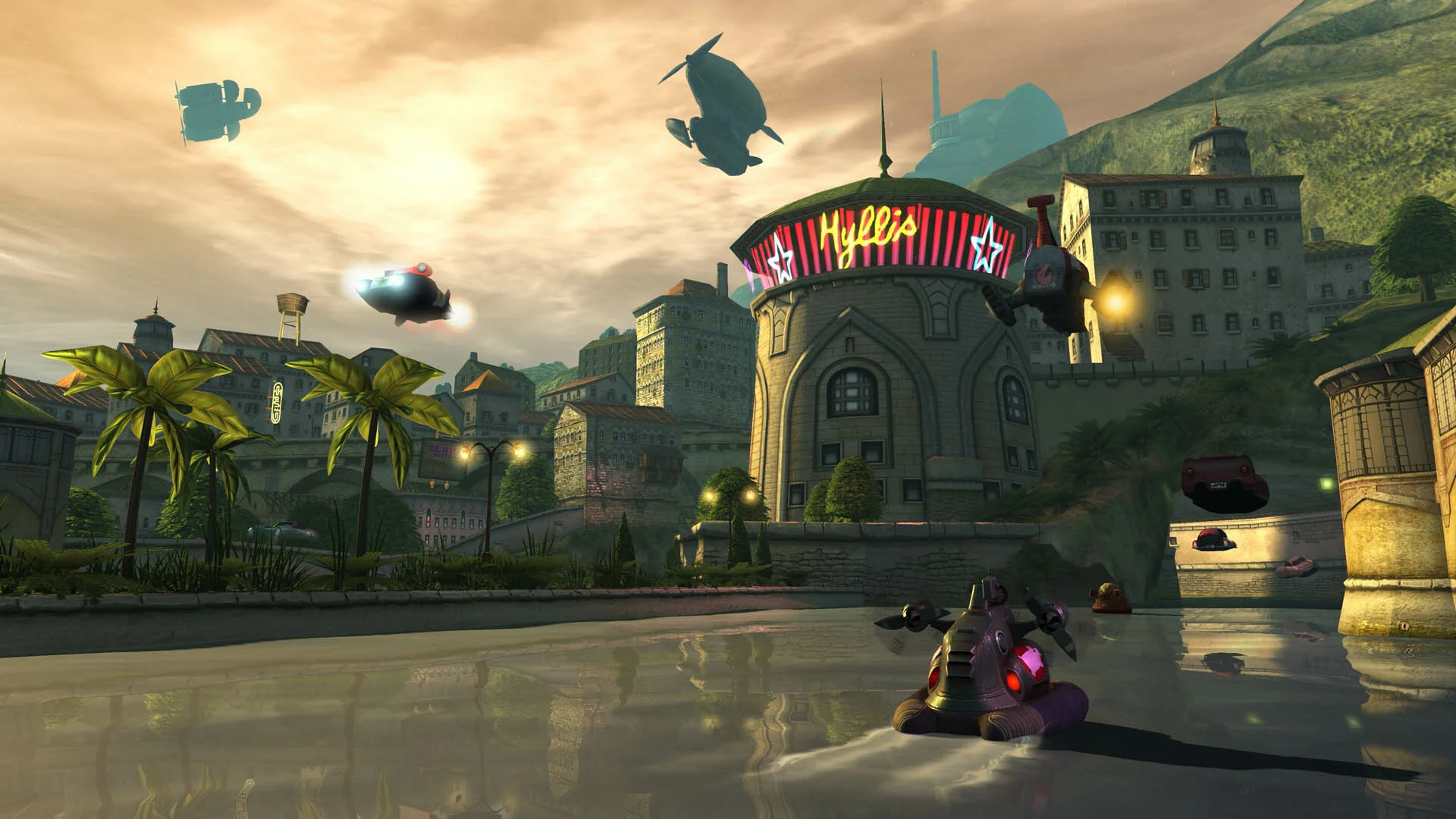
Hillys does the work a much larger game might have spread across planets: one readable city, one set of routes, one political system close enough to learn by sight. Image: Beyond Good & Evil - 20th Anniversary Edition · Ubisoft Montpellier.
The Camera as Argument
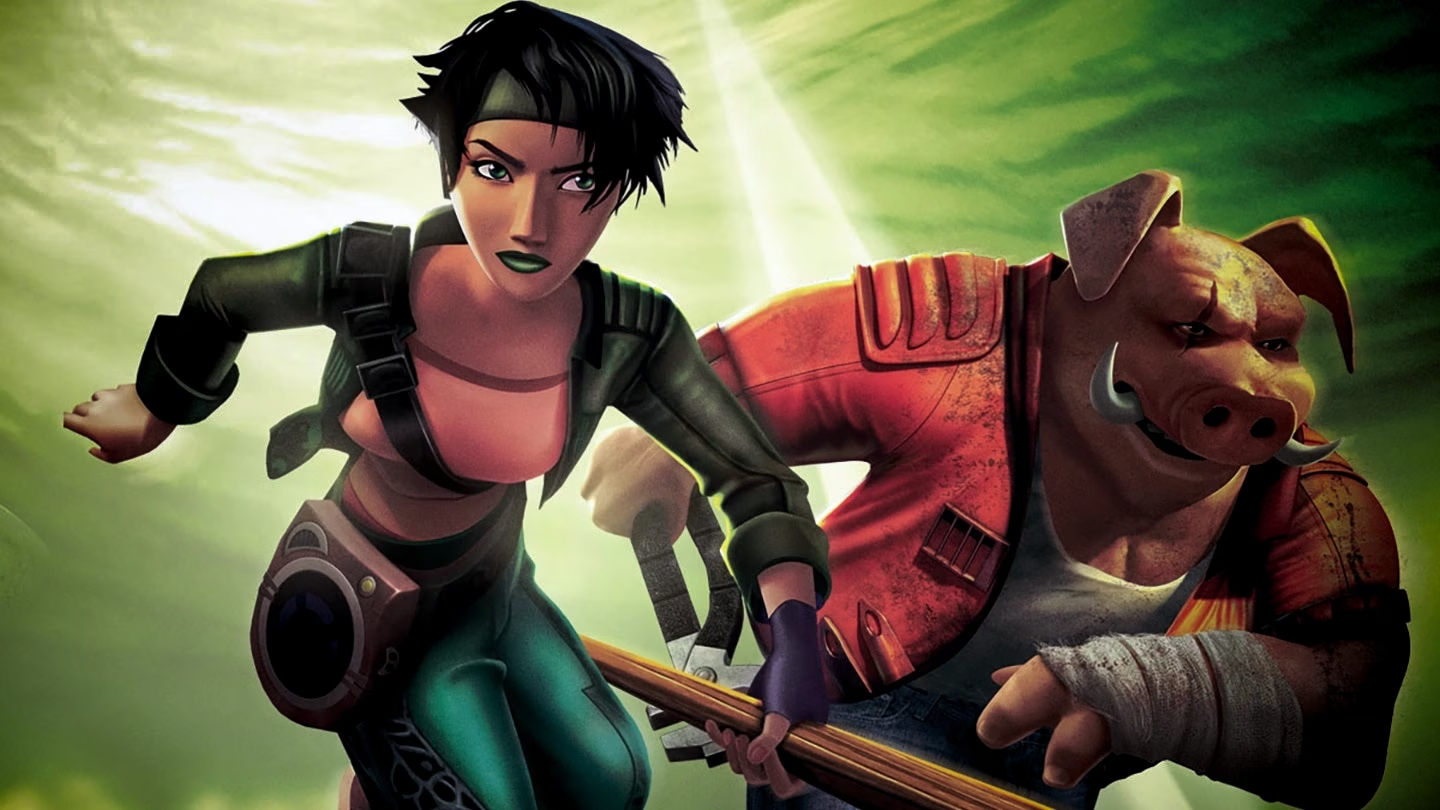
Jade is a photojournalist. This is not a cosmetic detail about her occupation. It is the central design decision.
The camera does two things simultaneously, and the design depends on both. You photograph wildlife for money — building a catalogue of the planet’s species, piece by piece. You photograph evidence for the IRIS Network — exposing what the Alpha Sections are doing in the facilities they control. One feeds your survival. The other feeds the truth. Neither is optional, and neither is passive.
Getting a shot requires positioning, timing, and risk. You edge into restricted spaces. You wait for something to present itself. You take the shot knowing you may have been seen. The act of documentation has friction. It costs something. In most games, tools exist to interact with obstacles. In Beyond Good & Evil, the camera exists to interact with reality — to assert that what you are witnessing is real and provable.
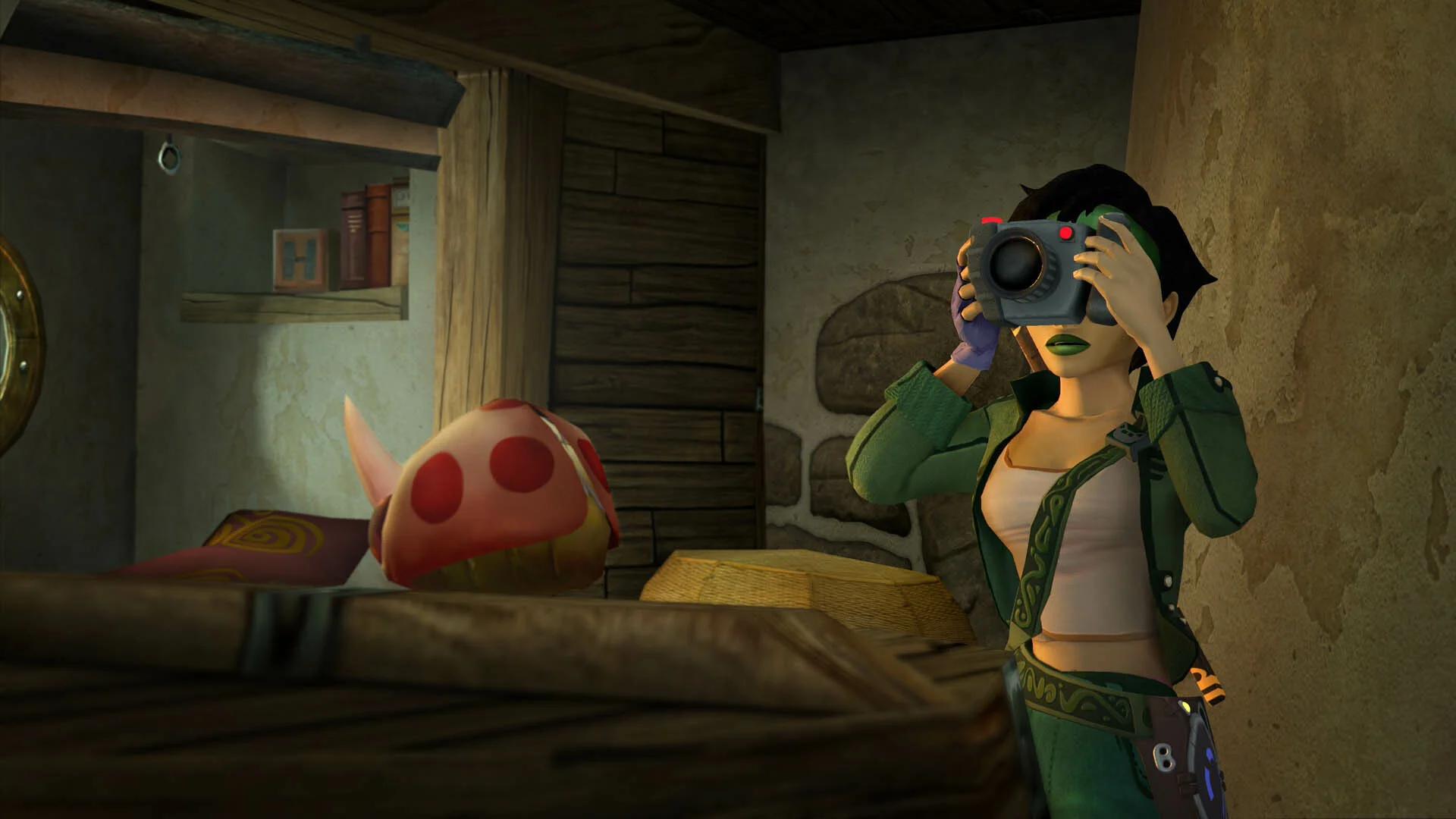
The camera is not a novelty tool or a side-economy skin. It is how Jade makes Hillys legible: species, evidence, timing, proof. Image: Beyond Good & Evil - 20th Anniversary Edition · Ubisoft Montpellier.
Photography in Beyond Good & Evil is also economic, and the economy carries its own argument. Credits earned from wildlife shots pay for the hovercraft upgrades that let Jade reach more of Hillys, which in turn gives her access to more species, more evidence, more places the Alpha Sections would rather she did not go. The loop rewards curiosity directly: the more you photograph, the further you can travel; the further you travel, the more the conspiracy hands you to document. A game that had wanted to tell a story of resistance could have distributed intel through cutscenes. This one makes the player earn every frame of the conspiracy themselves, shot by shot.
None of this is to say the design is frictionless. The stealth sections are blunt, the combat is a functional third rather than a highlight, and the hovercraft racing sits uneasily next to the photography loop it exists to serve. A modern player has to tolerate a few systems that feel like placeholders for the systems Ancel cared about. The trade is worth it, but the trade is real.
The score, composed by Christophe Héral, operates on the same principle. The DomZ language was built from a constructed fictional tongue with rolling consonants. The crashing metal sounds in the boss encounter were recorded from Héral’s neighbour’s son playing with scrap metal in a garden. The voices drifting through the city were layered into ambient sound that feels less like a cue and more like overhearing something that was already happening. The effect is a world that does not explain itself. Its ecological attentiveness, its deep history only partially visible, and its anthropomorphic characters treated with dignity all echo Hayao Miyazaki’s films. But the political edge is sharper. The Alpha Sections do not announce themselves as villains — they announce themselves as protectors. Their grip on information is the same as their grip on Hillys: total, justified, and entirely dependent on nobody looking too closely.
The Publisher That Buried It
Beyond Good & Evil arrived on shelves in November 2003 with almost no marketing budget. The holiday window that year included Prince of Persia: The Sands of Time, Star Wars: Knights of the Old Republic, and Mario Kart: Double Dash. Ubisoft’s own marketing attention was almost entirely focused on Sands of Time, which was easier to categorise, had a brand behind it, and looked like something consumers already understood.
Florent Sacré, one of the developers, described what happened inside the company: competition grew between the two projects, and when Prince of Persia began its commercial ascent, resources and attention followed it, leaving Beyond Good & Evil without the support it needed to reach its audience. Laurent Detoc, Ubisoft North America’s CEO at the time, later named the decision one of his worst business calls. Retailers reduced the price by up to 80 percent within weeks of release.
The reviews were genuinely good — recognising the writing, the world, the score — but they arrived without the marketing visibility to turn critical attention into sales. The Game Developers Choice Award nominations and the IGN recognitions for “Best Story” and “Best Adventure Game” came after the commercial window had already closed.
The irony is almost too neat: a game about the suppression of information was suppressed by its own publisher’s inability to tell people it existed.
The Climax Is a Broadcast
The Alpha Sections are not failing to protect Hillys. They are the threat. The DomZ do not operate outside the system; they operate through it. What the IRIS Network offers is not resistance in the conventional sense — not force meeting force — but exposure. The enemy’s continued operation depends on the population not knowing what is happening. The weapon against it is a camera and a transmission signal.
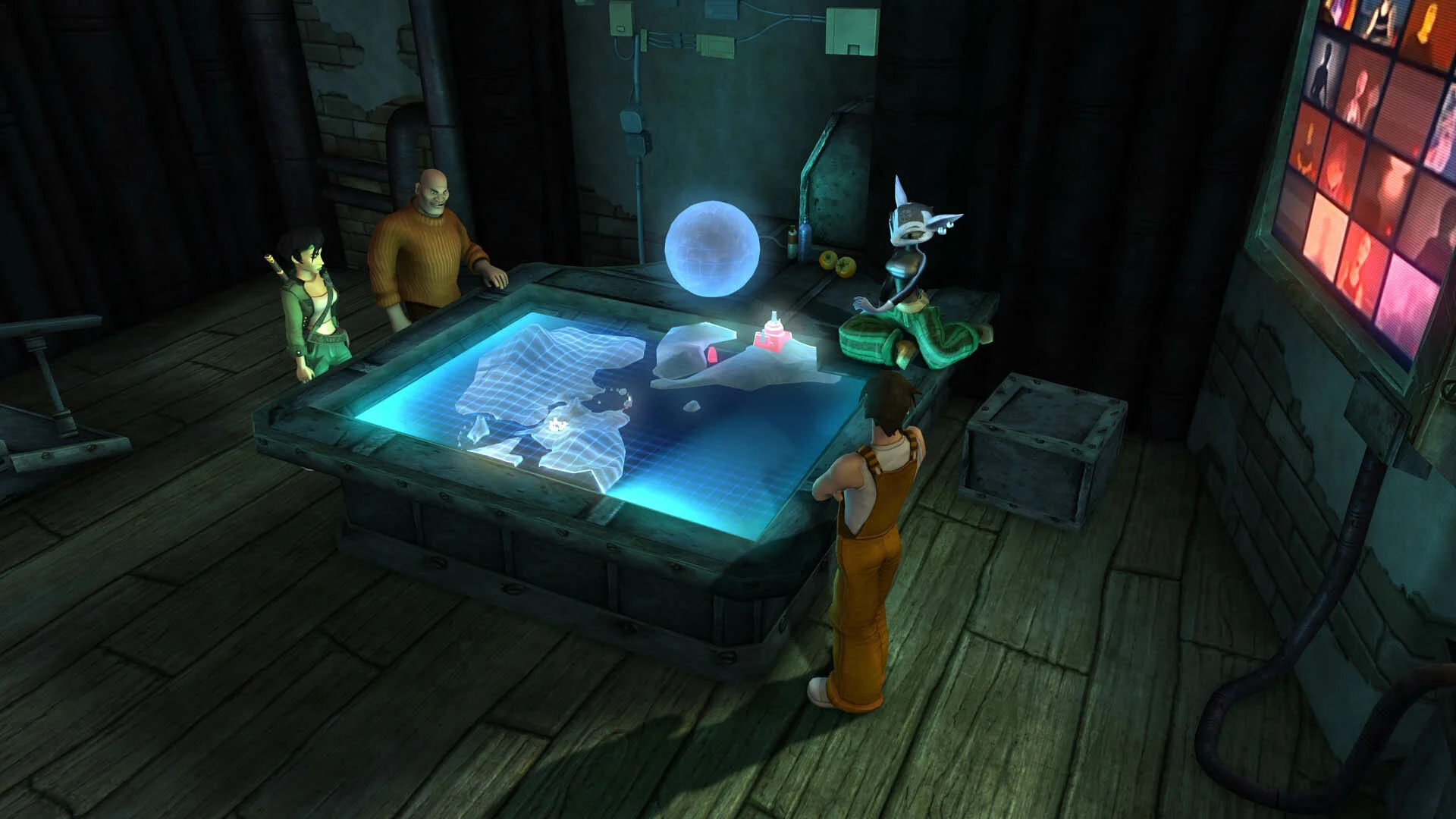
The resistance scenes matter because they keep the conspiracy practical: evidence is gathered, routes are planned, and the next act of exposure is made communal. Image: Beyond Good & Evil - 20th Anniversary Edition · Ubisoft Montpellier.
Jade does not resolve this through combat.
She resolves it by making what she has seen public.
The final act of the game is not violence. It is publication. That distinction is what distinguishes Beyond Good & Evil from everything else in the action-adventure genre that preceded it. Combat exists, but it is not the mode through which power is challenged. You win by broadcasting.
Every photograph you took was practice for this. Every wildlife shot, every covert image in a restricted facility, every piece of evidence you handed to the IRIS Network — all of it was preparation for a final act in which the act of looking turns out to be the only act that matters. The camera was never a tool alongside the staff and the hovercraft. It was the point.
What makes the ending land is that it reverses the direction of attention. For most of the game, Jade has been the one watching. The Alpha Sections patrol the skies, but they are opaque by design — armoured, helmeted, anonymous. The citizens of Hillys cannot see what they do inside their own facilities. The final broadcast forces that relationship to flip. The people who had been quietly administered finally get to look back, and what they see ends the regime almost without violence. Ancel is not telling the player that cameras are more powerful than weapons. He is telling the player that some forms of power can only be sustained by the absence of witnesses, and that making the witness possible is itself the action.
Ancel was writing in 2003, in the immediate wake of a period when media manipulation and state-controlled information had become subjects of serious public debate. Playing it now, from a vantage point much further inside that history, its argument is more legible — and more pointed — than Ancel could have anticipated when marketing changed that one word in the title from “between” to “beyond.” You raise the camera again. You wait for the moment. And when it comes, you take the shot — knowing that what matters is not that you saw it, but that you can prove it.