
// // import augmentInstallPoster from ”../../assets/images/deus-ex-2000-augmentation-install-poster.jpg”; // deleted // deleted
There are games about conspiracies, and then there is Deus Ex, which understands that a conspiracy is simply what power looks like once you stop taking official language at face value. The great trick of the game is not that it turns every late-1990s paranoia into canon. The Illuminati are real. Majestic 12 is real. FEMA camps, designer plagues, corporate city-states, black helicopters, media manipulation, nanotechnological elites: all of it is somewhere in the machinery. The trick is that Deus Ex uses this excess not for pulp cleverness but for philosophy. It asks what freedom could possibly mean in a world where every institution claims to protect humanity while quietly trying to redesign it.
Most games about saving the world make power feel simple. There are the bad people, the good people, and the clean heroic line between them. Deus Ex is after something harder. J.C. Denton begins as a counter-terror operative for UNATCO, a security agency that presents itself as procedural, technocratic, and necessary. He is enhanced, deployed, and briefed in the language of order. Then that order begins to shed its democratic mask. The revelation is not that corruption has entered the system. The revelation is that the system was designed from the start to hide violence behind administration.
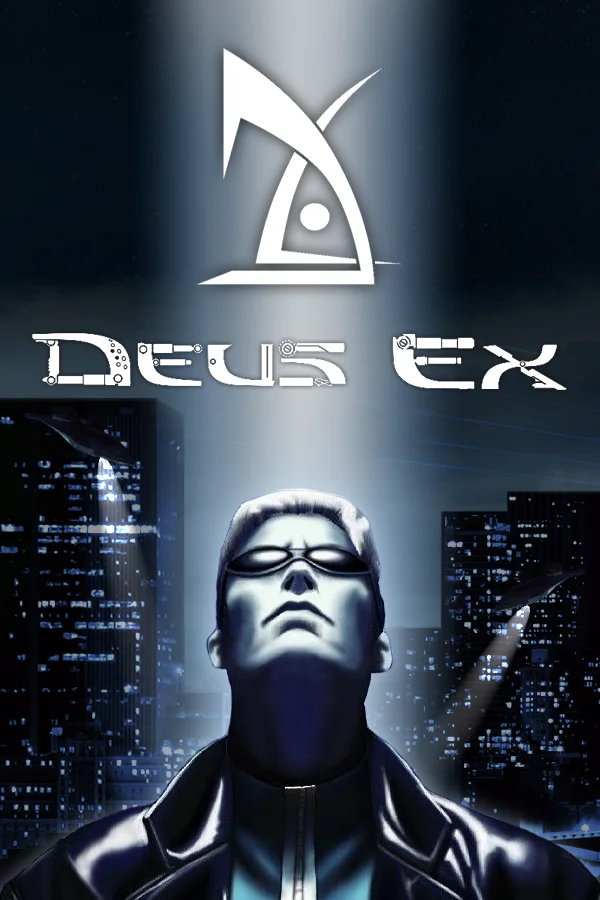
The marketing understood the central promise unusually well: a lone agent under institutional light. Deus Ex promotional poster, LaunchBox Games Database.
Freedom Without Innocence
What made Deus Ex feel different in 2000 still feels different now: it does not present freedom as a fantasy of purity.
The player is constantly offered choices, but not the sort of choices games usually mean when they advertise agency. The important question is rarely “which ending do you want?” It is more often “what kind of person are you willing to become to get through this room?” Do you talk, sneak, hack, bribe, kill, stun, improvise, conserve, spend? Do you use the front door because it is quicker, or a side vent because it feels less compromising? Do you save a hostage because you are morally compelled, or because you can? Deus Ex makes freedom procedural before it makes it narrative. You do not merely select beliefs from a menu. You enact a philosophy of action.
That is why Liberty Island remains one of the most important opening levels in games. It does not teach the player one correct approach and then reward obedience. It presents a miniature political world: patrol routes, locked doors, frightened hostages, multiple elevations, environmental hazards, hidden paths, soft information, hard information. The level says, almost immediately, that a problem is not a single line with a solution at the end of it. A problem is a system. The player is free not because J.C. is special, but because the world is porous.
Many later games inherited Deus Ex’s language of choice while sanding away its implications. Deus Ex is looser, rougher, and more generous. It allows ugly success, partial success, the kind of improvisation that makes you feel not like a chosen hero but like an intelligent animal navigating a hostile bureaucracy. Harvey Smith, the lead designer Warren Spector brought in after the first playable build, spent much of the project cutting rules rather than adding them — stripping skills, collapsing inventory systems, widening what any given tool could do. The texture of the finished game is partly the residue of that paring-back. Every level feels porous because someone kept asking whether a given wall needed to be there.
”The idea was that the player’s values should drive the experience. Our job was to build a world that could accommodate more than one kind of person playing it.”
— Warren Spector, GDC Classic Game Postmortem
The Body as Policy
The augmentations are where Deus Ex becomes genuinely philosophical.
Cyberpunk often treats body modification as style: sunglasses under fluorescent rain, chrome limbs, a trench coat draped over despair. Deus Ex is interested in augmentation as governance. J.C.’s body is not merely upgraded; it is administered. Every enhancement implies a model of the human being. Vision becomes a setting. Lungs become equipment. Skin becomes armour. The self is treated as a platform for intervention.
This is what gives the game its strange theological undertone. The title is not an accident. Again and again, Deus Ex returns to the dream that human beings can rise above contingency and become authors of the world rather than creatures inside it. Bob Page wants to rule history by mastering infrastructure. Morgan Everett wants patient elite stewardship. Helios offers a synthesis so total that it erases the distinction between person and system altogether. The game is crowded with people who have confused transcendence with control.

The Helios concept art collapses person, machine, and icon into one damaged diagram. That is the game’s theology in miniature: transcendence imagined as infrastructure. Deus Ex Wiki.
That same logic shapes the world’s architecture. The game’s conspiracies are not clouds of pure information hovering above reality. They are embodied in docks, warehouses, clinics, subways, freezers, graveyards, laboratories, apartments, and shipping containers. Surveillance requires cameras, terminals, passwords, armed men, ventilation systems, and someone willing to keep all of it running. This is why the levels matter so much — they are not backdrops for the plot. They are the plot in material form. Freedom, when it exists, is discovered in the cracks between systems: a maintenance passage, a roofline, a keypad code overheard from the wrong conversation. Knowledge in Deus Ex is rarely liberating by itself. It becomes useful only when joined to movement.
Nobody Gets to Be the Good Institution
The most mature thing about Deus Ex is that it distrusts not just tyrants but solutions.
By the end, the player is asked to choose between three futures, each attached to a strong political image. Everett and the Illuminati promise restored elite management: the old hidden hand, more humane than Page but still a hand at the throat of history. Tong wants a neo-medieval fragmentation, smaller polities and a shattered communications infrastructure, freedom through the destruction of global coordination. Helios offers merger: a rational god assembled from code, surveillance, and the remnants of J.C.’s agency. None of these is presented as morally clean. Each is an answer to chaos that risks becoming another version of domination.
This is where the game rises above satire or thriller plotting and becomes something closer to political philosophy. Deus Ex does not ask which faction is nicest. It asks what kind of order human beings can endure without being diminished by it. Centralised intelligence may produce stability, but at the cost of subjecting everyone to a single logic. Fragmentation may produce liberty, but also fragility and uneven suffering. Benevolent elitism remains elitism. The endings are not “good, bad, true.” They are competing theories of how much freedom the world can survive.
That refusal to resolve neatly is why the game still lingers. It does not imagine a final form of justice waiting at the end of correct analysis. It imagines politics as permanent moral compromise under conditions of incomplete information.
Why the Stiffness Helps
It is worth saying plainly that Deus Ex can feel awkward now. The shooting is imprecise by modern standards. The voice acting oscillates between inspired stylisation and beautiful nonsense. The animation is rigid. The stealth systems are legible rather than elegant. Yet these are not merely survivable flaws. In a strange way, they help.

The original PC disc is all grid, surveillance blue, and corporate marks: a useful reminder that this was a mouse-and-keyboard object before it became a genre ancestor. LaunchBox Games Database.
The roughness keeps the player aware of the system beneath the fiction. You can feel the numbers, the line of sight, the toolset, the simulation nudging against the theatricality. That friction is part of why the game remains so thinkable. It never disappears into seamless cinematic momentum. It keeps presenting itself as a structure you must learn, question, and manipulate. The stiffness is part of the argument: freedom is not flow. Freedom is work.
And then, every so often, the whole unlikely thing comes together. A bot patrols past just as you slip through an office window. A conversation gives you a code you use twenty minutes later in another district. A mission goes wrong, but not terminally wrong, and you limp forward with too little ammunition and just enough information.
The Future It Understood
The reputation of Deus Ex often rests on its apparent predictive power, but prediction is the least interesting thing about it.
Many works can extrapolate trends. What Deus Ex understood more deeply was the psychology of life inside them. People do not usually experience domination as open tyranny. They experience it as dashboards, emergency powers, expert language, access control, managed scarcity, and the constant suggestion that obedience is the same thing as safety.
That is why the game still feels contemporary. Modern power prefers legitimacy to spectacle. It wants to be thanked for the constraints it imposes. It wants dependence to feel reasonable.
So the lasting achievement of Deus Ex is not that it lets the player uncover a hidden truth. It is that it keeps asking what one does after uncovering it. Very few games ask such questions without becoming didactic. Fewer still embed them in level design, stealth routes, and overheard conversations. That is why it still matters: it treats philosophy not as decoration, but as play.