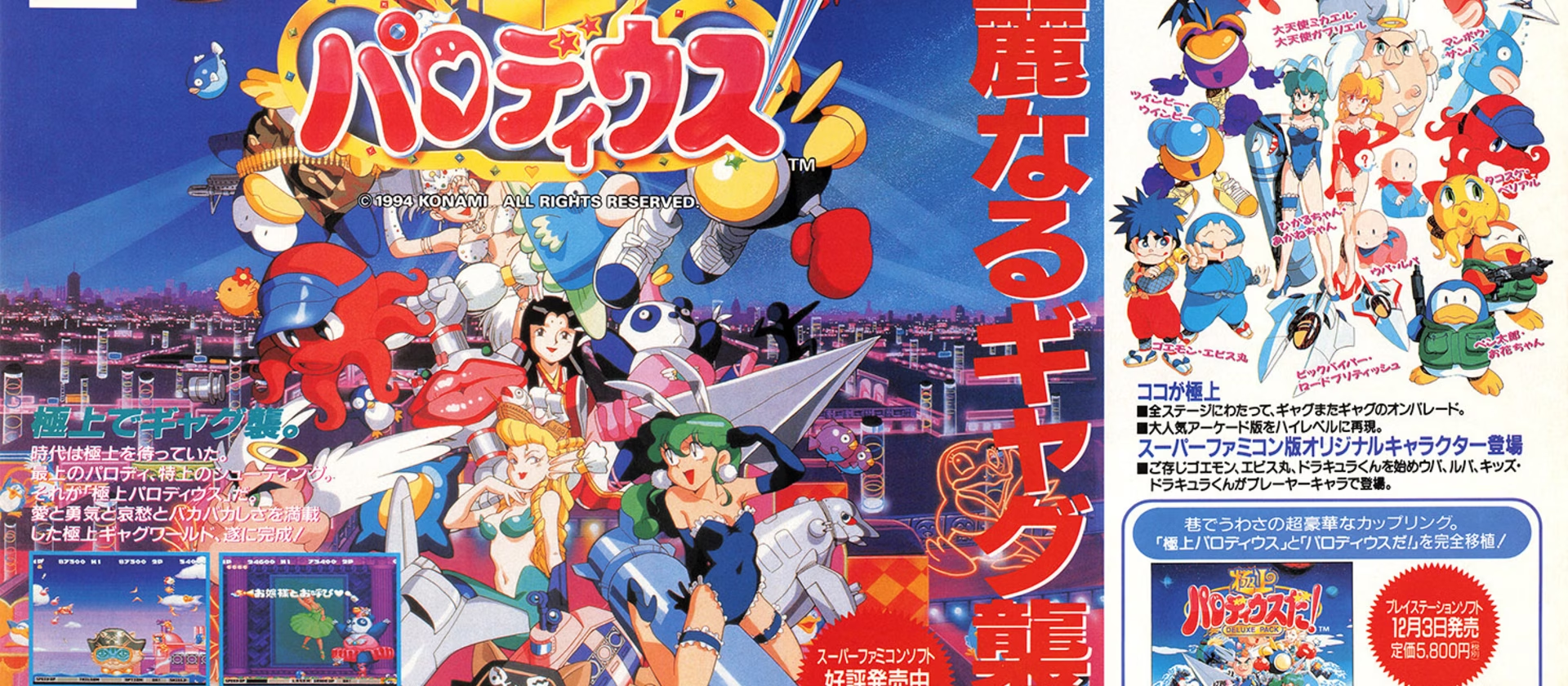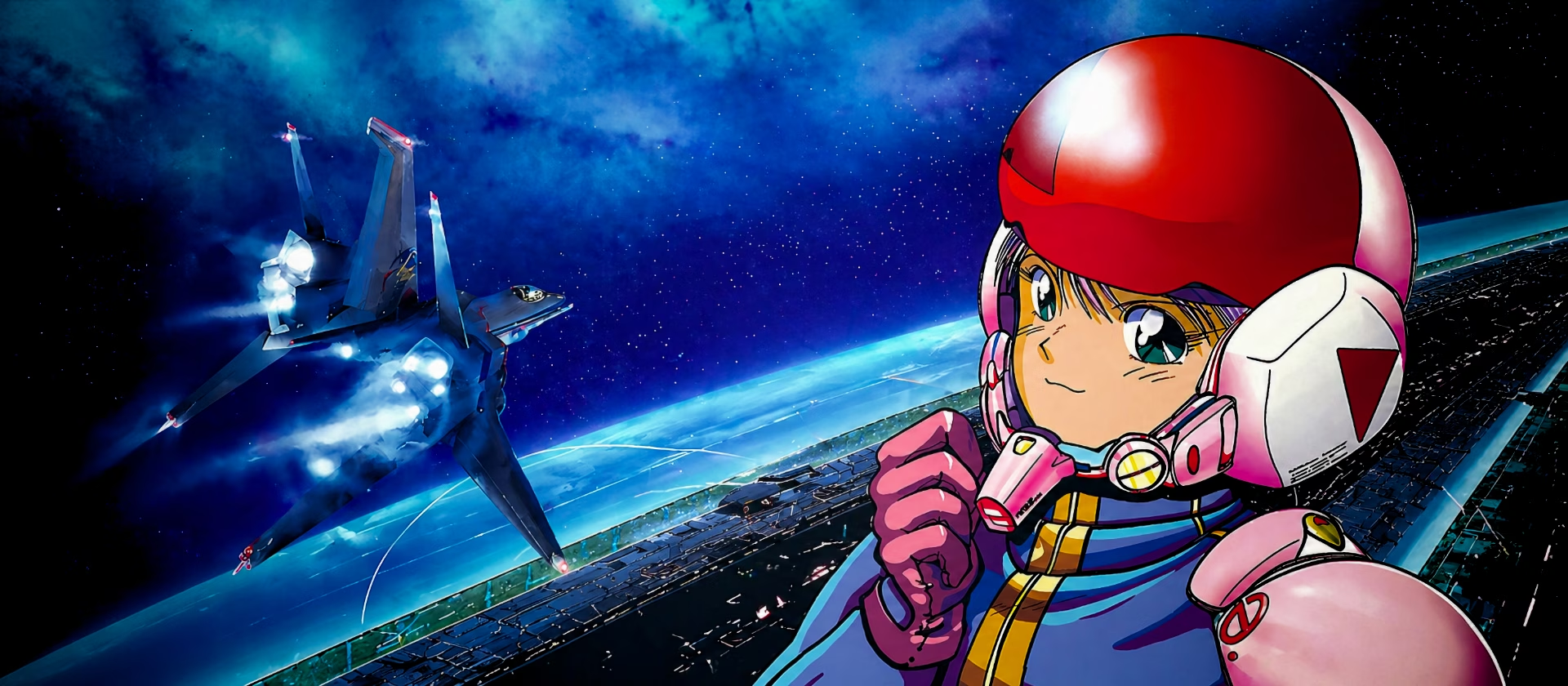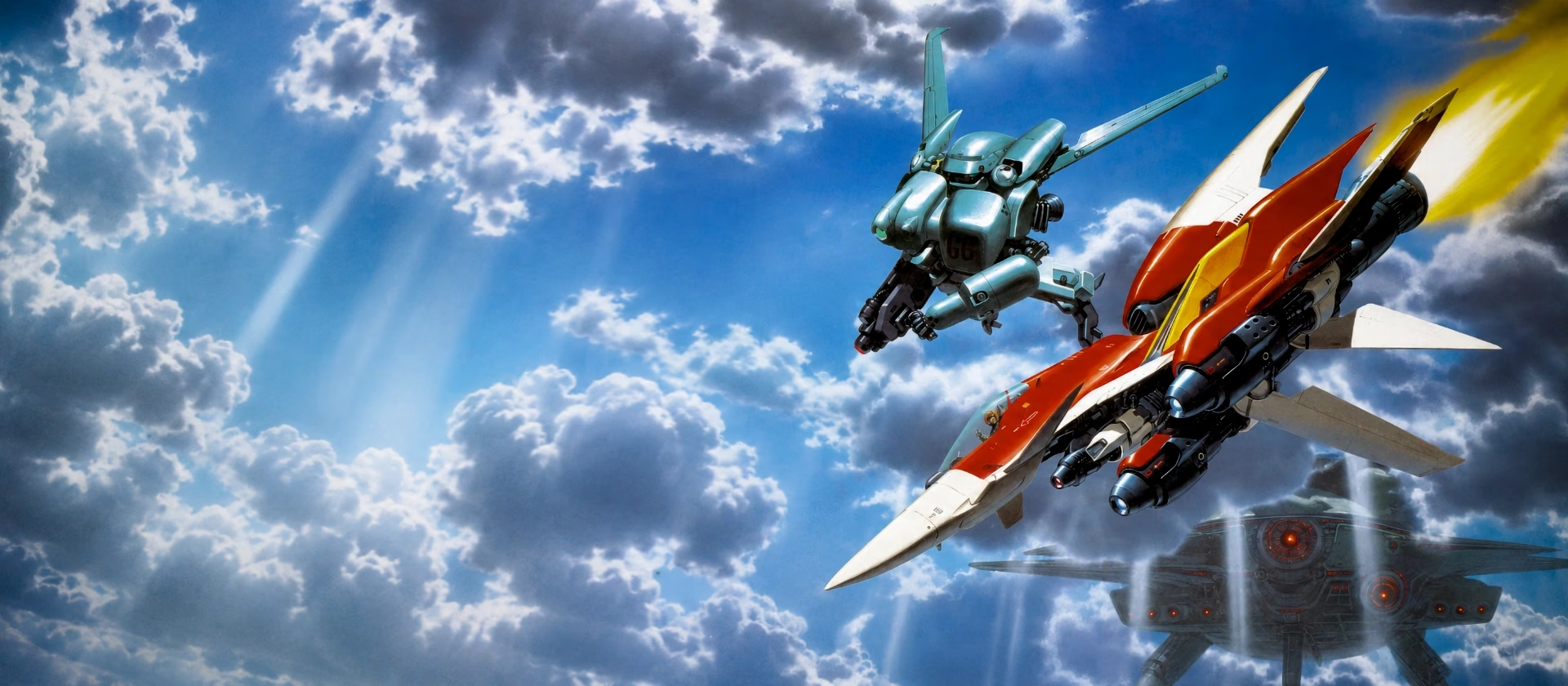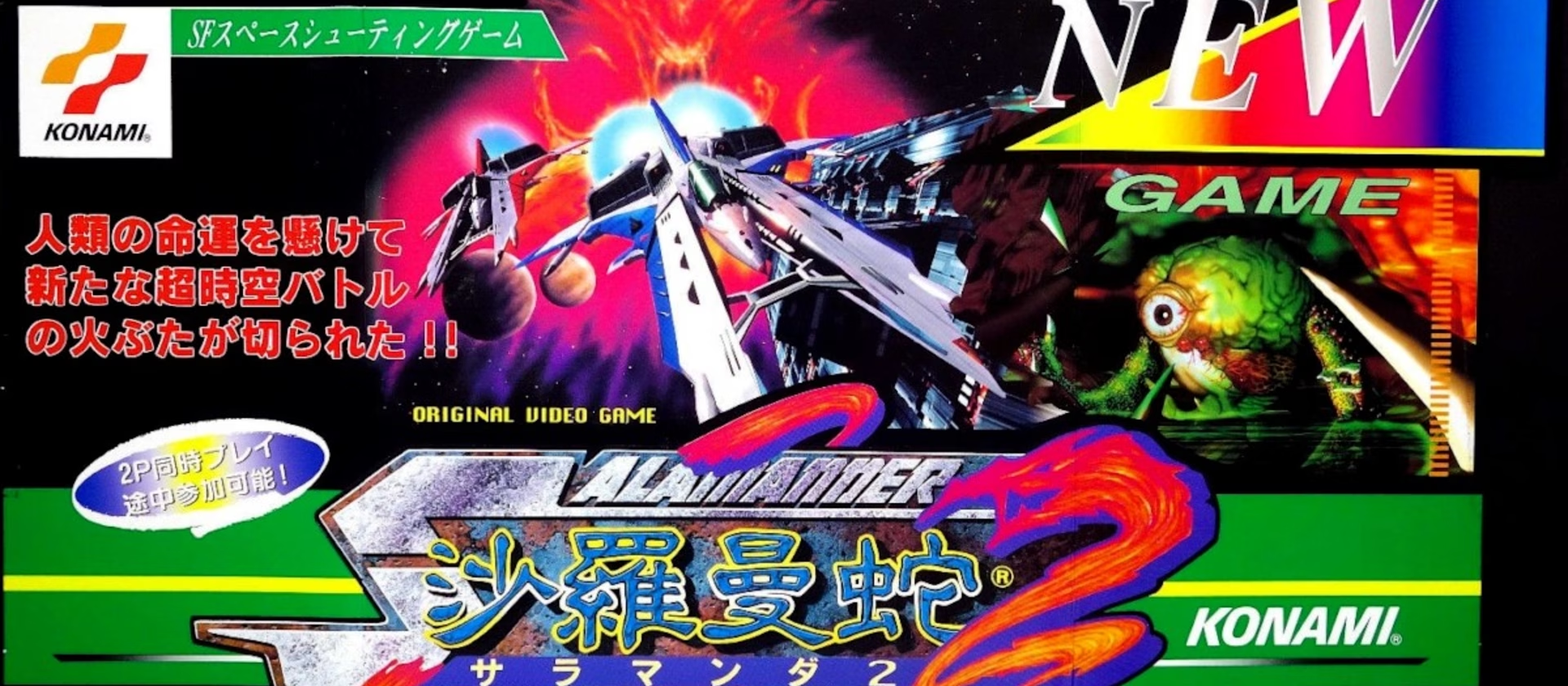
It took twenty-nine years to leave Japan. The cabinet went up in January 1996 — a Konami GX board, the same silicon that ran Gokujō Parodius and Sexy Parodius — and the Japanese trade press buried it on arrival. Game Criticism called the colour sense poor and the new Option Shoot mechanic useless. Gamest readers filed it alongside Ultimate Tiger II as a sequel that could not beat its parent. The shooter market was collapsing under them. Konami did not announce the silence; the silence was the announcement. Then the arcade flyer in this article went into a drawer, and Salamander 2 did not appear in any version outside Japan until M2’s Gradius Origins shipped on PlayStation 5, Xbox Series, Nintendo Switch and Steam in August 2025. Played now, with thirty years of distance and a training mode, the game the magazines could not read is hard to mistake.
When the Golem Walks Off
The opening fake-out is the cleanest evidence that nobody on the team had gone on autopilot. Stage 1 — Sublife Space, organic membrane behind a writhing red ground-line — sets up the Brain Golem of the 1986 cabinet exactly as the returning audience would expect. The horned, fleshy boss rises into the screen. Then it shrugs and leaves. What you fight instead is Biter, a six-eyed armoured eel whose mouth fills half the playfield, whose teeth are the cleanest sprite work in the game, and whose appearance is a knowing prank on the franchise’s own iconography.
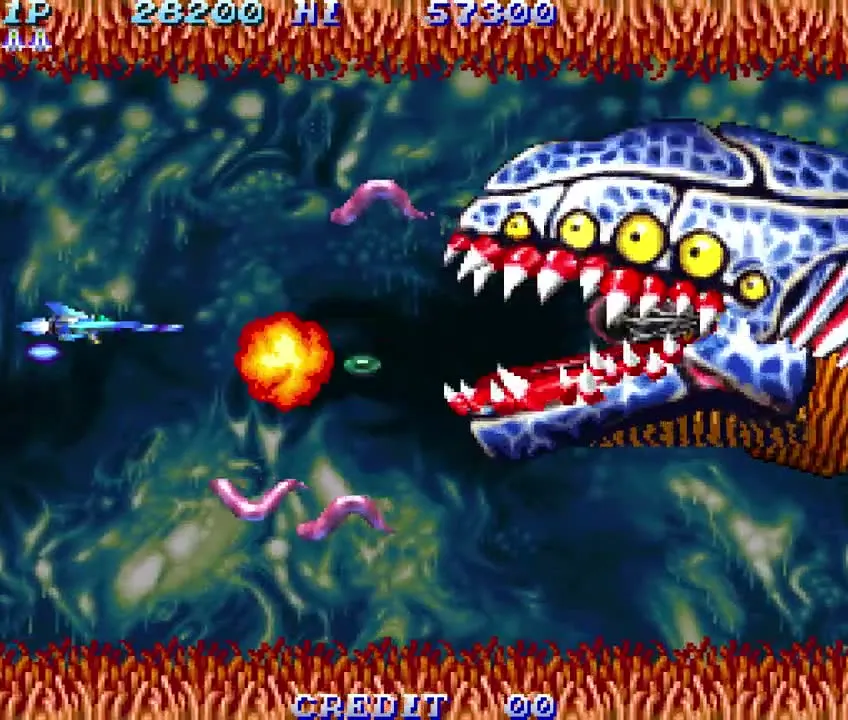
The Stage 1 fake-out — the Brain Golem of the 1986 cabinet rises, retreats, and hands the fight to Biter. Konami’s first move in the sequel is a knowing prank on the player’s own expectations. Salamander 2 · Konami, 1996 (Arcade, GX Type 2).
Mariko Tokida did the character art. In the 1997 developer commentary the Salamander Deluxe Pack shipped as bonus files — the only surviving testimony from the team — she said the Golem and the asteroids gave her the worst trouble in the project, that the colour palette had grown to the point of being unmanageable, and that the small enemies were “a battle in 16×16.” That last line is the diagnostic one. The board could push pre-rendered bosses and hand-painted backgrounds in 1996; the small enemies were still being authored at the resolution of the cabinet ten years prior. What the magazines read as a flat look is actually a transition signature: sprite-era Konami and CG-era Konami sharing one frame, the seam visible if you know to look for it.
The Biter figure is where the seam reads most clearly. The eel’s head is pre-rendered, polychrome, antialiased to the edges of its plates. The Vic Viper a quarter-screen to the left is the same chrome sprite from the previous decade. The small worm-grub enemies tumbling out of the dark are 16×16 pixels old. None of these things are wrong with the game; they are what the game is. The 1996 trade press was reviewing a shooter from 1996 against the shooters that would arrive a year later. The team was finishing a series and starting a new aesthetic in the same cabinet.
The Move the Magazines Couldn’t Read
The new mechanic was Option Shoot. Equip Options — the orbs from Gradius — and the dedicated B button no longer just deploys them. It fires them off the ship, in homing-lightning arcs that destroy bosses faster than sustained laser will. The launched Options then shrink and orbit the ship as Option Seeds, recoverable, holdable across deaths. The system reads, at five minutes’ acquaintance, like a complication that does not pay for itself.
”Enemy placement and presentation lack the ingenuity of the predecessor. The overall colour sense is poor. The Option Shoot has no good use.”
— Game Criticism magazine review, 1996; preserved via the citation chain at 沙羅曼蛇2, ja.wikipedia.org
That third clause is the one that the modern Option Seeds practice reads back against. Sit with the Gradius Origins training mode for an hour and the boss-DPS economy clarifies: the launched Option is a damage payload that recovers the Seeds while you wait through the next pattern. The two-state cycle is the score curve. DoDonPachi would codify a conditional-DPS economy of its own twenty-two months later, in November 1997, and the next decade of Japanese shmups would normalise the pattern. Konami’s draft of the idea is a year early, named differently, sitting unread in Game Criticism’s third bullet point.
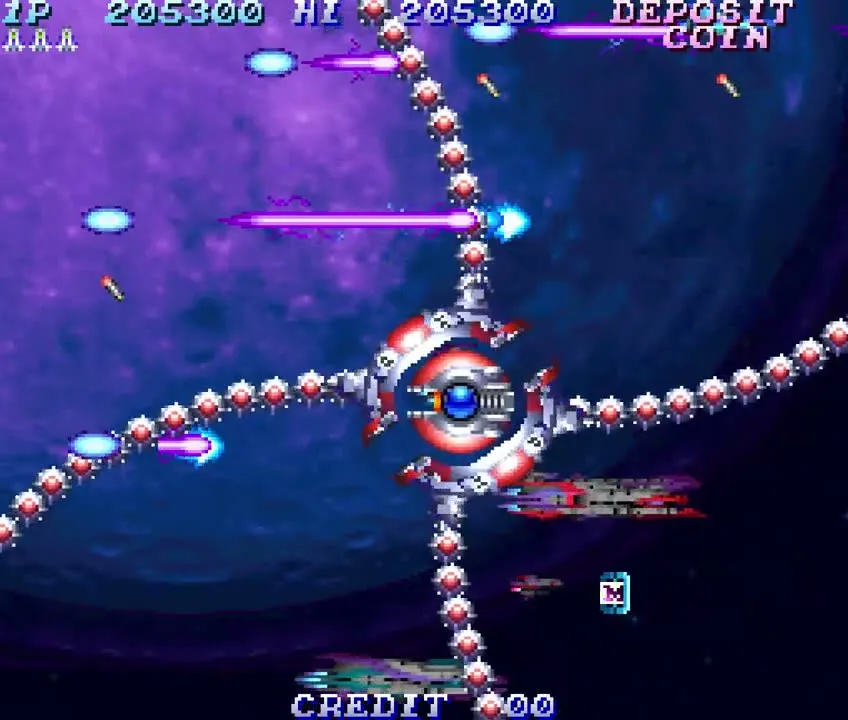
Plate Core, Stage 5 — the chain-arm boss that asks the player to time Option launches against the rotation, not the bullets. The mechanic the 1996 magazines dismissed turns out to be the centre of the scoring system. Salamander 2 · Konami, 1996.
The reception gap is the angle the article was always going to land on, and there is a reason the Game Criticism line is preserved in the Japanese Wikipedia citation chain even now. Salamander 2 released into the worst possible quarter for a Japanese horizontal shooter. Virtua Fighter 2 was a year into its dominance of the cabinets next door. Konami’s own Sexy Parodius would ship from the same board only weeks later and lap Salamander 2 on operator orders. Whatever the team had built, the room had moved.
Maeda’s Last Year of Sirens
The composer credit on the cabinet is Naoki Maeda under his early Ensoniq Maeda alias — named for the synth he was working on — sharing duties with Yuichi Takamine. Two years after Salamander 2 shipped, Yoshihiko Ota at Konami Computer Entertainment Tokyo would recruit Maeda to score the launch track for DanceDanceRevolution. Within five years he would be the sound producer for the franchise through DDR X. The Maeda whose name is still on every Bemani arcade in the world was, in 1996, mixing horizontal-shmup score on this cabinet.
Stage 2 — Prominence Fortress, vertical scrolling, solar-flare aesthetic — carries the track SENSATION, which is the closest the Salamander 2 score comes to naming its composer’s future. The kick pattern is dance-floor years before dance floors. The synth lead is the same family of sounds Maeda would push into BEMANI culture later. The other cues are mechanical in the Gradius way: stuttered arpeggios, walking bass under arpeggios, percussion that exists to mark beat units the player counts against bullet patterns. Less melody than Gradius II, by design — the Hardcore Gaming 101 retrospective is right that the percussion is thinner — and more rhythmic certainty than Gradius III had room for. The score is a metronome with a thesis. The thesis is that the rhythm is the play.
The second loop’s track list is the move that ties the score to the franchise. Cleared once and re-entered, the cabinet remixes Power of Anger, Last Exit, Planet Ratis from the predecessors, in arrangements that read as a goodbye letter. Whether the team knew at the time how much of a goodbye it was is the kind of question the bonus commentary does not answer.
The Bullet Wall Konami Visited Once
The final stage is the moment Konami briefly walks into a room that Cave was about to own. Stage 6 — Doom, vertical scrolling, deep starfield — closes on a multi-headed Lovecraftian creature, but the fight that gets the player there is a screen-wide bullet wall that the Black Hole retrospective rightly calls “quite novel in ‘96.” The DoDonPachi codification of bullet-hell density would arrive in November 1997, and Mushihimesama and Ikaruga would push the form into the next decade. The Salamander 2 wall is a sketch of the next genre by a team that had no plans to follow it.
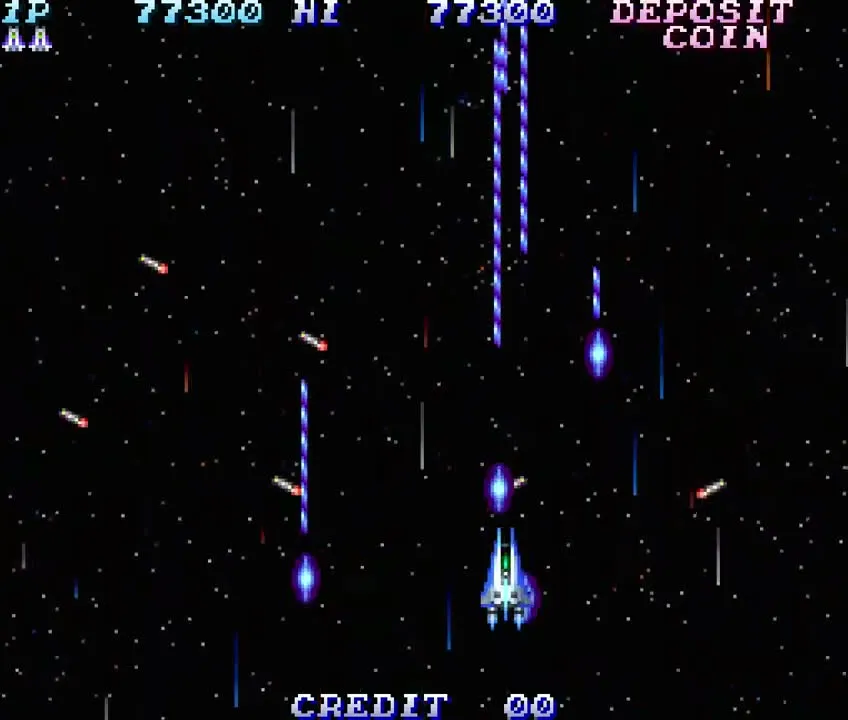
Stage 6’s final approach — a screen-wide bullet wall twenty-two months before DoDonPachi made the form an industry. Konami sketches a genre it would never commit to and walks out. Salamander 2 · Konami, 1996.
The R-Type homage of Stage 4 sets it up. The Giant Battleship section flies the player along the underside of titanic capital ships, the kind of horizontal capital-ship architecture Irem invented in 1987 and Gradius II had translated to Konami’s vocabulary by 1988. Salamander 2 renders the homage in pre-rendered greys against the deepest starfield on the board. The boss, Tenny Rop — a Tetran callback to Gradius II, the wording itself a franchise signature — closes the stage as cleanly as anything Konami had shipped in the cabinet era.
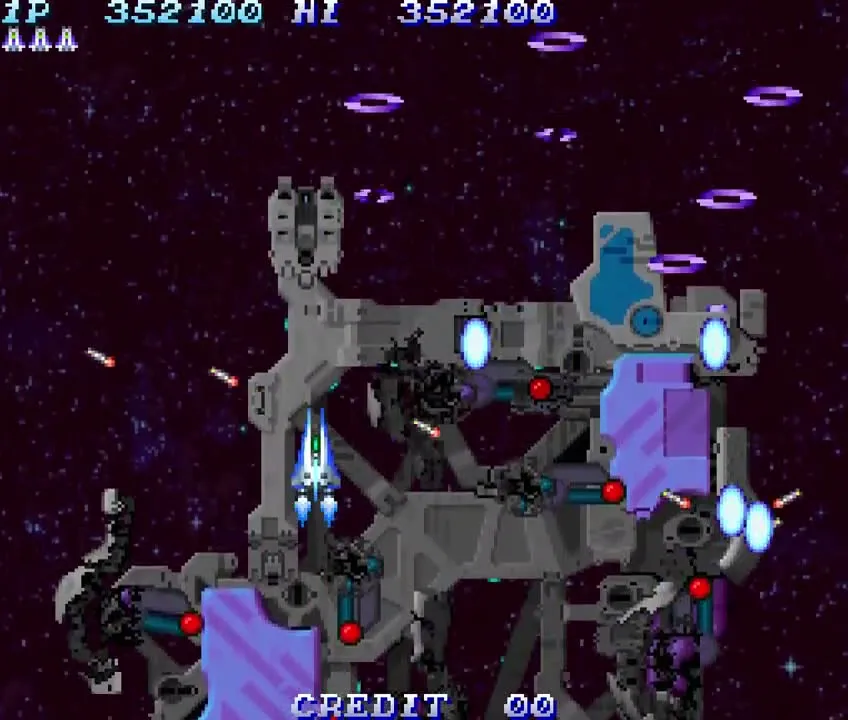
Stage 4 — the R-Type homage rendered through Konami’s pre-rendered CG, with the Tetran-callback boss Tenny Rop waiting at the top of the screen. The franchise’s whole capital-ship vocabulary in one stage. Salamander 2 · Konami, 1996.
What the cabinet does not offer is the depth its competitors did. Gradius III in 1989 and Gradius Gaiden the year after Salamander 2 both gave the player Edit Mode — a loadout grid before the first shot. Salamander 2 ships you Vic Viper or Super Cobra and a fixed weapon tree. A complete one-credit run is twenty-five to thirty minutes; Edge gave it 6/10 in 1996 and called the runtime short, and it was right. The Biohazard stage’s palette is genuinely flat. Some readings of those flaws are wrong — the colour-sense complaint underrates how much of the look is a deliberate transitional aesthetic — but the brevity, the absent customisation, the no-checkpoint generosity that comes at the cost of Gradius’s strategic stakes are honest costs. The game asks the player to take a short, generous, organically-styled hour. It is not asking for more than that.
Twenty-Nine Years to the Rest of Us
The flyer-back diagram on the wall in the second figure of any operator’s Salamander 2 cabinet is the artefact that Game Criticism should have read more slowly.
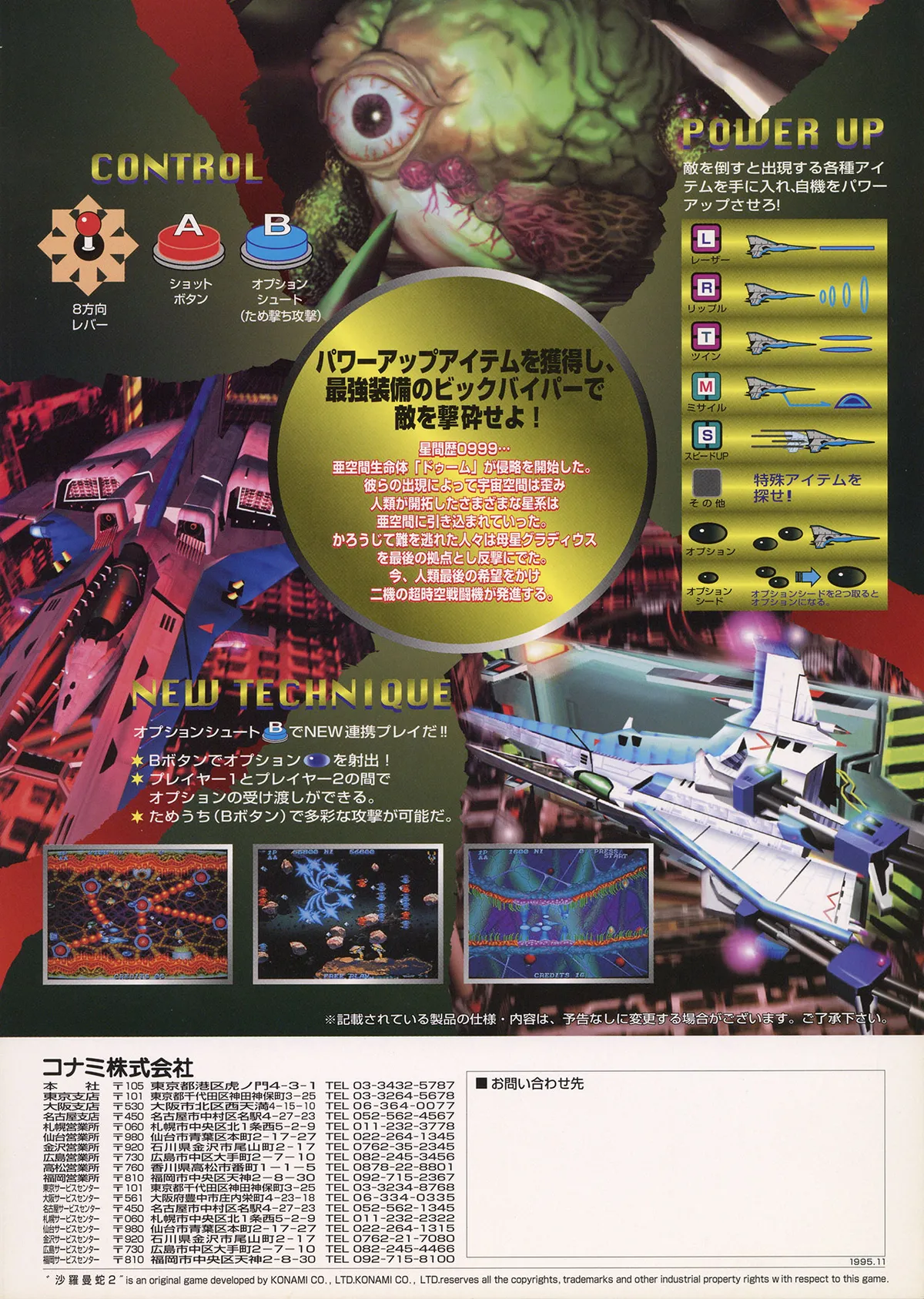
The 1996 flyer back, diagramming the mechanic the magazines would call useless within months. Konami’s own marketing department had it figured out — the launched Options leaving behind Seeds, the recovery loop, the boss-fight payload. Salamander 2 · Konami, 1996, Japanese arcade promotional flyer.
The diagram names what the prose did not: a New Technique, illustrated with the Vic Viper launching its Options and the resulting Seeds orbiting at reduced size. Konami’s marketing department had the system figured out before the operators received the boards. The trade press did not, and the cabinets came home in numbers the company never bothered to release. For the next twenty-nine years the only legal way to play the game was a 1997 Saturn / PlayStation compilation that sold inside Japan, a 2007 PSP bundle that sold inside Japan, or a MAME ROM. Salamander 2 became the longest-untranslated game in the Gradius lineage by a margin no contemporary would have predicted in early 1996.
The August 2025 Gradius Origins collection ends the wait. M2 — the preservation studio behind the Sega Ages line, Toaplan Arcade Garage, the Aleste Collection — has restored the arcade ROM with save states, rewind, a training mode that lets the player open the second-loop remixes without grinding to them, online rankings, and a region toggle that switches the cabinet between every regional build that ever existed. The collection bundles six other Gradius and Salamander cabinets and a new entry, Salamander III, the first new Salamander in over a decade. Konami’s own EU launch press release flags Salamander 2 among “regional versions previously unavailable internationally.” It is the corporate version of an apology.
What it gives the modern player is a six-stage, twenty-five-minute, instant-respawn Konami shooter with the kindest continue economy of any 1990s cabinet the studio shipped, the strangest organic art direction in the Gradius canon, a Mariko Tokida boss roster that has aged into precisely what the eye now wants from arcade CG, and a scoring system whose central mechanic Game Criticism misread in print. It is not the most beautiful 1996 arcade output Konami had — Sexy Parodius outranks it on that board — and it is not the most ambitious — Gradius Gaiden would arrive a year later for the home and would offer the customisation the cabinet refused. But it is the most legible Salamander Konami ever shipped, and the one the West has been allowed to read the longest while having no access to it at all.