In the opening minutes of Trip World there is a large round creature that looks faintly unnerving, the size of half the screen, with the kind of slouched posture a cartoon ogre has in a children’s book. It stands in your path. The game has already taught you to kick. You kick it. It becomes hostile, charges you, hurts you badly, and you spend the next minute trying not to die. Reload, or simply try again: walk past it. It does nothing. It lets you through. It had been friendly the whole time. The thing that turned it into a threat was you.
Yuichi Ueda’s 1992 Game Boy platformer is commonly catalogued as short, easy, beautiful, and expensive — a lovely curiosity from a developer otherwise famous for harder, sharper games. That description is not wrong, but it reads Trip World as a smaller version of something else, when it is in fact arguing with the thing it is smaller than. Ueda built it as a refusal. He disliked how platformers of the early nineties treated the player, disliked their punishing physics, disliked the convention that touching an enemy should automatically cost health, and disliked the unspoken rule that a game had to be completed to be worth anyone’s time. Every design decision in Trip World is a pushback against one of those ideas. Read it that way and the short running time stops being a flaw and becomes the point.
A Studio Looking the Other Way

The title card carries the flower the whole game is about retrieving. Trip World · Sunsoft · Game Boy, 1992.
By 1992 Sunsoft had a house style and a reputation. Blaster Master, Batman, Journey to Silius, the Fester’s Quest everyone likes to pretend was better than it was — Sunsoft games were mechanically tight, audiovisually showy, and mostly hard. That same year the studio released Gimmick! for the Famicom, a game so precisely calibrated that it is still cited thirty years later as one of the hardest and most beautifully engineered 2D platformers ever made. It was Gimmick! that started Trip World, not as a sequel but as its quiet opposite.
Yuichi Ueda has said that Sunsoft let him make the game he wanted, with almost no oversight, and what he wanted was a platformer that did not ask the player to master anything. He liked what Gimmick! was, and he did not want to make it. The early nineties consensus — that difficulty was a proof of seriousness and forgiveness was for children’s software — was exactly the consensus he was writing against. What makes that interesting is not that Ueda disagreed, but that Sunsoft, mid-way through producing a console platformer that wore difficulty as an identity, also shipped, from the same building, the design argument against it.
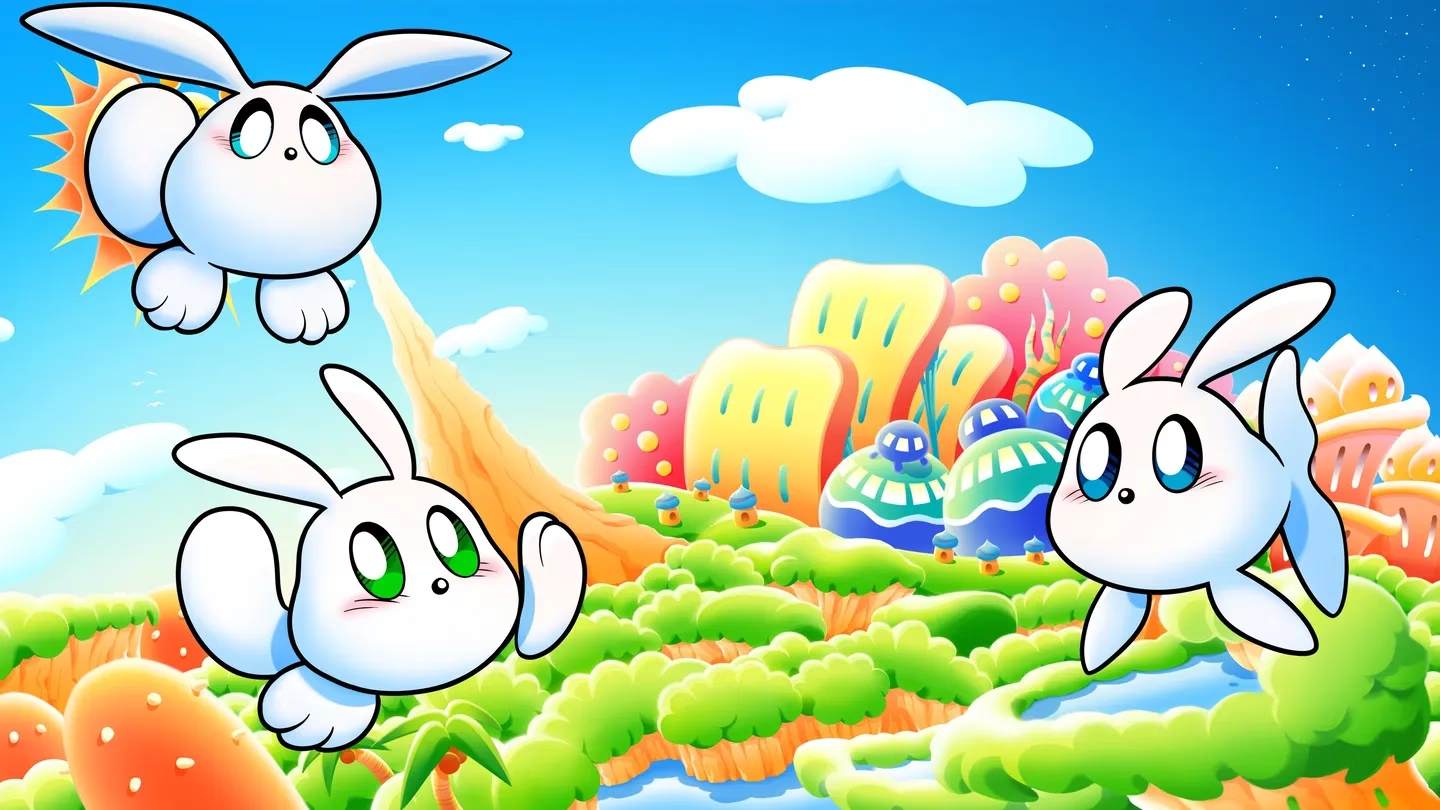
That argument is legible in every screen. Yakopoo, the rabbit-like protagonist, does not take damage from touching enemies. He is an extraordinarily good platformer — his jump arcs feel generous, his kick has no wind-up, he transforms into a fish to swim and a winged form to glide and a flower to hover — but the things he can do are almost all about being where he wants to be, not about surviving where the game has placed him. Where most 1992 platformers ask whether you can survive a stage, Trip World asks where in the stage you would like to stand.
The Mechanics of Not Hurting You
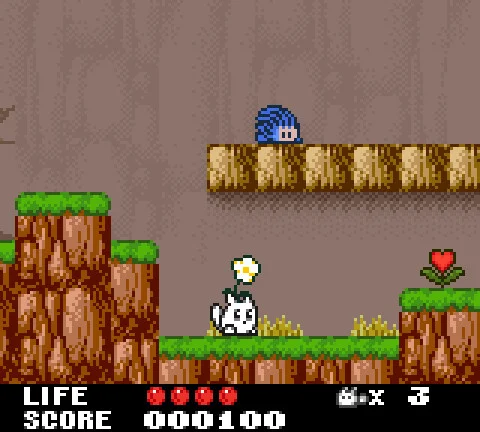
Flower-form Yakopoo near a resting creature that neither attacks nor flees. Trip World DX · Sunsoft / Limited Run Games, 2023.
Touch damage is the invisible architecture of most side-scrolling action games. Mario gets smaller. Mega Man flashes. Contra dies outright. The rule is so universal that designers stopped thinking of it as a rule — it is simply the grammar of the genre, a physics law inherited from the first generation of arcade platformers and never questioned. Ueda questioned it. He thought, plainly, that it did not make sense for a thing to hurt you just by being in the same place as you, and he built Trip World without it.
”I thought it was strange that enemies could hurt you just by touching you. It didn’t feel natural.”
— Yuichi Ueda, paraphrased in Trip World DX’s museum-mode developer interview, 2023
The consequence, once you feel it, is disorienting. Creatures walk near you without becoming a crisis. Several of them will actively ignore you and continue what they were doing. Some will fight back only if attacked first — the big round creature at the start is not an outlier but a tutorial. The game is full of passive bystanders that exist to give the woodland some texture, and the pleasure of traversal comes partly from learning to tell, by body language, which is which. There are real enemies, and they can hurt you through their deliberate attacks, and a few of the late-game encounters are genuinely dangerous. But the baseline state of being in the world is not combat. It is walking.
Against that backdrop, the transformation system reads differently. Yakopoo can shift into a land form with a short kick, a fish form that swims and fires, and a winged form that glides; temporary pickups turn him into a bouncing invincible ball, a spinning flower, and other shapes that resemble nothing so much as a child’s drawing of a good mood. These are framed in most writing about the game as combat options. They are better understood as traversal moods. The fish form is not for killing things in water; it is for being in water. The wings do not have an attack; they have a gentler fall. The flower bounces. What Trip World has built, quietly, under cover of a platformer vocabulary, is a movement game.
Five Stages, Twenty Minutes, No Apology
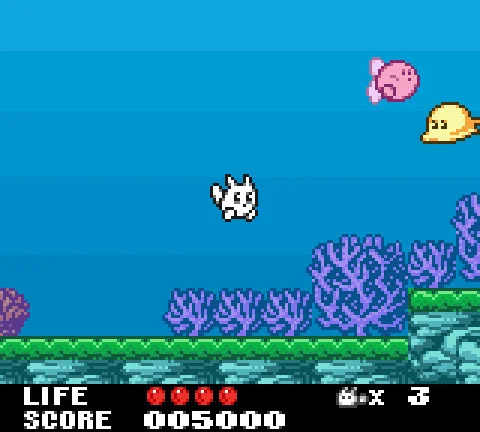
Fish-form Yakopoo: the swim stage as a mood, not a hazard. Trip World DX · Sunsoft / Limited Run Games, 2023.
This is where most coverage of Trip World stalls, because a twenty-minute action game written for an eight-hour genre is genuinely strange, and the easy thing to say is that it is too short. Several contemporary reviews said exactly that. Retrospectives still say it. It is the single most frequent complaint in the game’s reception, and it is the reading Trip World was built to reject.
Ueda has been consistent on this: he believed the assumption that a game had to be beaten to be enjoyed was wrong, and he wanted to make something that was pleasurable to be inside for however long you were inside it. Trip World is therefore designed to be completed. Not easily — even though almost everyone completes it — but completably, as a deliberate stance. It has no game-over screen that sends you back to the start of a chapter. It has no difficulty spike meant to filter the determined from the casual. It has no late-game gauntlet that retroactively recasts the earlier stages as preparation. It is five stages long because five stages is enough to see what it has to show you. The short form is load-bearing.
Read alongside Gimmick!, which is its contemporary and spiritual sibling inside the same studio, Trip World is not a lesser version of a hard game. It is a second answer to the same question about what a platformer is for. Gimmick! says: a platformer is a test you pass by getting better. Trip World says: a platformer is a place you go.
Priced Out of Its Own Argument
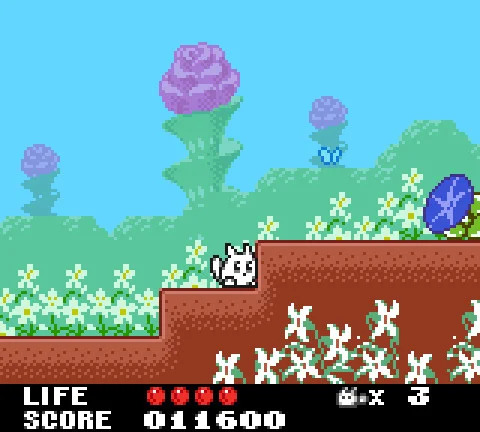
Most of Shabubu’s creatures simply go about their day — the pleasure of traversal is learning which ones bother to notice you. Trip World DX · Sunsoft / Limited Run Games, 2023.
The commercial history did the game few favours. Sunsoft of America passed on it; Trip World shipped in Japan on 27 November 1992 and drifted into Europe the following year in small quantities. It was never released in North America. The PAL cartridge became, by quiet accident, one of the rarest things on the Game Boy, and collector prices have tracked upward for two decades. Boxed copies routinely sell above two hundred and fifty dollars. Loose carts are not cheap. It is a small irony that a game about refusing to treat the player as an obstacle became, for most of its afterlife, an obstacle that the player had to overcome to play at all.
That rarity has also shaped the game’s critical reputation. Because so few people played Trip World in its actual commercial window, the discourse about it is disproportionately post-hoc — YouTube videos, blog retrospectives, collector lists. Much of it is affectionate, but much of it also reads the game through the lens that rarity encourages: as artefact, cult object, lost gem. Those are not frames Ueda built the game for. Trip World is not a hidden classic waiting to be rediscovered. It is a design argument that would rather be played than framed.
A Color Version Thirty Years Late
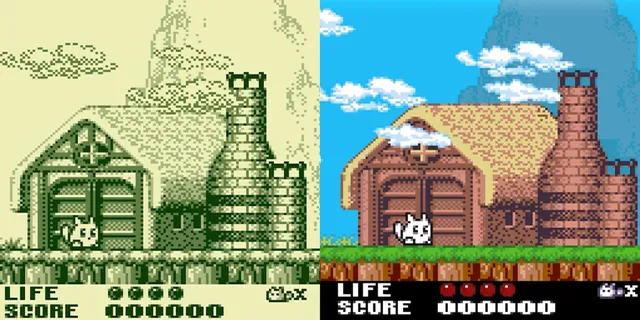
The same Shabubu village in monochrome and in the 2023 Game Boy Color build Ueda had only sketched in the nineties. Trip World / Trip World DX · Sunsoft / Limited Run Games.
There is a postscript. Ueda has said in interviews for the 2023 remaster that he had begun a Game Boy Color build of Trip World in the mid-nineties, and then abandoned it. Limited Run Games and the Carbon Engine team, working directly with him, finished that build thirty years later. Trip World DX ships both the monochrome original and a colourised version that is not a filter over the ROM but a ground-up port that runs on real Game Boy Color hardware, to the specification Ueda had sketched and never completed.
It is tempting to call this closure. It is not, quite. The monochrome version is still the game Ueda actually made, and its limits — the four greys, the little square screen, the compact sound chip — are part of the argument. What the colour version offers is a wider audience, and a designer who finally gets to see his work shelved alongside the platformers that became canon while his did not. The museum mode that ships with the remaster includes his design documents and video interviews, and they are worth watching: Ueda talks about Trip World in 2023 with the same quiet conviction it had in 1992. He did not think the idea needed defending then. He does not think it needs defending now.