// import combatPoster from ”../../assets/images/terranigma-1995-combat-poster.jpg”; // deleted
There is a moment early in Terranigma — perhaps twenty minutes in, before you have had time to settle into its rhythms — when the game asks for something games rarely ask at all, then or now. It asks you to resurrect a continent. Not conquer it. Not explore it. Resurrect it. You press the action button over a dark, frozen landmass, and the earth exhales. Flora erupts. Rivers find their courses. The world wakes up. And you understand, almost immediately, that you are not here to save the world in the usual sense. You are here to make it. That shift — from hero as conqueror to participant in the making and burden of a world — changes the emotional texture of everything that follows.
This is the final, scorched-earth masterpiece of Quintet, the studio that defined the “restoration RPG.” It is a game that famously missed North America, vanished into a legal abyss, and took its lead creator with it into the shadows of history. It is arguably the most ambitious title ever squeezed onto a 16-bit cartridge — a story that spans the evolution of life from single-celled organisms to the industrial revolution. To play it today isn’t just a retro exercise; it’s an encounter with a philosophy of game design that the industry has largely forgotten: that the most heroic thing you can do isn’t to destroy, but to rebuild.
The Burnout of a Greatest Hits Studio
The story of Terranigma — known in Japan as Tenchi Sōzō (The Creation of Heaven and Earth) — is inseparable from the collapse of the studio that built it. Quintet was founded by Tomoyoshi Miyazaki and Masaya Hashimoto, the creative engines behind Nihon Falcom’s early Ys titles. They arrived at their new studio with a specific ambition: an RPG that would depict the entire life cycle of a planet.
By 1995, Quintet was “pretty damn burned out,” as Hashimoto later admitted. They had spent years refining the “Soul Blazer Trilogy” — Soul Blazer, Illusion of Gaia, and finally Terranigma. They viewed Terranigma as their “Greatest Hits,” a desperate attempt to synthesize every mechanic and theological question they had ever poked at into one definitive statement. You can feel that exhaustion in the game’s melancholy. It is the work of creators who knew they were at the end of their rope, pouring every remaining ounce of imagination into a torus-shaped world where the sun-lit surface and the dark interior are locked in a fatal, symbiotic embrace.
“I wanted to create something where the player feels the passage of time on a global scale,” Miyazaki noted in a 1995 interview. That ambition nearly broke the studio. The team was so focused on the density of the world that they abandoned a nearly completed version of the game five years earlier, realizing the 4MB cartridge limit couldn’t house their vision. They pivoted to ActRaiser to stay afloat, but the “Planet Cycle” idea remained a ghost in their machine until the hardware finally caught up with their hubris.
The Industrial Evolution of a Toybox
Terranigma doesn’t just change its story; it changes its genre every five hours. It begins as an action-platformer in the underworld, shifts into a planetary restoration sim, and finally settles into a recognizable human history. This middle act is where the game’s argument becomes a mechanical reality through its Economic Growth System.
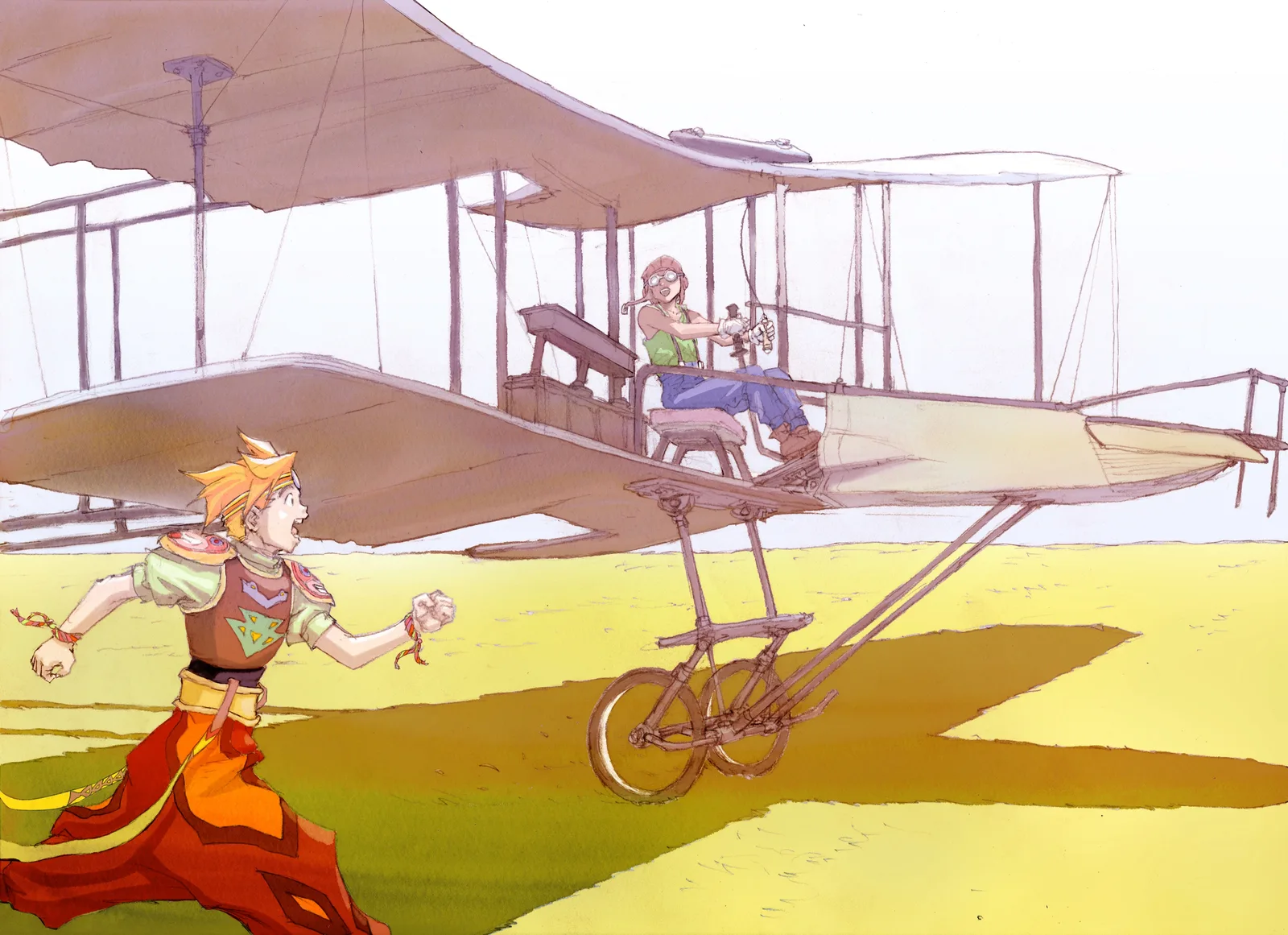
The “airbird” — one of the inventions Ark nudges into existence, and one of the side-stories that shifts a town’s economy for good. Art: Kamui Fujiwara, 2021.
In a move that pre-dates the “settlement building” of modern open worlds, Ark can influence the prosperity of towns like Loire, Freedom, and Suncoast. This isn’t just flavor text; it is a series of interconnected side-stories that mirror the real-world Industrial Revolution. You find a photographer in a small village and help him develop the camera; suddenly, tourism begins to flow between cities, altering their architecture and shop inventories. You assist an inventor with his “airbird” or help a baker refine a recipe, and you watch as the local economy shifts from agrarian subsistence to global trade.
But scenario writer Reiko Takebayashi didn’t make progress free.
”I wanted players to ask themselves if it’s really right to develop this town when it will destroy the natural habitat of these birds.”
— Reiko Takebayashi, Quintet
As you shepherd these towns toward 100% prosperity, you watch the civilization you resurrected begin to destroy the natural world you saved. You are faced with a choice: do you help a town develop a new technology to prosper, knowing it will drive a rare species of bird into extinction? The game doesn’t offer a Good/Evil meter. It simply makes you live with the quiet, empty nests. Complicity becomes a mechanic.
The RPG-Action Philosophy and the Koshiro Shadow
Tomoyoshi Miyazaki famously hated the label “Action-RPG.” He insisted Terranigma was an “RPG-Action” game. This sounds pedantic until you engage in combat. Most 16-bit action games are about reflexes; Terranigma is about physics and coordination. Ark’s move-set — the Slicer, the Flash, the Dash — isn’t a collection of separate attacks but a fluid system of momentum.
Enemies don’t just mindlessly charge; they coordinate. They immobilize you to set up a blow from another direction. They wait for you to commit to a dash before striking from the side. This physicality makes every fight feel like a miniature drama. You aren’t just mashing buttons; you are defending the life you just brought back.
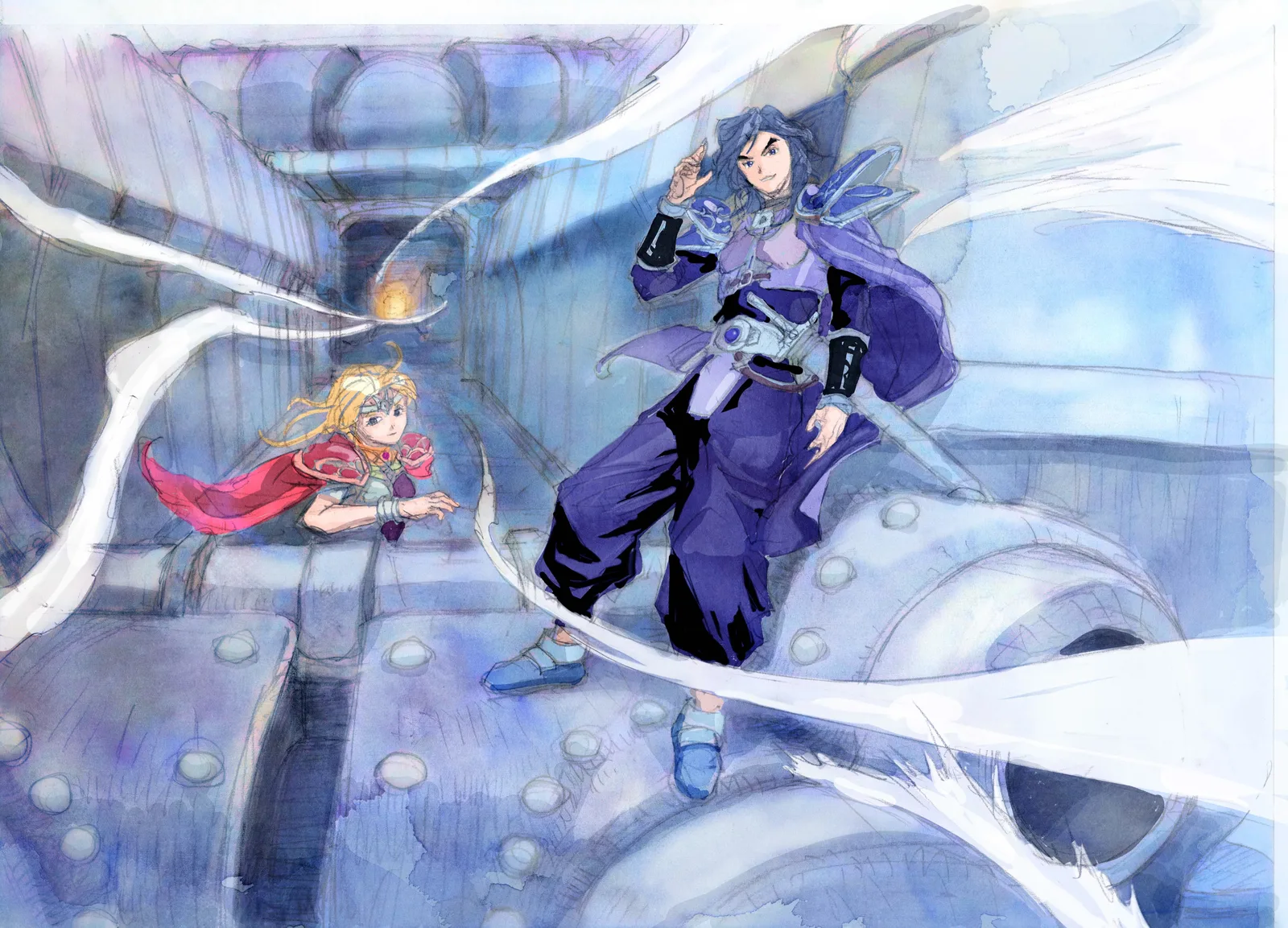
The laboratory interior — where the organic world gives way to human artifice, and where Koshiro’s uncredited synthwork takes over. Art: Kamui Fujiwara, 2021.
The laboratory dungeon in particular stands out for its jarring, synthetic atmosphere. It is here that the legendary Yuzo Koshiro contributed music. Though he went uncredited due to legal entanglements between Enix and Quintet, his FM-synth-inspired orchestration is instantly recognizable. It creates a sonic friction against the organic, orchestral themes of Takaoka and Hikichi, signaling to the player that they have moved from the world of nature into the world of cold, human artifice.
The Philosophy of the Torus
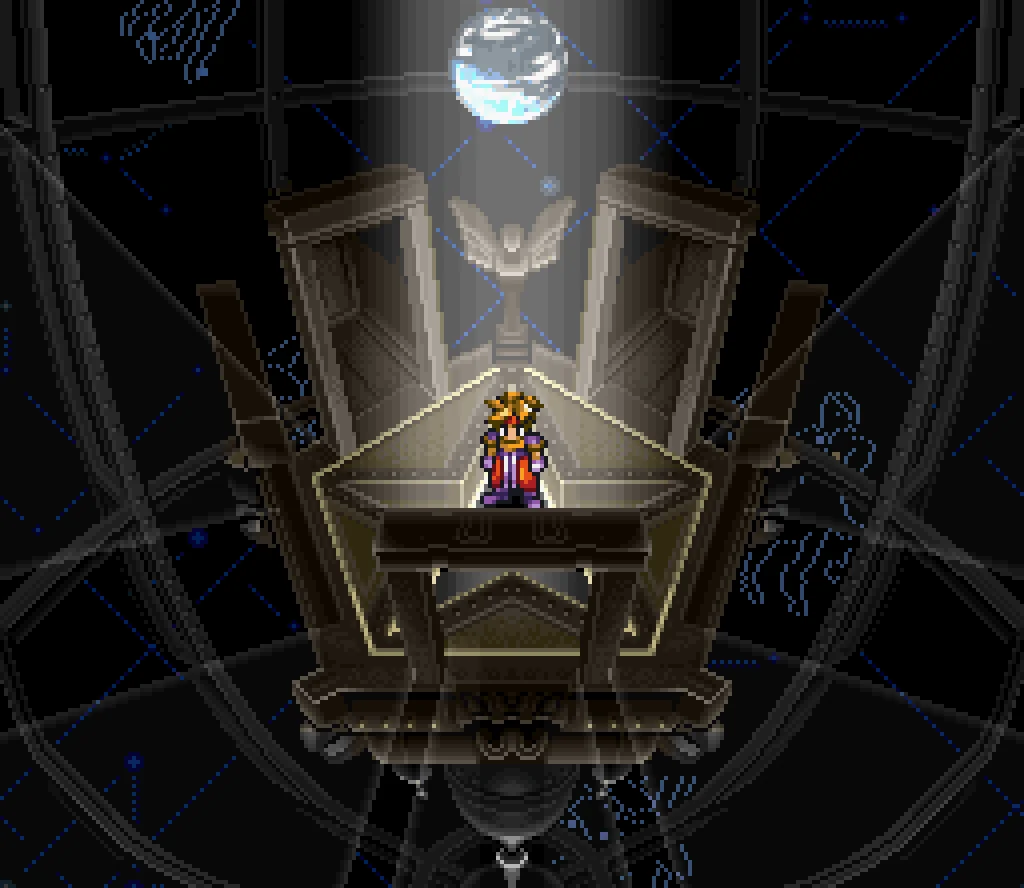
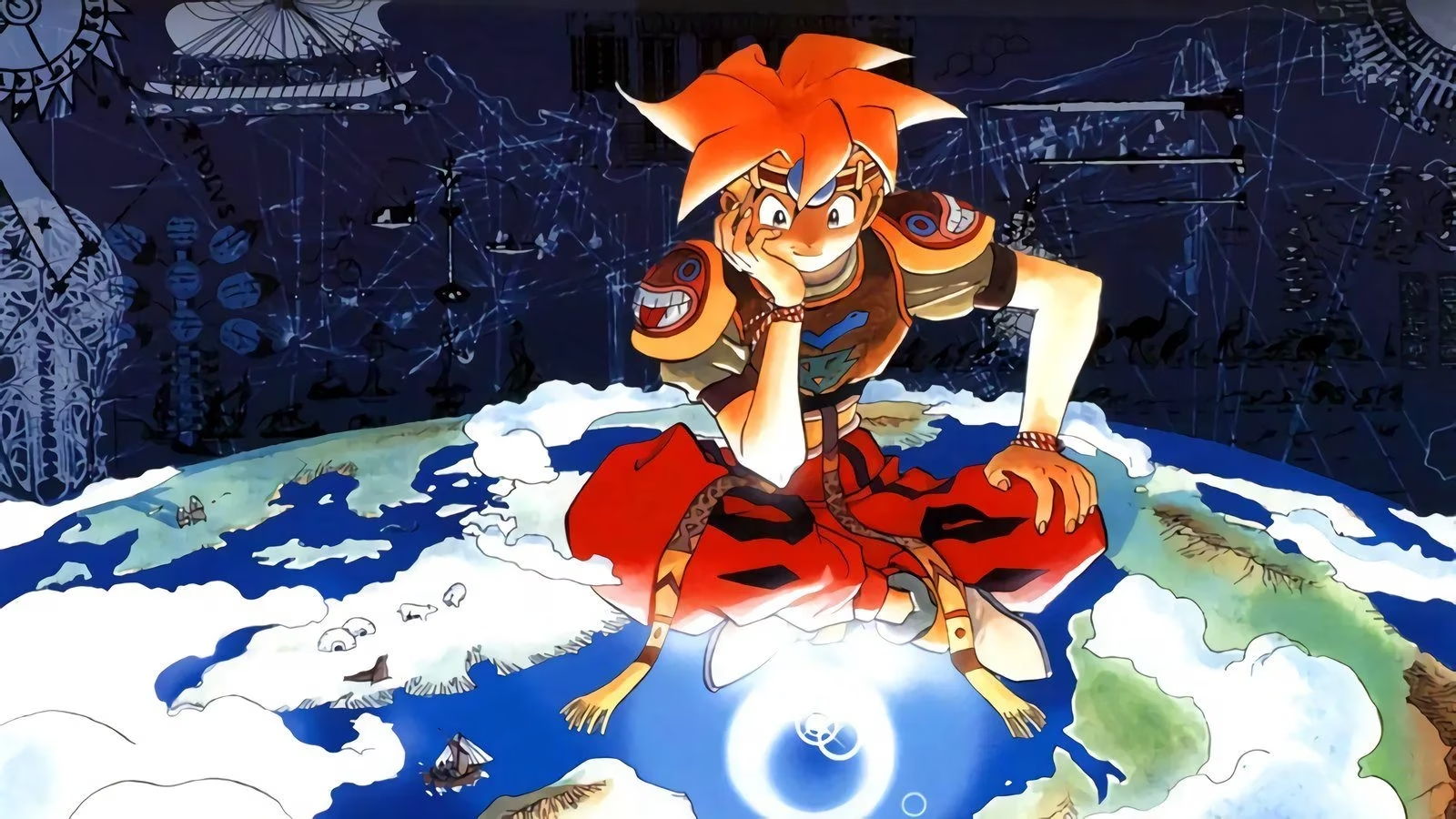
The observatory — the game’s clearest spatial argument, rendered in-engine: a single figure, the whole planet, and the geometry that binds them. Screenshot: Terranigma · Quintet / Enix, 1995.
At the heart of the game’s “Greatest Hits” ambition is the Hollow Earth theory. The world of Terranigma is a torus — a hollow sphere with a dark, crystalline interior (the Underworld) and a vibrant, sunlit exterior (the Overworld). This is not just a cool map design; it is the game’s spatial argument about duality.
In Soul Blazer, you liberated souls from cages. In Illusion of Gaia, you transformed between Light and Dark warriors. Terranigma synthesizes these ideas by making the player the bridge between two versions of the same world. Ark is an inhabitant of the Underworld — the “Dark” side — who is sent to bring light back to the surface. But as the story unfolds, the lines blur. Is the “Light” surface really good if its growth requires the destruction of nature? Is the “Dark” interior evil if it is the only place where the cycle of rebirth can begin?
This is a profoundly Eastern philosophical take on duality, eschewing the Western “Good vs. Evil” trope for something closer to Taoist balance. The “Sun and Moon” are not fighting for dominance; they are sustaining each other. Ark’s tragedy is that he eventually realizes he is a tool of both, a “cleaner” sent to scrub the world’s slate so that the cycle can start over. It is a haunting, existential realization for a 16-bit protagonist to face: that your very success as a “hero” ensures your own eventual erasure from the world you built.
The Ghost of Tomoyoshi Miyazaki
The tragedy of Terranigma isn’t just its North American absence; it’s the silence that followed. The game was localised into English, German, French, and Spanish for PAL territories, but never crossed the Atlantic — Enix had already shuttered its US subsidiary by the time the translation was finished, leaving a completed English build without a publisher to ship it. An entire region lost the game not to commercial failure or cultural friction, but to a closed office. After the early 2000s, Quintet simply… stopped. Their website went dark. Their bulletin boards closed. And Tomoyoshi Miyazaki — the director, the designer, the man who had carried the idea of a planet’s life cycle for fifteen years — vanished from public life.
This disappearance has created a legal “dead zone.” Artist Kamui Fujiwara has publicly speculated that the rights to Terranigma are currently unresolvable because Miyazaki cannot be located for a signature. This makes Terranigma more than just a retro game; it is a “loud absence” in the library of the SNES. It is a world that was resurrected once, only to be frozen again by the complexities of intellectual property.
To play it via a fan translation today feels like an act of digital archaeology. You are digging through the ruins of a studio that told a story about the fragility of life, only to succumb to the same fragility. As Miyazaki once wrote: “The world is a cycle. What goes up must come down. What is built must eventually return to the earth.” He lived his own philosophy to a fault.
What prevents the game from becoming a mere curiosity is its structural audacity. Most games reward you for taking things away — removing health bars, clearing maps, deleting enemies. Terranigma rewards you for addition. When the credits finally roll, the melancholy isn’t a cheap emotional trick. It is the earned result of a game that made you care about the birds before it made you build the city. It is a game about a god who built the world, realized he was only a visitor, and had the grace to let it go.