// import drillSlugPoster from ”../../assets/images/metal-slug-3-2000-drill-slug-poster.jpg”; // deleted
// import mothershipInteriorPoster from ”../../assets/images/metal-slug-3-2000-mothership-interior-poster.jpg”; // deleted
Metal Slug 3 begins like a joke told by artists who know exactly how expensive the punchline is going to be. A crab ambles into a ruined beach. Soldiers panic, roll, sneeze, salute, and die with theatrical precision. A tank the size of a lunchbox rattles under your feet. Then the level splits: down into water, up through a storm-lashed overland route, sideways into a cave where the genre’s military comedy starts mutating into pulp zoology. The cabinet is barely underway and it is already refusing the shortest path through itself.
That refusal is the point. Released to arcades on March 23, 2000, Metal Slug 3 arrived after the Neo Geo had become an anachronism in public. The Dreamcast was alive. PlayStation 2 was launching in Japan. 3D was no longer a future wager but the commercial language of the moment. SNK answered with a 708-megabit cartridge whose box treated the storage figure like a dare. The company was moving toward collapse, but the work on screen behaves like an argument against retreat: make the crab animate better, add the submarine, give the elephant a Vulcan cannon, draw the alien mothership, keep the bit in.
Routes, Not Padding
The obvious way to describe Metal Slug 3 is as excess, but excess is only half the story. Bad excess makes a game bigger by repeating itself. This one makes itself bigger by hiding alternate versions of its own imagination. The branching paths are not perfunctory forks where one corridor is slightly easier than another. They are genre substitutions. Mission 1 can become an underwater vehicle stage, a cave crawl, or a surface route full of giant crabs. Mission 2 turns the player into a mummy if they mishandle the desert ruins. Mission 3 can become a vertical climb through icy tunnels or a sequence with the new Drill Slug, a machine that converts the usual horizontal firefight into a grinding descent.
The result is unusually generous for a coin-op. Arcades usually teach efficiency: show the player the toy, charge them to survive it, move on. Metal Slug 3 instead spends development labour on material many players will not see on a first credit. That sounds commercially irrational until you remember what the series is selling. The pleasure is not only mastery. It is the suspicion that the next screen contains one more hand-drawn gag, one more doomed soldier, one more vehicle that should not exist and somehow does.
Animation As Character
The old praise for the series is that its sprites have personality. True, but too small. Personality here is systemic. Enemy soldiers do not merely absorb bullets; they express a whole comic theology of cowardice. They nap. They cook. They look delighted by food. They scream when their plans become inconvenient. They are individually disposable and collectively unforgettable, which is a strange balance for a game built around shooting hundreds of them.
That animation density changes how the violence reads. The screen is always collapsing from military spectacle into slapstick. A soldier lobs a grenade with deadly intent, then spends his final half-second as a startled cartoon body. The zombies in Mission 2 vomit blood beams with straight-faced grotesquerie. The Mars People, returning from Metal Slug 2, wobble between menace and toy-store absurdity. Even the vehicles have comic body language: the classic Super Vehicle-001 does not glide, it clanks and recoils and shudders like it is offended by its own workload.
This is why Metal Slug 3 has aged with such indecent confidence. Early 3D from the same period often has to be met halfway, forgiven for stiffness because it was inventing a new vocabulary. Metal Slug 3 needs less forgiveness. Its vocabulary was already mature, and SNK’s artists were speaking it fluently enough to waste animation on jokes. That waste is the luxury. That waste is the art.
The animation also keeps the screen readable at full speed. Soldiers telegraph throws, vehicles shake before they fire, bosses expose weak points through exaggerated motion rather than tutorial language. The style is funny, but it is not only funny. It is legibility disguised as excess. When the design is fair, it is fair because the artists have made danger visible through pose, rhythm, and silhouette. When it becomes unreasonable, especially late, the same clarity at least lets you understand the shape of the thing that killed you.
The Slug Cabinet
The vehicle roster is where the design’s childlike logic becomes clearest. A lesser sequel adds a tank and a plane. Metal Slug 3 adds the Slug Mariner for underwater routes, the Drill Slug for subterranean grinding, the Ostrich Slug for ridiculous cavalry speed, the Elephant Slug because someone correctly decided the elephant should carry heavy weapons, and the Astro Slug for the outer-space final stretch. The list sounds like playground escalation, but it works because every vehicle changes the player’s rhythm. The Mariner slows the action into buoyant dodging. The Drill Slug makes terrain feel edible. The Astro Slug widens the battlefield, then turns the final mission into a sideways shooter inside a run-and-gun’s body.
The official developer interview translated by Shmuplations is useful here because the staff talk about ideas that might have been rejected for being too much. In Metal Slug 3, “too much” seems to have been treated as a production target. The third entry takes the first two installments’ anti-war cartoon vocabulary and pushes it into horror, prehistory, science fiction, and kaiju absurdity without losing the crunchy discipline of its arcade controls. You can laugh at the elephant and still die because you mistimed a bullet by one character width.
A Marquee For The End
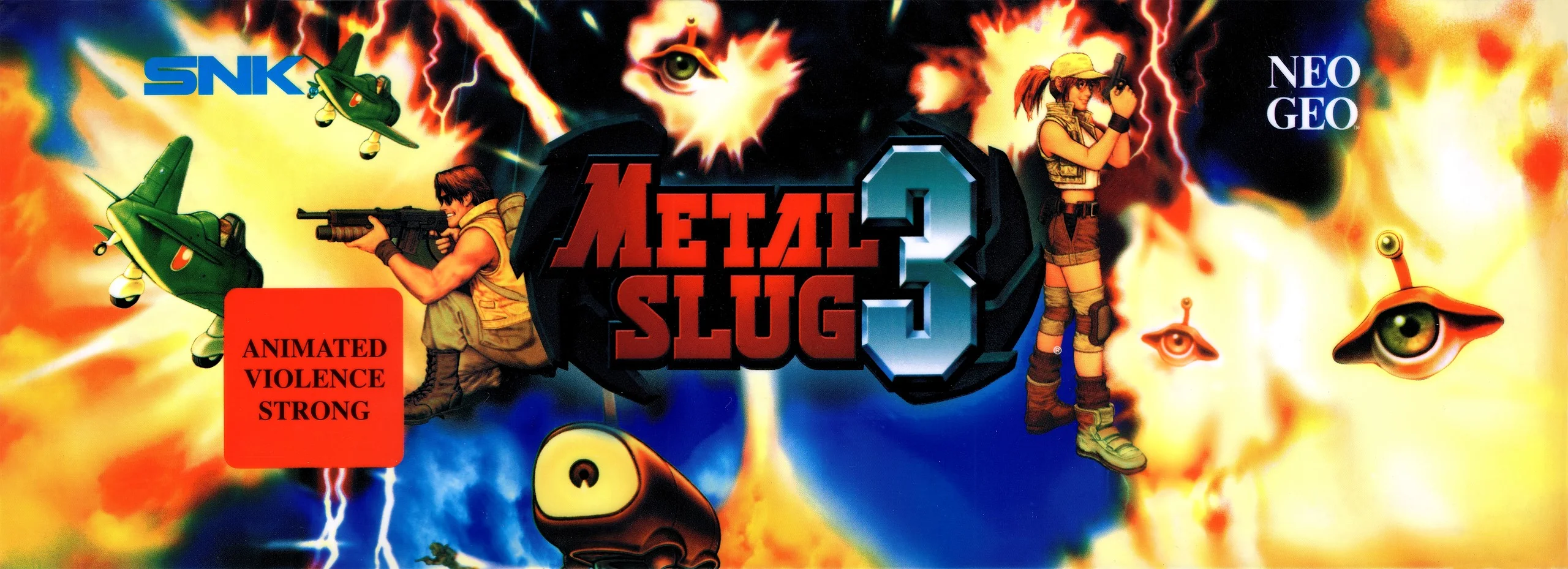
The arcade marquee carries the same confidence as the cartridge: bright, loud, crowded, and utterly unconcerned with looking modern in the 2000 console sense. Marquee image: LaunchBox Games Database.
SNK’s situation gives all this a retrospective ache, but it should not be allowed to flatten the work into a simple “last stand” myth. Metal Slug 3 was not the final Metal Slug game, and SNK’s history after 2000 is messier than a clean elegy. Still, the timing matters. This is a late Neo Geo production behaving as if the correct response to obsolescence is not simplification but density. Production sat with the original Nazca staff folded into SNK after the 1996 acquisition — the same designers, animators, and planners who had shipped the first two installments. The hardware could not impress by texture filtering or polygon count, so they impressed by staging, timing, compression, and labour.
That labour sits in the backgrounds as much as the characters. The series had always made war zones feel absurdly inhabited: laundry lines, signs, tents, food stalls, wreckage, small fires, stray animals, bits of civilian life pressed against military disaster. The third entry stretches that habit into a travelogue of impossible fronts. You are not moving through levels so much as watching the cabinet invent excuses to redraw the world. That is why the branching routes matter aesthetically as well as mechanically; each fork lets the art team change the climate, the enemy ecology, and the joke structure without waiting for the next mission break.
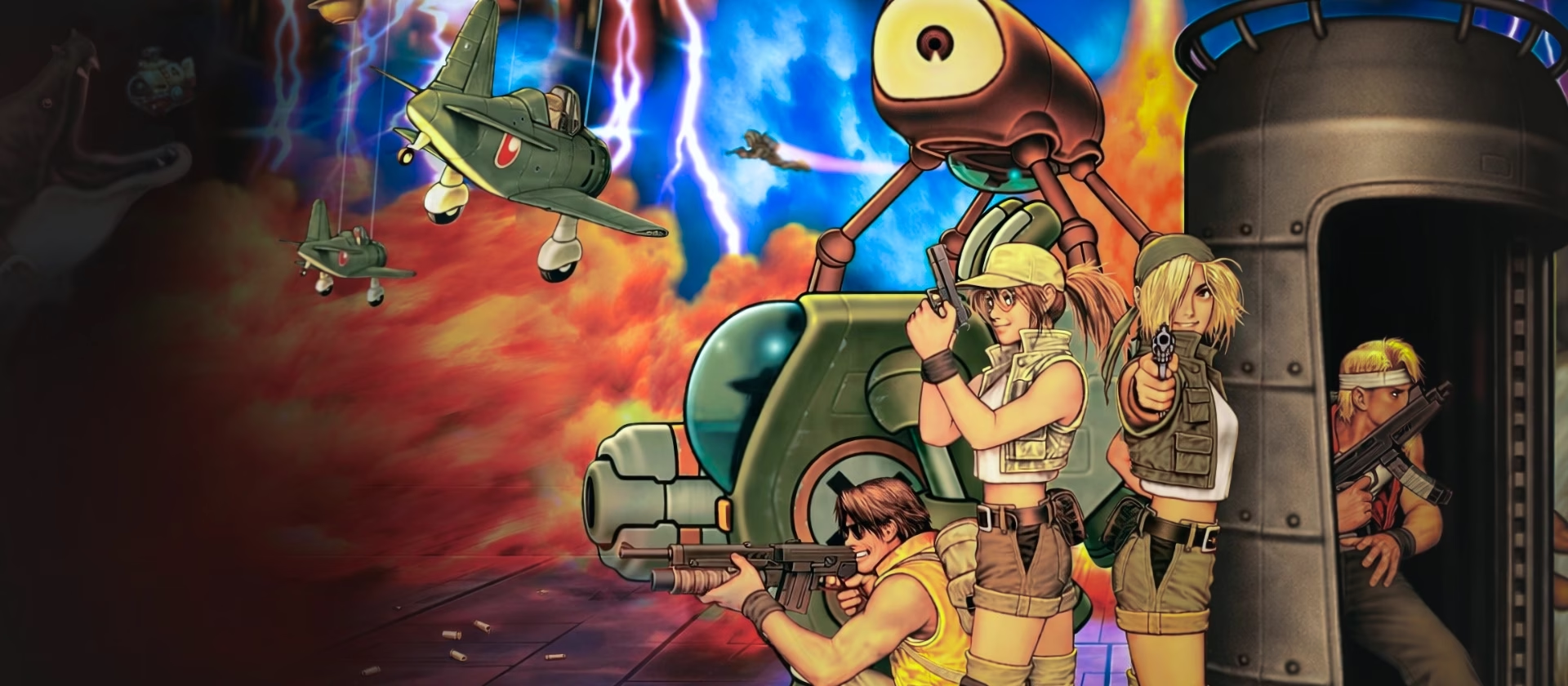
The Japanese flyer makes that argument visually. It does not sell austerity. It sells a world overrun with stuff: heroes diving through danger, alien bodies, war machines, logos, energy, noise. The cartridge itself is even less restrained, changing the backdrop before familiarity can settle. Jungle gives way to submarine trench, desert ruins to zombie infection, snowfield to bug hive, battlefield to space.
The Final Mission Problem
Then comes Mission 5, the level that explains both the series’ reputation and its exhaustion. It is a beach assault, then a vertical climb, then a rescue operation, then an aerial war, then a space battle, then an alien mothership infiltration, then a prisoner escape with the player fighting alongside the very soldiers they have spent five missions destroying. It is too long, in the way a finale can be too long when the creators have decided restraint is no longer useful.
It can be brutal in the arcade. It can also be glorious. The mission reframes the whole series’ joke about endless militarised escalation. The enemy army is suddenly pathetic in the face of a bigger invasion. Morden’s forces become temporary allies not through sentiment but through shared panic. Metal Slug 3 does not become profound, exactly, but it does become strangely complete: all those comic bodies, all that hardware, all those jokes about war machines and human foolishness, finally swallowed by a larger absurdity.
There is a tonal trick in that alliance. Metal Slug spends most of its time making the Rebel Army funny without making them harmless. They are buffoons with guns, and the player is invited to laugh at their routines while cutting through them. Mission 5 turns that long-running joke inside out. The same soldiers who previously existed as slapstick targets suddenly become useful, frightened bodies in the same catastrophe. It is not redemption. It is not even sympathy in a sentimental key. It is the work recognising, for one climactic stretch, that its best cartoon enemies are also the best measure of how far the situation has gone wrong.
That is why Metal Slug 3 remains the one people point to when they need to explain the peak of SNK’s sprite craft. It is not the cleanest arcade object. The first Metal Slug may be tighter. Metal Slug X may be easier to recommend for a brisk run. The third game is bigger, stranger, and less disciplined in the productive sense: a work whose extravagance is inseparable from its identity.
To play it now is to feel a team spending attention with near-reckless commitment. The density is not decoration. It is the message. The business around them was changing. The cabinets were losing cultural altitude. But inside this cartridge, for one last overwhelming hour, the old form still had more to give.