// import carrierFlybyPoster from ”../../assets/images/sin-and-punishment-2000-carrier-flyby-poster.jpg”; // deleted
// import earthMimicryPoster from ”../../assets/images/sin-and-punishment-2000-earth-mimicry-poster.jpg”; // deleted
The voice acting in Sin and Punishment is in English. All of it — every shouted order, every boss monologue, every line of story dialogue. Treasure recorded the whole thing. Nintendo shipped the cartridge in Japan only, at the end of 2000, and did not release it anywhere the dialogue was spoken. The game arrived in the West exactly once, on the Wii Virtual Console in October 2007, when the N64 had been dead for six years. By then, the audience it had been built for finally existed.
The Brief Was America
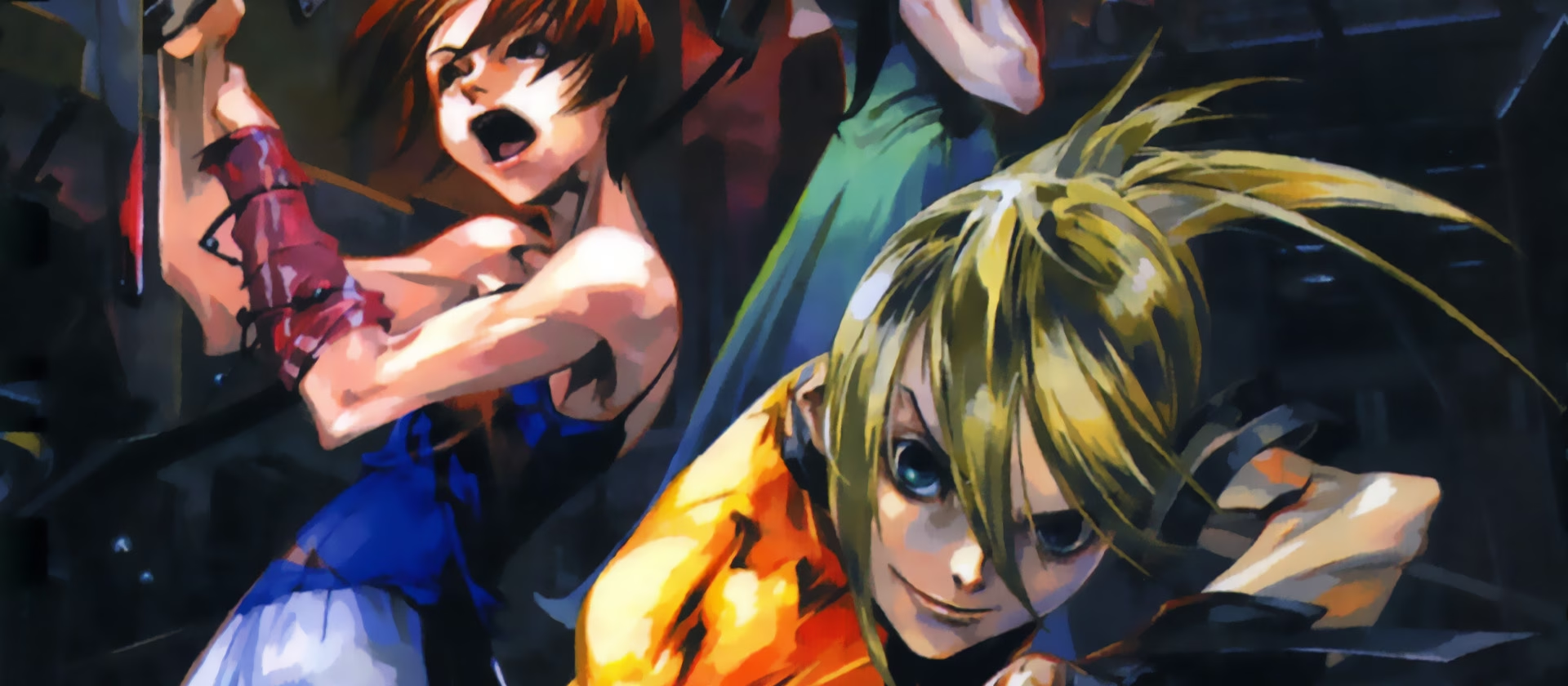
Treasure built Sin and Punishment because Nintendo asked them to. The two studios had met through Mischief Makers on N64 a few years earlier, and Nintendo wanted another collaboration — this time a Treasure action game aimed squarely at the American market. Nintendo supplied a producer from its first-party development division, Hitoshi Yamagami. Treasure supplied a small team, a working title (Glass Soldier), and a character designer, Yasushi Suzuki, whose art would later make Ikaruga and Radiant Silvergun feel like moving illustrations. The brief was explicit: make a shooter an American teenager would want.
”Our intent was to appeal to the American market, but it was ‘America through the eyes of the Japanese’, so we might have been a little off-the-mark. It ended up being only released in Japan.”
— Masato Maegawa, Treasure, in Nintendo Dream (2004)
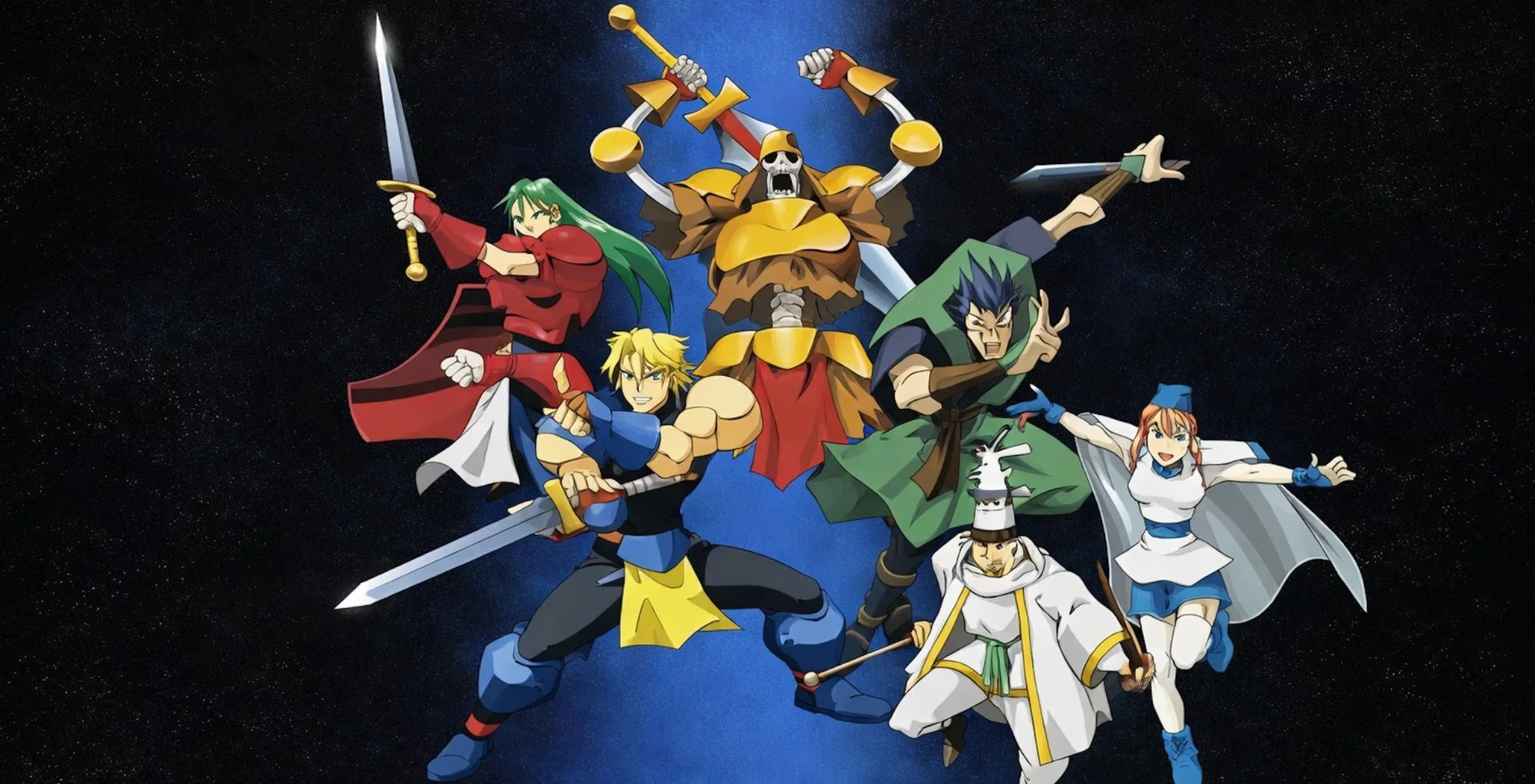
What Treasure produced is an extraordinary object and an impossible sales pitch. The hero is a Japanese teenager named Saki, fighting through a future Tokyo against American soldiers and mutant livestock; the dialogue is English but the cadence is entirely Japanese; the visual design is what Yasushi Suzuki’s pen does to Akira-era sci-fi anime when you ask him to draw something for a Western audience he has never met. Nintendo of America looked at the finished cartridge and quietly declined to localise it for the region it had been commissioned for. The reason has never made it onto the public record. What we have instead is the cartridge — English voices sealed inside a Japan-only release, waiting.
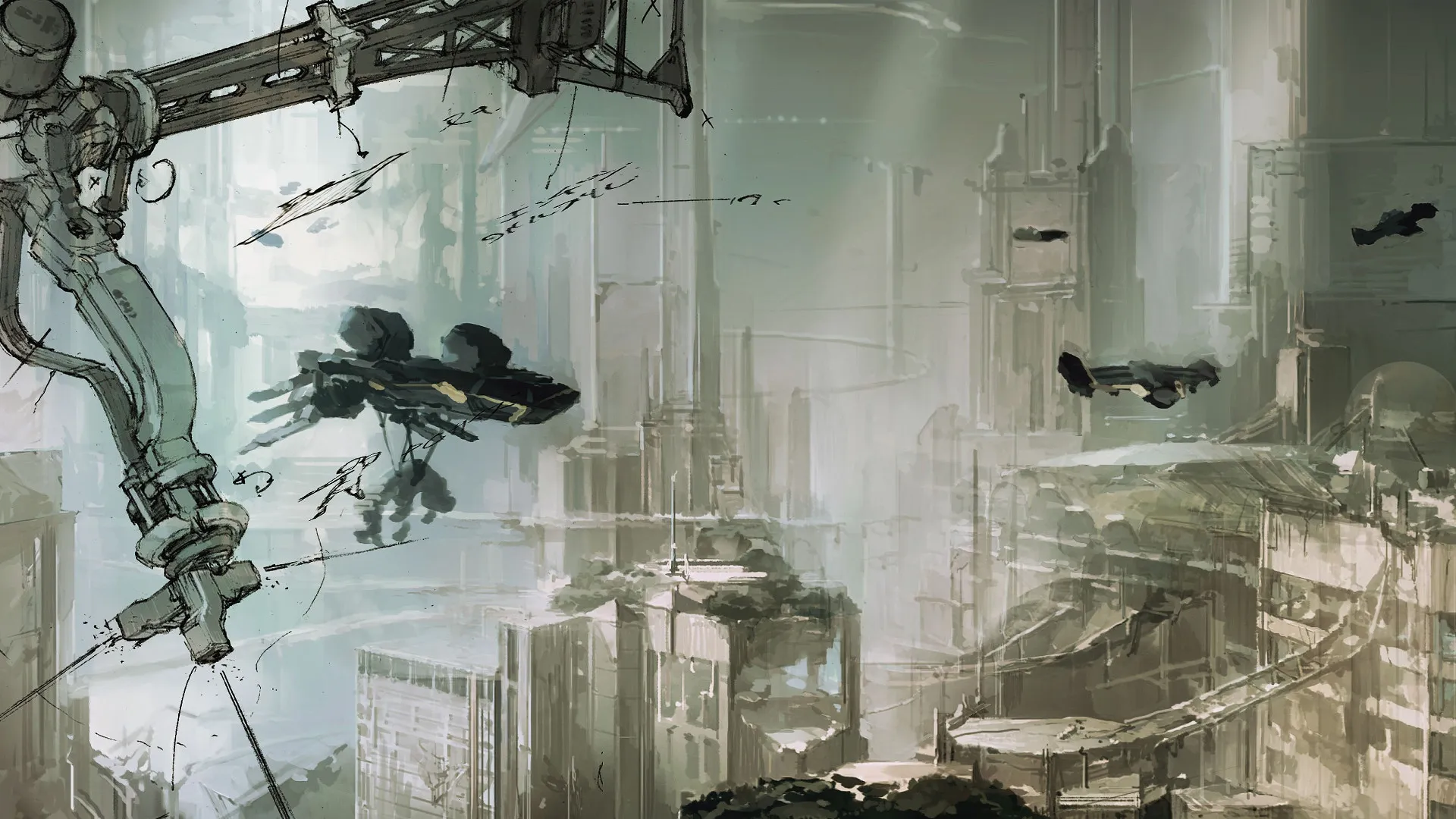
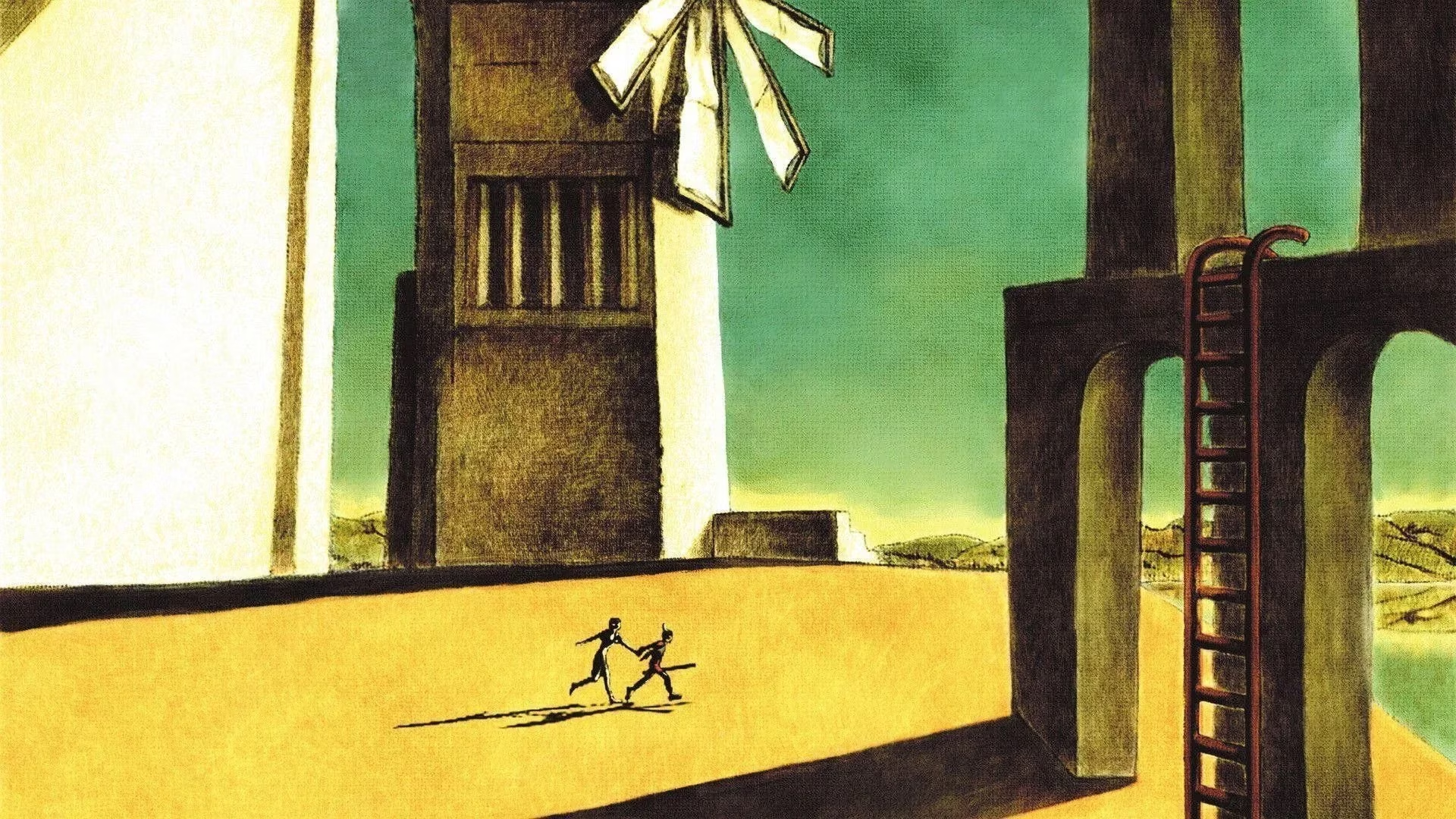
Yasushi Suzuki concept art of the game’s ruined future Tokyo. Sin and Punishment · Treasure / Nintendo, 2000.
A Shooter for the Wrong Hand
The input scheme is the first thing that tells you what kind of game this is. Sin and Punishment is a rail shooter — the camera drives you forward on a fixed path — but the game treats you less like a passenger with a gun and more like a figure skating down the screen under fire. Your left hand runs Saki with the analog stick and dodges with the D-pad, both operated from the N64 pad’s underused left grip position. Your right hand aims the reticle with the yellow C-buttons and fires with the Z-trigger. Movement and aim are fully independent. Both hands are always doing something.
No console game in 2000 expected its players to think this way. The PlayStation’s DualShock had two analog sticks; nobody had figured out yet that one of them should aim. Halo was a year away. Arcade twin-stick lineage went back to Robotron, but nothing on a home console in that shape had produced a game this dense. Treasure looked at an asymmetric pad built around a single analog stick and decided that was fine — they would use the whole thing.
”We thought maybe you could aim with the analog stick and move with the D-pad in the left position. We realized that the independent operations in the left position would be unexpectedly hard for players the first time they tried it.”
— Masato Maegawa, Iwata Asks (2010)
The prose for how this plays at speed is harder than the scheme itself. You are running right to left across an open platform while a cargo aircraft to the north dumps mutant dogs at your rear and a humanoid mech over your left shoulder fires guided missiles. Your left thumb jogs Saki through the missile spread; your right thumb lifts the reticle to the mech’s cockpit; the Z-trigger chatters; the missiles dissolve one by one as your crosshair passes across them. You have done three independent things in a second. The fiction of being overwhelmed coexists with the evidence that you are not.
The Machine That Wouldn’t Work
The cartridge that houses all this is one of the last significant games shipped for the Nintendo 64. Development started sometime around 1997 as a proposal; planning formalised in August 1998; the cartridge shipped in November 2000. Three years is a long time for a six-stage action game that finishes in under an hour, and the reason sits on the record: nobody at Treasure had ever made a real 3D console game before, and the N64 was not a machine that forgave apprenticeship.
”Before the Nintendo 64 system, there had been only entry-level consoles in terms of 3D capabilities. When I suddenly got my hands on a machine for real pros, for about a year it just wouldn’t work.”
— Atsutomo Nakagawa, main programmer, Iwata Asks (2010)
Satoru Iwata, leading that same interview a decade later as Nintendo’s president, agreed in milder phrasing: the N64’s Silicon Graphics architecture had been “just dropped into play,” with “all sorts of limitations.” The machine was hard to use and the team was learning it from zero. Yamagami, Nintendo’s producer on the project, later told Iwata that Treasure ranked among the three most difficult developers he had ever worked with; he also admitted he could have pushed the game out a year earlier if he had leaned on them harder. The difficulty settings were part of the fight. Treasure’s original shipping plan had what is now Hard set as the default, which Yamagami eventually vetoed on the grounds that nobody would ever see the story. Three late-added safeguards — a tutorial, an attract-mode demo, a practice Stage 0-0 framed as a dream sequence — were Nintendo’s concession to the ordinary player.
The game sold about a hundred thousand copies in Japan. Maegawa, on the record in 2001, declined to call it a success. Famitsu awarded it Platinum Hall of Fame status — Treasure’s first — at 35 out of 40. It was the highest score the studio had ever received, attached to the weakest commercial performance.
Fusion in a PCM Stream
The score is the easiest thing to miss on a first playthrough and the hardest to leave behind. Toshiya Yamanaka composed it as a subcontractor — he would later join Treasure full-time and score Ikaruga — working alone on a single Roland SC-88 Pro synthesiser and handing the finished tracks back to Treasure for playback. What Treasure did with them is the technical boast. Where most N64 games fed music through the console’s sequenced MIDI engine, Sin and Punishment streams its soundtrack as raw PCM audio off the cartridge, the same delivery format a CD-based console would use.
”The music of Sin and Punishment has a fierce, dense fusion sound, so even though the N64 was a last-generation console at the time, listeners could feel its power. That was PCM, accomplished thanks to a certain very talented programmer at Treasure.”
— Toshiya Yamanaka, shmuplations (2013)
Yamanaka calls his compositional approach a “wall of sound,” and admits he is not very good at leaving space. On a rail shooter pushing you into three simultaneous threats that is exactly the right failure — the music closes in around the action rather than decorating it, fusion bass lines and brass stabs and drum programming packed to the edges. The cartridge carries about twenty minutes of score. It has never had a commercial release. The only way the music exists outside the cartridge is as gamerips, circulating on YouTube and fan archives, stripped directly from the PCM stream.
The Seven-Year Correction
The Wii Virtual Console release on 1 October 2007 was the first time Sin and Punishment had ever been for sale in the West. Seven years late, on the second console generation after the one it was made for, Nintendo priced it at a thousand Wii Points — a little under ten dollars — and shipped it with English menus over the original English voice track. Frank Provo, reviewing it for GameSpot, noted that collectors by then were paying close to a hundred dollars for a used Japanese cartridge. The audience arrived almost overnight. What had been an obscure Treasure import became, in the space of a week, the piece of writing every Nintendo critic had been waiting eight years to file.
The correction did not stop at 2007. In September 2021, when Nintendo added the N64 library to Switch Online’s Expansion Pack tier, Sin and Punishment received something stranger still: a newly commissioned official Western box art, twenty-one years after the game it wrapped. The art looks a little rushed — Yasushi Suzuki’s character poses cropped tight enough to feel accidental — but the fact of it is the point. A Japanese cartridge from 2000 now has a North American box, retroactively, for a game that never had a North American release. The Virtual Console rescue became a full repatriation: English voice acting, English menus, English box art, and an audience that by now considers the game one of the best things the N64 ever carried.
The real answer to why it works today is mechanical. The control scheme that confused 2000 reads now as an early, articulate statement of the twin-stick idiom the medium would standardise a decade later. Saki moves like Vanquish’s Sam Gideon, like Nier Automata’s 2B, because Treasure had the thought first and nobody told them it wasn’t possible. The rail-shooter camera keeps the run under an hour, which is the right length for how dense it is — a ninety-minute version of this game would be unbearable. You can play it tonight, start to credits, on a Switch you already own, in the language Treasure recorded it in. The audience was the problem all along.