// import pockyAndRockyCoopPressurePoster from ”../../assets/images/pocky-and-rocky-1992-coop-pressure-poster.jpg”; // deleted
The first thing Pocky & Rocky teaches you is how to shoot. Point in eight directions, press the button, spray paper talismans into the waves of kappa and lantern spirits filling the screen. The second thing — the thing the game never says aloud — is that shooting loses. Not immediately; the first two stages are manageable on instinct alone. But late in the game, when enemies pour in from every edge and the air thickens with incoming fire, the impulse to keep pressing the fire button stops being a strategy. What actually wins is the other button — the one you’ve probably been treating as an afterthought. Press your wand toward the incoming projectile and swing at the correct moment. The bullet reverses at double speed and returns to its source with eight times the impact of your regular attack. Pocky & Rocky is a game in which the correct response to aggression is a ceremony.
Borrowed Property, New Cosmology
Natsume did not invent Pocky. Taito created her ancestor in 1986: Kiki Kaikai, an arcade shoot-em-up whose premise stood apart from everything around it. While the genre was overwhelmingly populated by fighter jets and alien armadas, here was Sayo-chan — a teenage Shinto shrine maiden in red hakama — hurling paper talismans at umbrella ghosts and river spirits drawn from Japanese folklore. The concept was remarkable. The execution, critics would eventually note, was not quite its equal: repetitive level design, a toolkit that failed to evolve, mechanics that felt prototype-grade. Kiki Kaikai found a modest audience in Japan and never reached the West. It existed as a game somewhere between compelling premise and unfinished thought.
When Taito licensed the property to Natsume in the early nineties for a Super Famicom title, the brief was a sequel. What Natsume returned was effectively a different game wearing a familiar costume. The miko protagonist remained. So did the tanuki companion, the paper talisman attacks, the gohei wand, the yokai bestiary. But the structure was rebuilt from the foundation. In place of one-hit kills, a health bar and a dedicated slide dodge. In place of monotonous scrolling, six stages with distinct visual identities, bespoke enemy behaviours, and set-piece boss encounters designed to test what the new mechanics could do. Two playable characters with genuinely different move sets. A cooperative system that changed how every fight played out. And at the centre of all of it, a bullet-reflection mechanic the original game never attempted.
The Japanese release landed on December 22, 1992 under the subtitle Nazo no Kuro Manto — The Enigmatic Black Mantle. North America received it six months later, renamed Pocky & Rocky. Pocky is not a corruption of Sayo-chan’s name. It is the name of a Glico chocolate biscuit snack. The localisation chose cuteness over context, and some of what the game means disappeared quietly in translation.
The Ceremony at the Centre
The gohei is a Shinto purification implement: a wooden stick with layered paper streamers, carried by priests and shrine maidens during harae — ceremonies of ritual cleansing. The logic of Shinto purification is not destruction but redirection. The miko does not annihilate evil; she expels it, turns it back upon its source, restores balance. This is the shrine maiden’s professional function. It is what she was trained to do.
Pocky’s gohei in combat does exactly this. It does not fire projectiles. It does not deal damage by connecting directly with an enemy. When the player orients toward incoming fire and presses the wand at the correct moment, the enemy’s own bullet reverses course, accelerates, and returns to its source dealing eight times the damage of Pocky’s ranged attack and more than sixteen times that of a standard melee strike. The game has bombs. It has upgradeable shot spreads that fan out in wide arcs and spiral patterns. It has a fully functional offensive toolkit that never approaches the damage output of what amounts to the correct ritual response: face the incoming impurity, hold your ground, redirect it.
Whether Natsume’s designers consciously built this parallel or arrived at it through gameplay iteration — and no surviving interview clarifies the intent — the outcome is structurally identical to the ceremony it mirrors. The miko positions herself between the community and the threat. She faces the danger directly, wand raised. She does not attack; she purifies. The enemy’s own force becomes the instrument of their defeat.
Western players received a game about a girl with a magic stick fighting goblins. That game is also very good. But the original — where the wand is a haraigushi, the enemies are yokai, and the ritual logic is encoded into the damage tables — is something else.
What the Folklore Carries
The enemies Pocky faces are not invented creatures. Every entity in the game draws from a codified Japanese tradition of supernatural beings — yokai — that exist at the threshold between human experience and something older. Kasa-obake are animated umbrellas counted among the tsukumogami, objects that acquire a spirit after a hundred years of use. Chochin-obake are paper lantern ghosts, creatures of ill-lit thresholds. Tengu are mountain spirits associated with martial pride and misdirected power; kitsune are fox spirits capable of deception and transformation, traditionally both dangerous and protective depending on whose household they favour.
The game’s antagonist, Kuro Manto, the Black Mantle of the Japanese subtitle, is a cloaking spirit — the precise category of malevolent entity that harae ceremonies were designed to address. Pocky is not on a fantasy adventure. She is doing her job.
Natsume’s artists rendered this with unusual specificity. The sprite work is not simply cute in a generic 16-bit mode: it is iconographically accurate in ways that only matter if you know the source material. Kappa have their characteristic water-dish skulls. Tengu wear their elongated red noses. Stage environments pull from recognisable Japanese settings — forest shrines, castle gates, night festival grounds — with the kind of visual fluency that comes from working inside a tradition rather than borrowing its surface texture.
Composer Hiroyuki Iwatsuki worked in the same register. For the water effects in the river stages, he did not reach for a digital sample library. He recorded actual water dripping into a bucket. He later named the staff roll music for Kiki Kaikai: Nazo no Kuro Manto his favourite piece he ever wrote.
”Of all the music I’ve composed for games, the staff roll music for Kiki Kaikai: Nazo no Kuro Manto is my favourite. I poured everything I had into that one.”
— Hiroyuki Iwatsuki, Shmuplations interview
This is the level of investment running beneath a game that most Western players encountered as a mildly charming action title with an unusual setting.
Two Characters, One Design Philosophy
Rocky is not a second Pocky. The period’s standard two-player solution — a palette swap, identical statistics, take turns on the same mechanics — would have been cheaper and easier. Natsume chose differently. Manuke the tanuki, renamed Rocky for Western release, has different mass, different defensive logic, and a different relationship to the game’s central problem of projectile density.
His bombs spread wide on the horizontal plane, trading the concentrated force of Pocky’s narrower arc for coverage area. His slide carries him further but takes longer to recover. His unique ability — a brief transformation into a stone statue, immobile and fully invulnerable — is not an offensive tool. It is a position-hold: convert to stone, let the threat pass over and around you, return when the pattern creates an opening. Rocky’s entire toolkit is built around patience and terrain management. Pocky is faster and more direct. Rocky builds space for Pocky to use.
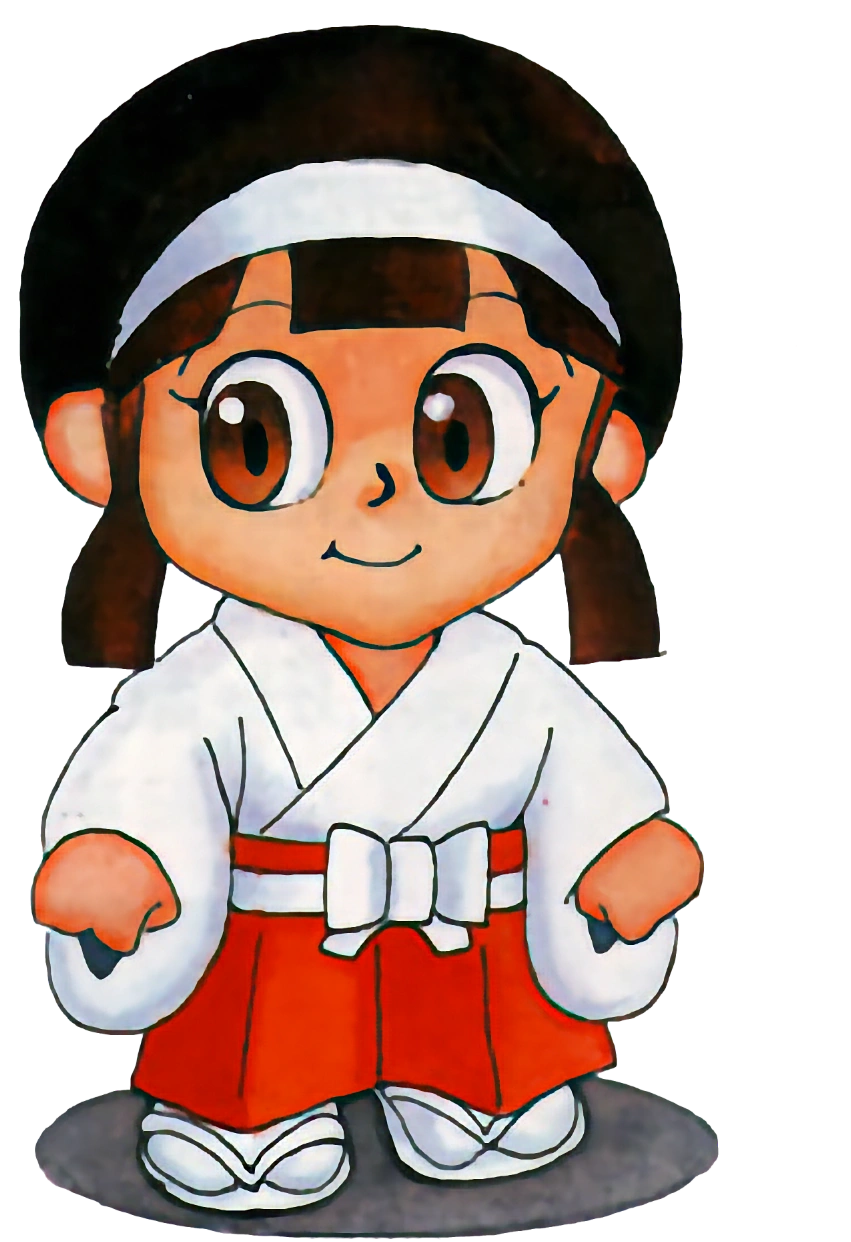
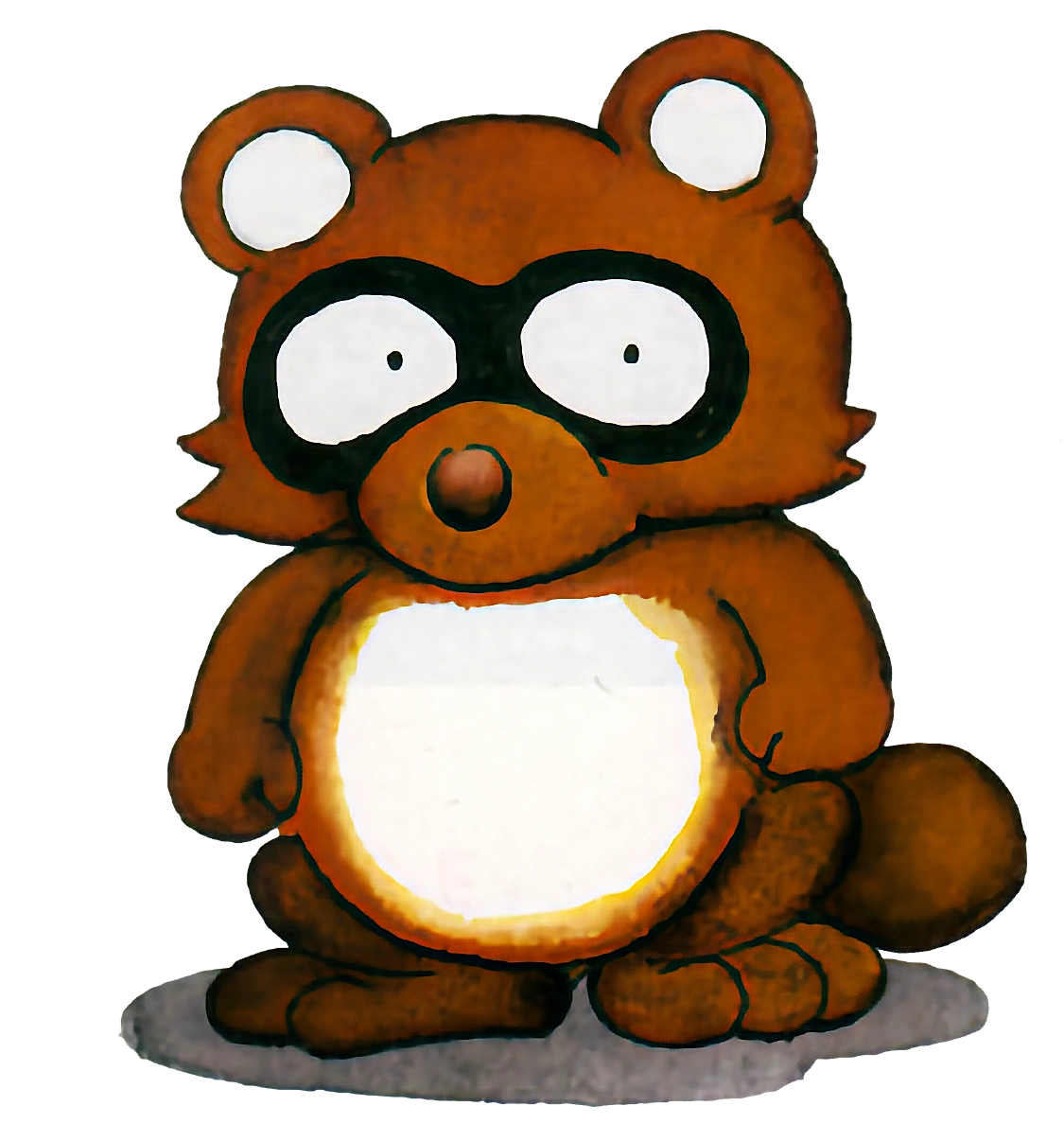
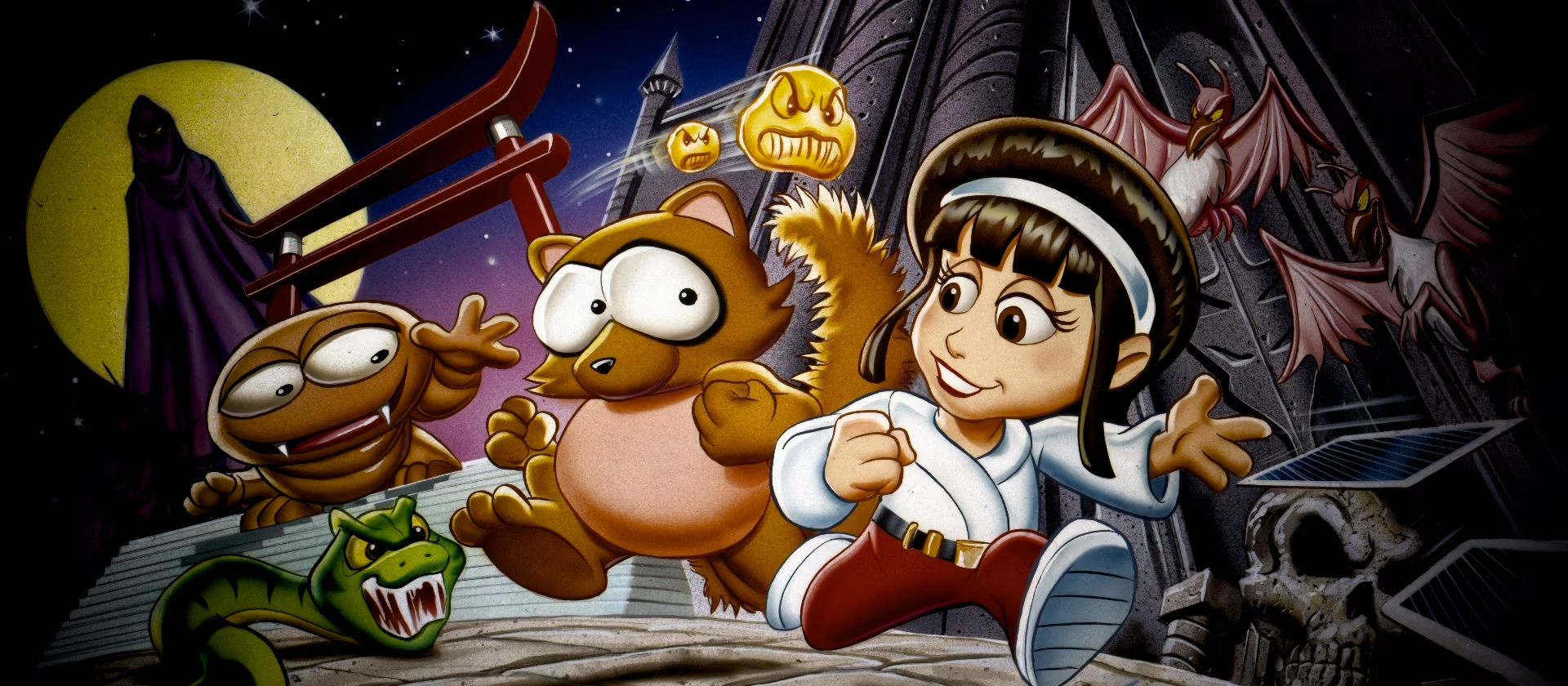
Rocky and Pocky — the tanuki who waits and the miko who strikes. Artwork: Pocky & Rocky · Natsume, 1992.
The cooperative mechanic that most clearly defines the design ceiling is the slide-launch. If the two players collide at a precise angle during a dodge, the physics calculate one as a projectile and the other as the launcher, sending the first spinning across the arena as a body-weapon. It requires timing the game never teaches explicitly. Nothing in the design demands you find it. It is in the game because Natsume wanted the cooperative ceiling to be genuine — something real players could discover through coordination and experimentation, rather than something the design had already mapped out for them.
The Difficulty Is the Argument
Pocky & Rocky is hard, and “challenging but rewarding” describes nothing useful about the particular texture of that difficulty. The game’s later stages are designed for a player who has stopped trying to outfire the enemy and started reading the projectile patterns as material to work with. Deflect when the screen fills. Slide when deflection is not viable. Use bombs as a last resort and carry them across stages, because they do not survive death. The difficulty curve is not the problem — it is the argument. The game does not yield to aggression. It yields to a specific understanding.
Players who push through to the final stage on firepower alone will find the game offering fewer and fewer openings to be aggressive. The combat becomes illegible if you approach it as a shooter. Stand your ground. Face the incoming. Trust the wand.
The retrospectives that tried to account for the game’s curious commercial afterlife tended to note that its distinct Japanese flair had a hand in keeping it unknown — an observation that is accurate and slightly incomplete. GamePro gave Pocky & Rocky a perfect score across every category in their April 1993 issue. Electronic Gaming Monthly named it Best Game Duo of 1993. Super Play placed it at number 91 on their top 100 SNES list in 1996 — quality acknowledged, prominence withheld. The Japanese flair was not incidental to the quality. It was structural. Strip it and you have a very good run-and-gun. Keep it, restore the gohei’s name and the yokai’s nature and the harae logic underneath the mechanic, and you have a game with a theology — one that has been patiently waiting in the cartridge for thirty years for someone to notice it was there.