The arcade flyer for Garou: Mark of the Wolves made its pitch in seven words. “Legends Don’t Die. They Get Better.” SNK printed that in yellow and black in late 1999 and sent it to operators alongside a cabinet running the finest fighting game the company would ever make. The slogan was also, in hindsight, the kind of bravado that only develops when the alternative is clearly visible on the horizon. Within two months of Garou’s debut, SNK had been absorbed by a pachinko corporation. Within eighteen months, the company that had spent a decade defining the Neo Geo had filed for bankruptcy, with reported debts of approximately ¥38 billion. The sequel had already started to move inside SNK. Then the staff scattered, the rights changed hands, and the future Garou had been built to open simply stopped.
That context doesn’t diminish the game. If anything, it sharpens it. Garou: Mark of the Wolves is available on Steam right now, with rollback netcode, and it plays exactly as it did in 1999 — which is to say, better than almost anything the fighting game genre has produced since. Understanding what SNK’s team was attempting, and why they succeeded so completely at a company that was already in free fall, is the difference between seeing a great game and understanding one.
A Game Built Against Its Own Series
Fatal Fury had started in 1991 as SNK’s challenger to Street Fighter, and by the late 1990s it was running out of answers. The franchise’s signature mechanical idea — the line system, which let fighters step between two planes of depth during a fight — had once been its identity. By the time Garou’s development began, it had become a liability. Designer Yasuyuki Oda surveyed user data and reached the logical conclusion: “The established line system and character styles were limiting the reach of the game.” The line system was cut entirely. Most of the existing character roster was set aside. Terry Bogard, the series’ decade-long protagonist, would return, but in a supporting role — no longer the anchor around which everything turned.
In Terry’s place: Rock Howard. The son of Geese Howard — the series’ deceased villain — raised by Terry after his father’s death, carrying both the killing edge he inherited and the decency he learned. Building the game around Rock wasn’t cosmetic; it was architectural. “Before all else,” Oda wrote, “our concern was devising a world where Rock not only could but should exist.” Every opponent, every stage, every mechanic was designed to make Rock’s presence feel inevitable rather than arbitrary. The visual identity followed. Where previous Fatal Fury games had trafficked in brawler energy, Garou moved toward something more angular, more deliberate — a game that had decided what it looked like and committed to that decision without hedging. Terry’s redesign was the proof: the baseball cap was gone, replaced by a wide-brimmed hat that sharpened his silhouette without sentimentalising it.
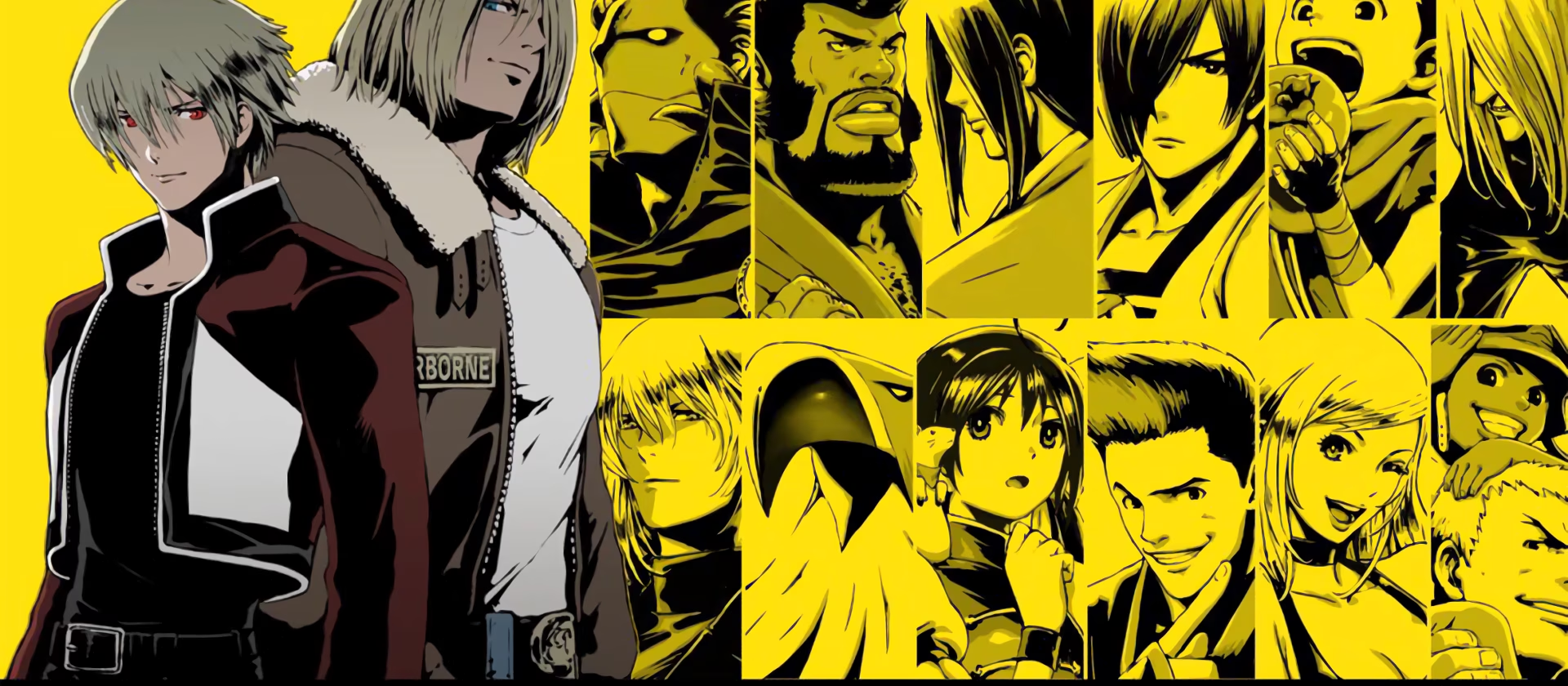
When the Dreamcast port arrived in the West, published by Agetec, it was renamed Fatal Fury: Mark of the Wolves — the franchise name restored, the reinvention repackaged as a sequel. The Japanese and North American covers tell the story clearly: the Japanese version shows Rock and Terry against white, two characters, clean; the North American version loads the roster in comic-panel strips across the top and shouts the Fatal Fury brand at the viewer.
Nobuyuki Kuroki later described the early development conversation more bluntly: the Fatal Fury team’s sense of style had gone old-fashioned. Earlier games had been built from bearded men, muscle, leather, and swagger. Garou thinned the silhouette, softened the macho bulk, and let contemporary pop taste into Southtown without making it feel imported. Hotaru, by Kuroki’s recollection, came from the team’s attempt to understand a then-emerging “moe” sensibility they knew they needed but did not quite speak natively. That is not a side note; it is why Garou’s new cast feels like succession rather than replacement. SNK was not just retiring old characters. It was retraining its eye.
Even the Japanese title was making a break. Oda later explained that Mark of the Wolves was the one Fatal Fury not called Densetsu — Legend — because, when SNK made it, the game was set in the future. You cannot turn the future into legend while you are still standing inside it. That is the cruel little hinge in Garou’s history: SNK designed the next era, then disappeared quickly enough that the next era became archaeology.
Just Defend, and What It Changes
If Rock Howard is Garou’s emotional centre, Just Defend is its mechanical soul.
In most fighting games, blocking is passive: hold back, absorb the hit, wait for an opening. Garou’s Just Defend asks you to time your guard input at the last possible beat before your opponent’s attack connects. Get it right and your character flashes white and gold, the damage evaporates, and a sliver of health returns to your bar. Mistime it and the game does not flatter you; you simply block normally, or eat the hit if your input was late enough. There is no ambiguity. The system is honest in both directions.
Oda’s stated intention was clean: he wanted “a new system that’d synergize well with Guard Crush,” making defence an active skill rather than a refuge. What he got was something that changed the entire psychological texture of a match. Against a skilled opponent, every extended combo becomes a question — are they Just Defending, reading your rhythm, or did they mis-time it? Every string you commit to is a gamble about how long you can sustain pressure before their defence converts. The game oscillates between offence that builds momentum and defence that can reverse it entirely, and that oscillation — the live possibility that patient, precise defence can steal back a round — makes every exchange feel consequential until the last hit lands.
That timing was not an abstract design ideal. Looking back while making City of the Wolves, Oda pointed out that Garou was built on Neo Geo hardware, under conditions with effectively no input delay, and that Just Defend’s original tuning assumed that environment. A modern release has to answer a question the arcade board never asked: how do you preserve a defensive system built around immediacy when players are using flat panels, pads, and online matches? That is why the 2020 Code Mystics rollback update matters. It is not a convenience feature bolted onto an old fighter. It restores the conditions Garou’s best idea needs in order to breathe.
The T.O.P. system adds a second layer before the match begins. At match start, each player selects which third of their health bar to designate as their T.O.P. zone — a range that, once entered, grants enhanced attacks, faster health regeneration, and a T.O.P. attack unique to each character. Choose a narrow zone and the benefit is concentrated; choose a wide zone and it’s harder to miss but diluted. It’s a decision about how you intend to play the match, made before a punch has been thrown, with real consequences for how your opponent approaches you. Oda described the design goal simply: “A game that’s snappy, without getting tiresome.” That’s a harder target than it sounds.
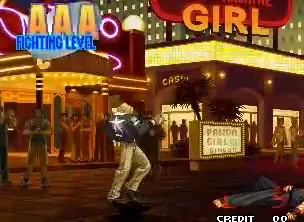
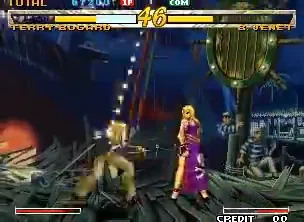
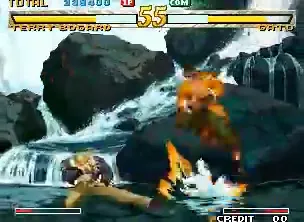
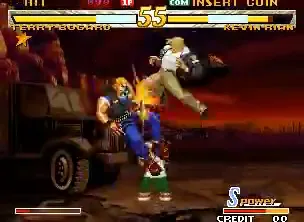
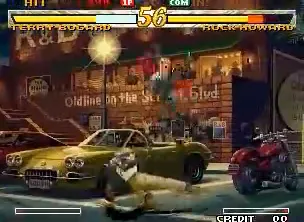
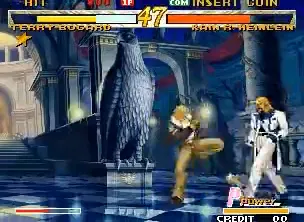
Khushnood Butt’s T.O.P. attack turns a chosen health-band into a tactical threat, not a comeback spectacle. Garou: Mark of the Wolves · SNK, 1999.
The Last Year SNK Had
Garou shipped in November 1999. Gamest — the Japanese arcade magazine that had championed SNK titles throughout the 1990s, run monthly reviews and strategy guides, given the company’s releases the critical coverage that made them culturally legible — had already folded. Its publisher Shinseisha went bankrupt the same year. The infrastructure that told Japanese arcade players what to pay attention to was gone as Garou was being played.
In January 2000, SNK was acquired outright by Aruze Corporation, the pachinko and slot machine manufacturer that had been its largest shareholder. The company’s founders lost operational control. Side ventures had compounded the problem: the Neo Geo World Tokyo Bayside amusement park had failed spectacularly; console publishing excursions had also underperformed. In April 2001, SNK applied for civil rehabilitation. The Osaka District Court declared bankruptcy in October. Playmore Corporation won the intellectual property rights at auction.
The sequel died with the old company. Oda has said he remained at SNK until after Mark of the Wolves shipped and early work on “2” had begun, before leaving for Dimps. Eiske Ogura, later a central SNK artist, has likewise described pixel work on Gato and Grant as part of his path through the old Fatal Fury team. In a later SNK creator interview, Kuroki remembered that new moves for Rock and B. Jenet had been done; Naoto Abe remembered new characters as complete. Memories differ on the story, which is telling in itself, but the broad outline is clear. This was not a fan’s imagined sequel hanging in the air. It was a working line inside the studio, carried by people who knew exactly what Rock’s unfinished story was supposed to become.
”If we’re able to make a sequel, I’d like to resolve all the existing backstories, including the mystery of Gato’s father.”
— Yasuyuki Oda, ASCII guidebook, 2000
Oda wrote that in a developer interview published while SNK was still standing. Gato’s father’s backstory was never resolved. The mystery sat for decades while Oda kept saying, in public and in private, that he wanted to complete Garou. By the time Fatal Fury: City of the Wolves finally resumed the franchise in 2025, he had also admitted the old continuation could not simply be resumed. Too much time had passed; too many players would be arriving fresh. City of the Wolves had to use the phantom sequel as a reference point while rebuilding the story as something a modern audience could enter.
The Pressure It Needed
The game is on Steam with rollback netcode. It plays close enough to itself for the compliment to matter: a twenty-six-year-old fighter whose central defensive idea asks for real timing, real nerve, real opponents. The sprite work — 688 megabits, among the largest cartridge sizes in Neo Geo history — holds at any display resolution because the artists drew at a level of detail that owed nothing to the hardware constraints of the era. Rock Howard’s animation cycles through poses with a granular specificity that makes modern pixel artists stop and study the in-betweens. Hardcore Gaming 101 noted one tiny expression of that density: the Start button does not merely taunt, it can wake little pieces of the background, and each character has hidden win animations. Garou is full of work most players will never notice, which is often the clearest sign of a team drawing past the brief.
The Just Defend system remains singular. Not as an impressive piece of design history for 1999 — singular now, in the era of rollback netcode and years of designers thinking hard about what precise defence in a fighting game should feel like. A timed defensive read that restores health on success is one of the genre’s most intelligent ideas. Garou arrived at it early, implemented it cleanly, built a whole game around its logic.
What the game asks is patience with asymmetric returns: the willingness to practise a timing that takes real hours to feel natural, in exchange for access to a system that rewards that patience with moments other fighting games cannot produce. When a Just Defend lands in a tight match — health restored, momentum broken, read validated — the clarity of it is something the genre rarely offers. GameSpot named the Dreamcast release Best Fighting Game of 2001. It was among the last things called great at a company that was already gone.
The wolves did not fall silent because the idea ran out. The company did.