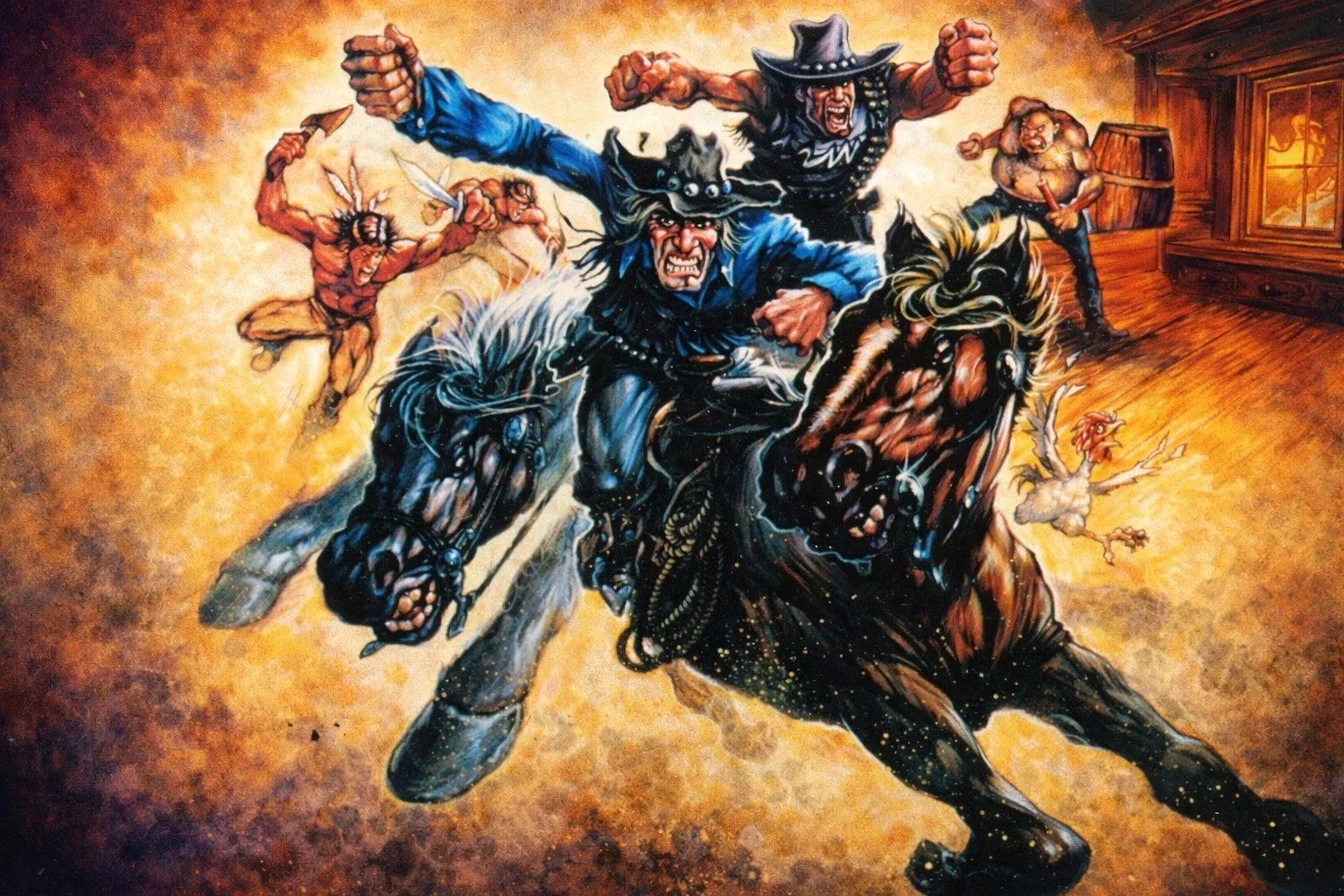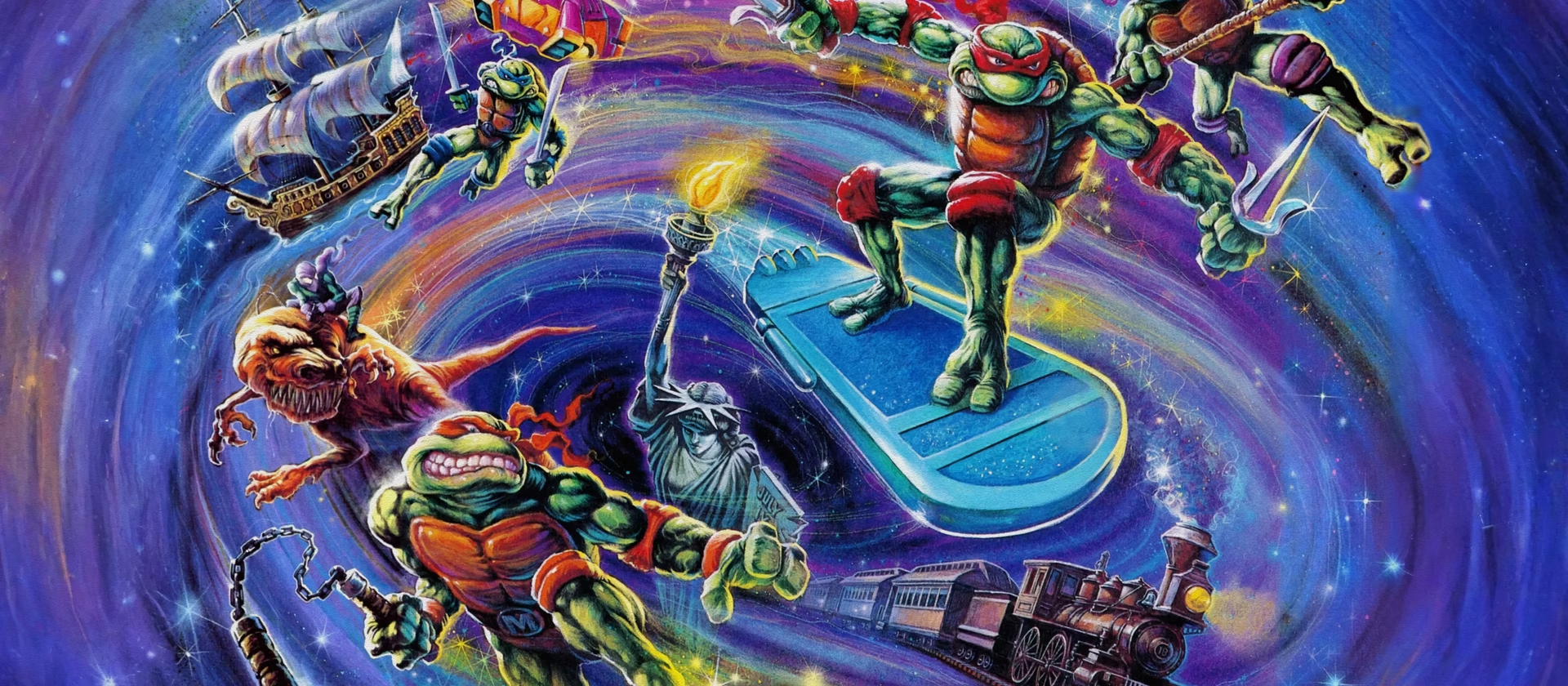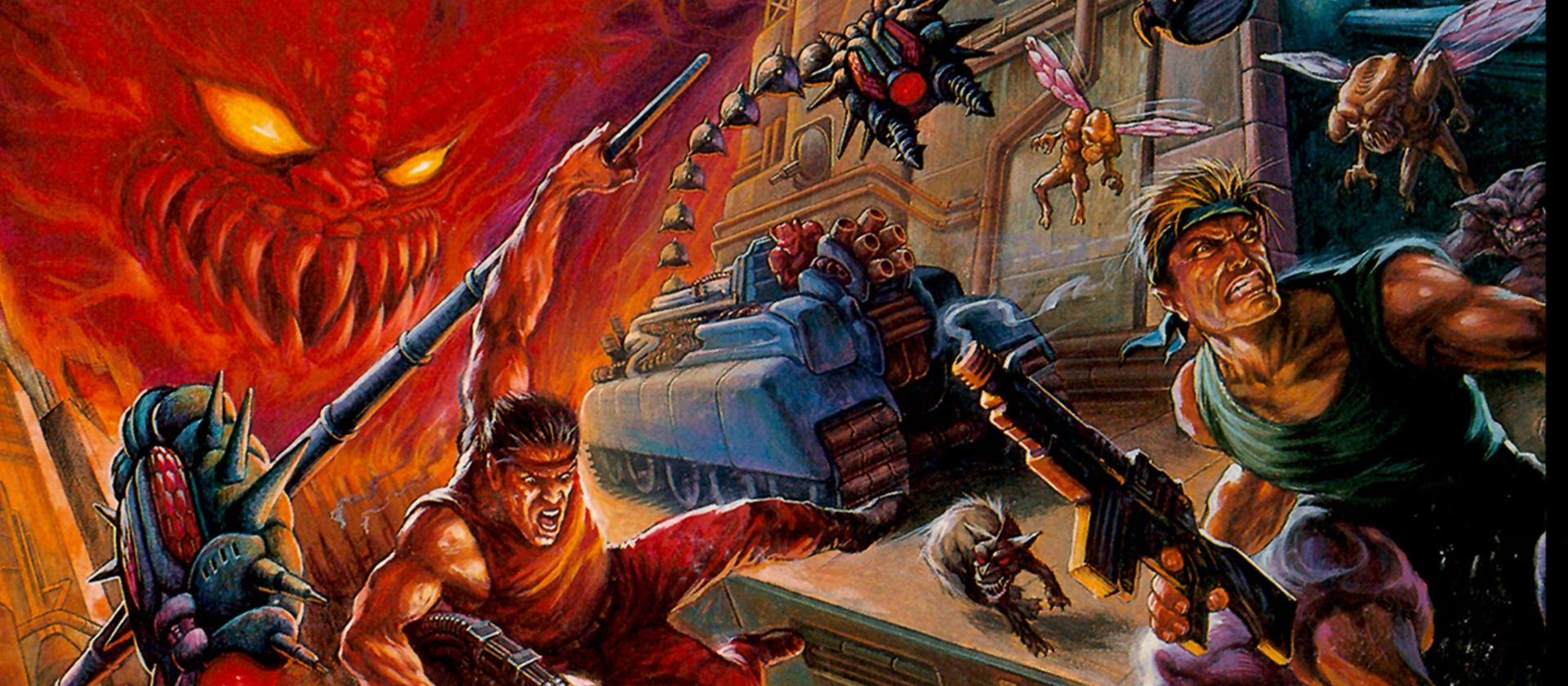
The team called it Sunset Ninja. That was the internal name, and it was the entire pitch: the chassis and the staff who had just shipped Konami’s best Western arcade run-and-gun, retooled for the genre’s most over-cultivated stereotype set. Hideyuki Tsujimoto, fresh off Sunset Riders, would direct again. The same Osaka studio, the same Konami GX-series house style, the same four-player cabinet logic. Only this time the cowboys were ninjas. What the team did with that idea is where Mystic Warriors stops being a swap and becomes one of the strangest arguments Konami’s arcade division ever made.
The argument lives in a research session. According to sanpei-btm, a former programmer on the team, a designer was dispatched to a video-rental store to figure out what the project was actually going to be. He came back with Enter the Ninja. He noticed a sequel on the shelf and brought Revenge of the Ninja back too. Sho Kosugi, mid-1980s, American exploitation cinema’s full-throated reinvention of the Japanese ninja. The team watched the tapes. They saw two ninjas on a rooftop tennis court bow, deliver elaborate hand-signs and unload swords, kusarigama, water-escape jutsu and ritual decapitations. They saw an opening dogeza prostration before a duel. They saw a martial-arts vocabulary that had nothing to do with anything Japanese audiences would recognise. The Japanese reaction, distilled by sanpei-btm: アメリカ人のニンジャ観すごいな — the American vision of ninjas is incredible. And the directive that followed was the one nobody expects. They were going to dramatize the misreading, not correct it.
Sunset Ninja
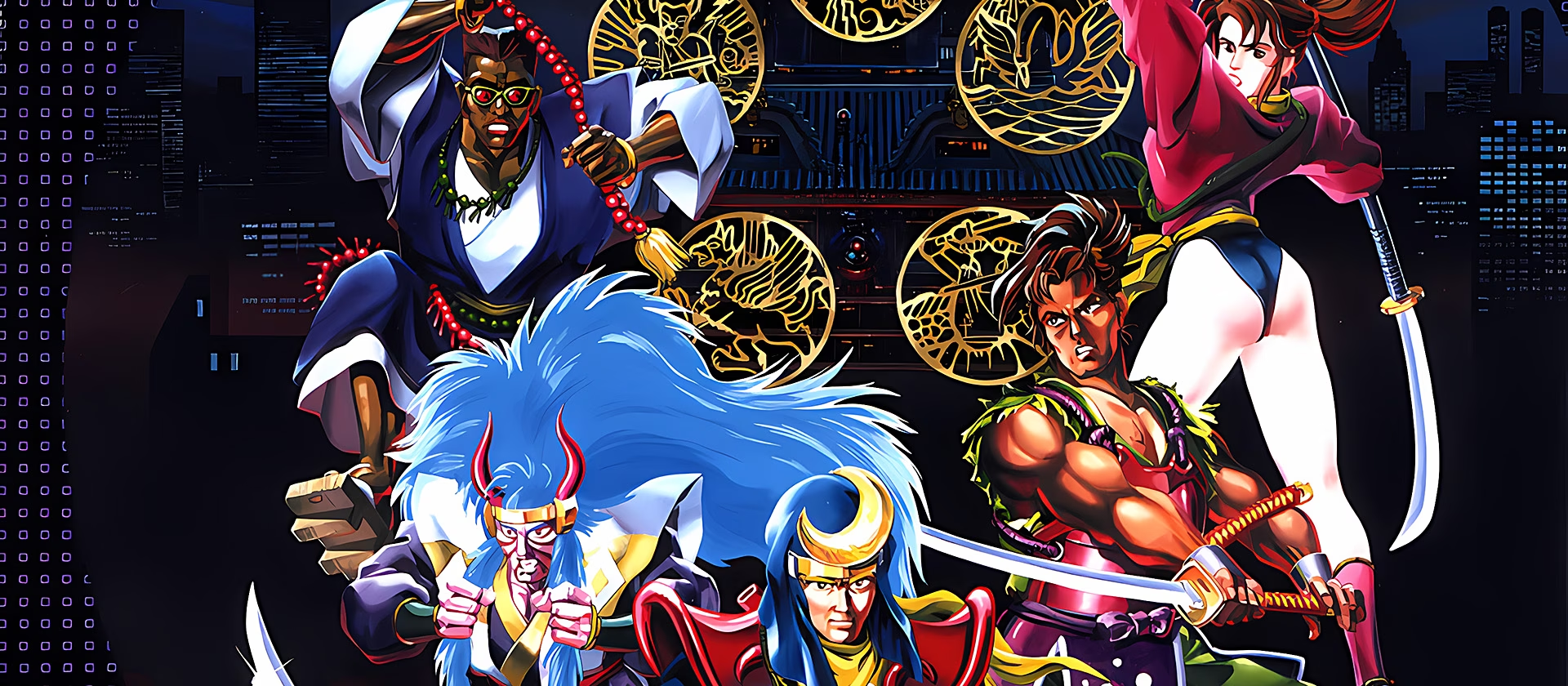
That decision controls everything downstream. The villain is SKULL Enterprise, a sinister Japanese megacorporation dominating the world economically while secretly building a robot ninja army to take it over outright — a satire of bubble-era Japan-megacorp paranoia from 1980s American thrillers, aimed back at Japan as a joke completing itself. The roster reads as exploitation-cinema typology compressed onto a character-select screen. Spyros, the American ninja in red. Keima, the kabuki ninja with face paint and a horned mask. Kojiro, the samurai. Yuri, the kunoichi. And Brad: a cornrowed African-American Buddhist monk in priest-like robes and sunglasses, wielding oversized prayer beads, fighting in an exposed red fundoshi.
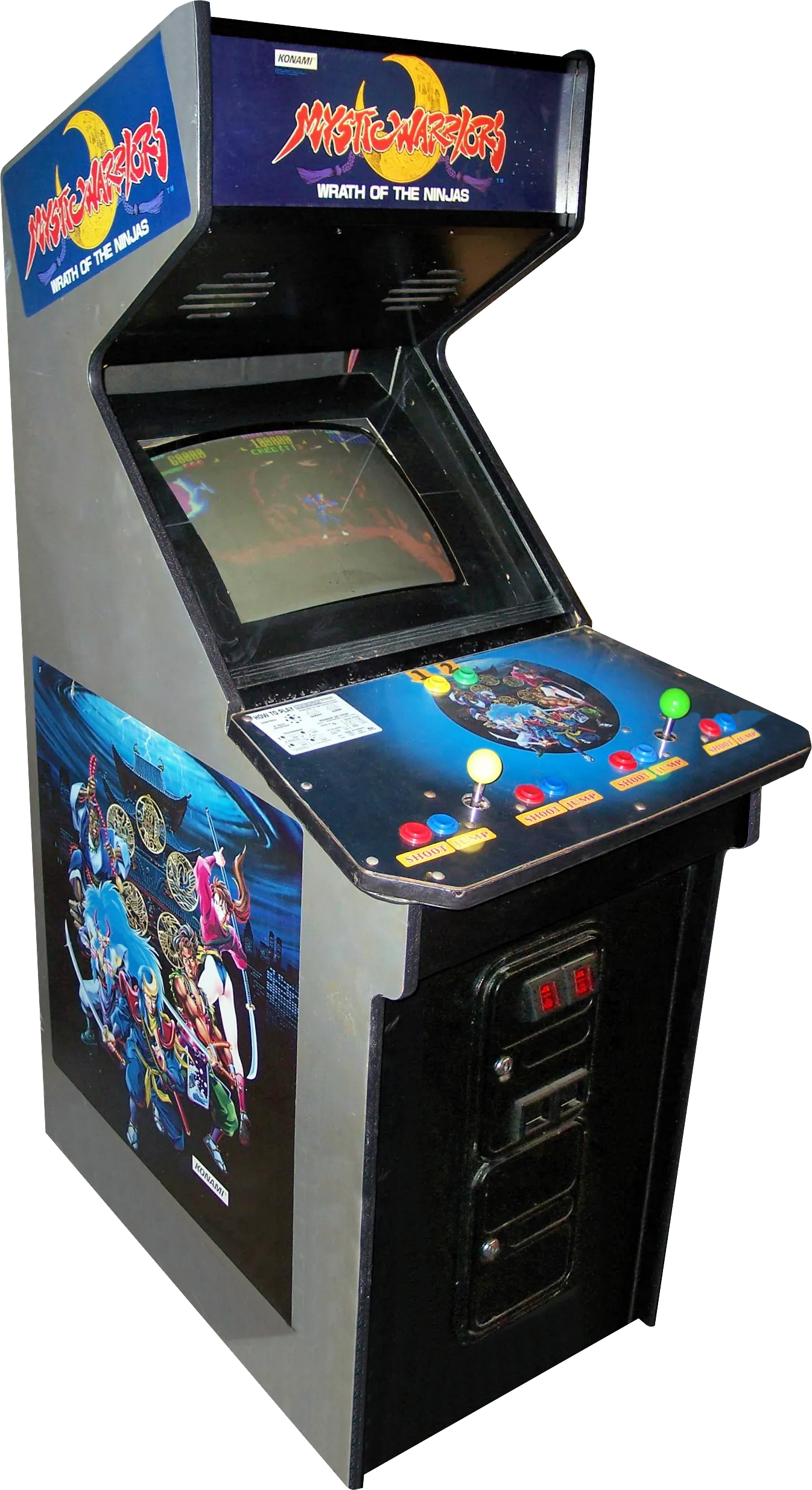
The four-player upright — the cabinet shape Konami had perfected on TMNT and Sunset Riders, now carrying a ninja roster nobody in 1993 had asked for. Mystic Warriors · Konami, 1992 · Arcade.
Brad is where the angle stops being theory. Sanpei-btm attributes the character to the team’s art lead — a former television animator who had worked on Doraemon episodes before joining Konami — and frames the design as the kind of thing only someone with that lineage would propose.
”普通は思いつかないですよ。”
— sanpei-btm, on Brad’s design
You wouldn’t normally even think of it. Quite. The design is shocking in 2026, and was meant to be shocking in 1992 — but the team’s argument is that they were quoting a genre that had already done this. American 80s cinema kept inventing increasingly elaborate ninjas, and Mystic Warriors is the Japanese game that calls the bluff: if you’re going to make ninja films this baroque, here is what your roster looks like rendered as arcade sprites. The five characters are not a marketing exercise. They are the thesis.
What the Video Store Returned
The Konami 2nd Development Division ran the project the way it had run Sunset Riders — Tsujimoto pragmatic and structural, the art lead reaching for whatever the script of the genre would tolerate. Sanpei-btm preserves one production aphorism in Tsujimoto’s Kansai dialect, addressed to a junior programmer agonising over a mid-boss: どうせこいつはすぐに死ぬんやから、そんなもんはどうでもええねん. This guy dies right away anyway, none of that matters. That was the studio culture: ship the cabinet, manage the scope, take the joke seriously enough to draw it well and not seriously enough to mistake it for a manifesto.
What the team built on top of that frame is a tighter run-and-gun than its reputation suggests. The control is two buttons over an eight-way joystick: attack and jump, with the attack auto-switching from shuriken volley at range to melee strike in proximity. That single auto-switch — borrowed from Shinobi — folds the genre’s whole distance-management logic into where you stand, rather than a button you press. Power-ups stack to level two and reset on death, Sunset Riders’ exact risk-economy. A life pool of four hits buys the player room to read a screen before paying for the mistake. Players can swap characters between credits. Two-player and four-player cabinets shipped in parallel, and on the four-player board you take whichever ninja the panel assigns and learn what their spread does — the same drop-in arcade-floor social machine TMNT had templated and Sunset Riders had refined.
English-language coverage has tended to say the five characters are functionally identical; the Japanese strategy guides disagree, and so does the cabinet under your hands. Spyros is the balanced default. Keima fires a wider but slower spread. Kojiro has the strongest vertical reach. Brad’s full-power weapon arcs three streams plus a centre shot — useful for melting bosses parked in one place. Yuri’s melee is the fastest in the game. The differences are statistical rather than systemic — closer to weapon-archetype tuning than Shinobi III’s discrete movesets — but on a four-player floor they are exactly the level of distinction that lets the panel argument from Sunset Riders repeat: somebody complains about being stuck with the wrong character, learns what the spread actually does, and stops complaining.
Auto-Switch and the Mine Cart Wall
The stages do not stay in one register. Stage one closes with a boss who drives a stolen truck straight through its own backdrop, the scenery catching fire behind him. Stage two suspends the run-and-gun grammar entirely for a snowboard chase. Stage seven is a sequence on the rear of a cargo aircraft with ninjas leaping between planes mid-air. The half-game story turn — the kidnapped fifth ninja, dramatically rescued and immediately killed the moment the cell opens — is the genre committing to a beat it usually flinches from.
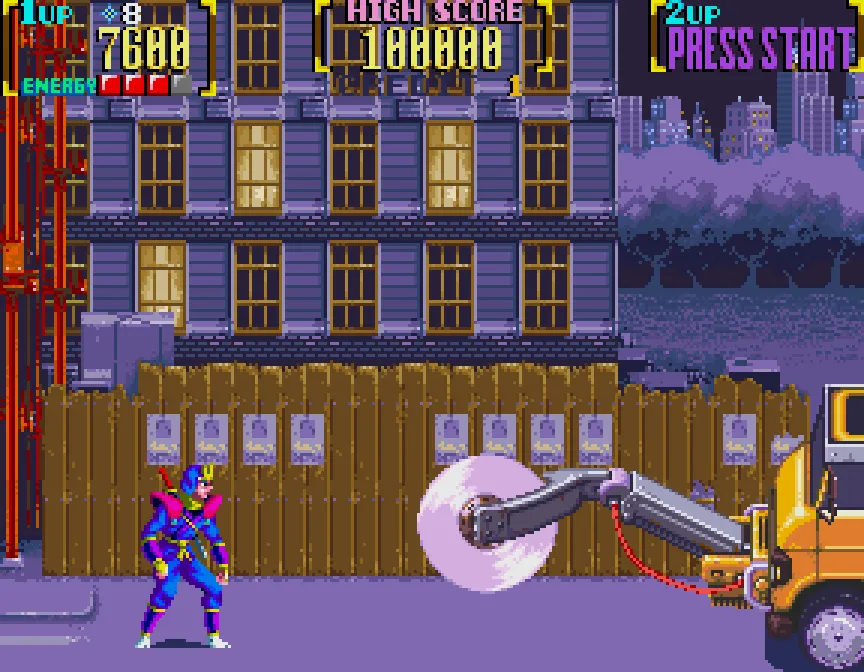
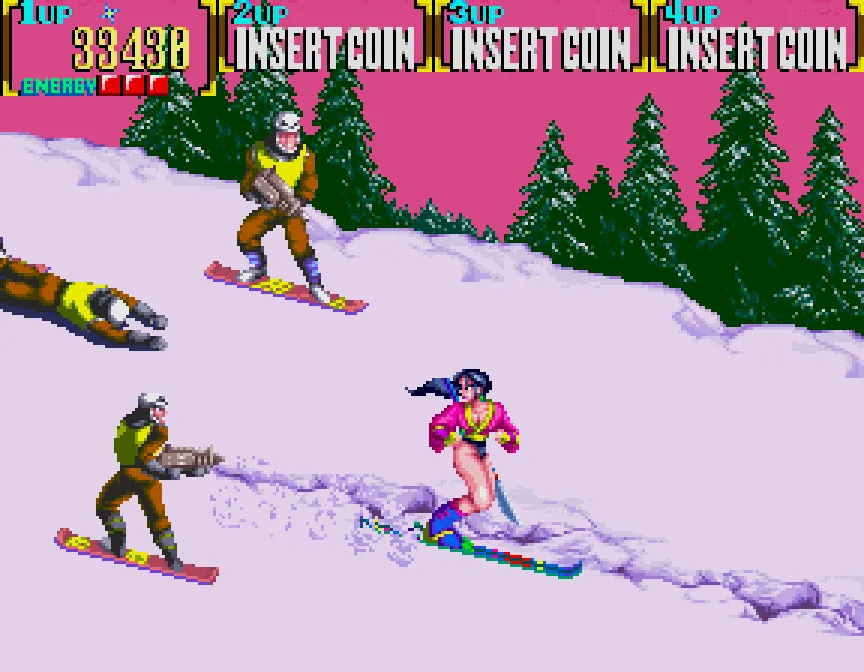
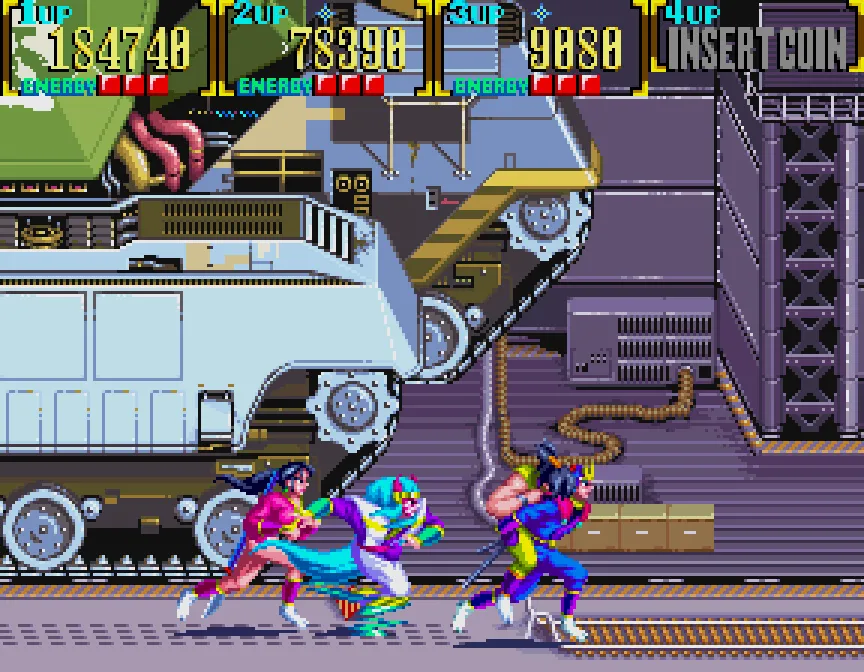
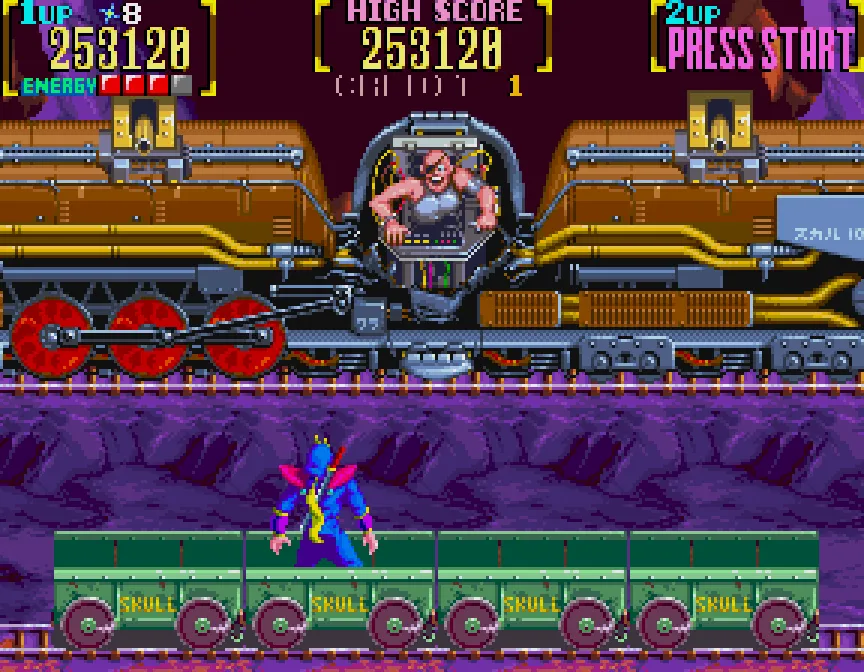
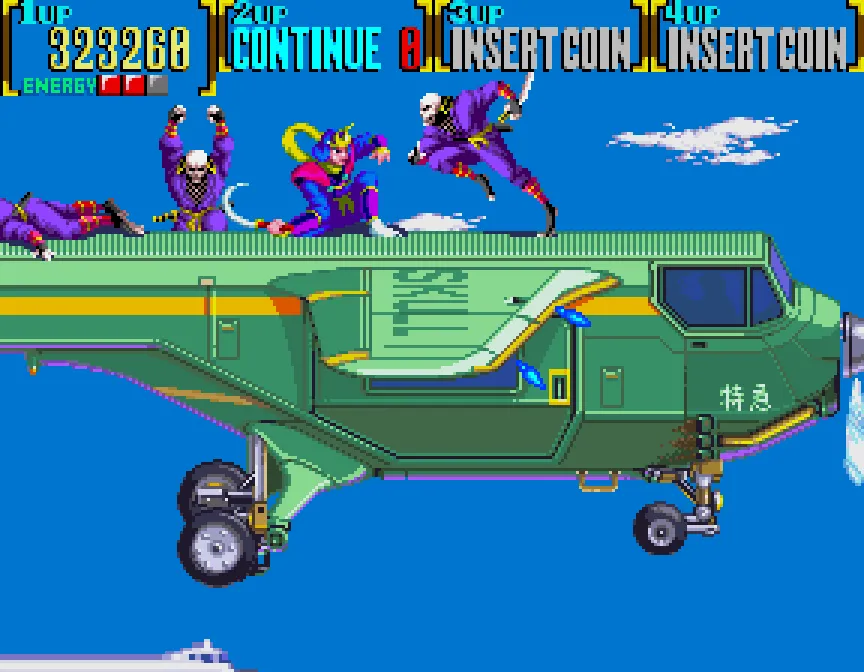
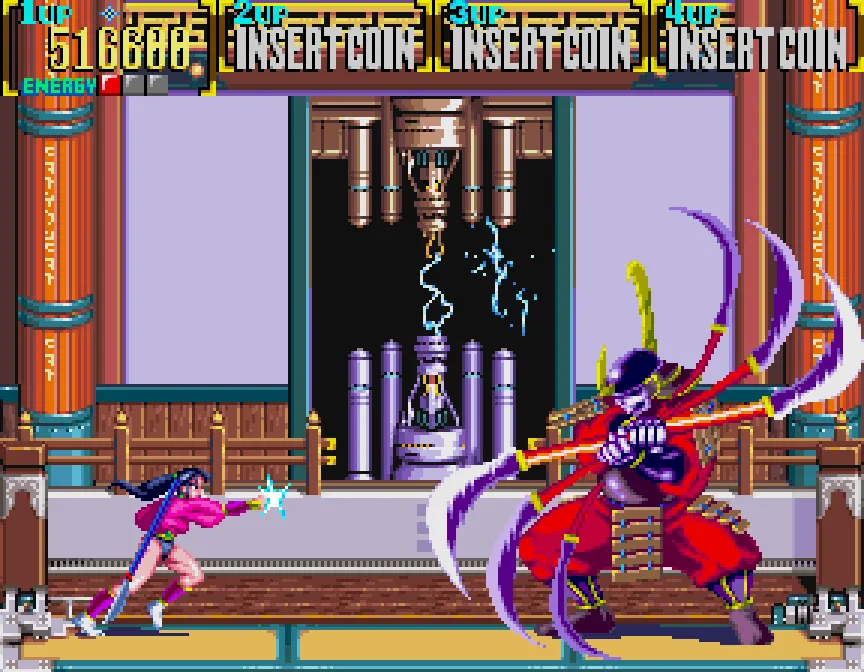
That set-piece variety is what the game gives now. The genre’s usual problem — a flat horizontal scroll past flat horizontal enemies — gets pushed against from every angle: skiing, mine carts, river logs, plane-hopping, elevator shafts. The friction is real too. Stage six is a forced-scroll mine cart with twin rail-mounted cannons, and it is the difficulty wall the cabinet was designed to filter players against; the Japanese strategy guide eienken and the Western fan retrospectives agree it is the hardest fight in the game. Stage nine’s elevator section is genuinely cheap by modern reading — unintuitive solutions, respawn patterns that punish unfamiliarity. The five characters’ weapon spreads are statistically close, and a modern reader landing on the cabinet expecting Shinobi III-level distinction between them will find a smaller delta than the marketing suggests. The total one-credit run is short — about thirty minutes — which is fair for the cabinet and terse for the couch. None of that breaks the case. It just reminds you which year you’re playing.
Shamisen Over Techno
The music does work above the hardware. Junya Nakano had joined Konami’s Osaka branch in 1991 straight out of vocational school. Mystic Warriors followed his arcade scores for X-Men, with Yuji Takenouchi supervising. The Stage 1 theme is shamisen and percussive shakers over a techno bed, with kabuki vocal samples cutting in over item pickups — 和風テクノ, the Japanese music blogs called it, Japanese-style techno. The composers used pen-names on the credits to reinforce the period-drama affect. The score speaks Japanese back at the player.
Two years later Konami restructured its Osaka personnel and Nakano left for Square. He went on to Threads of Fate, then to Final Fantasy X in 2001, sharing the credit with Uematsu and Hamauzu. The score that played to half-empty 1993 arcade floors was made by a composer one studio move away from helping write the most-listened-to JRPG soundtrack of the decade. The 2024 Arcade Archives port triggered a two-disc Mystic Warriors Game Sound Digital Collection — original plus arrange — thirty years after the cabinet first played to anyone. It is the kind of belated commercial confirmation the music deserved on shipping day.
Thirty Years to Reach the Couch
The reason none of this is common knowledge is timing. Mystic Warriors released in Japan on 21 December 1992 as a limited run and worldwide in February 1993, into the Street Fighter II boom. The four-player drop-in cabinet — the social machine Konami had built across TMNT, X-Men, Sunset Riders — was being overrun on every arcade floor by 1v1 versus-fighter cabinets that took quarters faster and turned the room into a tournament. Game Machine charted the game at number nine on its April 1993 table-arcade league, then it slid. There was no SNES port, no Mega Drive port, no PC port, no 1990s collection. The game existed only in the cabinet, and after the cabinets came out of arcades it existed only in MAME, for thirty years.
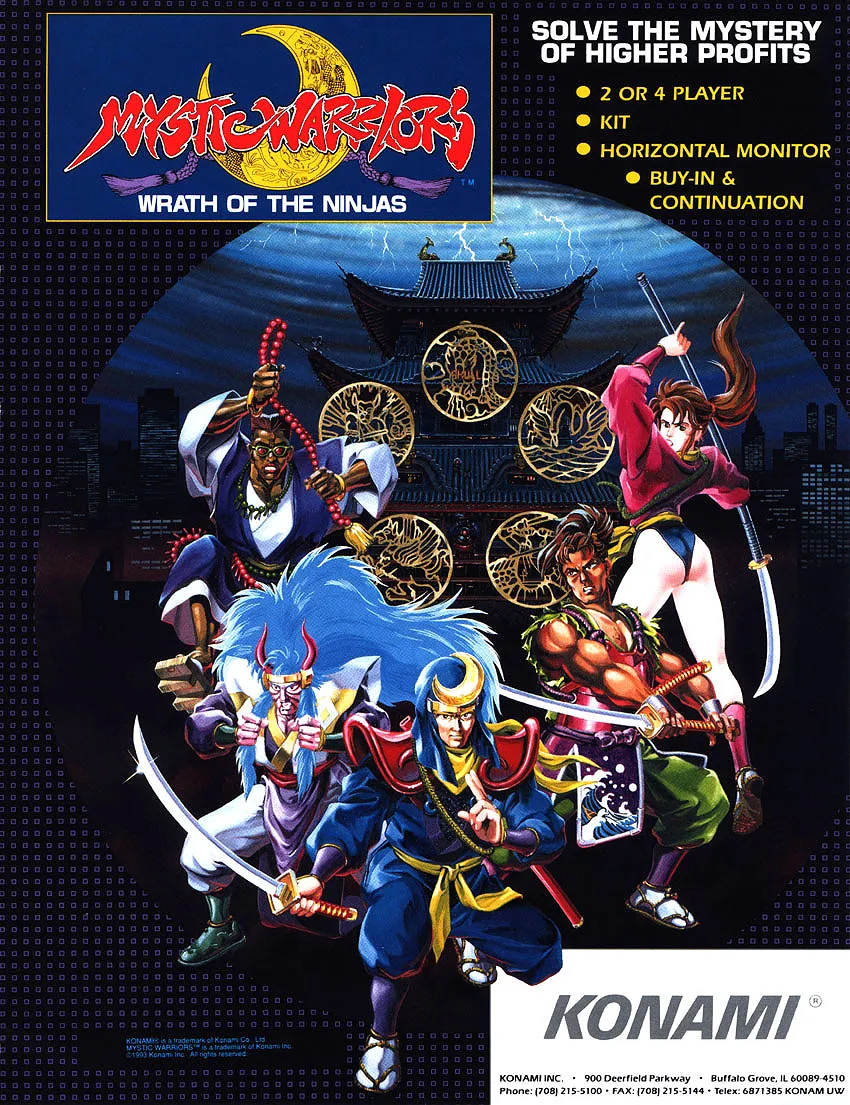
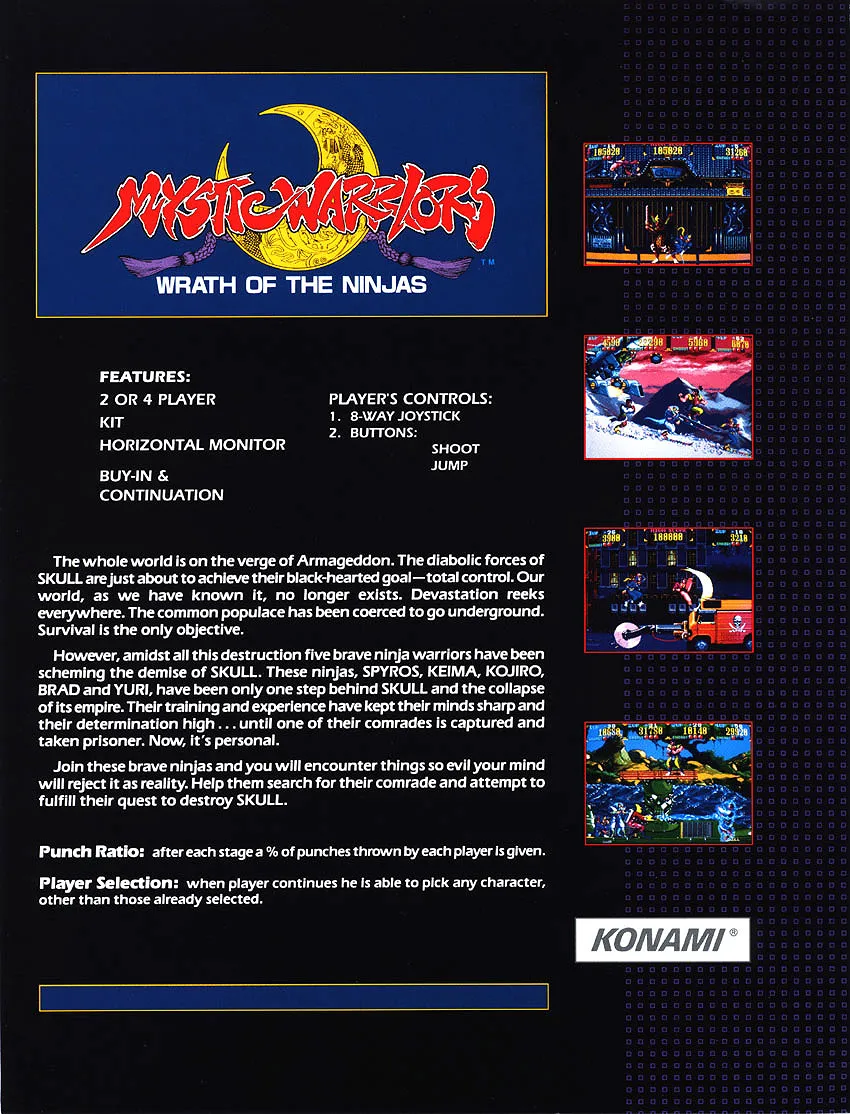
Konami’s US operator flyer — the one moment the game pitched itself to the West, before silence. Mystic Warriors · Konami, 1992 · Arcade.
That changed on 21 December 2023. Hamster’s Arcade Archives Mystic Warriors shipped on Switch and PS4 for US$7.99 — emulation, online leaderboards, CRT filter, four-player co-op intact. Sanpei-btm learnt of the release after the fact, via YouTube comments, and called the response 晩年の自分への赦し — late-life forgiveness. The Switch version updates for Switch 2. For around six pounds you can run the cabinet as it shipped, and you should, because what Sunset Riders did for the Western and what Shinobi did for the lone-ninja side-scroller, Mystic Warriors does for the four-player drop-in. It is the Konami arcade run-and-gun built on the strangest premise the studio ever fully committed to, finally playable without a coin slot.
The marquee — gold leaf, five silhouettes, and the title in English and Japanese. The cabinet’s last surviving advertisement to itself. Mystic Warriors · Konami, 1992 · Arcade.