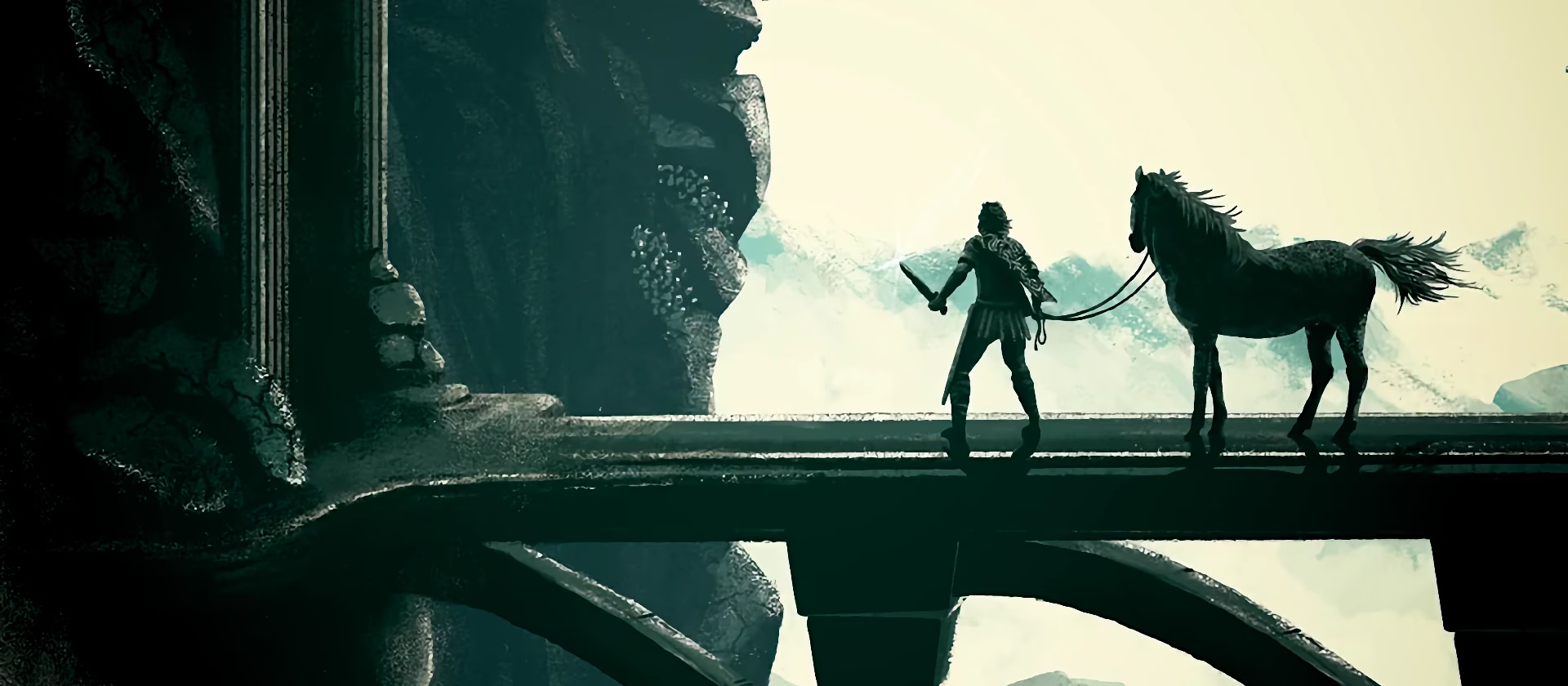
Shadow of the Colossus asks a question so old it sits at the base of half our myths: how far are you willing to go to save someone you love? Most games answer that question cheaply. They make the path righteous, the enemies disposable, and the cost abstract. Shadow of the Colossus does the opposite. There are no towns, no ordinary monsters, almost no dialogue, and barely a story in the usual sense. There is a horse, a sword, a bow, a dead girl, a voice in a shrine, and sixteen creatures standing between Wander and the bargain he has chosen to make. The result is not thin or unfinished. It is concentrated. The game has force because it refuses almost everything that might dilute the decision at its centre.
There is a Japanese design principle, kansō, that values elegance through the removal of the unnecessary, and the game often feels shaped by that same instinct. Not in some mystical or decorative sense — more in the hard, practical sense of a team deciding that if this thing was going to work, the usual clutter had to go. Fumito Ueda said as much in interviews around release. He had no interest in filling the world with weaker enemies just to give the player something to hit. If the game was going to be about heroic struggle, the enemies should be stronger than the player, not weaker. That idea sounds simple, but it changes everything: the mood, the pacing, the world, and the moral temperature of every victory. It also lets the Forbidden Lands start to read as something more than a level map. The place feels less like territory to conquer than ground you were not meant to disturb.
Nothing But the Important Parts
The first surprise of Shadow of the Colossus is how little it tries to charm you.
It does not throw jokes at you. It does not flatter you with constant success. It does not explain itself much. Wander rides into the Forbidden Lands carrying Mono, lays her on a stone altar, and asks an ancient entity called Dormin to bring her back. The price is clear even if the details are not. Kill the sixteen colossi, and Dormin will consider the request. That is the whole structure. Go out. Find the giant. Work out how to climb it. Drive your sword into the sigils buried in its hide. Watch it fall. Return to the shrine. Repeat.
The ride is not downtime. It is the game clearing your head before the next irreversible act. Clip via Tenor.
On paper, that sounds almost skeletal. In practice, it feels more complete than many larger games. When there are no side distractions, the ride across the landscape matters more. When there are no throwaway fights, each encounter carries more weight. When the story is not constantly telling you what to think, the act itself has to do the work. GameSpot’s original 2005 review spotted this immediately — describing the game as a full adventure made almost entirely from giant boss fights, and praising how focused the result felt. That focus is still what separates it from its imitators. Plenty of later games borrowed the idea of climbing a gigantic enemy. Fewer understood that the boss fights only feel this large because the game has cleared so much room around them, and because each one is tied to a question that never goes away: is Mono worth this?
Heroism Without Fodder
Ueda’s rejection of minor enemies is one of the most revealing production decisions behind the whole project.
“I didn’t want to have weak enemies that the player can easily kill. I wanted the player to feel like they are challenging something much more powerful than themselves.”
That is not just a combat design preference. It is the reason the game feels morally strange. Most action games teach you how to feel about violence by making the targets disposable — enemies that rush you, snarl at you, and exist mainly to be cleared on the route to something bigger. Shadow of the Colossus takes that comfort away. Because there are only sixteen enemies, and because each one is treated like an event rather than a hurdle, you cannot reduce them to background noise. They are too big, too singular, and too deliberate for that. Some attack on sight. Some barely register you at first. Some seem almost defensive, as though you are the one bringing the violence to them. They read less like monsters than idols, landmarks, or guardian spirits fused into the landscape.
That is why the game’s emptiness matters. If there were ordinary enemies all over the map, the colossi would feel like especially impressive bosses. Because there are none, the colossi become the entire moral centre of the game. Every ride is a journey toward one decision repeated in a new form. Every victory feels a little less like triumph and a little more like commitment. The game never presses this point too hard — it does not stop to tell you that violence is complicated. It just removes the usual excuses and leaves you alone with the act. Love, here, is not cleansing or redemptive. It is invasive. It sends Wander deeper into a place that feels half cathedral, half ecosystem, and asks whether devotion can become desecration without ever meaning to.
How the Giants Work
The fights still feel special because the colossi are not just large enemies. They are environments with behaviour.
In the developer interview translated by GlitterBerri, Ueda’s team discussed how the colossi had to feel neither fully animal nor fully mechanical — strange enough to avoid becoming simple monsters, but solid enough to seem physical and real. Fur was kept not merely as decoration but because it helped communicate scale and gave Wander something believable to grip. Movement was equally specific: the team wanted the player to feel the instability of a body climbing another moving body — the sensation of being thrown, losing footing, or hanging on by fingertips when the creature bucked and twisted beneath them.
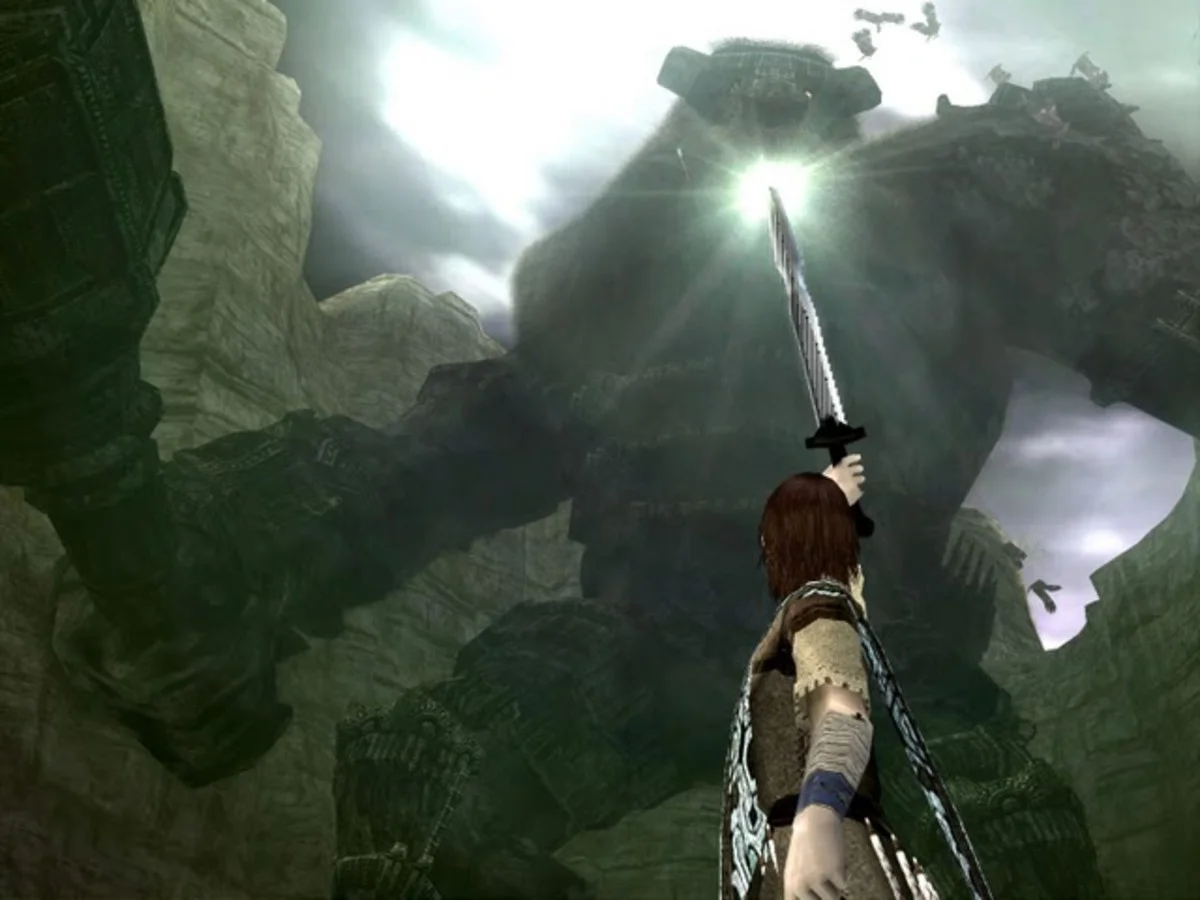
Scale is made legible through the simplest possible composition: a small body, a raised sword, and a creature large enough to become the landscape. Screenshot: Shadow of the Colossus · Team Ico / Sony Computer Entertainment, via LaunchBox Games Database.
That physicality is why the fights still feel different from later cinematic boss encounters. They are not just spectacles to survive. They are spatial problems to read. You are not memorising attack patterns so much as studying anatomy, terrain, and momentum. Where does this creature carry its weight? Where does it expose a path upward? What part of the arena will provoke the behaviour you need?
The answer is different almost every time. One colossus is a tower you scale through timing and nerve. Another is a creature you have to lure, unbalance, and then climb before it recovers. Another turns the ground itself into part of the puzzle. GameSpot called the battles part puzzle and part action in 2005 — that remains the cleanest description. They are memorable not because they are merely big, but because each one asks for a different kind of understanding.
The number itself is part of the discipline. The team did not begin with sixteen colossi — Ueda has said the first figure in his head was 48, which became 24, before production realities locked it at 16. The cut shows in the final structure. The colossi that remain vary not just in appearance but in rhythm, silhouette, arena logic, and emotional tone, and the game never bloats around a strong central idea by repeating it too many times.
The camera sells the vertigo without turning the encounter into a cutscene. You are still reading grip, stamina, surface, and movement. Clip via Tenor.
This is also where the music quietly does its best work. Kow Otani’s score does not fill the game wall to wall. It swells when it needs to, turning a climb into a charge or a stagger into release, then backs away again. The Forbidden Lands themselves are often described as empty, but they are empty in the sense a stage is empty before a performance. The ruins, bridges, lakes, and cliffs hold the weight of the colossi and make the ride toward them feel like a journey into something abandoned rather than a checklist between objectives. By the time the game is done, it is hard not to read Wander less as a hero crossing open country than as a pilgrim violating a sanctuary.
The Cost of Winning
What makes Shadow of the Colossus endure is that it never fully settles the question at its centre.
It would be easy to make this game morally blunt. The colossi could be openly malicious, making Wander’s task feel righteous. Or the game could overcorrect and lecture the player after every kill. It does neither. It stays calm. It lets the pattern repeat. It lets Wander look a little worse each time he returns to the shrine. It lets the bodies collapse with a weight that feels wrong. It trusts that repetition, once stripped of all the usual noise, will do its own work on the player. You are left with the oldest moral bind there is: if the person you love can be restored only through sacrilege, destruction, and the violation of a world that seems older and cleaner than you are, do you stop?
That restraint is why the ending lands — not because it comes out of nowhere, but because the whole game has been preparing you through structure rather than speeches. You have been riding out into silence, finding something ancient, climbing it, killing it, and coming back changed. By the end, the transaction no longer feels hypothetical. It feels exact.
Strip away the legend, the influence, the reverence, and what remains is still unusually strong design. It still understands that scale by itself is cheap. A giant enemy means very little if the game around it is too busy, too noisy, or too eager to congratulate the player. Shadow of the Colossus earns its scale by narrowing your attention until each encounter feels like the only thing in the world that matters. That is why its themes still hold. It is about love, but not in the soft or consoling sense. It is about what love becomes when mixed with entitlement, grief, faith, and human certainty that nature and the sacred will yield if we press hard enough.
Only a few games have ever trusted themselves that much. Shadow of the Colossus still does.