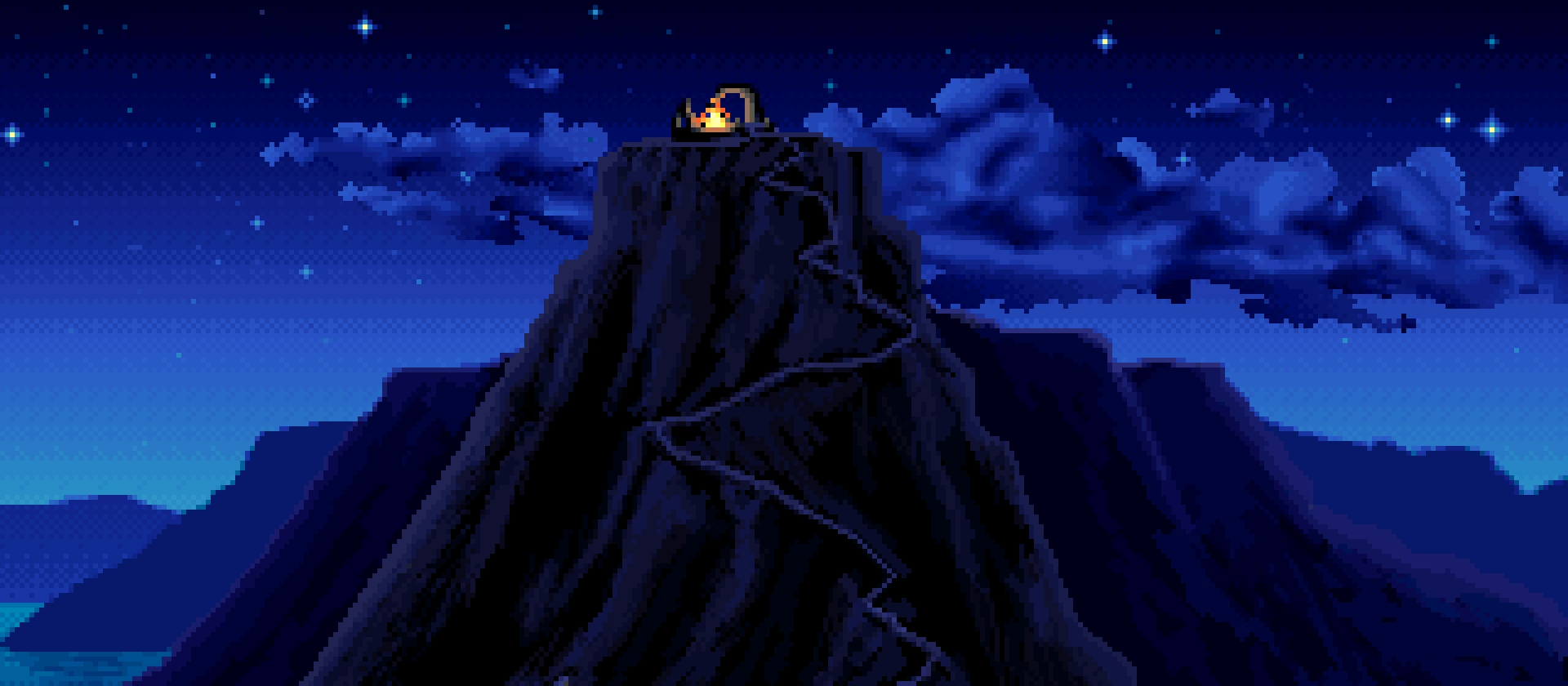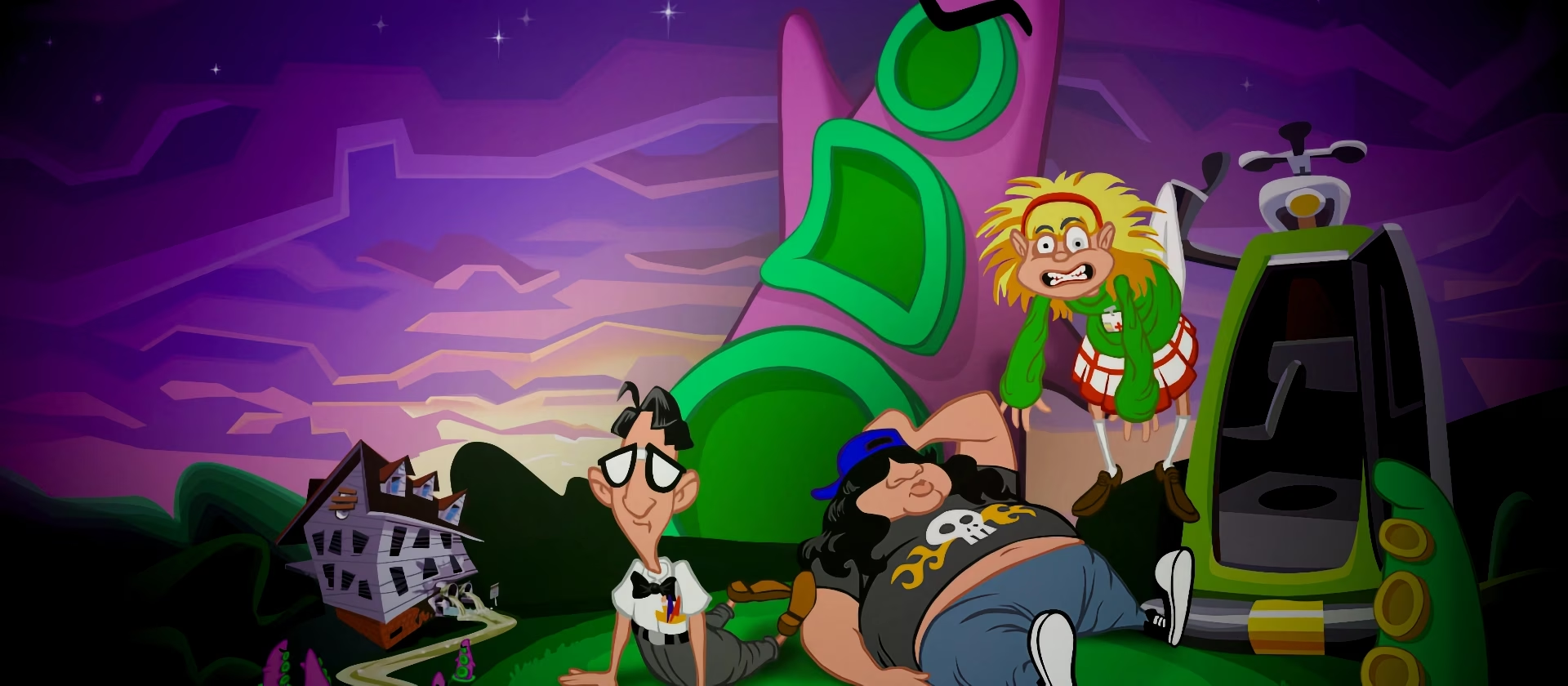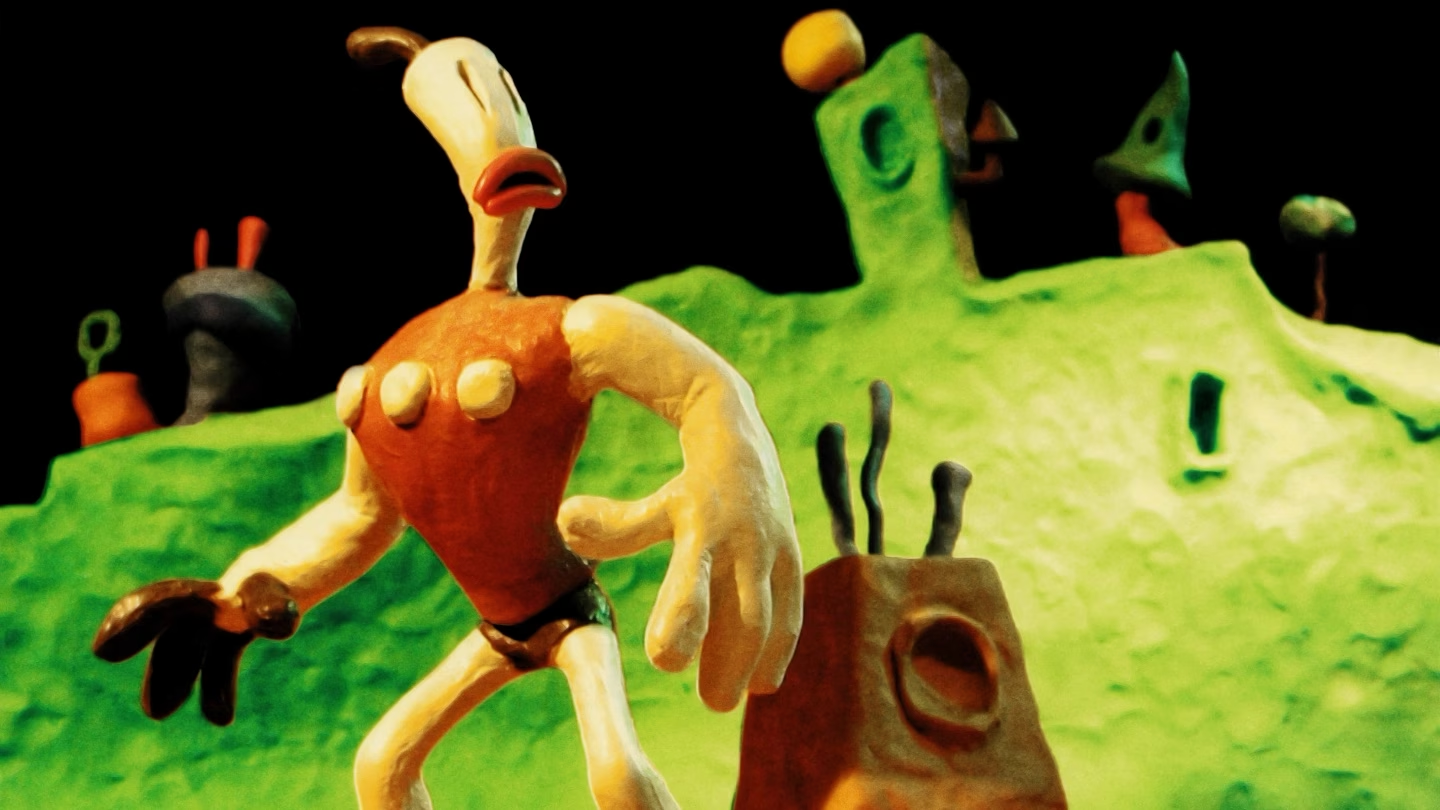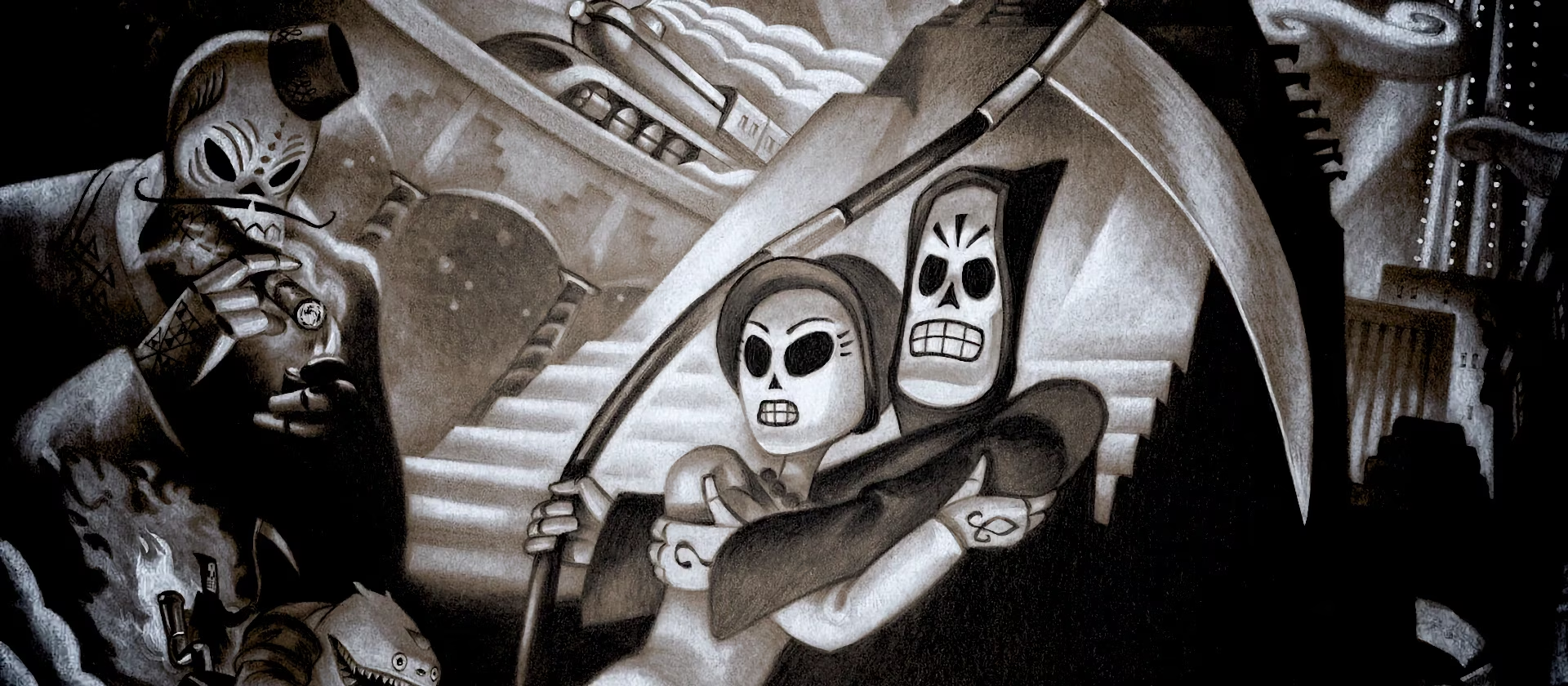
The elevator pitch should not have worked. A point-and-click adventure game set in a retro-futuristic Aztec afterlife, styled after 1940s film noir, starring a skeleton travel agent in a pinstripe suit named Manuel Calavera. A game built on a new engine, written almost entirely by its director, released into the most competitive gaming season in history.
It works because Grim Fandango is not a collage. It is a single, deliberate world — one that does not wait for you to understand it.
You arrive in the middle of things. Conversations are already happening. People finish them without you. They turn away, walk off, continue lives that don’t hinge on your input. The Department of Death processes souls whether you intervene or not. Manny is not the centre of this place. He is caught inside it, the same as everyone else. That distinction — between a game that builds a world around you and one that simply places you inside one — is why Grim Fandango is still worth your time.
A World Built from Contradictions
The idea had been forming since Tim Schafer’s college years, when anthropology courses introduced him to Mexican folklore and a Day of the Dead art book showed him calaca figures — papier-mâché skeletons whose bones were painted on the outside. He looked at their simple, geometric shapes and thought: texture maps. Around the same time, he attended a local film noir festival, and something clicked into place. Raymond Chandler in the Land of the Dead.
The pitch, when it came, was almost accidental. Schafer had submitted the Grim Fandango concept to LucasArts at the same time as Full Throttle — two ideas offered simultaneously, and Full Throttle was chosen first because it had greater mainstream appeal. After that game’s commercial success, the door opened. The second pitch came easily, on the strength of the track record. The project that followed was anything but.
What matters is how completely the game commits to its strange premise. The Department of Death is a bureaucracy first and a setting second. Souls arrive, are assessed, and assigned travel based on the virtue of their lives. Those who lived well are meant to receive express passage. They don’t. Tickets are intercepted. Routes are manipulated. The system is already compromised, and the spaces reflect that same corruption — Art Deco towers alongside bone-white forests and rusted ports, each location carrying its own visual language. What holds them together isn’t style but attitude: a consistency of tone that allows wildly different environments to feel like parts of the same world. These places weren’t built around puzzles. The puzzles were fitted into them.
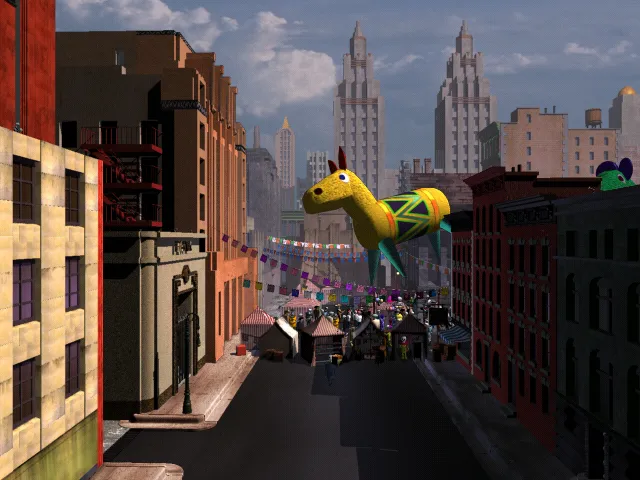
El Marrow makes the premise architectural: bureaucracy as skyline, bone-white geometry as civic planning. Original-era location image via Grim Fandango Network.
A New Grammar, Written in Lua
The deepest technical decision in Grim Fandango’s production history wasn’t the world or the writing — it was a programming language. LucasArts programmer Bret Mogilefsky, brought on to build the new engine after SCUMM was finally retired, chose to script the GrimE engine in Lua: a new, still fairly obscure language developed in Brazil that was elegant, learnable, and infinitely extensible. It was one of the first uses of Lua in any commercial game application. The decision proved consequential far beyond LucasArts — the language spread through the industry via Grim Fandango’s success, eventually becoming a staple of game development, present today everywhere from Roblox to World of Warcraft.
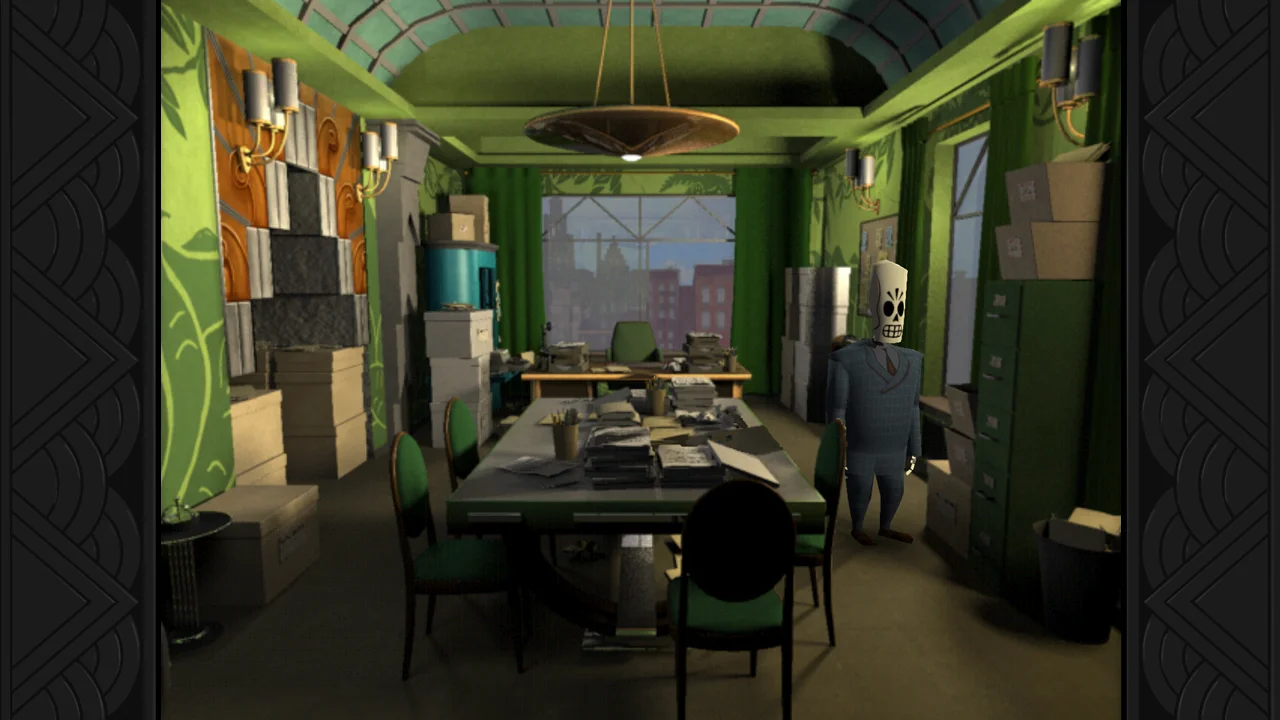
The remaster makes the set logic easier to read: a fixed camera, a furnished room, and Manny staged as a body moving through a pre-rendered space rather than a cursor acting on a flat painting. Screenshot: Grim Fandango Remastered, Double Fine / Steam.
The engine itself was built on the bones of the Sith engine from Jedi Knight, repurposed and rebuilt to achieve something new: 3D characters moving through pre-rendered static backgrounds shot from fixed cinematic angles. The result gave Schafer what SCUMM never could — quick camera cuts as Manny moved through a room, the ability to stage a space like a film set rather than a stage. The architecture of the game changed when the camera changed. Locations that had previously been experienced as flat, navigable images became something closer to sets. Manny didn’t point at the world. He moved through it.
The crunch to ship the game was protracted and brutal even by the industry’s standards: months of sixteen- and eighteen-hour days. Even with that sacrifice, the team had to drop several puzzles and characters, including a five-step climactic sequence against the antagonist Hector LeMans. Schafer later estimated they would have needed another one to two years to realise everything planned. What shipped was already more ambitious than anything the studio had made.
”I wanted to do a detective story, basically Raymond Chandler in the Land of the Dead.”
— Tim Schafer, GDC Postmortem, 2015
Four Acts, Four Years
Across four acts, the game jumps forward in years. There is no transition, no ceremony — just a hard cut and the quiet realisation that time has passed without you. Manny moves through a corrupt city, a rain-soaked harbour, an industrial frontier, and finally a capital where the system reveals itself. Each space feels like a different story already in progress. The architecture shifts — what begins in an Art Deco bureaucratic tower ends in something grander and more compromised, a city built entirely on stolen virtue.
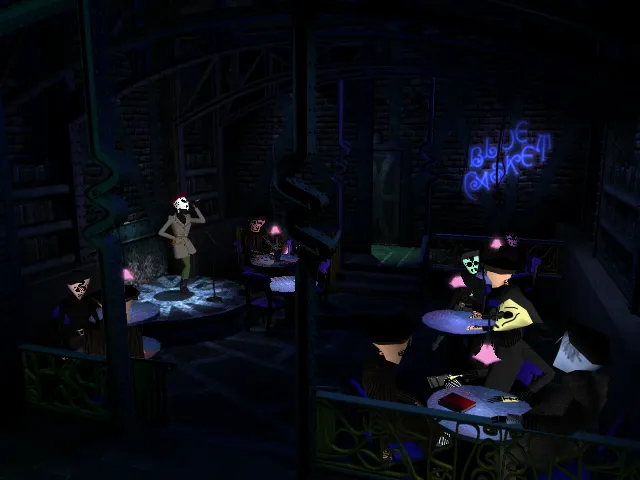
Rubacava changes the rhythm from office comedy to nocturnal harbour noir. The Blue Casket feels like a room you enter late, after everyone else has already decided who they are. Original-era location image via Grim Fandango Network.
People have changed when you return to them. Some have moved on. Some have hardened. Some are gone. The game makes no effort to catch you up. You register the distance and keep moving.
You don’t shape these events. You arrive after they’ve begun.
The writing — produced largely by Schafer himself — mirrors that logic. Dialogue crackles with the wit and moral weight of the crime fiction it draws from, but it also does something quieter: it remembers. A line you barely register early on returns hours later with consequence. A background detail becomes a solution. Characters who seem incidental in act one are revealed to have been essential all along, not because the plot demands it but because the world has a coherent logic the game was always trusting you to find. It doesn’t just reward attention — it keeps track of it on your behalf.
The score, composed by Peter McConnell, draws on Duke Ellington and Benny Goodman for its orchestral backbone while weaving in South American folk music via live musicians McConnell recruited from San Francisco’s Mission District — including a full mariachi band. The result functions less as accompaniment than as atmosphere. McConnell built the entire digital orchestral layer to sound as though a live conductor were watching the game in real time, varying tempo and phrasing the way a film score responds to the edit. The music reinforces the world’s reality in a way that no visual element could. The sense that this place exists beyond the player’s immediate view, that its streets are occupied by people who don’t require your attention, is partly structural and partly sonic.
Even without sound, Glottis sells the score as performance rather than wallpaper: big body language, lounge timing, and a song the room seems to know already. Clip via Tenor.
The Year That Swallowed It
Released on October 30, 1998 — deliberately timed to arrive just before the Day of the Dead — Grim Fandango landed in the middle of perhaps the most competitive month in the history of PC gaming. Half-Life, Metal Gear Solid, and The Legend of Zelda: Ocarina of Time all arrived within weeks. The reviews were extraordinary: a Metacritic score of 94, awards from every major publication, GameSpot’s PC Game of the Year. The sales were a disaster. Approximately 95,000 copies sold in North America by 2003, against a development budget of $3 million. Worldwide, estimates range between 100,000 and 500,000 units total by 2012. The game Schafer and his team had given three years of their lives to was, commercially, a rounding error.
The problem wasn’t simply timing. It was identity. Grim Fandango didn’t fit what the adventure game genre had been — too cinematic, too structurally ambitious, too strange — and it didn’t align with where games were heading. The late nineties had already shifted the centre of gravity: PlayStation was repositioning games as adult entertainment, and titles like Resident Evil 2, Metal Gear Solid, and Silent Hill were demonstrating what prestige looked like in the new landscape. Adventure games were something your older sibling had played on a beige computer. LucasArts released one more adventure game after Grim Fandango — Escape From Monkey Island — and then never made another. Tim Schafer and most of the team left to found Double Fine Productions. The game that was supposed to revitalise the adventure genre became, instead, its eulogy.
The critics recognised its achievements clearly — the game was not praised for the wrong reasons. It failed commercially because it arrived too late for an audience that had sustained the genre and too early for the audience that would eventually find it. The players who would have loved Grim Fandango in 1998 were already playing PlayStation. The players who would eventually declare it a masterpiece hadn’t started gaming yet.
Legibility, Not Modernisation
The 2015 remaster, produced by Double Fine after Schafer acquired the licence from Disney following LucasArts’s closure, removes most of the original’s friction without altering its structure. Point-and-click controls restore clarity. Lighting improves readability. The audio was re-orchestrated from the original Pro Tools files, with McConnell finding that some samples no longer held up and rebuilding them under Nile Rodgers’ Sumthing Else label. Director’s commentary, recorded by Schafer and key members of the team, reframes intent throughout.
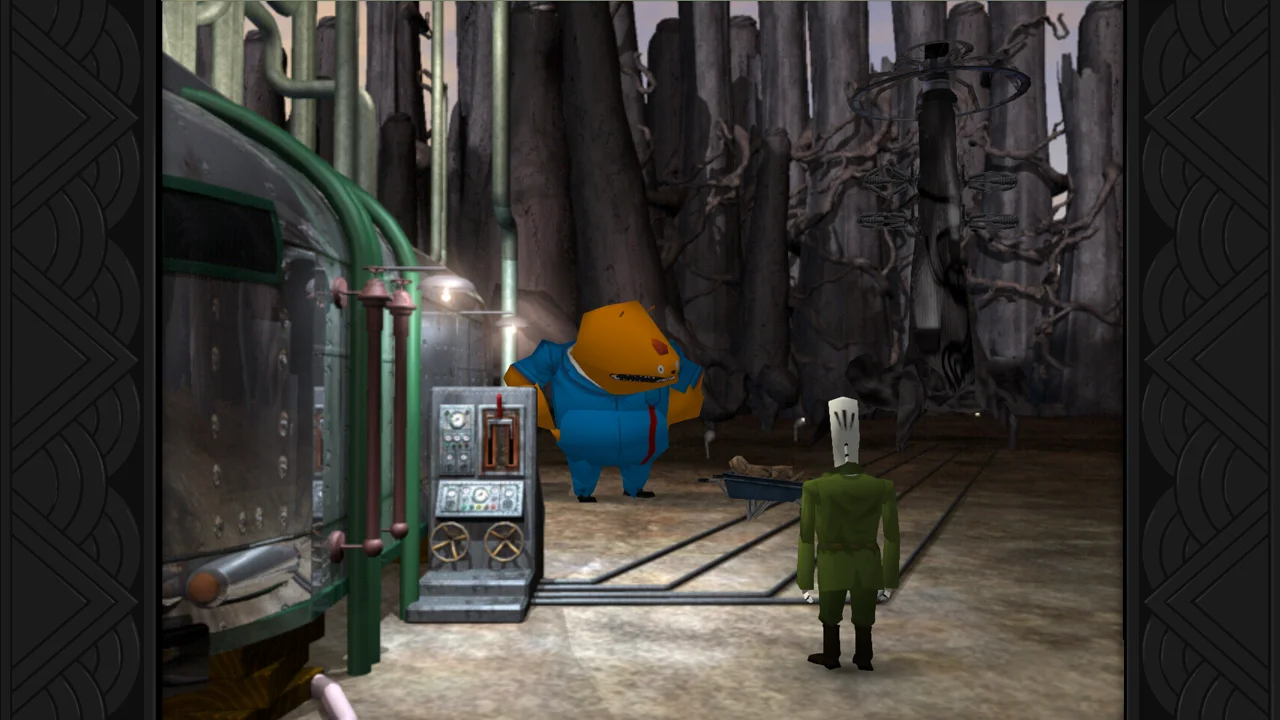
The remaster’s best visual argument is restraint: new lighting and cleaner character textures, but the same strange industrial silhouettes and fixed scene grammar. Screenshot: Grim Fandango Remastered, Double Fine / Steam.
It doesn’t modernise the game. It makes it legible.
Playing it now, the unevenness is still there. Some puzzles resolve with precision; others resist clarity and require patience. The balance is clear. You don’t solve problems to win — you solve them to stay, to hear the next line, to see the next room, to follow Manny a little further into something already in motion. A world that does not depend on you, and invites you to stay anyway. Once you’ve seen what that looks like, it becomes difficult to return to games that simply wait for you to act.