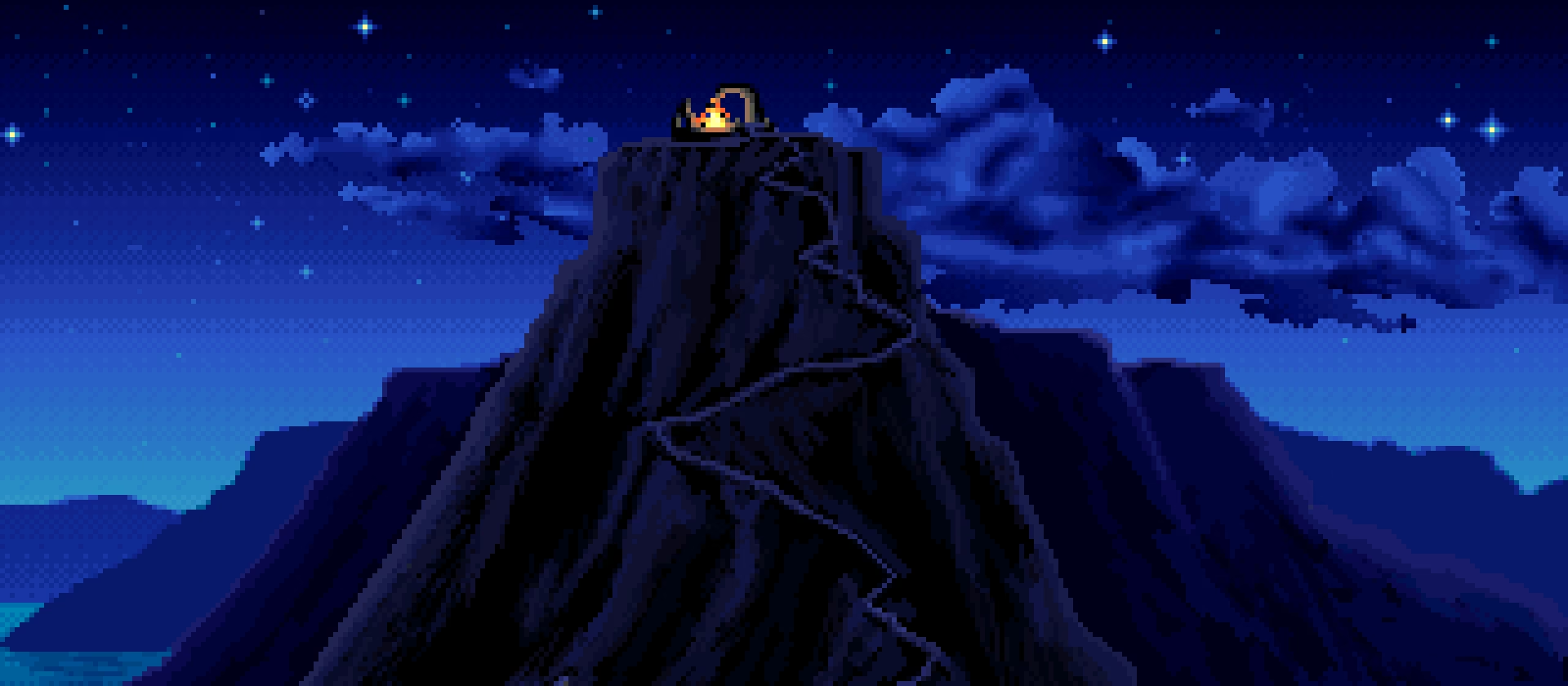
Indiana Jones fought Nazis once in 1981, once in 1989, and for fifteen years afterwards he stopped. The third film closed on a literal sunset and Spielberg, Lucas, and Ford spent the next decade and a half failing to agree on what should come next. By the time Kingdom of the Crystal Skull eventually arrived — fridge, aliens, monkey-swinging Shia LaBeouf — the audience had already decided what the fourth Indiana Jones was. They had decided it was a game.
The Fate of Atlantis shipped in June 1992, three years after The Last Crusade and sixteen before Crystal Skull. It is the only post-1989 Indiana Jones story that anybody who likes Indiana Jones still defends, and the reason is that Hal Barwood and Noah Falstein were handed an assignment Hollywood had spent years failing to deliver and finished it inside two. They did it by ignoring the brief Lucasfilm Games handed them — a six-year-old shelved screenplay nobody had wanted to film — and writing an original story from scratch, around a diagram they found in a library.
That matters because Indiana Jones is not only a hat, a whip, and a map line. The films work when discovery has a method: an inscription read correctly, an object recognised under dust, a myth treated as a puzzle rather than a mood board. Fate of Atlantis understands that grammar better than the later films because adventure games are built out of that grammar. To progress, the player has to inspect, infer, misread, try again, and finally make an archaeological joke useful.
A Monkey King, and Then a Diagram
The job started badly. LucasArts wanted a tie-in to a script. The script was Indiana Jones and the Monkey King, Chris Columbus’s 1985 draft for the third film, set in Africa and Asia around a Chinese garden of immortality-granting peaches. Lucas had rejected it six years earlier in favour of the more grounded Holy Grail material that became Last Crusade. Barwood read it. He told Lucasfilm he did not want to build a game out of it. He asked for permission to write something original.
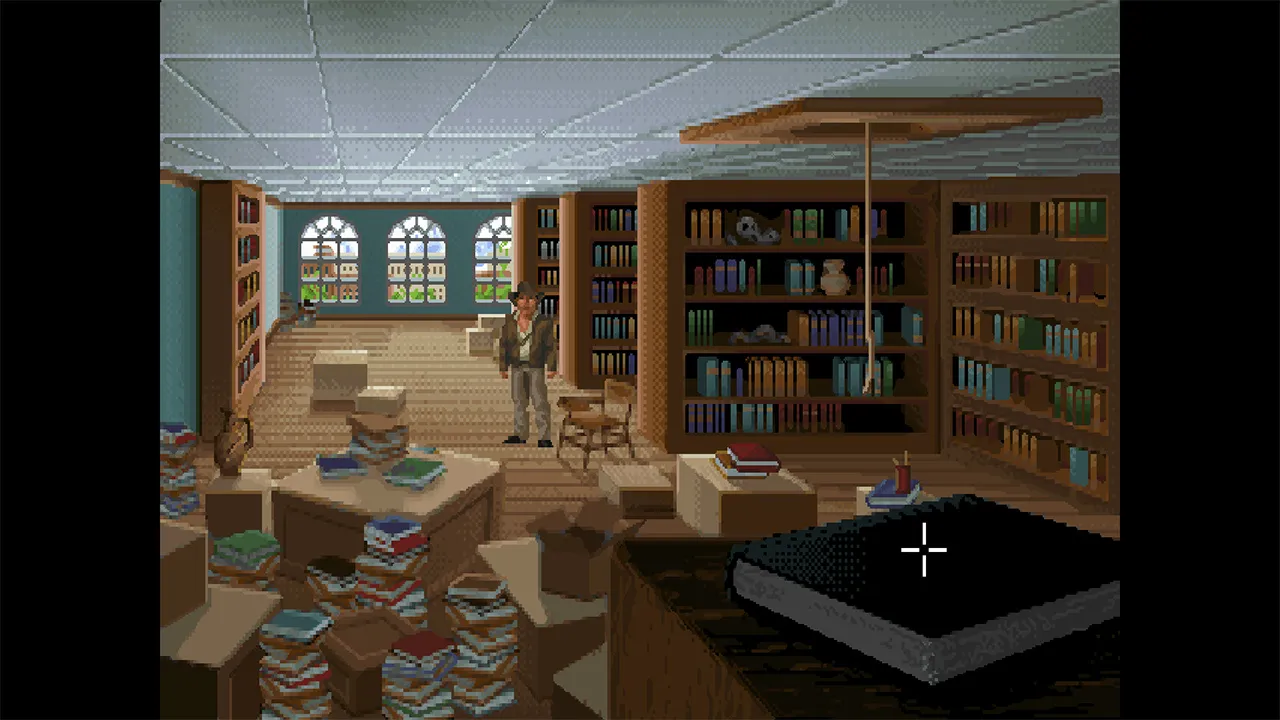
Barnett College in act one. Barwood spent his research months reading Plato’s Critias and the cranky 1980s pseudo-history shelved beside it — the room you walk into in the opening minutes is a portrait of the writer’s desk. Indiana Jones and the Fate of Atlantis · LucasArts, 1992.
The replacement came from the Skywalker Ranch research library. Looking for material that might support a globe-trotting Indy plot, Barwood and Falstein pulled down a Time-Life volume called Mystic Places — a book of cranky 1980s pseudo-history about Atlantis and the lost continents. Inside was a diagram of the city as Plato had described it in the Critias dialogue: three concentric rings, harbour at the centre, alternating bands of land and water. The shape looked, to two adventure-game designers, exactly like a board.
”When we saw the diagram of Atlantis in the book, we thought, ‘Oh my god, that’s a game!’”
— Hal Barwood
What Barwood and Falstein built around that diagram was an Indy story unusually fluent in the source material it pretended to be inventing. The metal Indy chases through Iceland, Algiers, Crete and Knossos is orichalcum — Plato’s name, in the same dialogue, for the alloy that powered the Atlantean civilisation. The locations are stitched together by Indy’s hunt for a lost copy of the Hermocrates, the dialogue Plato never finished. Sophia Hapgood, the former Barnett graduate turned nightclub psychic who carries the plot alongside Indy, is Barwood’s invention — but the orichalcum she chases is fifth-century BC. The film series had taught audiences to think of Indy as a man who finds biblical relics. The game found a more interesting question: what if the relic predated the Bible by two millennia, and was described, in detail, in a book that actually exists.
The joke is that the source material makes the fantasy feel less inflated, not more. Atlantis has become shorthand for anything blue, glowing, and vaguely tragic, but Plato’s city is an engineering problem before it is a legend: rings, canals, harbours, metals, laws, measures. Barwood and Falstein use that dryness as fuel. Every old tablet and machine part points back to a city with rules, and rules are what adventure games know how to turn into pleasure.
Three Paths Through One Continent
Falstein, looking back at the player split over Last Crusade’s fist-fights — half the audience had loved them, half had thought them punitive — pitched a structural solution. The middle two-thirds of the new story would branch. The same plot beats, three different routes through them. The Wits path concentrated on puzzles and dialogue. The Fists path turned the journey into a fist-fighting circuit through Crete and the Aegean. The Team path partnered Indy with Sophia, the player solving most of the journey alongside a second character who could be talked to, given items, asked for help.
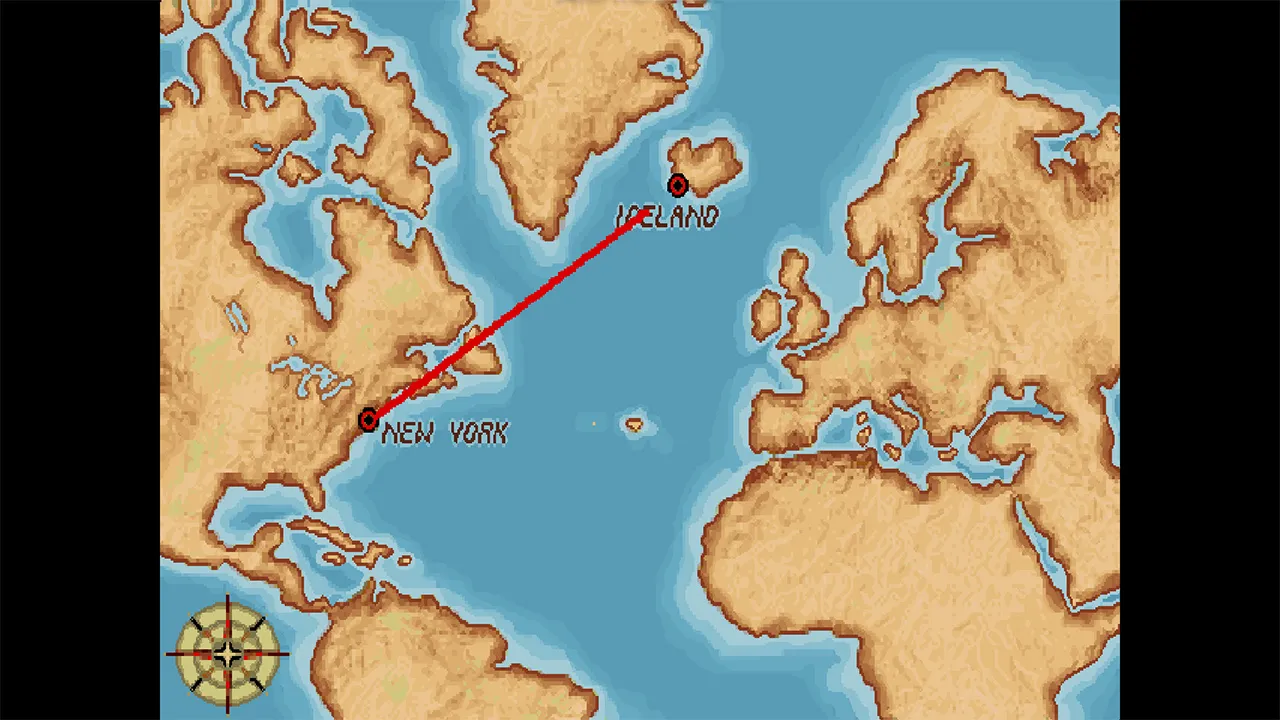
The travel map after the first split. Barwood thought of his locations as “bubbles” — set-pieces strung together by visual contrast, not plotted geography — and the world map is the device that makes the leaping legible. Indiana Jones and the Fate of Atlantis · LucasArts, 1992.
The cost was real. The branching added about six months to the production schedule and forced the team to write three games’ worth of dialogue, scene logic, and inventory states. Falstein moved across the building to The Dig before the implementation was finished, leaving Barwood to wire up all three paths alone.
”Noah Falstein and I set up three paths — wits, team, and fists — to take the player through the game on his or her own terms, depending on preference for lonely puzzle-solving, companionable cooperation, or bare-knuckled action.”
— Hal Barwood
Played at release, the headache was invisible. Played now, with thirty years of branching-narrative orthodoxy behind it, the design still carries more confidence than most modern AAA stabs at the same idea. The three paths converge once Indy reaches Atlantis — necessary for the schedule, but also for the argument. The point of the branching is not to hand the player a different story; it is to hand them a different relationship to Indiana Jones. On Wits, you are an archaeologist. On Fists, you are an action hero. On Team, you are half of a couple. The film franchise had spent four years failing to choose between those three modes. The game let the player choose, and choose again on a second run.
That choice changes the temperature of individual scenes without flattening them into menu-state theatre. Monte Carlo can become a social puzzle, a con, or a brute-force problem. Crete can ask for memory, muscle, or cooperation. Sophia is not a morality meter with hair; on the Team path she interrupts, resists, misunderstands, and occasionally solves the room before Indy does. The branching does not advertise consequence in the modern prestige-drama sense. It gives the player’s preferred Indy a route through the same myth.
Picture Bubbles and Painted Backdrops
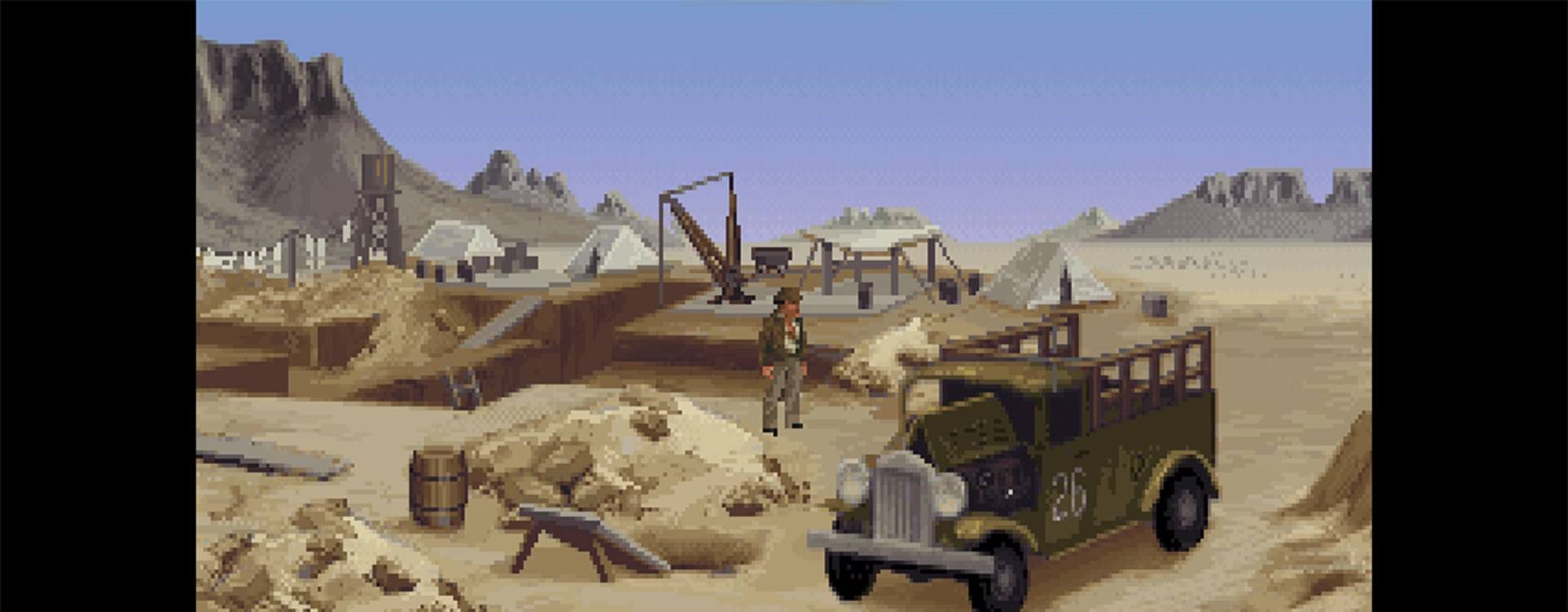
The structural problem Barwood faced after locking the branching was visual monotony. A twelve-hour adventure game played at the same camera distance, the same character scale, the same painted-pixel resolution, would die of its own consistency. His solution was the term he uses for it: bubbles. Discrete location set-pieces, strung together not by plotted geography but by visual contrast. The Iraq dig site that opens the desert chapter shares no palette, architecture or atmosphere with the Algiers bazaar that follows it; the bazaar shares nothing with the Iceland glacier camp; the camp shares nothing with the Aegean submarine sequence. Each bubble is its own short film.
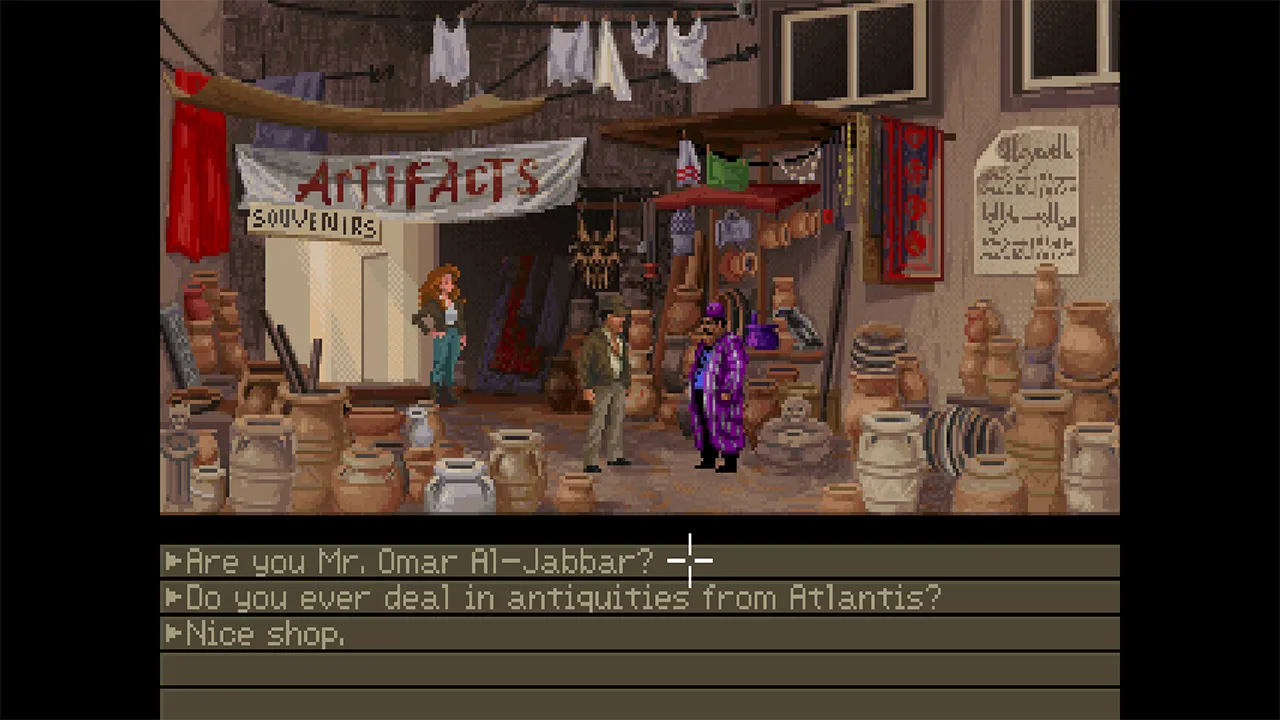
The Algiers bazaar — one of Fate of Atlantis’s most heavily worked backdrops. Hanging laundry, a stitched ARTIFACTS banner, pottery stacks, and a vendor whose violet robes carry more chapter-setting work than any line of dialogue. Indiana Jones and the Fate of Atlantis · LucasArts, 1992.
The painted-pixel art carries the trick. The bazaar above has hanging laundry, pottery stacks, a stitched banner reading ARTIFACTS over a souvenir stall, and a vendor in violet robes whose costume tells you more about the chapter than the dialogue script will. The Knossos labyrinth is rendered in cobalt and deep navy, dimmed to a register normally reserved for ghost stories. Iceland is washed in cold blue-white. The Yucatán hides a Mayan pyramid behind a hand-painted “Trinkets” stand. Each backdrop is a piece of editorial work in its own right, and crucially, none of them recur. Fate of Atlantis spends location budget the way a film spends location budget — once, with intent, then move on.
iMuse Learns to Listen
Beneath the pictures, the iMuse middleware — LucasArts’ adaptive-music system, debuted on Monkey Island 2 the year before — was getting its second proper shakedown. Clint Bajakian, Peter McConnell, and Michael Land write in a register that can survive interruption: brass fanfare, nightclub sleaze, desert percussion, and puzzle-room suspense broken into cues the engine can reassemble. iMuse lets those cues change without ever cutting; one MIDI phrase blends into another on a beat or a phrase boundary, dictated by where the player is and what they have just done. In Fate of Atlantis its most effective use is also its smallest. When Indy is walking, a percussion track plays. When he stops, the percussion fades and the strings carry. The cue is simple enough to describe in one sentence. The effect — that the music is listening to your feet — is the kind of texture games would later spend a decade rediscovering.
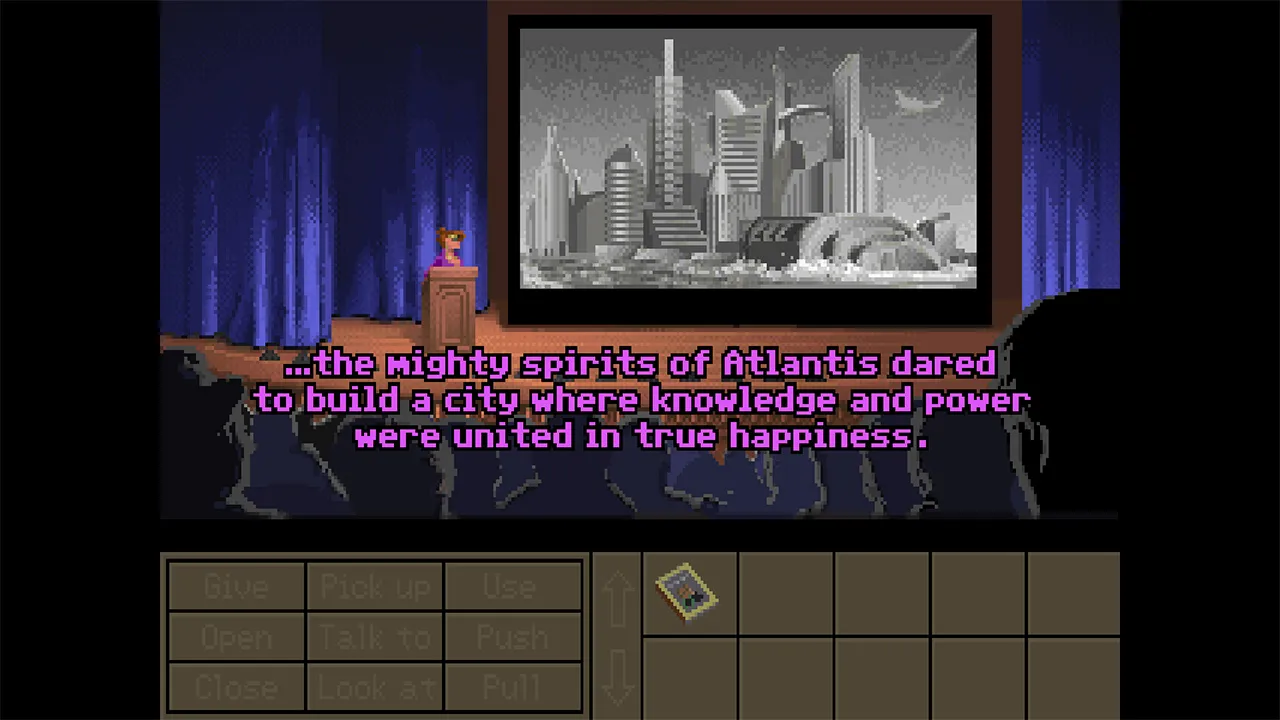
Sophia’s nightclub lecture — Barwood’s invented character introducing the Plato material that will carry the rest of the plot. iMuse drops the bar music to a hush the moment she starts speaking, then lifts it back when the audience boos. Indiana Jones and the Fate of Atlantis · LucasArts, 1992.
The voice direction added in the 1993 CD-Talkie edition is uneven. Doug Lee, who took Indy after Harrison Ford declined, never quite settles into the part. The supporting cast, recorded in fewer takes than the production would have wanted, leans theatrical where the floppy edition’s silent reading had been understated. Players who can get the original floppy build running — through ScummVM, with the MT-32 driver — get Barwood’s writing in its purest form. Players who take the CD-Talkie get more spoken Indy, less inner Indy. It is a trade, not an upgrade.
The Sequel That Stayed
Hollywood’s attempts to follow Last Crusade with a fourth Indiana Jones produced, across the decades that followed, two films and a half-dozen abandoned drafts. Crystal Skull made more than three-quarters of a billion dollars and is not defended. Dial of Destiny lost money and is not defended. Fate of Atlantis ignored its brief, ignored the franchise’s appetite for biblical relics, and went looking for Plato instead. It has outlasted both partly because Barwood and Falstein cared about the archaeology, partly because they cared about the puzzle of how a player gets through it.
A run through the Team path takes twelve hours and ends with Indy and Sophia at the centre of a city that exists, in Plato’s Critias, exactly as Fate of Atlantis lays it out. The pleasure is specific to the medium. No film of this script could have given you the choice of how to spend an afternoon in Monte Carlo, or the dignity of solving Plato’s stone-test by reading the dialogue carefully, or the small clean victory of fitting an orichalcum bead into a slot a thousand years of Aegean weather had left waiting for it. Hollywood had blockbuster resources and decided, twice, that what an Indy story needed was extraterrestrials. A team of fewer than twenty had a copy of Plato and a SCUMM compiler, and decided the answer was Plato. Fate of Atlantis keeps winning in proportion to that gap.