In July 1994 Violent Storm was the tenth most-played arcade game in America. RePlay magazine’s operator chart put it there — between Mortal Kombat II on the way down and Samurai Shodown still on the way up, three months after the cabinet had landed in Japan and seven after Europe. Konami’s last belt-scrolling brawler arrived at the exact moment the fighting-game boom was eating the genre alive, made operators’ money anyway, and then went home. It has never been ported. It was not included in the 2019 Arcade Classics Anniversary Collection (that compilation was the shoot-em-ups plus Haunted Castle). Hamster has not put it through Arcade Archives. Thirty-three years after the operator chart, the only legal SKU is the bare ROM the cabinet was built around — which is to say none at all. The most distinctive belt-scroller Konami ever shipped is also the one the company has most thoroughly left behind, and the gap between the operator data and the rerelease drawer is the article in miniature: Violent Storm worked, then nobody filed the paperwork.
Tenth in America, Nowhere After
The chart position is worth holding onto for a second, because it does the work the cult reputation usually skips. Violent Storm was not rescued by retrospect. RePlay had it twenty-first in Japan in November 1993, “selling well” in Europe by January, and tenth in the US that July — operator data, machines on routes, coins in slots. The same year’s arcades were already starting to look very different. Mortal Kombat II shipped that April. Street Fighter II Turbo was nine months old. Samurai Shodown and Virtua Fighter were both eating floor space. The belt-scrolling brawler, the form Konami had effectively co-invented with Crime Fighters and Vendetta and the TMNT cabinets, was visibly running out of oxygen, and the company knew it: Violent Storm was the last one they shipped. After 1993, Konami’s arcade attention swung to rhythm games, light-gun cabinets, and the next generation of board hardware, and the brawler was simply allowed to lapse.
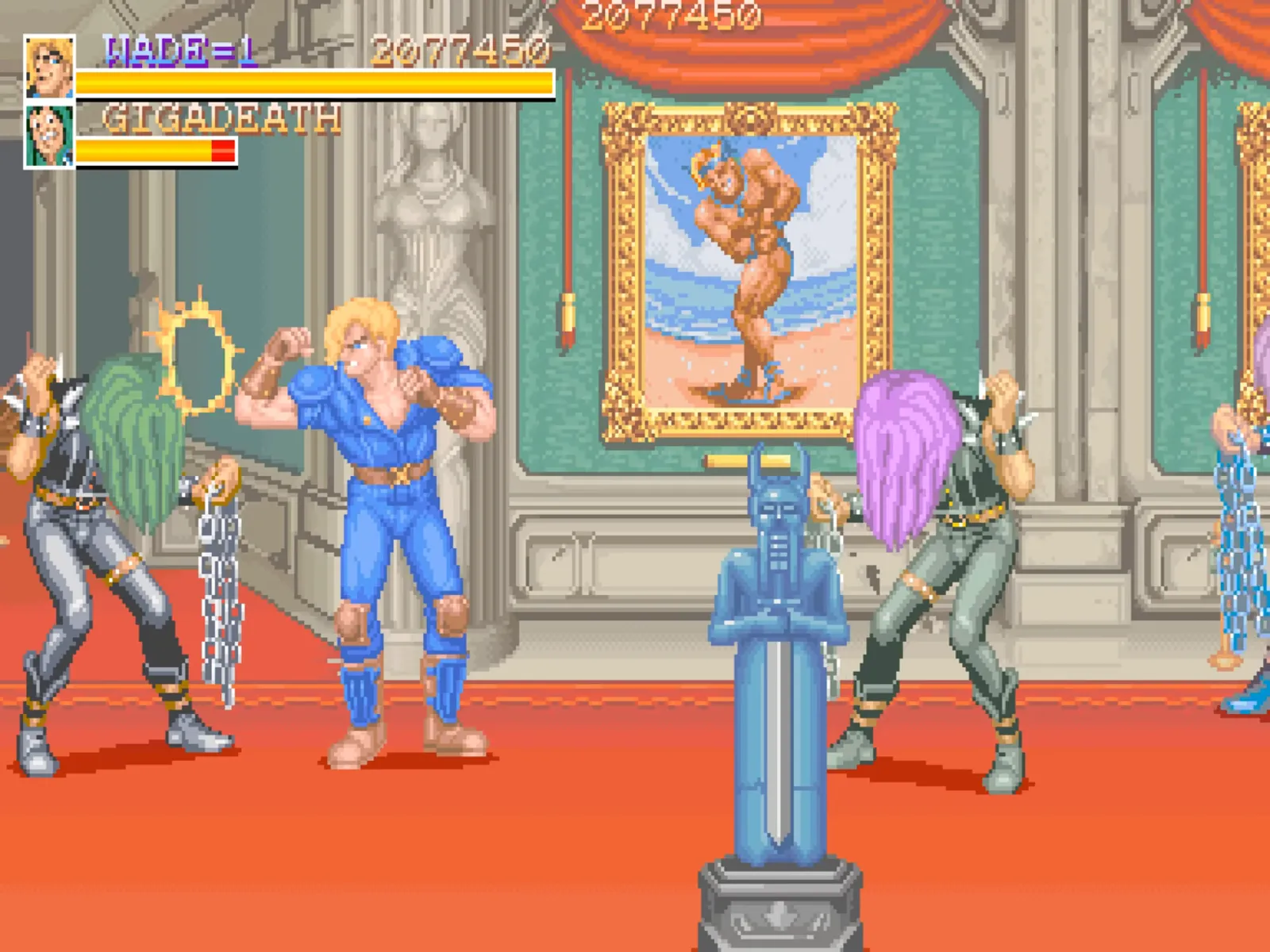
Stage 6, on the red bridge — the iconography of the TMNT arcade cabinet, six years on. Screenshot: Violent Storm · Konami, 1993 · Arcade.
The bridge is the wink. Stage 6 fights you across a red iron bridge against Sledge, a turtle-coded heavy who teleports out of frying-pan stance — Teenage Mutant Ninja Turtles: The Arcade Game, six years older, opened with the heroes scrabbling across that same red span. The set-piece is not subtle. Konami is staging its exit on the bridge that built the cabinet, and the company that designed the wink is also the company that has spent thirty-three years not finding a legal way to put the game back on a screen.
A Diner at the End of the World
The aesthetic doesn’t fit any of the categories the brawler genre had spent six years drawing. Final Fight gave you 1989 Metro City, urban-decay realist. Streets of Rage did neon noir. Vendetta, Konami’s own three years earlier, did Streets-adjacent street-gang grit. Violent Storm is a sealed bubble-city behind chain-link fences, with foregrounds out of an Americana postcard somebody dropped in petrol and lit — counter stools, plate-glass diner fronts, neon Cobalt signs, jukebox brick saloons. The horizon is Mad Max. The street furniture is American Graffiti. The shopping mall in Stage 4 has chandeliers.
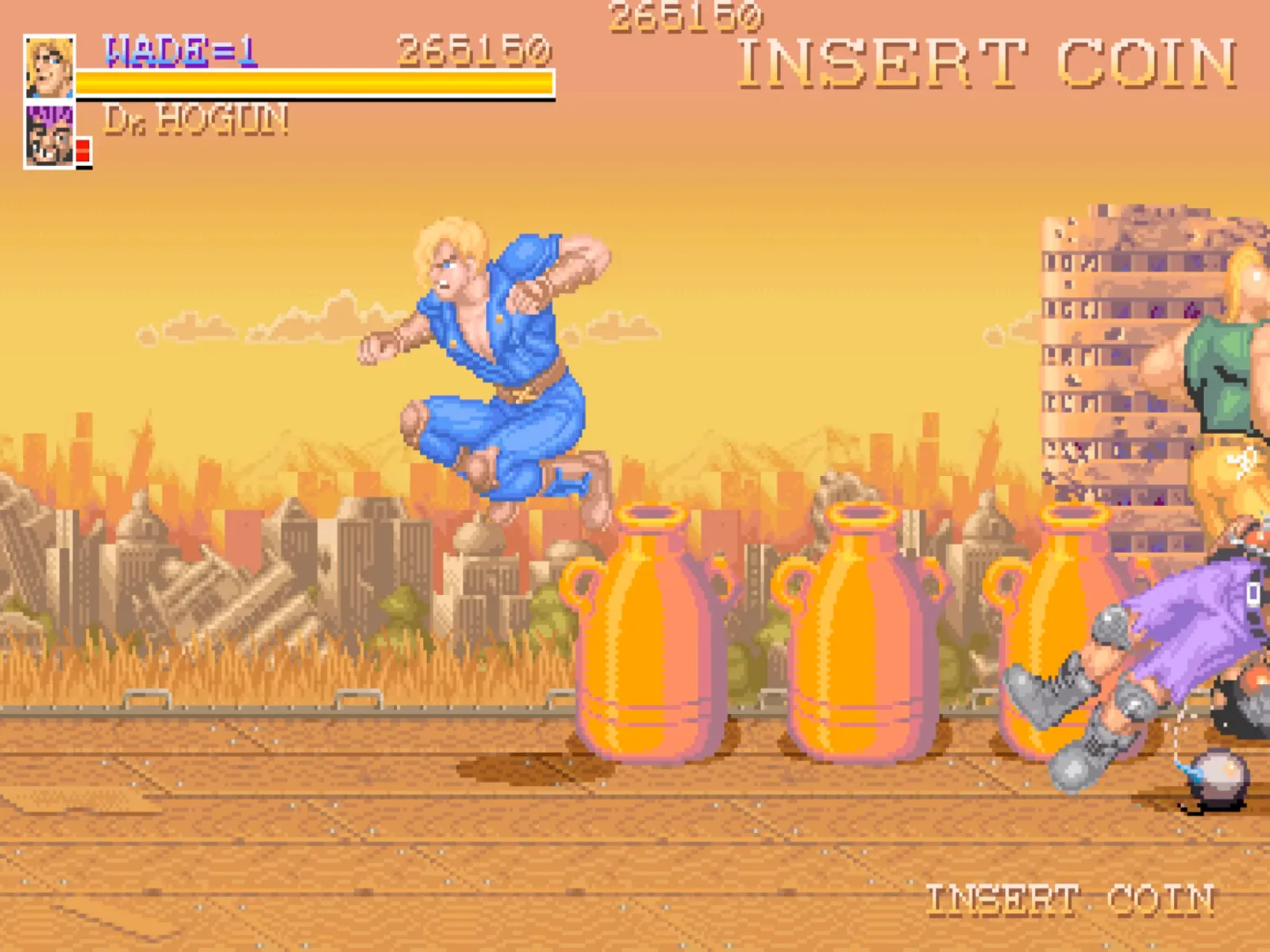
Stage 1 — the sealed city behind, the urn-lined boulevard in front, fires on the horizon. Screenshot: Violent Storm · Konami, 1993 · Arcade.
You can read this as accident — the cheap version, half a dozen pastiche moves a sprite team pulled out of a reference folder. The cabinet doesn’t behave like an accident. The food-stand vendor on Stage 2 is a hippie who hands over a health-restoring lobster. The pigs in the boulevard punt into footballs when you hit them. Stage 5 is a museum stronghold whose centrepiece boss, Mr Julius, is a marble muscle-statue that climbs off its pedestal to pose at you between attacks. Stage 4’s boss, Doyle, wears a jetpack and twin claw-arms that read as a direct Power Loader cribbing from Aliens. By Stage 7 you are fighting Geld in a sky-room flanked by suits of medieval gold armour, and a tiny TwinBee plush is sitting on the floor as a bonus pickup — the Konami sound-room signing its own name in the corner of its own painting. Hardcore Gaming 101 put the verdict best — “probably the brightest, cheeriest nuclear holocaust depicted in media next to Adventure Time” — and the tonal contradiction is the argument. The brawler is dying around Violent Storm; Violent Storm responds with the only post-apocalypse in arcade history that thinks the apocalypse is a venue.
Two Buttons, Three Bodies, One Loop
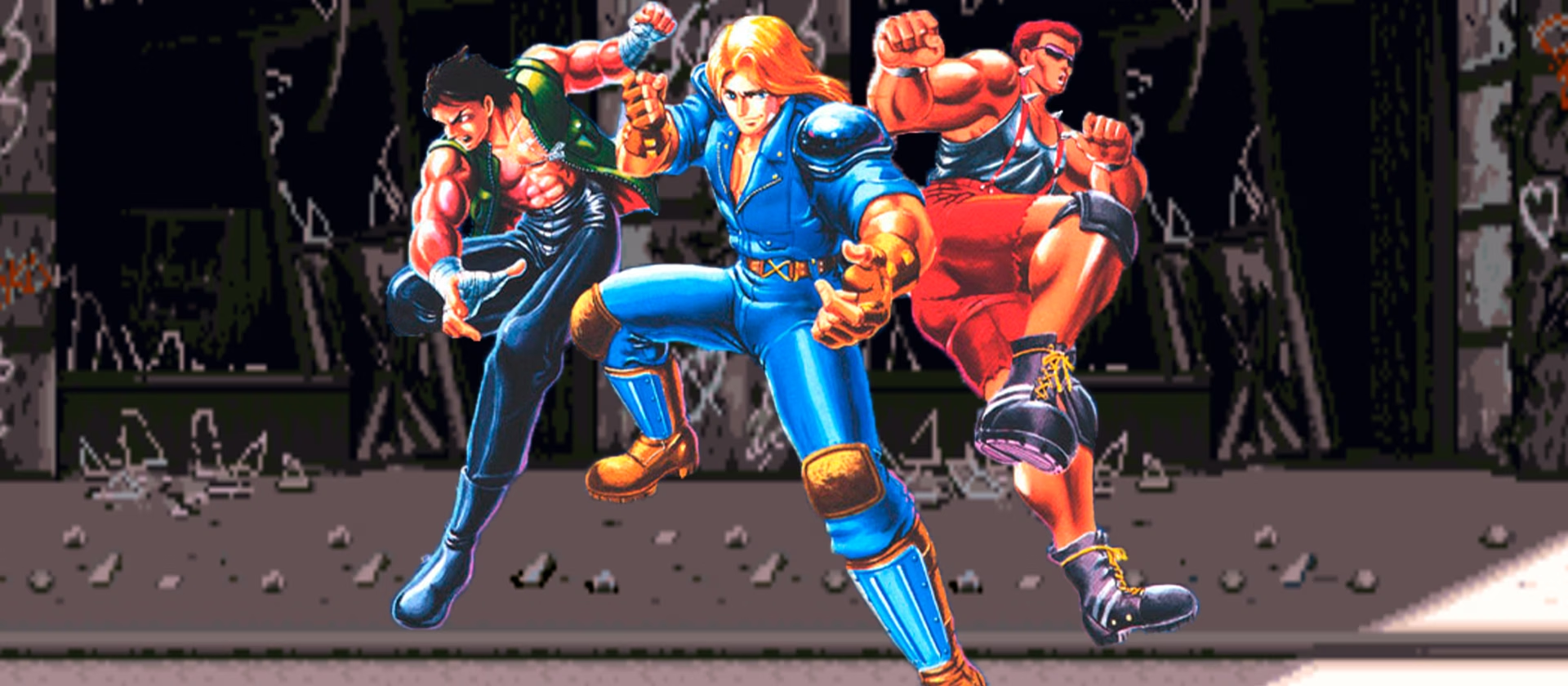
The cabinet is JAMMA, three-player, eight-way lever, attack and jump. Both buttons together fires a Mega Crash special at the cost of a sliver of HP. The roster is three deep — Wade balanced, Boris a Black powerhouse character who is the only grappler in the cast, Kyle a mash-the-kick speed build — and that thinness is the first friction a modern player names. Streets of Rage 2 had shipped with four nine months earlier. Final Fight had three, but Final Fight was 1989. Indie Gamer Chick, reviewing it in 2023, put the count question in the air cleanly: Three? That’s it? You couldn’t have programmed just one more? The same review made the case for the rest of the design.
”It has a LOT more personality than Final Fight. Then again, chicken pox have more personality than Final Fight.”
— Cathy Vice, Indie Gamer Chick, 2023
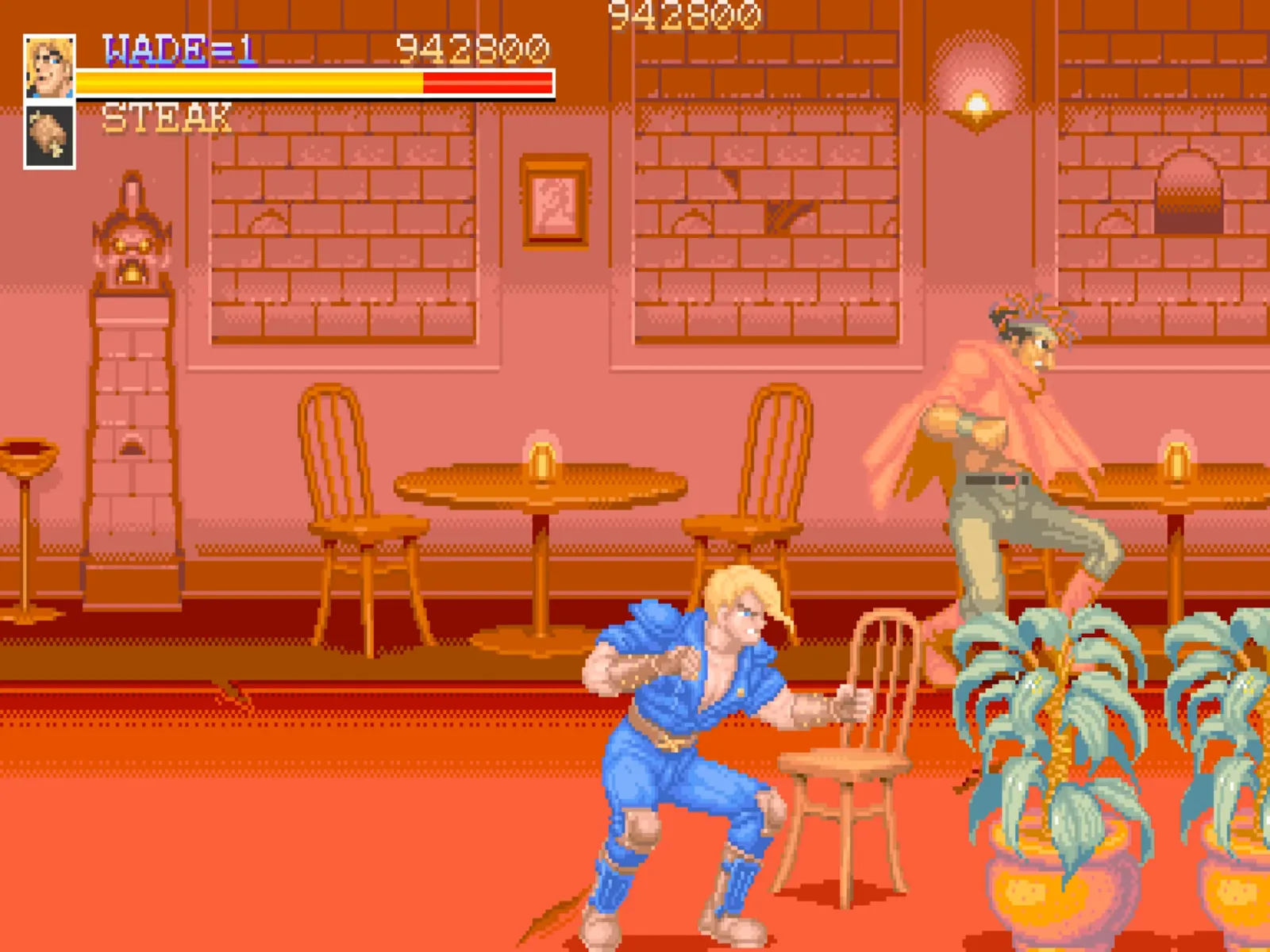
The Stage 3 saloon — every chair, table, plant pot, and bar stool is a pickup. Screenshot: Violent Storm · Konami, 1993 · Arcade.
What’s underneath the three-body roster is a moveset deeper than the Final Fight template. Dashing attacks come off a diagonal-plus-button input and cost nothing; a forward-jump cancel pops you out of the dash; grapples chain into ground attacks and knockdown combos; most enemy groups don’t have enough HP to soak more than a single sweep, which means the brawler’s worst pacing failure — the slow chip-away crowd — almost never lands. The screen empties. You walk on. Boris’s piledriver is the cleanest grapple animation in any Konami brawler. A no-continue clear unlocks the Violent Round, a denser-spawn second loop that exists exclusively for the kind of player a 1993 arcade was trying to keep at the cabinet for a second quarter, and which modern emulation lets you actually reach.
The friction beats are real and worth saying out loud. Sprites are among the biggest Konami ever drew, the play-field is 384×224, and a busy screen reads as cramped — designed identity, not a flaw, but the first thing a modern player bounces off. Geld’s final form spits acid puddles that linger on the playfield through the boss timer; the spike is sharp enough that Indie Gamer Chick crossed it off into frustration. Off-screen enemies sometimes refuse to come back to the centre. One-credit clears land at twenty-five minutes, thirty with continues — a normal arcade run that reads as short against a modern player’s idea of a full game.
Fukui Before Square
The thing every retrospective names first is the music, and it is the music that the orphan-status keeps from getting the credit it deserves. The Mystic Warriors board carried two Konami K054539 PCM chips, sixteen ADPCM voices in total, and the Stage 1 BGM uses them to throw a sung vocal hook over the surf-rock — BREAK OUT — BREAK OUT — FIGHTING — followed by a gospel-rap chorus on Stage 3 and synth-pop chorales on the museum-stronghold stages. Vocal sampling in arcade BGM in 1993 was effectively unheard of. The chip allowed it; the score uses it as a structural element, not a stinger.
The arcade marquee, oxidised over Konami orange. Violent Storm · Konami, 1993.
Three composers are credited under house handles — Seiichi Fukami as “Prophet Fuka”, Youhei Kishimoto as “Kishimaro”, and Kenichiro Fukui as “Everybody”. Fukui’s Konami arcade run was already over by the time Violent Storm hit cabinets: Lethal Enforcers in 1992, G.I. Joe in 1992, Violent Storm in 1993. In 1995 he transferred to a Square subsidiary called Solid, then up to Square Tokyo, and proceeded to score Einhänder, Front Mission 5, and Project Sylpheed, arrange tracks for Final Fantasy VII: Advent Children, and play keys in Nobuo Uematsu’s prog-metal band The Black Mages until the project ended in 2010. Which is to say: the soundtrack the cult cites most is the bridge between a Konami sound-room writing surf-rock for a brawler and a Square composer arranging prog-metal Final Fantasy. Violent Storm’s score is the credit immediately before the move.
What you get out of running it now, then, is a piece of work with three things very few of its peers had: a tonal argument that runs through every backdrop, a vocal-sampling soundtrack a year ahead of any obvious peer, and a moveset that takes the Final Fight template and adds enough dash-and-cancel grammar to make groups feel like rhythm rather than attrition. What you don’t get is Streets of Rage 2’s roster depth or Final Fight 3’s difficulty curve, and the orphan-status that gives the game its cult oxygen also means the only way through the door is the ROM. Take the trade. The Konami sound-room only signed off the brawler genre once, and it did so by stacking surf rock against a sung chorus on a board that had been built to carry sixteen sample voices because somebody, somewhere in Tokyo in 1992, had thought the next big board ought to be able to sing. It sings. It does so behind a curtain nobody at Konami has so far bothered to draw back.