// // import finalFightSodomBossPoster from ”../../assets/images/final-fight-1989-sodom-boss-poster.jpg”; // deleted // deleted
// // import finalFightPoisonRoxyPoster from ”../../assets/images/final-fight-1989-poison-roxy-poster.jpg”; // deleted // deleted
Final Fight did not influence Street Fighter II. It was Street Fighter II — or the closest approximation of it that could be built before a hardware shortage made the sequel impossible. The same directors, the same character design vocabulary, the same convictions about how fighting should feel at speed: all of it arrived in arcades in December 1989, reshaped into a different genre by circumstances that had nothing to do with design intent. When Akira Nishitani and Akira Yasuda finished shipping Final Fight and moved directly to Street Fighter II’s development, they carried this game’s bones with them. The car-smashing bonus stage that became one of SF2’s signature moments first appeared here. The animation philosophy for making large, distinct characters feel physically different from one another was worked out here, on a four-person pixel art team, under ROM constraints so severe they invented solutions that other developers hadn’t yet conceived of needing. Final Fight solved the problems that made SF2 possible. SF2 got the credit because it arrived two years later in the correct genre.
The Chip That Rewrote Street Fighter
The sequence is documented and overlooked. Capcom’s management wanted a Street Fighter sequel in 1988. Nishitani’s team had been building toward one under the internal title Street Fighter ‘89 — a direct continuation, not a reinvention. Then a global shortage of 1MB ROM chips closed off the path. The original Street Fighter had used 48 megabytes for its graphics alone. The sequel would need at least as much. With the shortage, the ceiling was 32MB. The sequel was impossible.
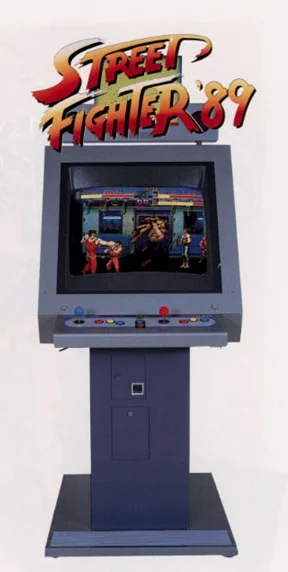
The cabinet before the name change. Via fightersgeneration.com · Capcom, 1989.
The pivot to a belt-scroller wasn’t arbitrary — Double Dragon’s success had demonstrated the market for the form — but it wasn’t a clean creative break either. Capcom’s sales division still promoted the project at trade shows as a Street Fighter sequel. One character was described in marketing materials as “a former Street Fighter.” Metro City remained the setting. The name changed only when arcade operators pushed back: the finished game was nothing like Street Fighter, they said, and they were right. What it resembled, instead, was the thing Street Fighter was supposed to become. The “Final Fight” name that replaced Street Fighter ‘89 didn’t erase the origin — it obscured it.
Four Pixel Artists and the Miraculous Memory
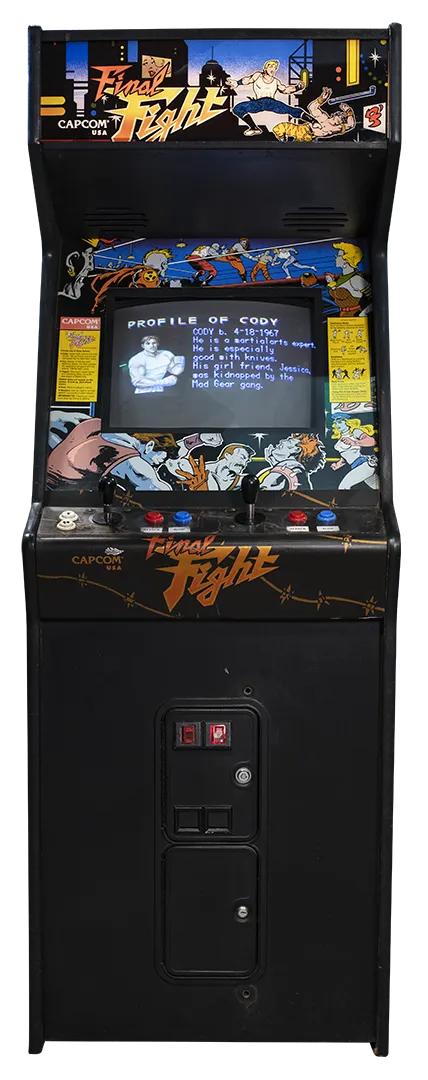
Final Fight upright cabinet. Capcom, 1989.
The pixel art team numbered four. Nishitani’s previous project, Forgotten Worlds, had used twenty. The constraint didn’t limit the game’s ambition — it focused it.
Their answer was the “Huge & Cool” principle: make the characters enormous. Rather than spreading a limited animation budget across small figures with many frames of movement, the team concentrated everything into oversized bodies with roughly twelve walking cycles each, compressed within 32-pixel widths. The result was characters who moved with intention rather than fluency — big, planted figures that registered as genuinely physical, absorbing hits and dealing damage with a solidity the hardware had no business producing. To manage memory allocation, the team printed pixel art and cut and pasted it onto boards marked with ROM capacity measurements, treating available space like a puzzle solved by hand.
The visual reference came directly from Capcom’s management. President Kenzo Tsujimoto told the team to study Walter Hill’s filmography — Streets of Fire (1984) and Hard Times (1975) specifically. The developers watched them on three monitors simultaneously in a room set aside for the purpose. Akiman, the character designer, described the constraint clearly: for the original Street Fighter they had used 48MB just for graphics; for any sequel, they had 32MB to work with. Every frame earned its existence.
The film research left deep marks. Cody’s name and bearing came from Tom Cody in Streets of Fire — Michael Paré’s protagonist, a man who moves through his city with the weary authority of someone who has seen everything fail. Haggar merged Jean Valjean from Les Misérables (specifically the second-act Valjean, the reformed man who becomes a civic figure) with the visual register of the manga Mad Bull 34. Guy leaned on the team’s conviction that American players wanted ninjas. These are not shallow character sketches. They are genre logic compressed into silhouette — characters whose visual design argues their gameplay role before you’ve touched a control.
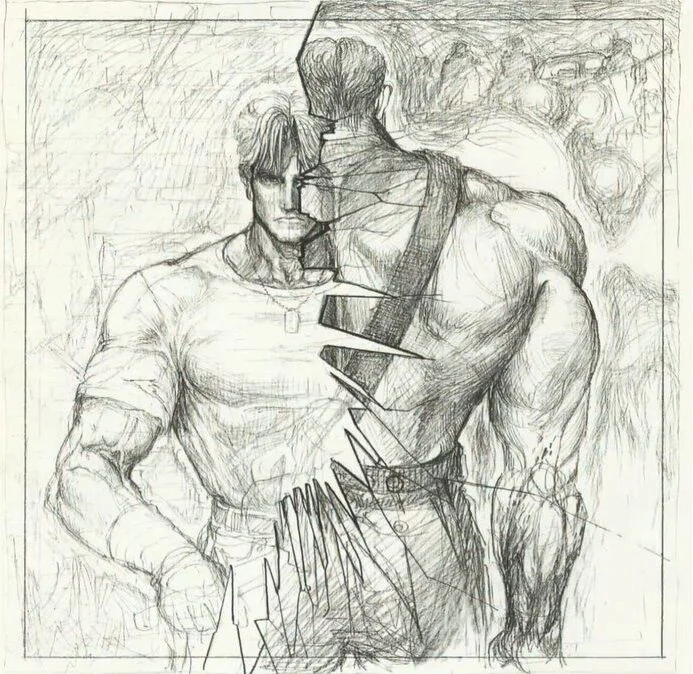
Akiman’s concepts for Cody and Haggar. Scale, posture, and physical vocabulary already fixed before a pixel was placed. Via fightersgeneration.com · Capcom, 1989.
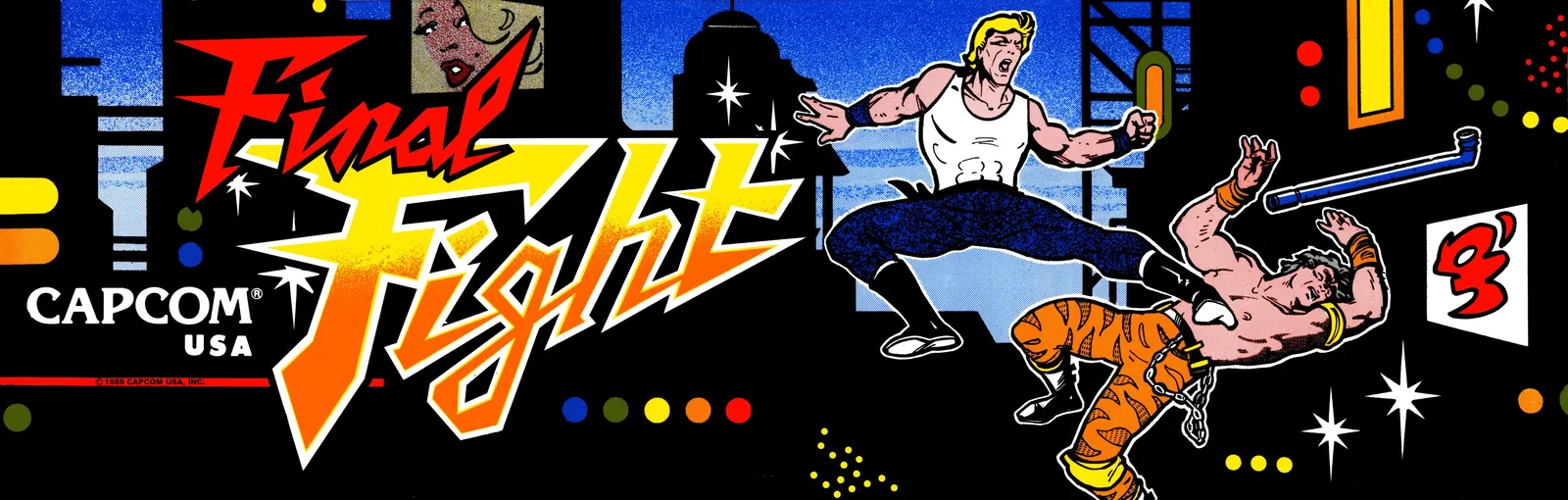
Final Fight arcade marquee. Capcom USA, 1989.
Near production’s end, a memory board went missing. It was found under a desk, and it provided exactly enough space for the ending sequence the team had already accepted they would cut. They called it the Miraculous Memory. The game came that close to not having an ending at all.
The Mayor, the Ninja, the Vigilante
The three-character roster is the game’s central mechanical argument. Selecting between Haggar, Guy, and Cody is not a cosmetic choice — it is selecting difficulty and play style simultaneously, and the differences run deeper than the stat screen suggests.
Haggar is the grappler. Walking into an enemy initiates a grab; from the grab, you can chain punches into the opponent’s body, or redirect the final hit into a throw by reversing the joystick at the moment of impact. His spinning piledriver is the most damaging unarmed attack in the game — the tool that makes patience rewarding and forces every other decision into its orbit. Haggar is slow, and the slowness is the design. He demands positional thinking, requires you to manage where you stand relative to multiple enemies before committing. You cannot button-mash effectively with Haggar. His ceiling is high precisely because his floor requires something that a first session will not naturally produce.
Guy is the speedrunner’s character. He can jump off the edge of the screen — the invisible wall bounding the play area — transitioning directly into a flying side kick with exceptional range. Hit-and-run is not just viable with Guy; it is the intended vocabulary. The wall-jump technique takes time to internalise and, when it clicks, reveals a second game inside the first: one about momentum and distance rather than weight and positioning.
Cody is the knife character. When a found knife is in his hands, Cody stabs rather than throws — repeatedly, rather than once, dramatically increasing sustained damage output compared to characters who use the knife as a thrown projectile and lose it. Cody is the accessible option for new players, but mastery looks like weapon inventory management: knowing when to press the advantage, when to hold, when to release so the enemy fumbles and loses it too. He is balanced in the sense that a well-designed default is balanced — the template that makes the other two options legible by contrast.
In two-player co-op, which most players never experienced, these distinctions become negotiation. The arcade game was designed for two people thinking in real time about the same space, and the character differences are a language for dividing that space productively. Solo, the game holds together but the credit-fed difficulty — calibrated for a machine that charged per attempt — is harsher without a cabinet around it, and a single run clocks under an hour.
What the Cartridge Couldn’t Hold
The game most Western players encountered was not this one. The 1991 Super NES port — which sold 1.5 million copies and became Final Fight’s canonical memory — arrived missing Guy as a playable character, missing the Industrial Area stage, and missing two-player co-op. Faced with the constraints of an eight-megabit cartridge, Capcom cut until the game fit. The cuts were significant enough to constitute a different game: shorter, solo, with one fewer play style available. A revised version, Final Fight Guy, later restored the character but kept every other omission. Neither version was what Nishitani and Yasuda had built.
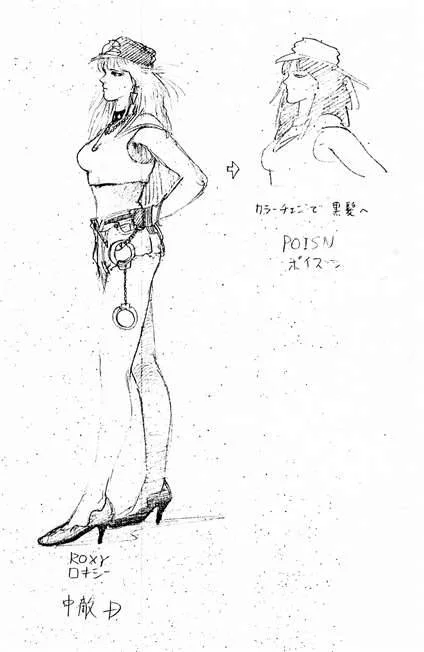
Akiman’s concept sketch for Poison. A character designed with intent, caught in a localisation dispute she had nothing to do with. Via fightersgeneration.com · Capcom, 1989.
The Poison and Roxy situation is a window into a different kind of constraint. The two female enemy characters were redesignated as transgender in the Japanese arcade release — designer Nishitani’s attempt to preempt potential North American lawsuits over hitting women in a beat-em-up. Nintendo of America rejected even this and replaced both characters with male enemies named Billy and Sid for all NA Nintendo ports. The confusion over Poison’s identity persisted for decades; Capcom gave contradictory statements as she developed her own cult following, and the question of her canonical gender was never formally resolved. The origin of that ambiguity is a localization anxiety from 1989, applied to a character whose design had nothing to do with any of it.
The Sega CD port, released in 1993, restored Guy and improved the soundtrack significantly — the best home version for a decade. The authoritative modern option arrived in 2018: the Capcom Beat ‘Em Up Bundle brought arcade-perfect builds to Switch, PS4, Xbox One, and PC with online co-op. That is the argument. The complete game, played as designed.
The Blueprint That Entered Street Fighter II
Nishitani shipped Final Fight in December 1989 and began work on Street Fighter II. In the Shmuplations translation of the 1991 Street Fighter II developer interview, he is unambiguous:
“Final Fight was actually going to be Street Fighter II. I had been diligently working on the design plans for another game, but Capcom told me we needed to make something with less memory.”
— Akira Nishitani
The sequel he’d spent years designing came later, built on the foundations he’d just laid.
The car-smashing bonus stage that became one of SF2’s signature moments appeared in Final Fight first. The animation principles for large characters — how to make power and speed readable through movement, how to make a character roster feel like a set of genuinely different options rather than reskinned damage numbers — were established here, under constraints, before SF2 needed them to be true. The team that built this game taught themselves, in a city under chipset rationing, the things their next project would require.
The genre credit went to others. Double Dragon arrived before Final Fight and established the belt-scroller model. Street Fighter II arrived after and defined fighting games for a decade. Final Fight occupies the space between them — not a tributary but a headwater, the project in which Capcom’s best designers worked out the problems both genres needed solved. Played today in its arcade form, with a second player and all three characters on offer, it doesn’t feel like a classic that influenced later work. It feels like a studio thinking out loud — getting most of it right the first time, for an audience that mostly never saw it.