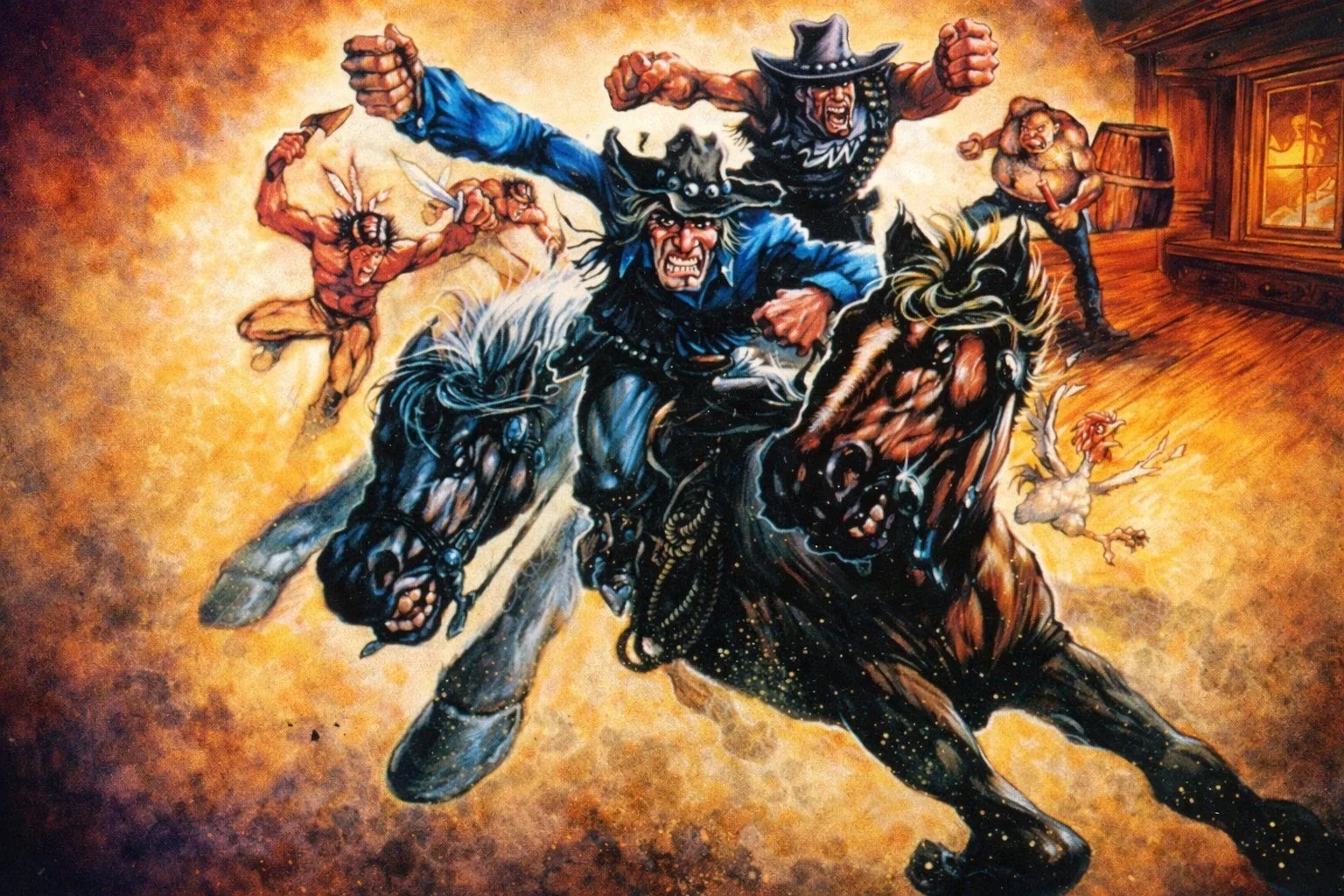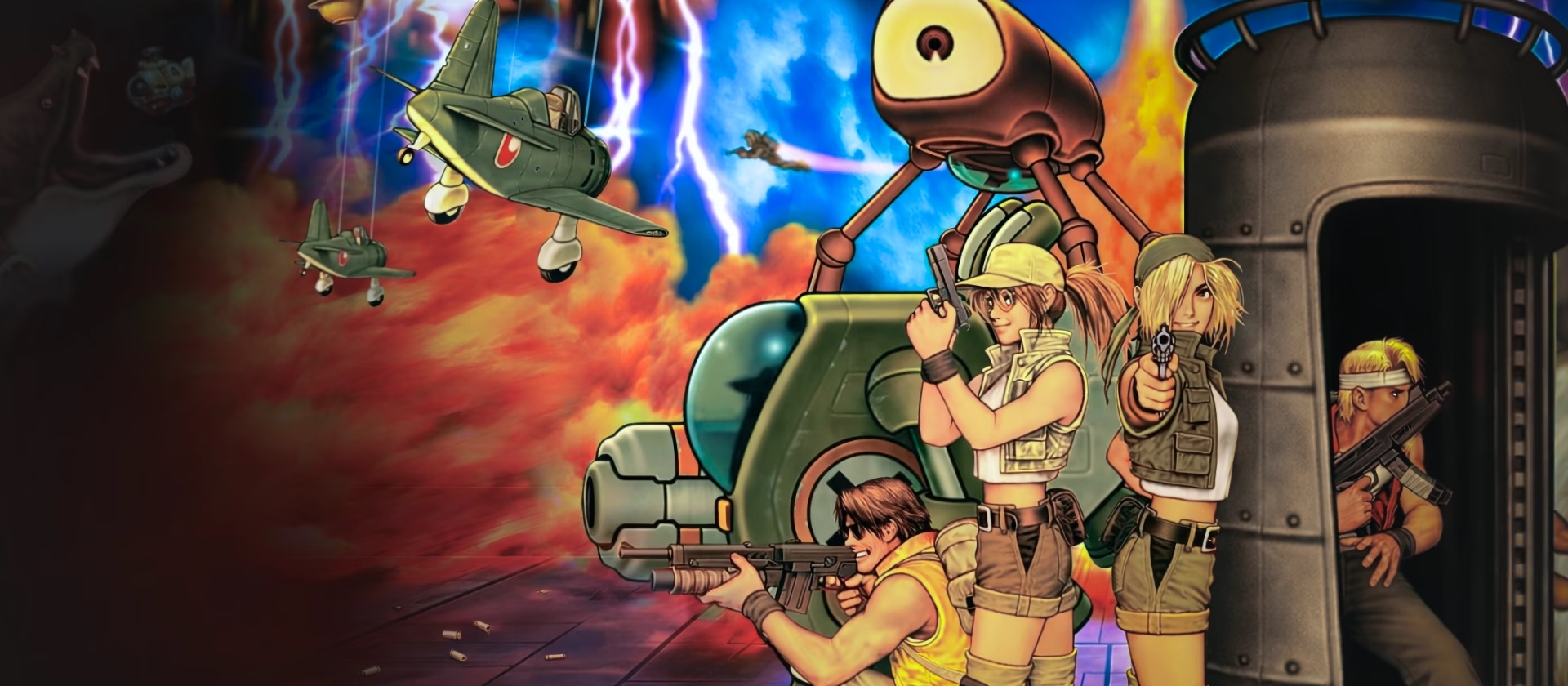
// import shipCannonsPoster from ”../../assets/images/streets-of-rage-2-1992-ship-cannons-poster.jpg”; // deleted
// import funfairBrawlPoster from ”../../assets/images/streets-of-rage-2-1992-funfair-brawl-poster.jpg”; // deleted
Every piece written about Streets of Rage 2 begins with the music. That is understandable — the soundtrack is extraordinary, and its composer, Yuzo Koshiro, has given enough interviews over thirty years to make the story easy to tell. A Japanese prodigy raised on Tokyo nightclubs, FM synthesis pushed beyond reasonable expectation, a Mega Drive that somehow sounds like a warehouse rave. It is a good story. It is only half the game.
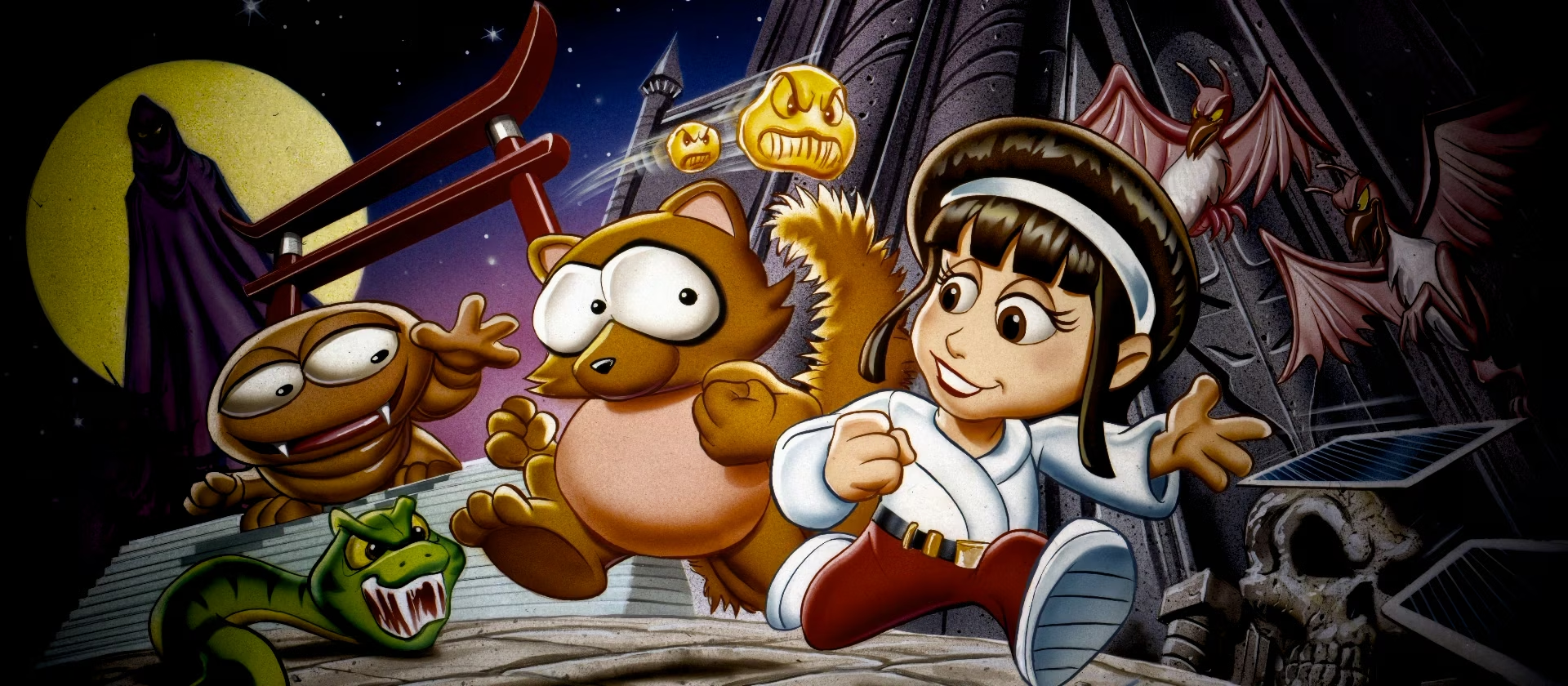
The other half belongs to Ayano Koshiro, Yuzo’s older sister. She was lead graphic designer, and the person most responsible for the game’s combat feel, character identities, and enemy design. She designed every character. She specified the timing, damage, and arc of every move. She considers Story of Thor her definitive work because Streets of Rage 2 was a Sega game and she doesn’t feel she can fully claim it as her own. When the sequel is described as one of the finest console games of the 16-bit era, it is describing something substantially shaped by her. Her name is in the credits. It rarely appears in retrospectives.
It’s Like Clothes
Ancient Corporation in 1992 was not a large studio. Ayano estimated the permanent staff at four: herself, Yuzo, one programmer, and one other. With outside contractors, the team numbered around ten. She worked from ten in the morning until two or four at night.
During pre-production, they installed an arcade cabinet in the office. Street Fighter II. Ayano played Guile. Yuzo played Zangief, and always asked her to play Guile because that was the character he struggled against most. The console brawler in 1992 ran on momentum: walk right, hit things, reach the end. Final Fight had set the template in 1989 and every contender since had been measured against it. From the SF2 sessions came a different design target — combat that flowed rather than mashed, with an internal logic to it. Two jabs, a straight punch, a heavy hit, and the enemy goes flying. That rhythm, light-light-medium-heavy, is the spine of the game, and it is why the combat reads immediately to a player arriving with no history of it: the logic is in the feel, not the manual.
Ayano absorbed what she was interested in and put it directly into the work. Fighting manga with a taste for physical consequence. The Contra series, whose stage-by-stage progression she credited as the model for how the game would build story through environment rather than dialogue. Whatever fashion was current: Skate was originally going to have roller skates until she heard rollerblades were the new thing. There was no internet; she bought magazines and cut out the relevant pages. Asked later about her design philosophy, she put it simply.
”It’s like clothes. If you find something you like, you just put it on.”
— Ayano Koshiro
Sega Wouldn’t Give Her One More Week
The roster was rebuilt around differentiation. Axel and Blaze returned; Adam, the third playable character from the first game, was dropped. Ayano’s reasoning was direct — he had no real speciality, and the sequel’s larger sprites demanded sharper identities. His replacement was his younger brother Skate, fast and tricky, and Max Thunder, a wrestler built around Yuzo’s preference for throw-based characters: slow, punishing on connection, genuinely difficult to use well.
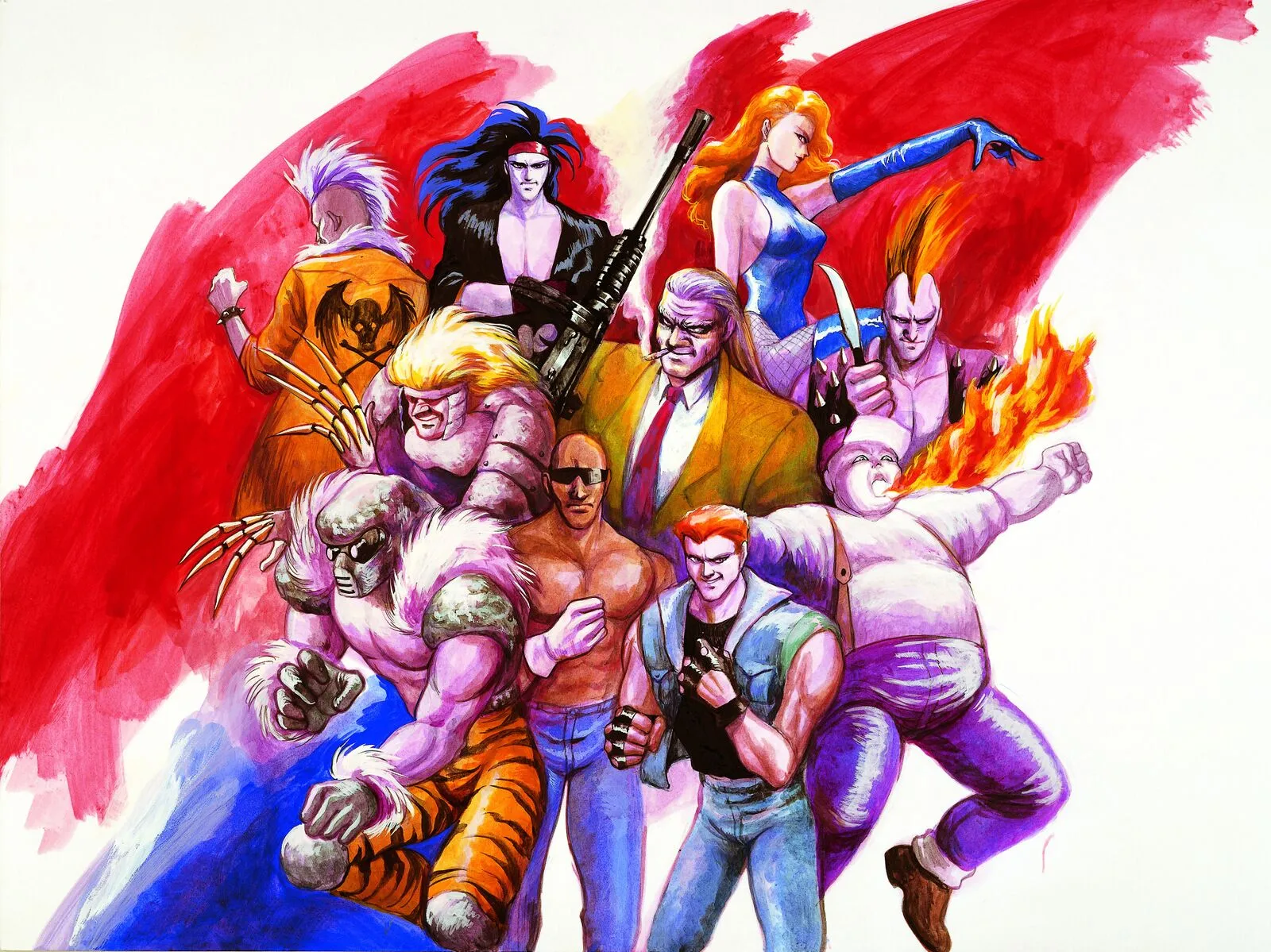
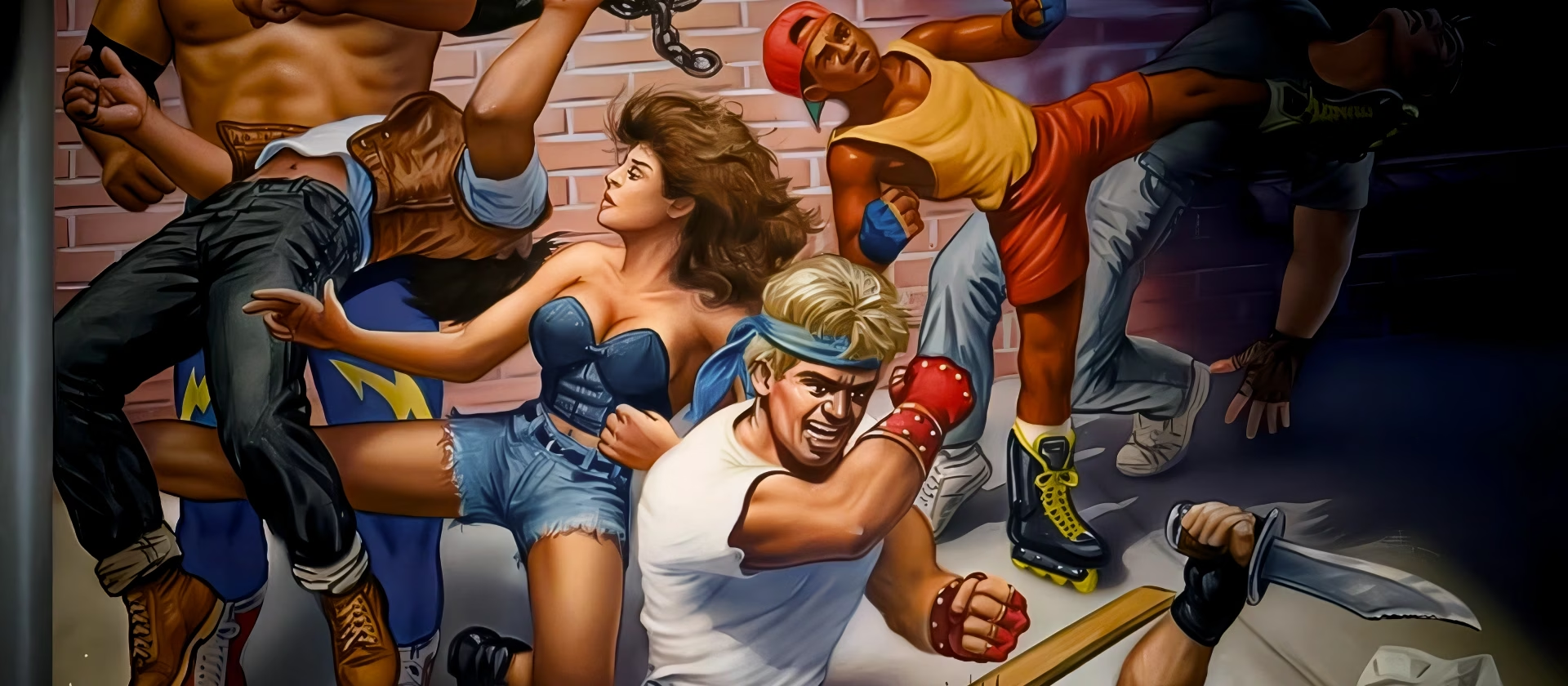
Ayano Koshiro designed every character in the game — hero and enemy — specifying the timing, damage, and arc of every move. Key art: Streets of Rage 2 · Ancient / Sega, 1992.
The moves came from an iterative loop. Ayano would write a rough specification — this attack does this much damage, hits in this arc — and the team would code it, gather around the screen, and test until the impact felt right. The hit sounds were chased the same way, drawing on a comedy duo whose routines used exaggerated impact noises. When the effects finally landed, she said, everything suddenly had substance behind it.
The first game’s special attack, a police car that carpet-bombed the screen, was gone — a casualty of the sequel’s diagonal scrolling. In exchange, Ayano gave each character a dedicated special. Rather than a shared panic button that erased every problem, the sequel asked players to choose when to spend health, and whose special suited the moment. Spectacle traded for expression. Every decision costs something, and the cost is always legible.
Development lasted roughly half a year. Towards the end, Ayano was deep in work on Shiva, the game’s imposing bodyguard, specifically designing his sprite for a Versus mode she was determined to include. She needed one more week. Sega wouldn’t give it. The phone conversation became heated. She was crying on the call — not from sadness, she said, but from fury. She had put too much of herself into the game to let a deadline take something away at the last moment. The Versus mode Shiva was cut.
She still talks about it.
Eight Stages, Four Characters, One Idea
What you are doing for the three to five hours the game takes to finish is learning, through repetition, how each of four characters solves the same problems differently. Every enemy has a name — Barbon, Fog, Kusanagi, Souther — and a distinct behavioural signature. Galsias with knives charge you down with a deceptive hitbox that punishes hasty counters. Donovans knock you out of the air. Signals throw you if you let them close, which makes them far less dangerous once you know to break the approach early. Learning these patterns is most of the game, and each stage introduces new ones.
Axel’s Grand Upper clears groups. Blaze’s somersault resets a flanking enemy. Max’s standing special empties a room when it connects, which it doesn’t always. Skate’s speed threads gaps nobody else can use. Axel’s basic combo is the clearest illustration: the first two hits are control, short range and low commitment; the third commits you forward; the fourth sends them flying, far enough that you decide whether to chase or hold position for what is coming from the left. When it works — when a grabbed thug clears two others on the way down — the satisfaction is physical, immediate, and entirely earned.
Two players changes everything. The constant micro-negotiation — who takes which enemy, who guards the left flank, who burns their special on the crowd that just spawned — runs underneath the action for the whole game. Streets of Rage 2 remains one of the best co-op games ever made not because it was easy together, but because the decisions it generates are interesting enough to keep two people talking through them.
A Mega Drive Learning to Dance
Yuzo Koshiro’s relationship with electronic music started long before Streets of Rage. He was thirteen when he became a fan of Yellow Magic Orchestra, and he taught himself to program sound on the PC-8801, the same home computer he would later use to compose the Streets of Rage soundtracks. The line from a teenager playing YMO covers to a composer making club music for a Mega Drive game is straight, even if it took a decade to travel.
The sounds he was chasing — drum machines, basslines, the texture of early house and techno — were what he was hearing at a club called Yellow in Tokyo in the early 1990s. He built his own sequencing tool and wrote the programming language it ran on, working from the PC-8801 rather than Sega’s expensive official development kit. The music was not especially popular in Japan at release; club music of that kind didn’t take off there until the late 1990s, and Japanese players preferred rock and jazz in their games. The audience that made the soundtrack famous was overwhelmingly Western: teenagers in the UK, France, and the United States who encountered house and techno for the first time through a Mega Drive cartridge. The soundtrack is a deliberate cultural export, sent through Sega hardware to an audience he had never met.
Motohiro Kawashima, Koshiro’s collaborator, composed three tracks independently and co-wrote a fourth. His contributions sit at a harder, more abrasive edge — faster tempos, rawer synthesis, closer to early techno than to Koshiro’s warmer house — and the two registers map onto the game’s own tonal shift as the stages move from lit streets to industrial darkness.
Her Name Was in the Credits
Streets of Rage 2 arrived in North America on December 15, 1992, and in Japan and Europe that January. The reception was emphatic — perfect scores, chart-toppers in both the UK and Japan, reviews that described Yuzo Koshiro as the finest game composer working. The soundtrack’s reception was strong enough that clubs began booking Koshiro for DJ sets built around the tracks.
The version that reached American homes was not quite the game Ayano had finished. The North American release removed a flying kick animation of Blaze’s that the Japanese and European versions retained, and quietly cut Mr. X’s cigar from Western releases. Small changes, but telling ones — its edges filed by people who had never met Ayano Koshiro.
The cultural reach proved durable. London label Data Discs pressed the soundtrack to vinyl in 2015 as their inaugural release; Streets of Rage 4, released by Dotemu in 2020 after a twenty-six-year gap, surpassed 2.5 million downloads and brought both Koshiro and Kawashima back to contribute tracks.
Ayano was not involved in any of it. Sega opted to develop Streets of Rage 3 internally; the same pattern held for Streets of Rage 4. She still works at Ancient, primarily handling finances. Her children, given a Mega Drive Mini a few years ago, chose to play Puyo Puyo.
Asked about Streets of Rage 3, Ayano put her finger on what most brawlers never quite solved: it lacks pace and rhythm, she said, and feels the same from start to finish. That observation defines what the second game gets right — not just better combat, but cadence. Koshiro’s music moves with it, calibrated to the tempo of the stages in ways that only become apparent when you play something else and notice what is missing.
What Ayano and Yuzo Koshiro built in under a year, in a room with a Street Fighter II cabinet and roughly ten people, is the game the genre measures itself against. Ayano considers Story of Thor her real masterpiece, and she is probably right to — it is more fully hers, and she knows it. But Streets of Rage 2 is the game that reached the widest audience, set the standard for the console brawler, and launched a soundtrack that outlived its platform by three decades.
History remembers the music first. The combat works because the feel of it, the decisions it generates, the clarity of its character design, were built with the same care and specificity as the soundtrack that tends to get all the credit. That work has a name. It is Ayano Koshiro.