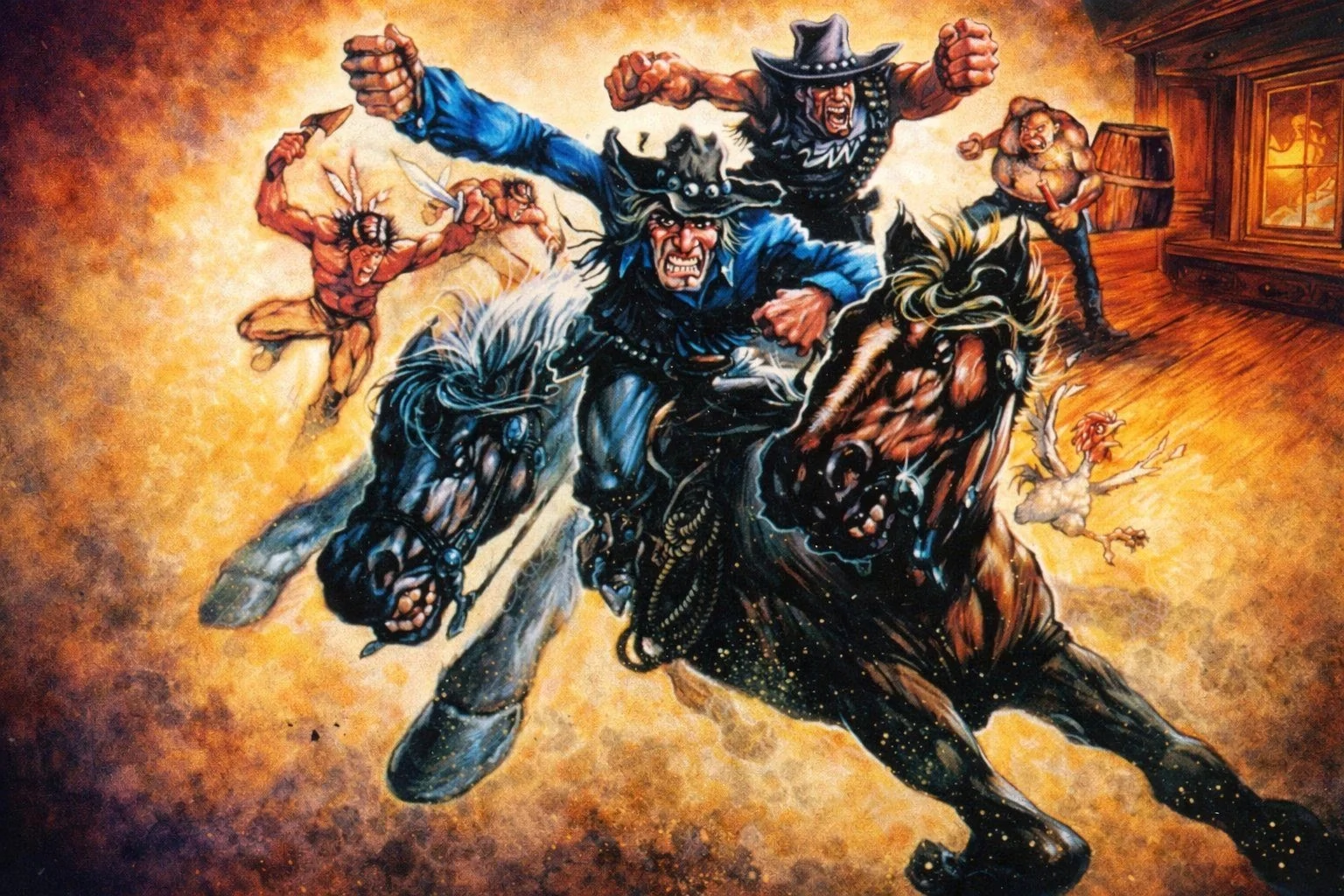
Hideyuki Tsujimoto had already made one of Konami’s sharpest arcade games. Super Contra (1988) was fast, hard, and mechanically exact — tighter than the home version most players know. When Konami tasked him with a new cabinet in 1991, he reached for the same arcade board family that had powered the wildly lucrative four-player Teenage Mutant Ninja Turtles and would soon carry X-Men: a Konami GX-series 68000 board, designed from the ground up for shop-floor co-op. He did not reach for another military theme or another science-fiction premise. He reached for the Western. That choice made Sunset Riders possible, and it made it strange: a Konami run-and-gun shaped by the visual language of the Spaghetti Western, built specifically for the social physics of a crowded arcade floor. Tsujimoto understood that four players on screen simultaneously creates a level of visual noise that would dismantle a traditional shooter. His answer was to design for performance — not survival, but showmanship. You jump onto saloon balconies. You slide under incoming fire. You shoot in eight directions while flying across the screen. The game is fast enough that you look competent even when you are not, and that gap between the player’s skill and their apparent coolness is the first thing you notice.
The second thing you notice is the grin. Four bounty hunters, eight outlaws, one English aristocrat at the top, and a score mechanic built around the cash value of the people you kill. Sunset Riders tells you exactly what it is in the first seconds of every stage: a face, a bounty, and the unambiguous understanding that you are not here to save anything. You are here to get paid.
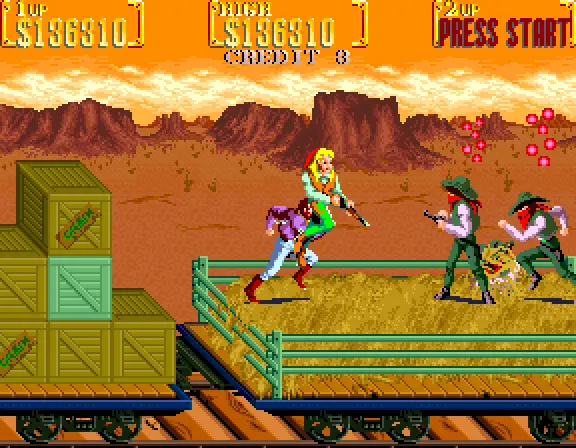
By the train stage, the Western premise has become pure arcade grammar: moving footing, horseback enemies, flying bullets, and a sunset doing more work than nostalgia ever could. Native 288×224 MobyGames arcade screenshot, upscaled 2×. Sunset Riders · Konami, 1991 · Arcade.
Four Riders, Four Choices
The four riders are not cosmetic. Steve and Billy carry revolvers — quick fire rate, tight spread, and with the right power-up, twin pistols that turn them into bullet hoses. Bob’s rifle is slower but hits harder and reaches farther. Cormano carries a shotgun: widest spread in the game, awkward at range but catastrophic when the screen starts to crowd. In a genre full of nominal character choice, Sunset Riders makes the differences matter, and the cabinet reinforces them structurally.
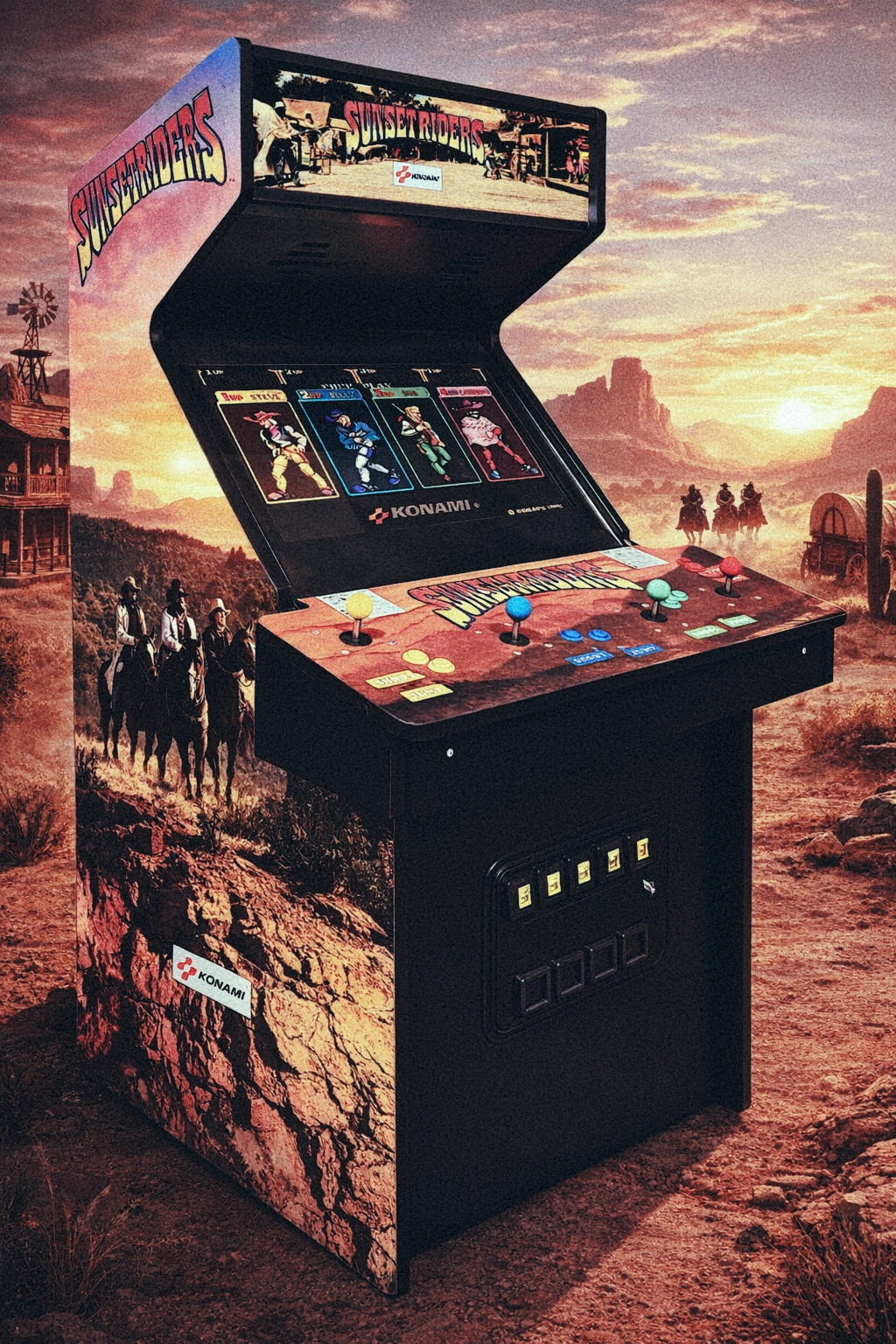
The four-player upright. Sunset Riders · Konami, 1991 · Arcade.
The arcade machine came in two forms. The two-player version lets you choose your rider. The four-player version assigns one character to each control panel — which means you often play whoever is left. That small constraint changes the entire mood. Cormano’s shotgun is no longer a preference selected from a menu. It is your problem now. So is Bob’s slower rifle. The conversation that forms around that fact becomes part of the game. Somebody gets the shotgun. Somebody complains. Ten minutes later, somebody realises the shotgun is catastrophic at close range, which most of the game is. The argument resolves into understanding, and that arc — from friction to competence — is what separates a great cabinet from a good one.
The four-player version stops feeling like a solo test with extra bodies attached and starts feeling like a social machine. You are not assembling an ideal loadout. You are taking a role and making it work. That gives each run a little friction, a little personality, and the kind of low-stakes conflict between players that fills an arcade with noise — which is exactly what Konami needed it to produce.
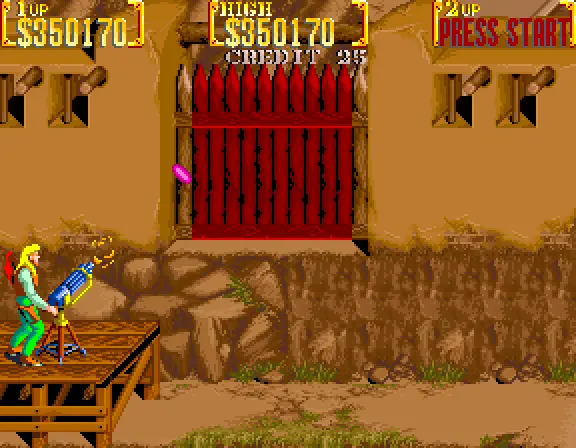
Paco Loco turns the late game into a firing line: one giant silhouette, one obvious weapon, one place the screen wants your eye to go. Native 288×224 MobyGames arcade screenshot, upscaled 2×. Sunset Riders · Konami, 1991 · Arcade.
Bosses Worth the Bounty
Most of Sunset Riders’ personality lives in its bosses, and each one earns their wanted poster. The bounty rises in clean $10,000 increments stage by stage, then jumps. Simon Greedwell opens proceedings at $10,000 — a man whose name announces his vice before he draws his gun. Hawkeye Hank Hatfield follows for twenty. Dark Horse rides in on his armoured stallion for thirty. The Smith Brothers in the saloon — chandelier chaos, lanterns and dynamite, opposite balconies — for forty. El Greco on a runaway train for fifty. Chief Scalpem in the mountains for sixty. Paco Loco and his gatling gun for seventy. And then a $30,000 leap to Sir Richard Rose — the English villain in a top hat with a metal corset under his waistcoat — at one hundred thousand. The skill spike is encoded as bounty inflation. Each boss enters with a face, a bounty figure, and enough visual identity to make the confrontation feel personal rather than procedural.
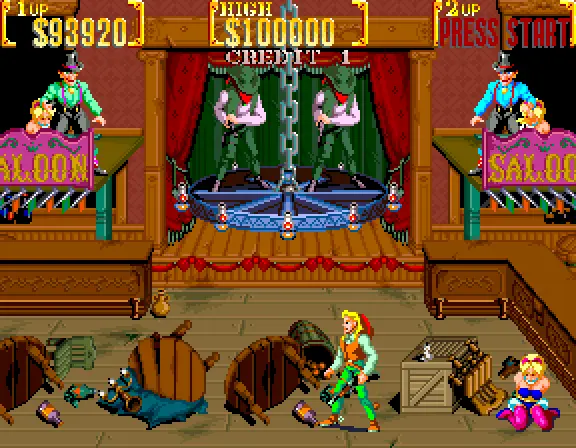
The Smith Brothers turn the saloon into a stage set: balcony threats, floor threats, dancers, dynamite, and a boss pair framed like a vaudeville act. Native 288×224 MobyGames arcade screenshot, upscaled 2×. Sunset Riders · Konami, 1991 · Arcade.
That matters more than it first appears. Most action games of this period want you to feel heroic. Sunset Riders wants you to feel mercenary, and the wanted posters are the game’s thesis in miniature — not scene-setting, but a complete statement of purpose. You are the violence the frontier requires, and you have a price for it. None of the bosses overstay their welcome. They are punchlines, silhouettes, reward structures. They break up the run with a new face and a new problem, then get out of the way before the game turns stale.
“Bury me with my money.” — Simon Greedwell, upon defeat, Stage 1
That line is remembered because it is funny, but it lasts because it tells the truth. When you defeat El Greco while playing as Cormano, the dying boss throws his red sombrero into the air and Cormano catches it and wears it for the rest of the game. It is a tiny piece of character animation, almost throwaway. But it tells you a great deal about the team behind it. This is not a stiff game. It is exact, but it leaves room for a flourish.
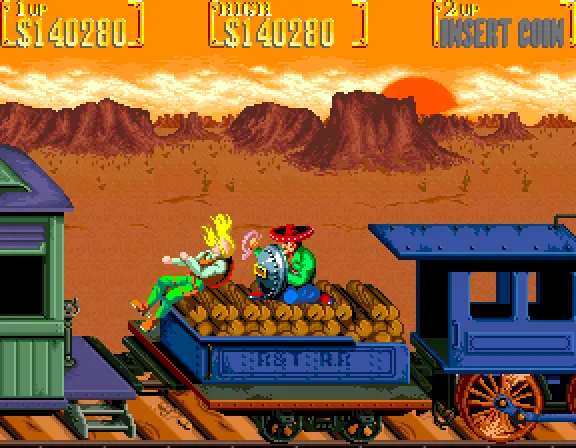
El Greco is a moving stage problem as much as a boss: shield, whip, train roof, and enough sunset colour to make the duel read instantly. Native 288×224 MobyGames arcade screenshot, upscaled 2×. Sunset Riders · Konami, 1991 · Arcade.
Two Buttons, Eight Directions
The game’s real quality is how cleanly it reads. Two buttons: shoot and jump. Eight directions of aiming. A slide that takes you under incoming fire. The ability to jump between tiers of platform without breaking your rhythm. Enemy reactions are chunky and immediate. Threats are usually obvious. The screen gets busy but rarely muddy. That sounds simple until you remember how many run-and-guns lose their shape the moment they start trying to impress you.
The native still is crisp enough to show why the cabinet reads: flat bridge, clear enemy silhouettes, bullets on clean diagonals. Motion clip included separately as WebM/MP4. Sunset Riders · Konami, 1991 · Arcade.
Contemporary reviewers responded to that legibility. A SNES Force review gave the home conversion 89%, calling it “easy to pick up, hard to finish” — and that characterisation remains accurate. The controls are immediate enough to feel mastered within one or two stages. The punishment is very real. First runs will include deaths that feel cheap: an attack with a tighter tell than expected, an enemy arriving from just off-screen. But the game’s clarity keeps frustration from curdling into drag. You usually understand what killed you, and a full run is short enough that learning never feels like labour.
The SNES port is the best home version by some distance — four characters, all eight bosses, the full stage flow — though it’s the censored cabinet, not the cabinet as shipped. Nintendo’s 1993 content rules redrew the cancan dancers, cut the courtesans who handed out power-ups, removed the dynamite-tossing cowgirls, replaced the Stage 6 Native American warriors with generic bandits, and renamed Chief Scalpem to Chief Wigwam. The Genesis port is best avoided entirely: two playable characters instead of four, only four bosses, reworked stage flow. One of the joys of Sunset Riders is abundance, and stripping it down to that skeleton leaves you with a game that no longer makes its case.
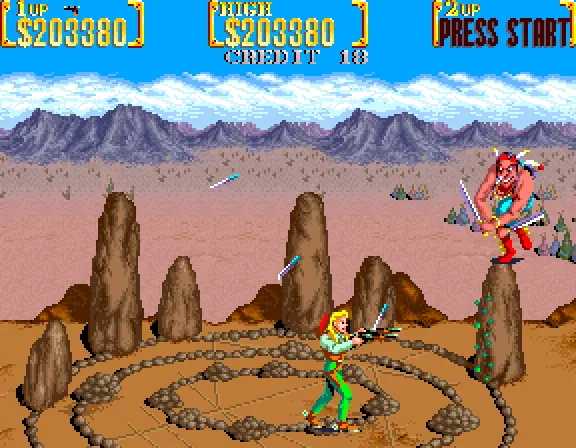
The Stage 6 boss is also the game’s hardest genre caricature to meet now: mechanically clean, visually confident, and unmistakably built from old Western shorthand. Native 288×224 MobyGames arcade screenshot, upscaled 2×. Sunset Riders · Konami, 1991 · Arcade.
The Mystery of Cormano
The best piece of trivia in the game is also the most revealing about the culture inside Konami’s development team. The Mexican bounty hunter was originally called “Hermano” in the European prototype — simply Spanish for “brother,” a placeholder name that was never intended to survive to release.
In the early 1990s, Konami’s official Italian importer was a company called Elettronica Videogames, headquartered in a small town north of Milan called Cormano. When a Konami delegation visited to demonstrate the European prototype, the company’s chief technician jokingly suggested renaming the character after the town where they worked. The joke survived every subsequent review. The final game kept it.
That story has the quality of a legend that has grown more polished with retelling, and whether or not every detail is precise, it suits Sunset Riders perfectly. This is a polished arcade game, but not an over-managed one. It still feels like the product of a team making each other laugh, keeping the good ideas, and letting odd little accidents harden into canon. A character named after an Italian suburb, carrying a shotgun and wearing a sombrero, who catches a dead man’s hat and keeps it for the rest of the game. You could not have designed something that emblematic on purpose. It had to arrive sideways.
The Sound of the Frontier
Composer Motoaki Furukawa had been a working Konami staff composer since October 1986. By the time he took on Sunset Riders he had already scored Nemesis 2 on the MSX-2, the arcade Gradius II: Gofer no Yabou — the score VGM Online still calls his most iconic — and Super Contra alongside Tsujimoto. Sunset Riders was his Western, and the result is one of the best arcade soundtracks of the period. The town level canters. The train chase pushes forward. The saloon themes lean into showdown tension without losing the pulse underneath. Furukawa used the cabinet’s FM synthesis to approximate Ennio Morricone’s whistle and the heavy, galloping bass that defines the Spaghetti Western — but he never laboured the homage. The score moves because the game does, and that synchrony between sound and momentum is what separates a great arcade soundtrack from background noise.
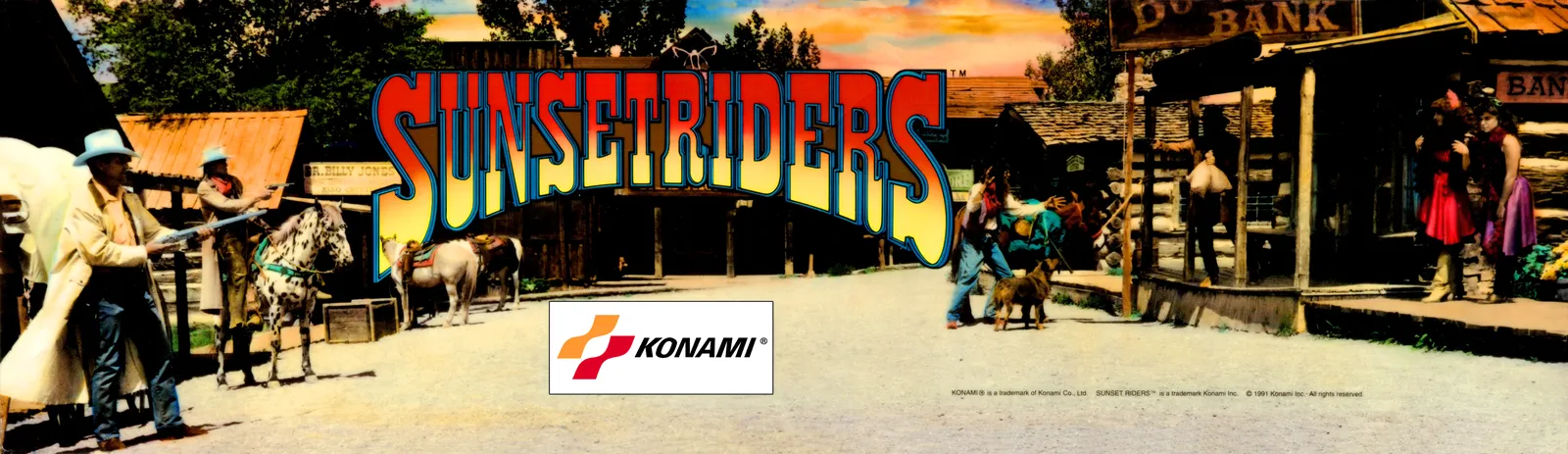
The arcade marquee — a live-action Western photograph as backdrop. Sunset Riders · Konami, 1991.
Konami knew it had something worth preserving: the soundtrack received its own Japanese album release in September 1992 on King Records. That kind of investment was unusual for arcade game music at the time, and it clarifies where Sunset Riders sits in Konami’s own estimation. This was not a licensed-property cash-in or a genre exercise. It was a considered piece of work, and the music confirms it — not by sounding expensive, but by sounding exactly right for the game that contains it.
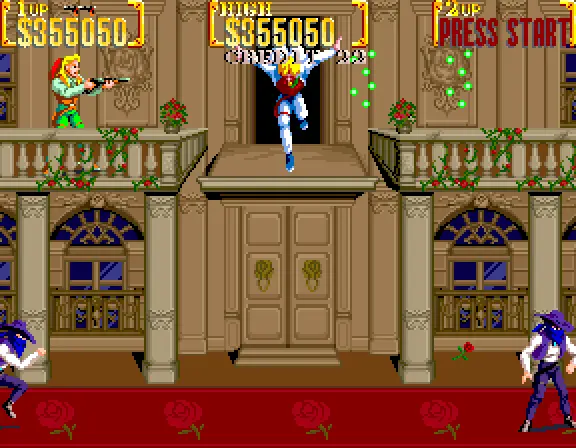
Sir Richard Rose gives the bounty economy its final image: an aristocrat on a mansion balcony, still posing after every outlaw below him has already been priced. Native 288×224 MobyGames arcade screenshot, upscaled 2×. Sunset Riders · Konami, 1991 · Arcade.
The arcade original via Arcade Archives is the one to seek. Simon Greedwell falls from his balcony, coins spilling around him, and says what he says. The game tells you what it is, precisely, and then it asks you to keep paying — not because it has run out of ideas, but because you have not run out of desire. Fast, legible, funny, greedy, and over before it overstays its welcome. Very few arcade games manage all of that at once, and none of them do it with quite this much style.