// import dojoPoster from ”../../assets/images/tekken-3-1997-dojo-hit-poster.jpg”; // deleted
// import hongKongPoster from ”../../assets/images/tekken-3-1997-hong-kong-poster.jpg”; // deleted
Jin Kazama throws a crackling purple fist. In the arcade build, the temple behind him is a piece of polygonal architecture you could walk around if you were holding a debug camera. On the PlayStation port that shipped six months later, the same temple is a flat bitmap ceiling — a cylindrical room Namco’s engineers painted to counterfeit a depth their machine could not compute. The sleight of hand, and it was sleight of hand on the order of a conjuror palming a coin, was that nobody who bought the game noticed. Not the players. Not the press. Not even the fighting-game regulars who, a year earlier, had made a sport of dismissing Tekken 2 for the clumsiness of its geometry.
That reception gap is what keeps Tekken 3 load-bearing in the PlayStation library. Here is a game Namco shipped with its engine deliberately hollowed, its stages repainted as trompe-l’oeil, its roster doubled for a generation that had never seen a Japanese arcade — and it outsold Virtua Fighter 3’s home conversions by an order of magnitude, ended the first fighting-game arms race, and taught the rest of the decade what a 3D fighter was supposed to feel like. Pick it up today, on any television, and the distance between what the game is and what it delivers becomes the whole argument for playing it.
Eight Per Cent, and Honest About It
The arcade board was Namco System 12, descended from the System 11 that had carried the first two Tekken titles but lifted to roughly four megabytes of working memory. The PlayStation it had to translate to held half of that. The one-to-one squeeze had been managed twice before, but Tekken 3’s production budget had doubled and its motion-capture sessions had grown from a handful of fighters to dancers, wrestlers, capoeira practitioners, taekwondo prodigies — a roster designed so every character moved unmistakably like itself. None of it fit.
What Namco did next is described, in hindsight, with a candour unusual for a finished-product postmortem. Katsuhiro Harada, who co-directed with Masahiro Kimoto, has put the surviving animation data at something close to a tenth of the arcade version’s volume, and the stage rendering for most environments at zero polygons. The Hong Kong street, the punk subway, the forest temple, Jin’s cliffside ring — all repainted onto a cylindrical skybox, rotated under the camera to fake parallax, handed to the player as if nothing had changed.
The texture of the honesty is in the routing. Namco did not paper over the compromise; they prioritised through it. The animation team re-timed every character so that the dropped frames fell in recoveries rather than active windows — the frames a player actually reads stayed in, the frames a spectator reads got cut. Backdrops were selected for how well they would survive the cylinder: night settings, neon signs, distant silhouettes, anything whose horizon could be painted rather than computed. Anything that resisted the painting — fine distant architecture, the busy daylight stages of the arcade build — did not make the translation.
The result is not a compromised port. It is a compromised port that identified what about itself had to remain uncompromised — the hit, the tempo of the recovery, the legibility of the stance, the frame on which a throw becomes un-escapable — and protected those. The price was a set of backdrops that flatten, on close inspection, into paintings. The dividend was a fighting game that still plays cleaner than almost anything Namco has shipped on hardware ten times the power.
The Side-Step That Opened the Grid
In arcade rooms in late 1996, Tekken 2 regulars had a joke about the series: two dimensions with extra steps. The sidestep in Tekken 2 was nominal — a small arc that moved the character two body-widths off the axis before the engine forgot about the third dimension. Everything useful happened on a line.
Tekken 3’s sidestep is the mechanic that broke the line. Tap up or down on the pad and the character shuffles off-axis with enough travel, and enough recovery parity, that an opponent whose turn it is to attack can suddenly be pressing a button into empty air. The animation is small — a half-step — and that is deliberate: a larger step would have read as retreat. Namco sized the sidestep to precisely the distance required to dodge one heavy attack, no more. The grid became a floor.
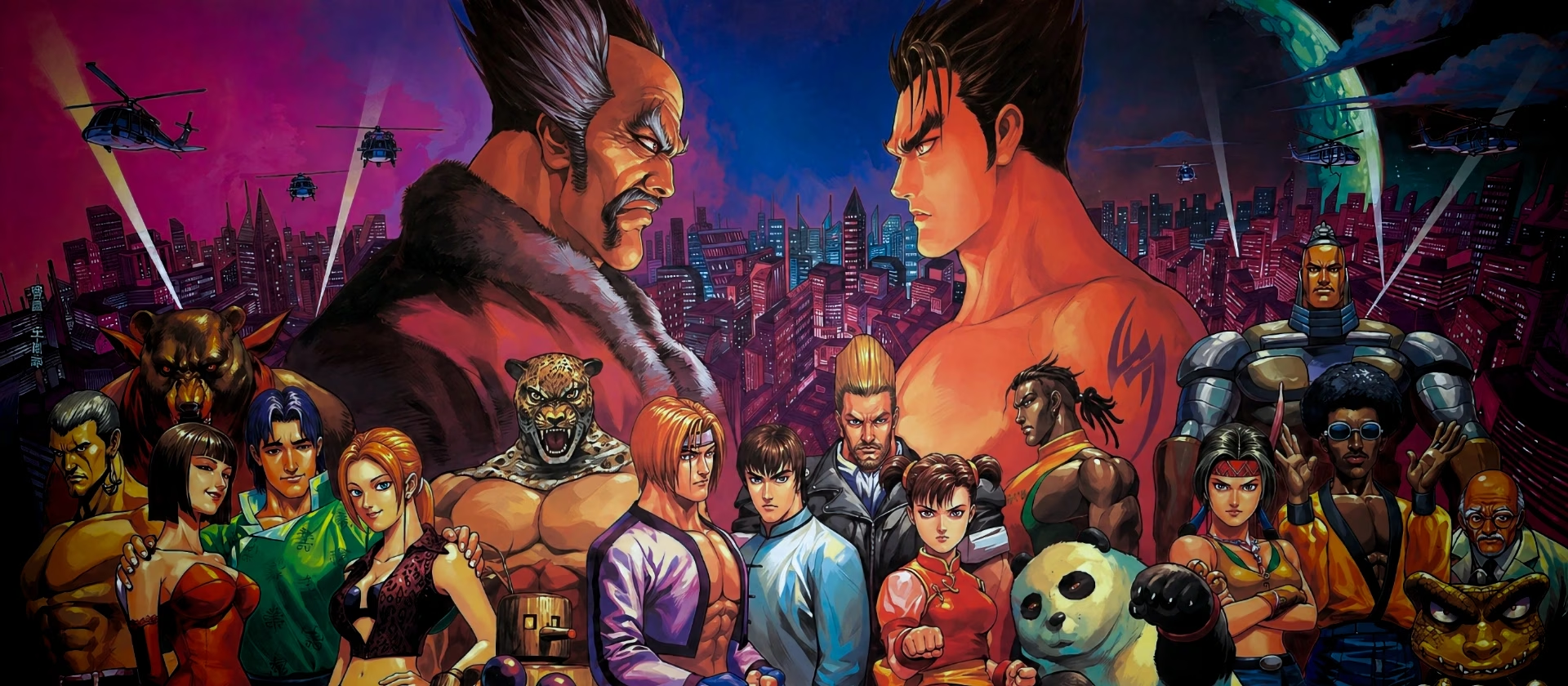
The rest of the roster expanded to answer that change. Move lists had to grow because now every stance had to cover two axes of threat at once. Twenty-three playable fighters — double the Tekken 2 count — were a necessity, not a feature bullet: the game needed more neutral games to test the sidestep against. And the new characters carried archetypes the series had not carried before. Hwoarang, the taekwondo prodigy, built around flurry kicks that punish whiffed sidesteps. King, the wrestler rebuilt around ten-hit chain grapples the frame budget could afford only because throws froze both bodies in a pre-baked clinch. Eddy Gordo, the capoeira dancer whose moveset was — notoriously — learnable by a child mashing kick buttons, and whose presence in the roster was Namco acknowledging that the game would live longer in living rooms than in arcades.
Pick it up now and the hands remember it. The low-parry is two frames tighter than memory suggests. Juggle combos that look exotic in highlight reels are loose enough that a beginner can accidentally start one. The bonus modes — Tekken Ball, the volleyball-with-hitboxes diversion; Tekken Force, a side-scrolling beat-em-up that throws the cast at waves of thugs — are not extras. They are the disc earning its price against a player who will never see an arcade.
Hong Kong House on a Temple Mountain
The soundtrack is the part of Tekken 3 that did not get cut. Namco’s sound team — Yoshie Arakawa, Nobuyoshi Sano, Keiichi Okabe and a shifting composer pool — had been given more DSP channels and more memory than any previous Tekken, and they spent it on a score that still sounds like no other fighting-game OST of the period.
The genre register is a composite. Hong Kong opens on a funk bassline and builds into a house break that would not have been out of place on a Shibuya dancefloor the summer of the game’s release. The forest temple gets drum-and-bass with a shakuhachi layered on top. King’s wrestling ring is big-beat — Fatboy Slim translated into arcade-fight tempo. Jin’s theme is industrial synth with a Japanese-pop topline. The score moves between these registers the way the roster moves between fighting disciplines: each stage sounds like its character’s idiom played loud through a club PA.
What keeps the set from reading as pastiche is the round-tuning. Every track is built around the pace of a thirty-second exchange — first chorus near the twenty-second mark, exactly where a tight round turns desperate; the breakdown arriving around the moment a first knockdown becomes likely. Play the game on mute and you do not merely lose atmosphere. You lose the tuning fork the game was using to tell you where in the fight you were. The soundtrack is, in a literal sense, part of the frame data.
There is a second trick inside the score that takes half a dozen matches to notice. The music does not loop at a clean boundary. Each track is written long, with a secondary breakdown at around the seventy-second mark, so that the rare round that goes the distance hands the player a fresh movement rather than a repetition. The arcade cabinet had a hardware constraint that would have made this impossible; the PlayStation, with a disc to read from and streaming audio the arcade board did not support, made it trivial. It is one of the few things about the home version that is strictly better than the coin-op. Two decades on it is still the most quoted fighting-game score outside Street Fighter II, and unlike Street Fighter’s, almost nothing about it dates.
What the Cyclorama Still Teaches
The temptation, opening this piece, was to argue that Tekken 3 holds up. The interesting claim is the stranger one: its compromise holds up. A different and better thing.
The flat bitmap cycloramas, viewed on a modern television, look exactly like what they are. They still work, because the game never asked them to do more than frame the fight. The tenth of the animation data that survived the cut is still the tenth that matters. The sidestep is still the clearest demonstration in the medium of a mechanic that changed a genre by adding, of all things, a dimension. The score still sounds like nothing since.
What the game offers a player now is less nostalgia than clarity. Modern fighters sell complexity — frame-data apps, neutral-theory videos, six-button tutorials, single-player grinds that parse like second jobs. Tekken 3 sells the opposite proposition. The feel arrives immediately. The depth is in pressure and spacing rather than memorised strings. A match between two strangers on the same couch still resolves faster and more decisively than most of what has been built since. The fighters carry legible archetypes, the backdrops stay out of the way, the soundtrack does the work of frame data, and the round is over before boredom can start being a variable.
The received wisdom on Tekken 3 is that it is an arcade-perfect port on a platform that could not, strictly, render arcade-perfection. The sharper reading is that Namco knew they could not render the arcade, so they built a different machine — quieter, cheaper, painted where it needed to be painted — that delivered the same conversation between two players. The cabinet and the disc were not the same game. They were the same argument, made to different audiences, in different lighting.