// import weaponClashPoster from ”../../assets/images/samurai-shodown-2-1994-weapon-clash-poster.jpg”; // deleted
// import combatFlowPoster from ”../../assets/images/samurai-shodown-2-1994-combat-flow-poster.jpg”; // deleted
At an SNK office in Osaka, the director of Samurai Shodown II stood up from an arcade monitor and shouted 「怒りゲージ満タンだ!」 — ikari gēji mantan da, “Rage Gauge full!” He had just lost to his own planner at Street Fighter II. The shout was a joke, a piece of office-floor sarcasm at a rival studio’s expense. The mechanic it named was about to ship in the game his team was finishing — a comeback meter every fighting game of the next thirty years would copy.
The story doesn’t travel. Nobody mentions it when arguing that Samurai Shodown II is the best 2D weapons fighter ever made. What gets mentioned — the dodge roll, the weapon-break Super, the cast of fifteen — is surface. Underneath is posture: a game built in refusal, against Capcom and SNK’s own producers. Play it today on a Switch and what you feel in the hands is that posture—a fighter about weight, patience, and punishment the genre has quietly declined to repeat.
When Losing Built a Meter
Yasushi Adachi had been given four seasons to build the sequel to his own 1993 game, and he was spending them smoking too much and losing office matches to his planner, Tomoki Fukui. The SS2 character Caffeine Nicotine was named for Adachi’s own crunch habit; Dengeki Neo Geo teased him about it on the record. The Rage Gauge, introduced in 1993 as a taunt-filled meter, was being reworked into something closer to a true comeback mechanic: fill it by absorbing damage, cash it in for a Weapon-Breaking Super that sent the opponent’s blade pinwheeling off-screen. Somewhere in that work, Adachi kept losing to Fukui at Street Fighter II. The shout was how the gauge got its working name.
It would be easy to treat that as trivia. It isn’t. SS2’s Rage Gauge is the first fighting-game comeback meter tied to weapon-breaking — a specific, mechanically load-bearing first. The joke-origin matters because the whole system rebukes the game Adachi had just lost. Street Fighter II rewarded the player who executed cleaner. The Rage Gauge rewarded the player who lost worse. Every modern comeback meter — Guilty Gear’s Burst, Marvel vs Capcom’s X-Factor, Street Fighter IV’s Revenge Gauge — grew from office-floor sarcasm at a rival studio’s expense.
Adachi liked defiance. He would pick a harder version of the same fight with his own management in the weeks that followed.
The Argument Against the Combo
Open the game on a Switch today. Pick Haohmaru. The first thing the hands notice — the thing that makes every modern fighter feel bloated by comparison — is how little the controls demand. Four buttons. Light slash, medium slash, heavy slash, kick. No magic series, no linkers, no counter-hit system. What the buttons do instead is commit.
A heavy slash in Samurai Shodown II takes the same time to throw that a fireball takes to cross the stage in Street Fighter II. The startup is long; the recovery is longer. Miss one and the opponent has eight frames to decide how much of your life bar to remove. Land one clean and the round is over. This was not a balance oversight. When SNK management told Adachi the damage model had to change — that a round decided by one clean exchange was too punishing for arcade economics — he refused. The line he gave the interviewer James Mielke in 2017 still reads like a manifesto:
“I thought it was very interesting to have players fight under the risk and fear of fighting with weapons and feel the destructive force of the sword, so I ignored them and kept it in the game.”
— Yasushi Adachi, director, Samurai Shodown II
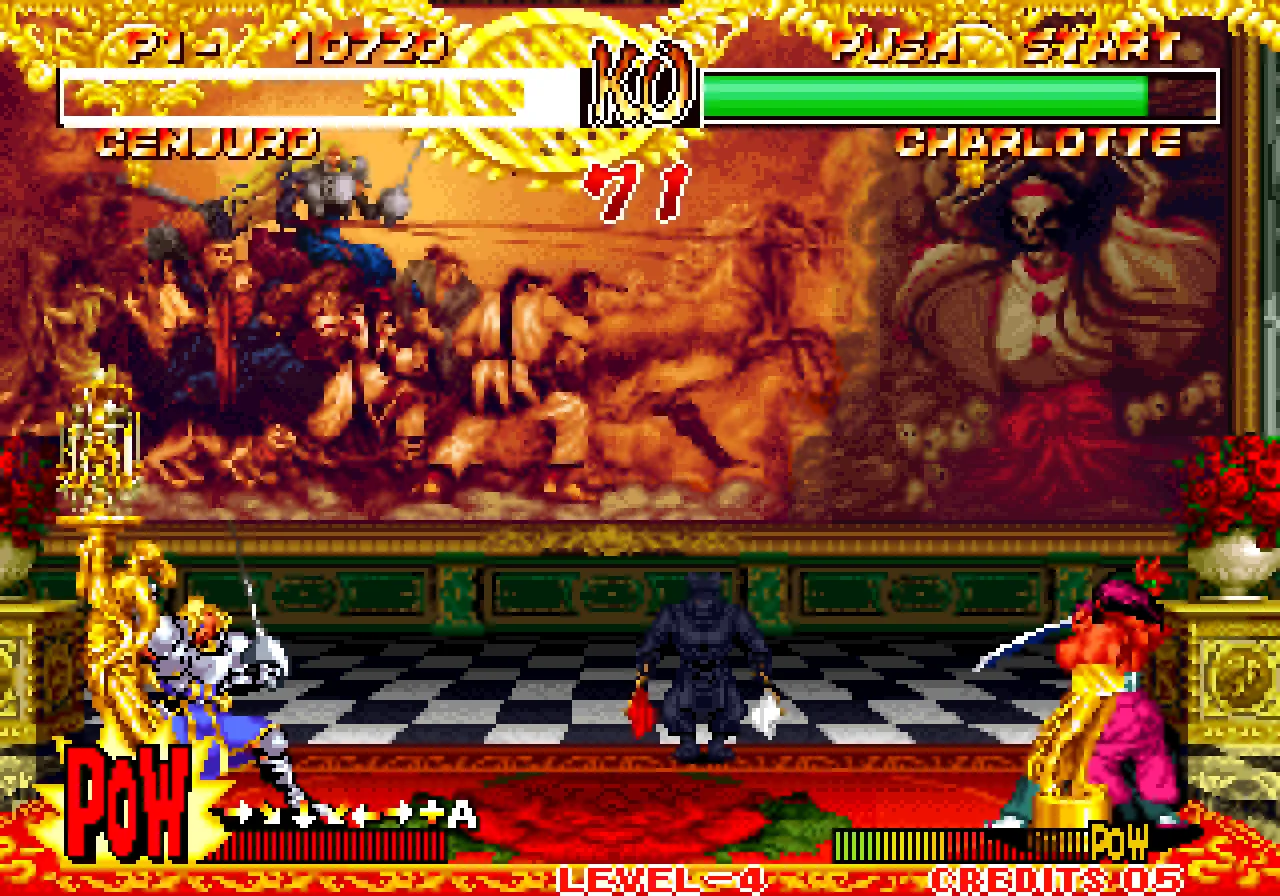
Charlotte and Genjuro on the tapestry stage. A single clean exchange can end the round. Samurai Shodown II · SNK, 1994.
The argument that one-hit damage made is the argument the whole game makes. A combo is a proof of execution — a player demonstrating they can do the complicated thing quickly. Samurai Shodown II has no interest in complicated. What it wants is for two players to stand seventeen pixels apart and lie to each other about when they’re going to move. The roster of fifteen is balanced not by power tiers but by range and commitment: Nakoruru’s short blade forces her to close; Earthquake’s cleaver is terrifying at range but leaves him a wall when it misses. Nothing in the cast is a trump, nothing is a joke, and the game loses interest entirely the moment you try to play it like a Capcom product. It wants the stare-down. It rewards the stare-down. It will punish you specifically for trying to convert advantage into a chain.
A Game That Learned to Wait
What keeps this from tipping into stasis is the second layer SS2 sneaks under the surface. The player who has read the stare-down correctly wins a discrete set of things — a few unbreakable pixels of advantage, a cue to act, a chance to close. The player who misread doesn’t just lose damage. They lose their weapon. Once a blade is on the floor, the next forty seconds are a different game.
Three systems do the work. The Rage Gauge fills with incoming damage and with deliberate taunts — that same meter Adachi named, now with real mechanical teeth. When it caps, the Weapon-Breaking Super becomes available for the length of one exchange. Land it clean and the opponent’s sword pinwheels across the stage. Kuroko, the masked handler from the opening cinematic, sprints back out and drops a replacement after a delay — but in the window between loss and resupply, the disarmed player is kicking and punching against an opponent still armed. It is the most punitive advantage mechanic any arcade fighter shipped in the decade, and it is deliberate.
Underneath sits the POW meter, inherited from Art of Fighting, which fills as damage goes out rather than in. And under both sits the plainest system SS2 contributed to the genre: the evade roll. Tap two buttons and the character briefly disappears forward or back — too brief to be a block, too committed to be a dodge. Played well it becomes what the player D3D described in a 2019 interview, after twenty-five years still mining the CPU matches for discoveries, as one of three axes the whole game turns on: heavy slash, stun, evasive movement. Nothing else. Everything else is reading.
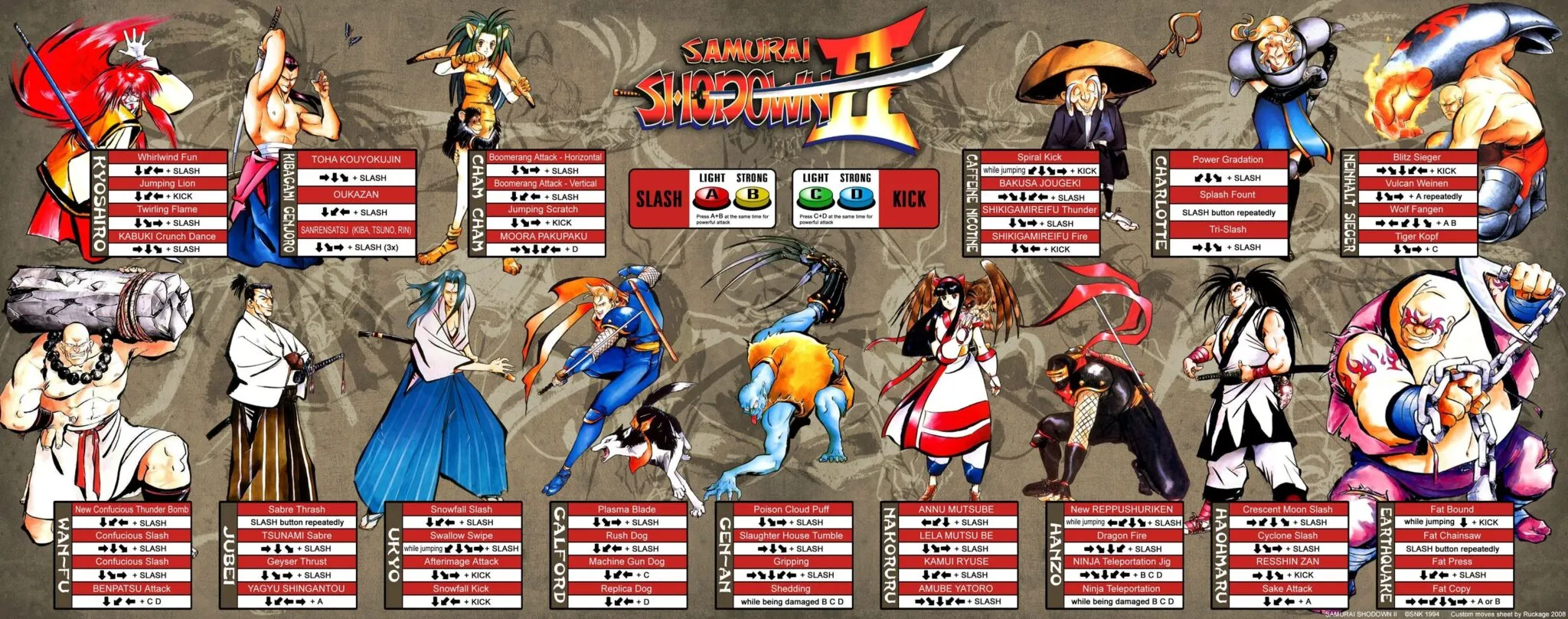
The full command list. Fifteen fighters, a handful of inputs each — the vocabulary the stare-down is built on. Samurai Shodown II · SNK, 1994.
Foley from a Sink
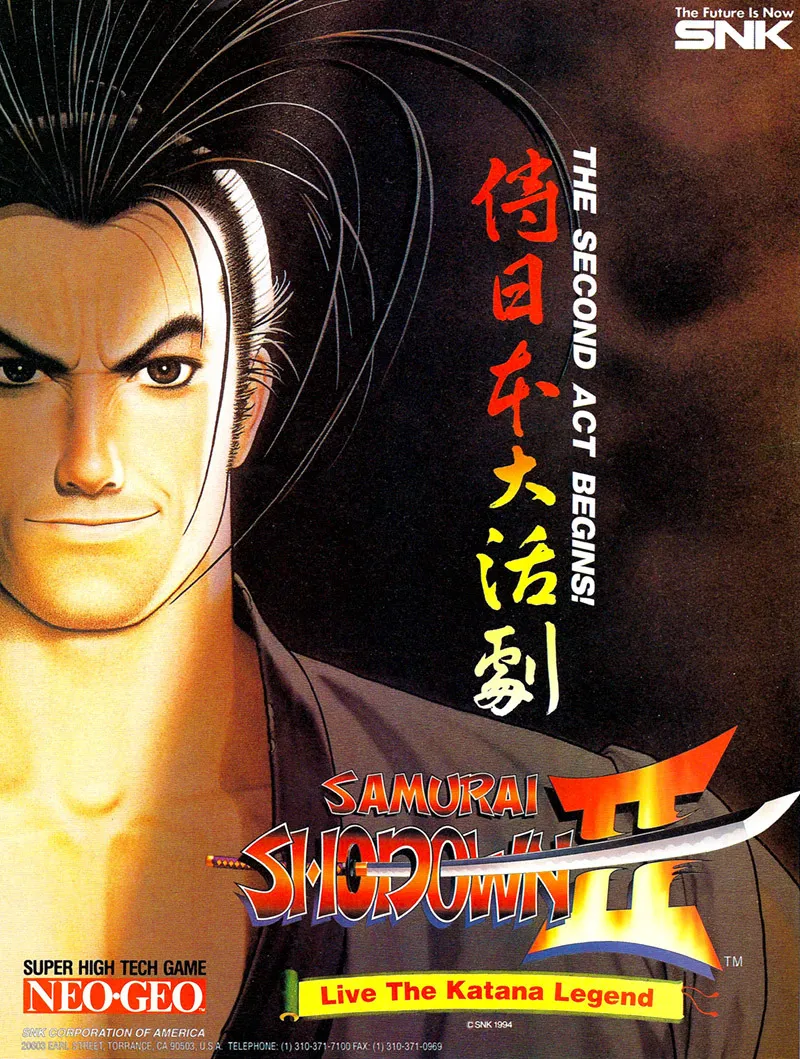
Shinkiro’s 1994 arcade poster. 侍日本大活劇 — “a great samurai melodrama, Japan.” SNK, 1994.
The sound is part of the argument. Every fighting game before SS2 had scored sword combat with braggadocio — shouts, brass, the melodrama the genre has always leaned into. SS2’s soundtrack, composed by a team that included Norio Tate and Yasuo Yamate, works a quieter register. Stage themes sit low and patient. Genjuro’s Sukigahara Field opens on a single repeated string figure that could pass for a Takemitsu sketch; the Hell-forge stage replaces melody with the drone of flames and a pulse low enough to sit under speech.
It is the foley that does the strangest work. Asked in 1995 how the sword-clash sounds were built, Tate described a production method a modern Foley artist would laugh at:
“The sound of swords clashing at the hilts was made by scraping office kitchen-sink metal against various other metal objects. The sound of a successful strike cutting flesh was made from processed cabbage-cutting sounds.”
— Norio Tate, SNK Sound Team, 1995
This is not charming-studio trivia. It is the sound of a game that refused to use stock libraries. The weapon clash has a specific tinny resonance — more kitchen than battlefield, which is precisely why the fights feel domestic in scale even as the damage is operatic. The hit on flesh is dull, wet, and short. And the silences between — the pause the game inserts after a clean slash, the stillness of a round’s final second before the victory pose — are not audio gaps. The SNK Sound Team’s own gloss on what they were after, from the same period, was “a world of wabi-sabi… silence is also music.” A game that spent its foley budget on a sink and a cabbage and got that result earned the sentence.
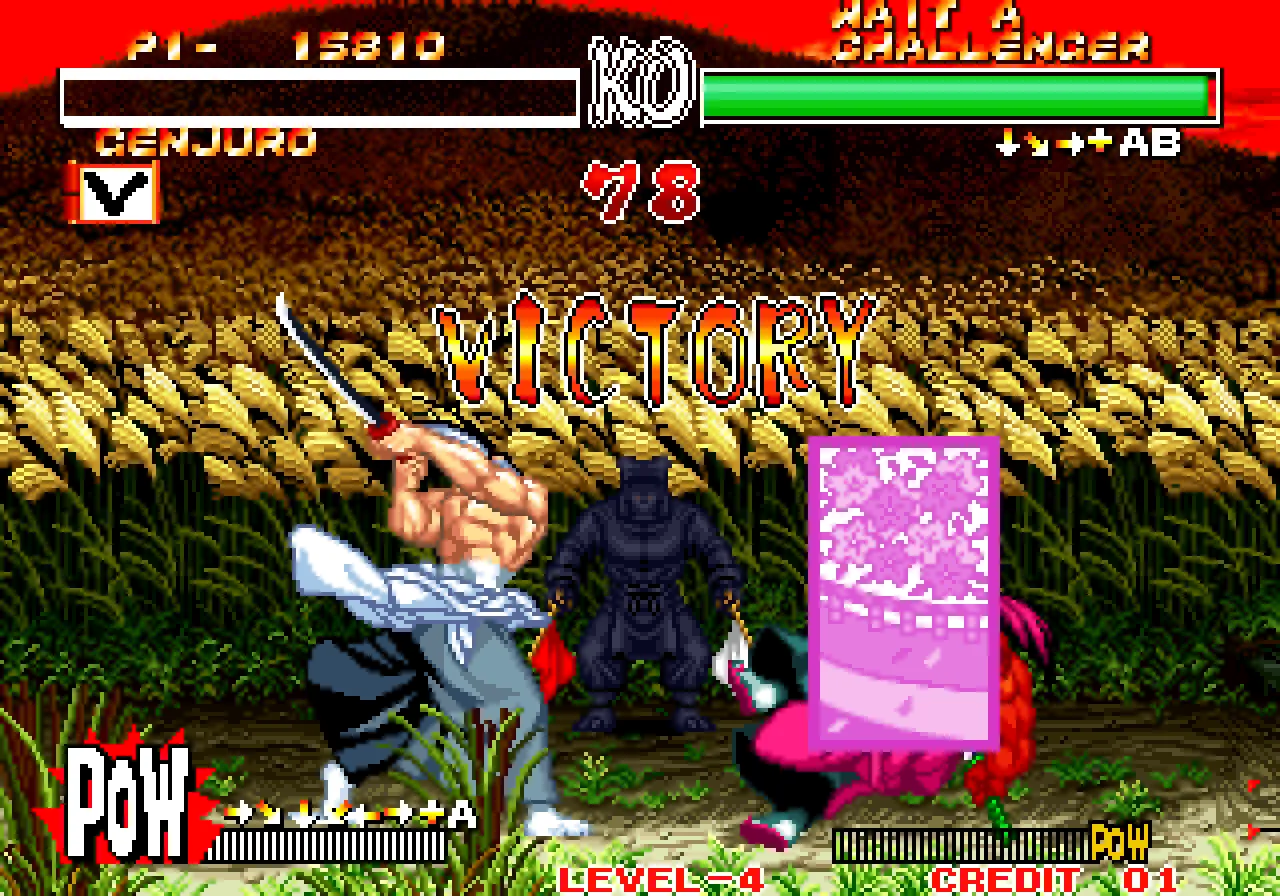
Genjuro at the end of a round, Sukigahara Field. The music thins; the wind doesn’t. Samurai Shodown II · SNK, 1994.
Still Unfollowed After Thirty Years
The genre moved past SS2 without learning from it. Samurai Shodown III arrived in 1995 with harder systems; SS4 deepened weapon-breaking; by SSV the scene had stopped paying attention. In the 2D fighting canon — the games that keep getting reissued, that get rollback netcode, that get cult followings — SS2 sits in a strange position. It’s widely loved but narrowly imitated. No game since has tried to make one-hit damage the entire balance. No game since has tied its comeback meter to weapon-breaking. Guilty Gear and Street Fighter sanded their risk models. The 3D generation replaced weapons with combos. When SNK rebooted the series in 2019, the team modelled the new game’s fundamentals specifically on Samurai Shodown II—skipping every other entry on the way.
The numbers in 1994 were already telling you this. Famicom Tsūshin put the AES cart’s first-week sales at 75,066 — respectable for a Neo Geo release, not a blockbuster. EGM handed it four 9/10s and placed it fourth on the 1995 Hot 50, the highest fighting game on the list. The audience that found it found it completely; the audience that didn’t, didn’t. In a year when Killer Instinct and Tekken were redefining what a fighting game meant to a casual player, “didn’t” was most of the audience. This is the reception gap to sit with. Samurai Shodown II was never misjudged in 1994. It was well-judged by the small number of people who took it seriously, and ignored by everyone else, and the scene that moved on moved on specifically away from the things that made it work.
On a Switch today, those things are still there, still undiluted, still waiting. The NeoGeo Collection ships the original MVS build with save states and a decent scanline filter. Thirty minutes with Haohmaru against the CPU is enough to notice the stare-down. A few hours is enough to find yourself holding the stick differently than any modern fighter lets you hold it — lighter, more patient, suspicious of your own instinct to press a button.
That feeling is what survived the decade of combo escalation. It is what the genre has been slowly, quietly, trying to find a way back to. Samurai Shodown II got there first, and stayed.