// import repelExchangePoster from ”../../assets/images/last-blade-2-1998-repel-exchange-poster.jpg”; // deleted
// import comboSequencePoster from ”../../assets/images/last-blade-2-1998-combo-sequence-poster.jpg”; // deleted
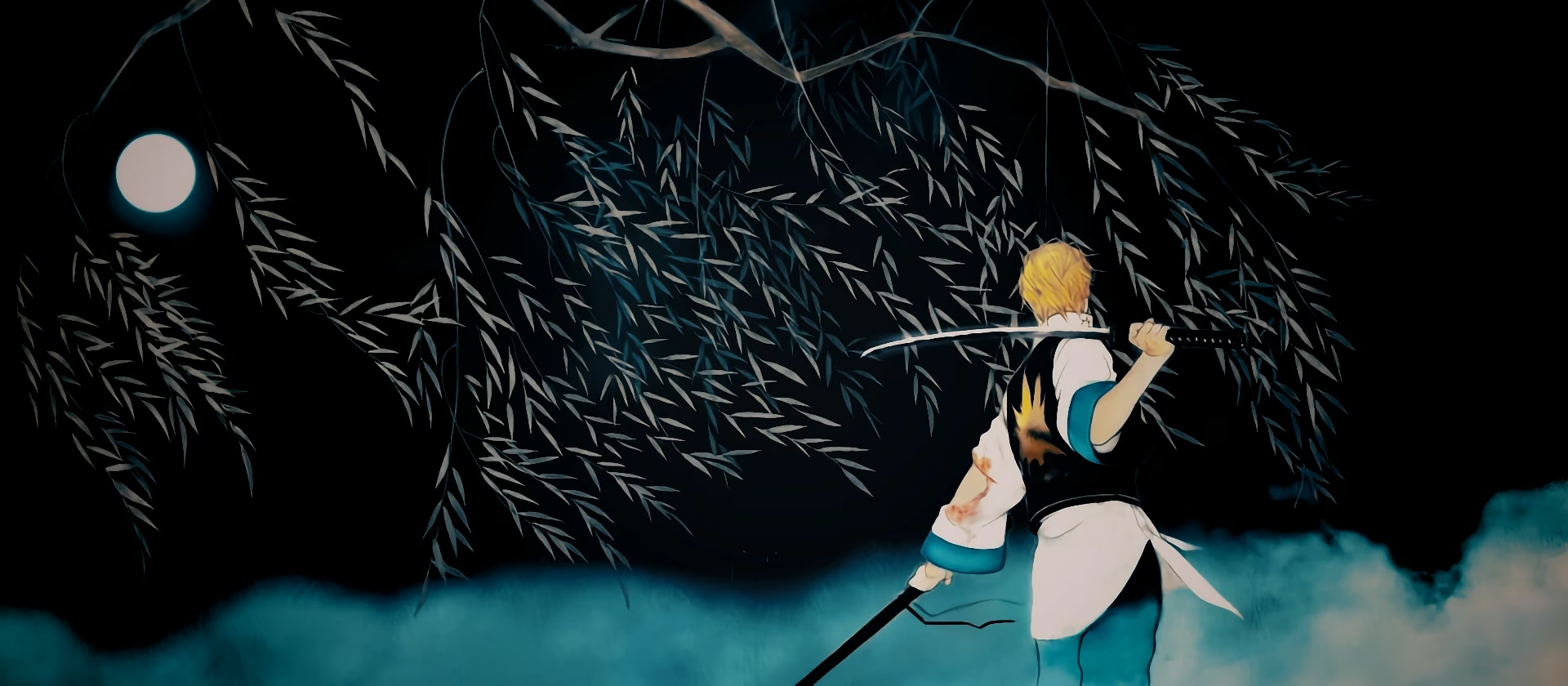
The stage is a graveyard. A half-collapsed shrine roof, wheat to the waist, bare branches against a full moon. There is no music. What the game plays instead is the wind through the wheat, the rustle of the trees, and — when a fighter moves — the sound of a hakama dragging through the grain. On a hit, the music doesn’t return. The sounds register the violence and the stage goes quiet again.
In 1998, SNK shipped a fighting game whose best stage refused to play music. The Last Blade 2 — Bakumatsu Roman: Dai Ni Maku, Gekka no Kenshi in Japan — landed in a winter the 2D genre had already been declared dead in, on hardware the industry had written off, from a company whose own bankruptcy filing was a little over two years away. Nobody in the press was listening for what was being said. What was being said was this: the samurai era is ending; so is this one; here is how it feels.
When the Katana Went Out of Fashion
November 1998. Tekken 3 had been in Japanese arcades for a year. Soul Calibur was weeks away and about to redraw what a three-dimensional fighter could look like. Virtua Fighter 3 had already persuaded the enthusiast press that the future ran through polygons and Yu Suzuki’s stopwatch. Into that weather, SNK released a sprite-based swordfighting game on the Neo Geo MVS — a board that had been commercially terminal for two years and would formally die in 2004. The pitch to the operator: please continue feeding coins into the hardware everyone agreed was finished, to play a game set in the final decade before Japan dismantled the samurai class.
The launch was not a triumph. Game Machine did list the game as the second most popular arcade title in Japan that December, but December 1998’s charts were a thin slice of a scene already migrating. Edge, reviewing the Dreamcast port in February 2001, handed out a 6/10. The piece would be rediscovered eventually — argued over, given the rollback netcode that made it playable online in 2020, placed by consensus among the finest 2D fighters ever made. All of that happened later. In 1998, what SNK released was a game about obsolescence, released into obsolescence, by a company whose own obsolescence was already underway. It is possible to mistake that arrangement for tragedy. What is stranger is how much of it the game seems to know.
A Fighter Built to Be Studied
Three modes. Speed collapses combos into long, chained rhythms reminiscent of Street Fighter Alpha’s Custom Combo. Power returns to a more traditional shape — individual specials, bigger damage, supers you earn toward. EX, unlocked by an input at the character-select screen, strips the modes back and trades them for Super Desperation Moves that fire when the red lifebar bite-point lands. None of these were fashionable choices. In 1998, fighting games were shedding systems, not layering them, and the ones staying 2D were chasing either Capcom’s four-button grammar or SNK’s own KOF teams. The Last Blade 2 put three distinct play philosophies on the character-select screen and let you pick.
Under all three sits the Repel — a parry that predates Third Strike by several months and rewards commitment over button-mashing. Time the input against an incoming attack and the game freezes for a blink, hands over frame advantage, and invites you to answer. Across the cast, a Repel doesn’t just negate damage; it reshapes the round. Missing one is worse than missing a block, because the recovery commits you long enough to die. It is a system built to be studied. Two players who know it look like two players having a conversation; two who don’t look like two people waving sticks.
The designed friction is total and the broken friction is absent. The roster — sixteen fighters plus two bosses, with Hibiki and Setsuna new to this instalment — is balanced in the way balanced rosters from 1998 usually are not. No character is a joke. None is a trump. The cast differentiates by range and intention, not by clear power tiers, and rewards a player who learns its timings rather than the player who finds its exploit. That it took another two decades before the FGC could meaningfully play online matches against each other is most of the reason this was a secret shared by a few hundred people for most of the game’s life.
The Setting Is the Argument
Set the mechanics aside for a moment and look at what the game is about. The Bakumatsu is the final fifteen years of the Edo period — roughly 1853 to 1868 — the interval between Commodore Perry’s black ships arriving off Uraga and the Meiji Restoration abolishing the samurai as a legal class. It is the period of the Shinsengumi, of Sakamoto Ryoma, of sword schools dissolving into civil service jobs. For a Japanese audience in 1998 it was the most-filmed, most-novelised, most-exhausted historical period in the country’s popular canon. SNK went there anyway.
The choice looks, now, unmistakably deliberate. A fighting game in 1998 was itself an act of stubbornness, and 2D fighting specifically was a form that had just discovered its own twilight. The Bakumatsu is the story of people who know their world is ending and pick up a sword regardless. Samurai Shodown had used the setting as swagger — bravado, roar, the katana as spectacle. The Last Blade 2 reads it as elegy.
Look at the character illustrations. Interviewed by Arcadia in 2001, the artist known only as Tonko explained she had been chosen specifically to find a register different from Shinkiro’s KOF gloss and different again from Samurai Shodown’s Mori-style bravura. The solution she reached for was ukiyo-e.
”I like the spare linework — that decisive way of drawing. The dev team was doing such amazing work, and I wanted to honour the spirit of what they’d created.”
— Tonko, Arcadia, 2001
The spare linework survives into the in-game portraits. So does the decisiveness. The cast is drawn calmly, without the rictus poses 2D fighters usually reserved for their hero art — swords lowered more often than raised, shoulders dropped. Tonko’s own gloss on the series is the best description of the game anyone has offered: “not a cheerful world… a unique, richly emotional atmosphere.” She was describing her art. She might as well have been writing the design brief.
Strings, Wind, and Rustling Leaves
The soundtrack — composed by SNK’s sound team including Masahiko Hataya, Yasuo Yamate, and Hideki Asanaka — does something almost no arcade fighter had tried. It scores the Bakumatsu in a Western pseudo-Romantic idiom. Not the synthesised shamisen-and-taiko package genre convention would expect. Strings. Arpeggiated piano. Themes that sound, in places, more like film composition than fighting-game music. For a game whose genre cousin Samurai Shodown insisted katana-on-katana must be scored with braggadocio, this is a tonal wager.
Then, on certain stages, the game does the boldest thing in its whole audio design. It stops playing. In the graveyard, the soundtrack withdraws almost entirely — there is only the howl of the wind, the rustle of the long wheat, and the sound of cloth dragging through it. The foreground wheat parts as fighters move through it. Branches fall from the trees above as the round wears on. It is stage design that behaves like weather. Writing at the time for Neo-Geo.com, the reviewer Blaine caught it exactly:
“Almost no sound at all — just the howling wind and rustling leaves. A feeling of desolation and loneliness.”
— Blaine, Neo-Geo.com
The weapon-contact sounds are written to the same specification. Metal strikes metal one way; metal strikes wood another; metal strikes scabbard differently again. Two characters with different weapon classes sound entirely distinct on clash — a Kaede parry against a club-wielder registers a different timbre than the same parry against another sword. The audio registers what most fighting games never bothered to notice: that the cast is heterogeneous in kind, not just in move-set, and that their fight ought to be heard that way.
The Rediscovery That Came Too Late
For most of its life, The Last Blade 2 was a cult object. The Dreamcast port in 2000 gave it a home outside arcades but couldn’t fix its timing. Edge’s 6/10 was not wildly out of line with how a press corps already finished with 2D fighting was going to receive it. The 9,379 copies of the Neo Geo CD release Famitsu recorded in the first-week chart are the closest thing to a contemporary consumer moment the game had. What brought it back was archaeology. Collectors kept the MVS boards circulating. Tournaments — small, specialist, rarely streamed — kept the cast alive. Then in May 2020, Code Mystics and SNK shipped a rollback netcode beta for the Steam build, and followed it through to PS4. The game that had been a regional-specialist’s game, or a bar-cabinet’s game, became a game with matches every night of the week.
The modes everyone had been told were the roster’s soul turned out to be exactly that. The Repel worked as designed. The restraint — the stillness, the mournfulness, the refusal to shout — turned out to be what the genre spent the next twenty years finding its way back toward. This is the reception gap to sit with. The Last Blade 2 was not misjudged in 1998. It was barely judged at all, because the scene it belonged to was being written off, and because its specific qualities were the qualities that scene had asked 2D fighters to drop.
What is strange, in retrospect, is how calmly the game took it. Most games that arrive late protest. They shout, they overreach, they beg to be noticed. The Last Blade 2 shipped with a stage that plays no music and a main theme that opens with a plucked string figure almost embarrassed to be loud. It knew what moment it was in. It made the case anyway, in the register it chose, and waited for a scene that could hear it.