The two companies that fought the arcade fighting-game wars of the 1990s shook hands for the first time on a handheld so small the gesture was almost missed. SNK vs. Capcom: The Match of the Millennium shipped on a Neo Geo Pocket Color cartridge in December 1999 — seven months before Capcom vs. SNK reached the arcades, a year before it landed on Dreamcast. Twenty-six chibi fighters, a two-button stick, a set of team modes no handheld fighter had attempted, and a diplomatic coup the press awarded perfect scores to without ever quite naming what had happened.
What had happened was a reunion. The two executives credited on the box as co-producers had designed the original Street Fighter together at Capcom in 1987, then walked out before the sequel — Takashi Nishiyama and Hiroshi Matsumoto — and built SNK’s entire rival canon: Fatal Fury, Art of Fighting, The King of Fighters. Twelve years later, with SNK months from bankruptcy and its handheld flatlining in American retail, Nishiyama reached back across the aisle to an old Capcom colleague — Yoshiki Okamoto, the producer of the Street Fighter II Nishiyama never stayed to make — and proposed a peace. The treaty fit in a coat pocket.
The two who made Street Fighter
The thing to understand about Nishiyama is that he had already done this once before. He came to Capcom in 1984 from Irem, where he had designed Kung-Fu Master, and brought with him a prototype that would, under Capcom’s brief, become Street Fighter. Matsumoto joined him as lead designer. The hadouken — the projectile that would give the entire genre its grammar — Nishiyama later traced to the Wave Motion Gun from Space Battleship Yamato, the 1974 anime he had grown up on and had been trying, for years, to turn into a playable input. The arcade cabinet shipped with pneumatic pressure-sensitive buttons players pounded so hard Matsumoto’s hands swelled during testing.
”During the development, the pneumatic buttons didn’t yet have their rubber covers. All that pounding made my hands swell up.”
— Hiroshi Matsumoto, 1987 developer interview
Neither man stayed to work on what the series became. They left Capcom for SNK in 1988 — Nishiyama invited onto the board, drawn by the promise of helping design an arcade system around swappable cartridges. He got more than that: he ended up contributing to the Neo Geo hardware itself, then authoring the game the platform would build its identity around. Fatal Fury shipped in 1991 and read, unmistakably, as the same man’s second draft of the same idea. Terry Bogard wore Ken’s palette, threw a Hadouken under a different name, and fought across two planes of combat because Nishiyama had decided his Street Fighter hadn’t used depth enough. Art of Fighting followed in 1992; The King of Fighters in 1994. Each of those games existed because the people who made Street Fighter 1 had walked — and because the people who made Street Fighter 1 could not stop thinking about how they would have made Street Fighter 2.
A truce brokered in chibi
By early 1999, the rival canon had run for a decade and SNK was running out of money. The Neo Geo Pocket had launched the previous autumn in monochrome, the Color model in March; the case for the platform was a clicky eight-way microswitched stick the Game Boy Color’s rubber diaphragm could not match, and the catalogue was aggressively fighter-heavy. It wasn’t enough. A 25,000-unit run in North America’s first two months gave way to a two per cent US market share by May 2000. Aruze, the pachinko manufacturer about to acquire the company, was looking at SNK’s books. Art director Toyohisa Tanabe later said the SNK-vs-Capcom idea was put in motion specifically to help the struggling handheld.
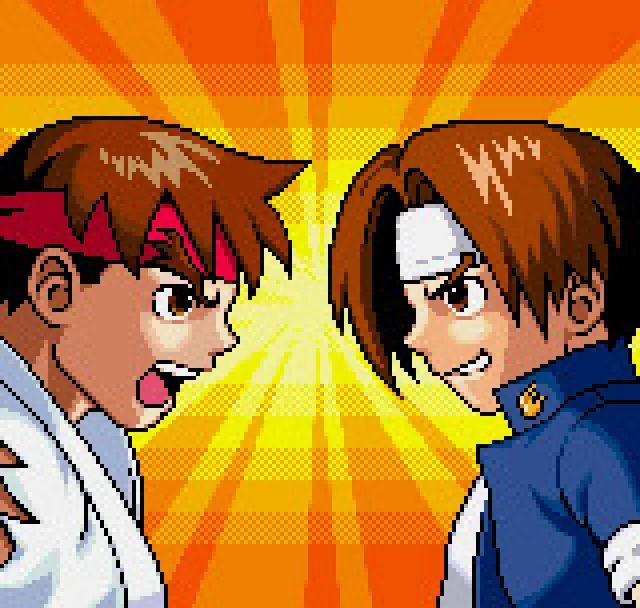
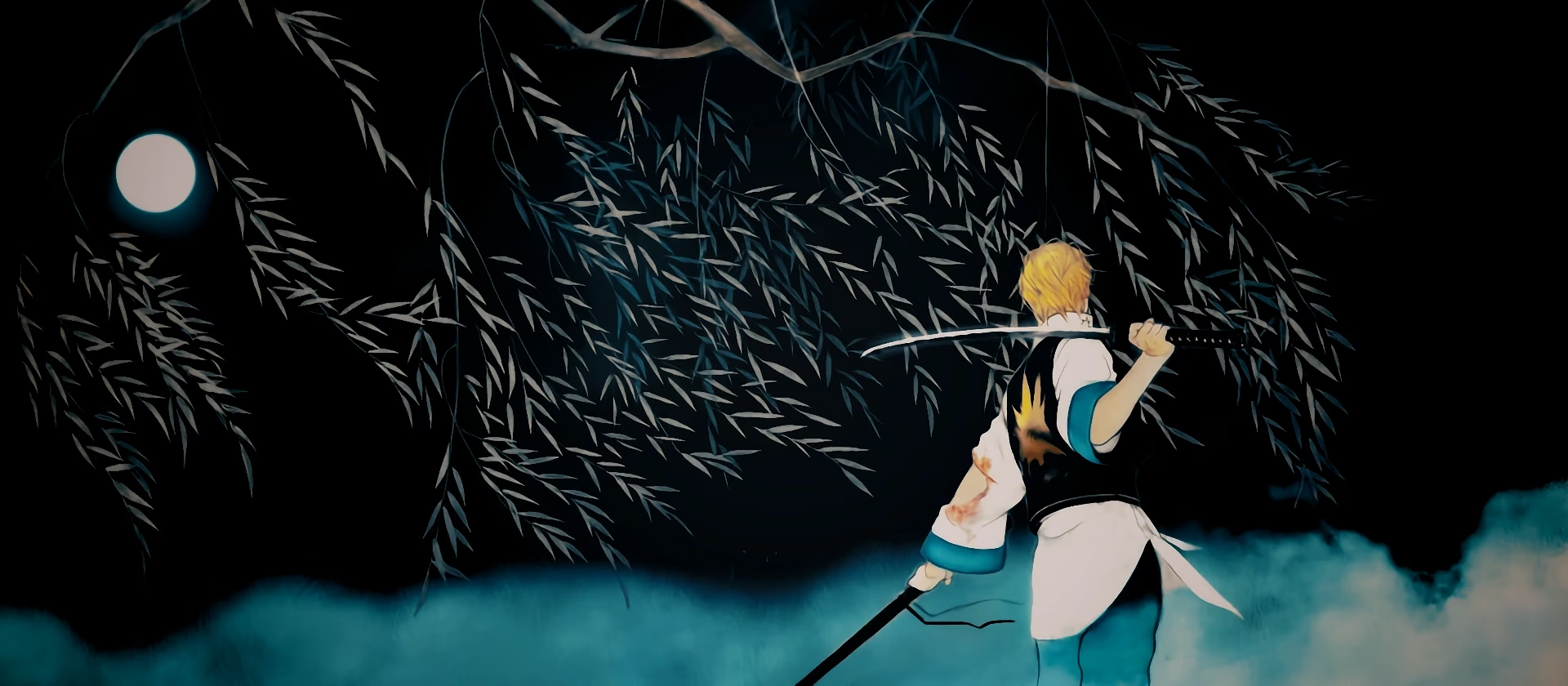
Kyo against Ryu — the matchup the two rival canons had been implying for a decade, finally allowed to happen. Match of the Millennium · SNK, 1999.
Nishiyama took the pitch to Okamoto. Okamoto took it to Capcom president Kenzo Tsujimoto and SNK’s Eikichi Kawasaki. The four names signed off. Matsumoto stayed on the Tokyo production; Nishiyama was already planning his exit and would leave SNK early the following year to found Dimps — the studio that would, ironically, later co-develop Street Fighter IV. The Match of the Millennium is, in that sense, the last game the two men who made Street Fighter 1 ever made inside SNK. A truce signed on the way out.
The chibi art style was the compromise that made it possible. Super-deformed proportions — half-size bodies, oversized heads — are a visual language both rosters could share without one company’s house style overpowering the other. Ryu and Terry at full scale would have read as a power comparison. Ryu and Terry at chibi scale read as something gentler: a register in which neither side condescends, and in which the player can enjoy the matchup without having to choose a side.
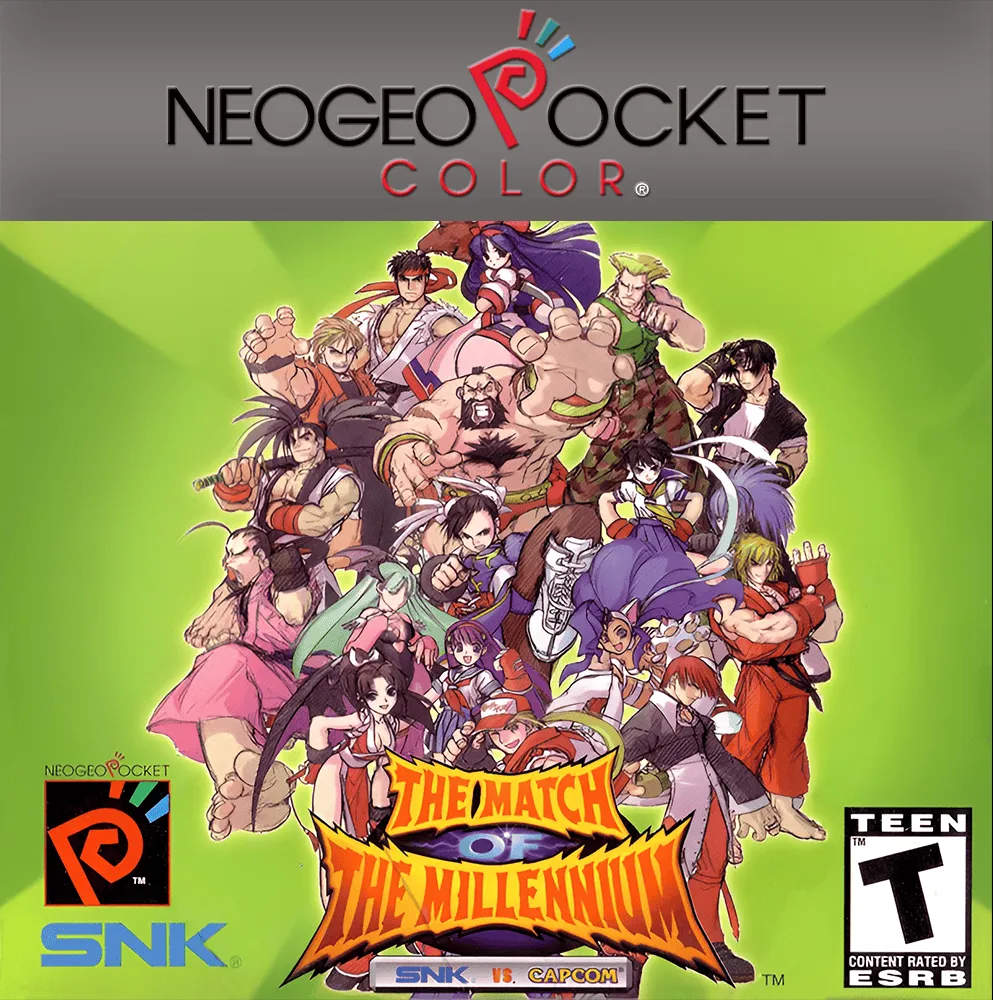
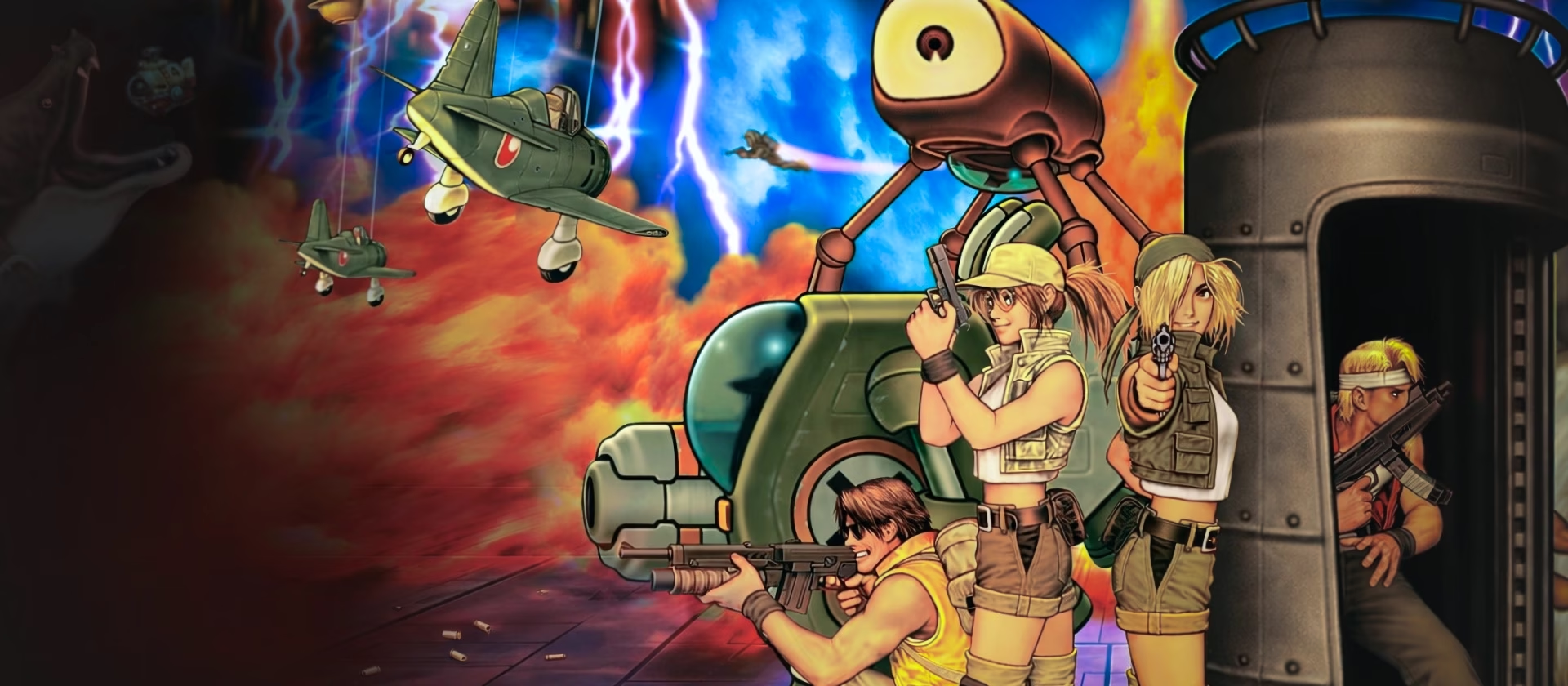
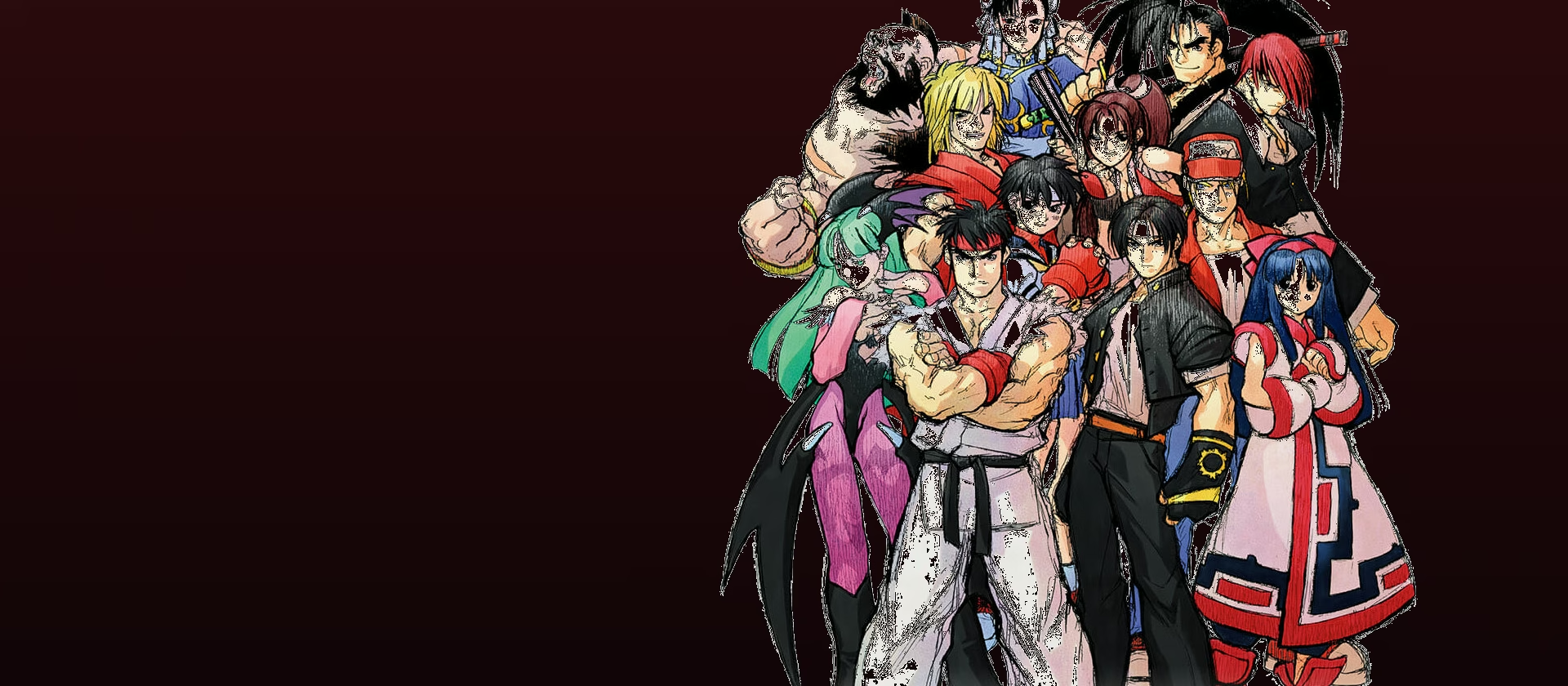
The cartridge as platform chrome framed it — twenty-six fighters arranged as one group portrait, no corner reserved for either company. Match of the Millennium · SNK, 1999.
The stick that earned the fight
Two buttons. That is the non-negotiable. The Neo Geo Pocket Color ships with two action buttons and a microswitched stick, and any fighting game on the platform has to reconcile itself to fewer inputs than a SNES pad. Match of the Millennium reconciles by leaning into the limit. Light attack, heavy attack, and a simultaneous twin-press for a dedicated throw. Specials are quarter-circle and charge motions on the stick; supers are motion-plus-both-buttons. Chain combos route light into heavy into specials in an acknowledged canonical sequence — a kind of grammatical rhythm no arcade fighter of the same year would bother to put into its tutorial. The roster of twenty-six fits on the hardware without any of them feeling like filler.
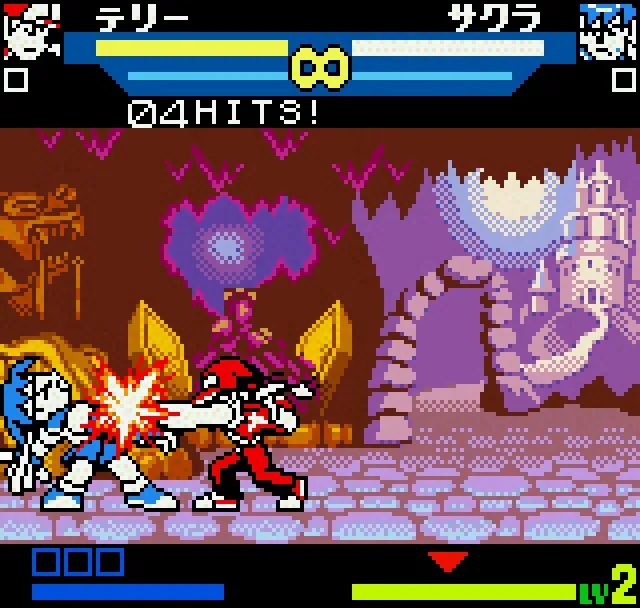
Terry’s Burn Knuckle arriving on the fourth link of a chain combo. Tag mode lets you swap mid-combo; supers drain a shared meter. Match of the Millennium · SNK, 1999.
The stick does the work the buttons can’t. SNK’s decision to ship an eight-way microswitched click-stick rather than a cross-pad turned the NGPC into the only handheld on which a shoryuken input feels correct. The clicks register — audibly, haptically, across two planes — in a way no Game Boy diaphragm pad could. Ken’s Shoryuken, Terry’s Burn Knuckle, Iori’s Yami Barai all travel through an input chain you can hear ticking off under your thumb. It is the closest a 1999 handheld ever came to feeling like an arcade.
Ken against Kyo in front of Mount Rushmore — a chain combo clicking out on the microswitched stick, counter climbing past seven hits. Match of the Millennium · SNK, 1999.
Three team modes sit on top of the system. One-on-one, a KOF-style three-character queue, and — startling for a handheld in 1999 — a tag mode with characters swapping mid-combo, assist attacks, a shared super meter. Match of the Millennium is the first fighting game on a portable that asked to be played competitively rather than as novelty, and it got its wish.
”This game has a better gameplay system than some arcade fighting games — and it packs more heart and polish than some other recent fighting game releases on the ‘big boy’ consoles.”
— Fighters Generation
The ceiling arrives faster than a full-scale arcade fighter allows. Twenty-six characters on two buttons means motion vocabulary is shared across the roster — character-select variety outruns mechanical variety — and at higher difficulty settings the CPU becomes predictable before it becomes punishing. That is the NGPC’s constraint. Match of the Millennium fits twenty-six fighters onto a canvas that a home arcade release would fill with eight at triple the depth, and asks whether the crossover is worth that compression. The click-stick is what tips the answer.
Arcade music through a straw
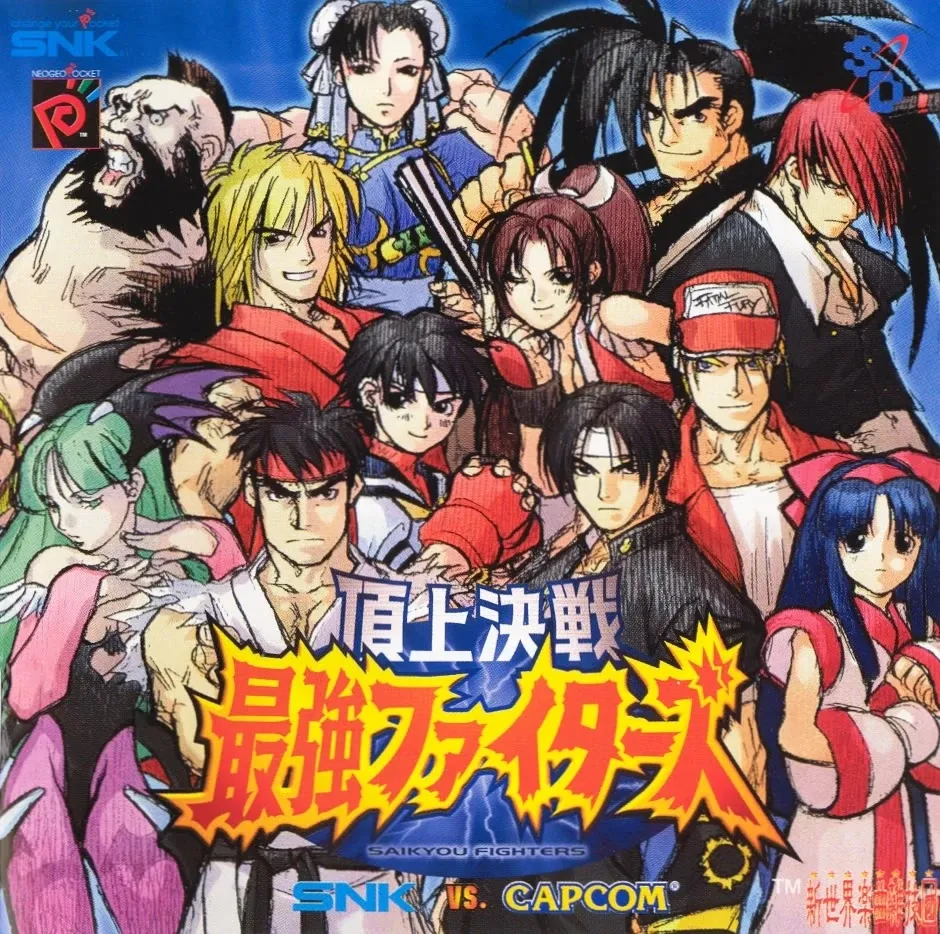
Japanese OST cover — released under the Japanese title “Choujou Kessen: Saikyou Fighters” (Summit Showdown: Strongest Fighters). Three square-wave voices and a noise channel, arranged as if that was always enough. Cover: SNK, 1999.
Three square-wave voices and one noise channel. That is the NGPC’s sound chip — a Toshiba T6W28, sitting in the same grey plastic case as the stick. Match of the Millennium takes the themes fans of either company would want — Ryu’s stage music, Terry’s Kurikinton, Iori’s saxophone, Chun-Li’s theme — and cannot render any of them the way the arcades did. What it does instead is translate. Shinsekai Gakkyoku Zatsugidan — SNK’s sound collective — reduces each theme to three lines of melody and a percussion skeleton, and the act of reduction turns out to be the thing that saves the score.
Ryu’s theme at two voices and no orchestration is a different song: sparer, stranger, more melancholy than the arcade version. Terry’s becomes a marching cadence. Chip music arranged by people who remember exactly how the full arcade version sounded is a specific genre of nostalgia — not replication, translation. You hear what the composer wanted to keep. You hear, also, what they couldn’t bear to cut. The compression is editorial.
Alongside the translations sits a new score written for the chip. The menu theme, the team-select jingle, the boss music for the two-character finale against Geese and Bison — these are original compositions, not arcade imports, and they understand the hardware the way Tetris’s Korobeiniki understands the Game Boy: they sound good because they sound small. The constraint is the aesthetic.
A handshake the market missed
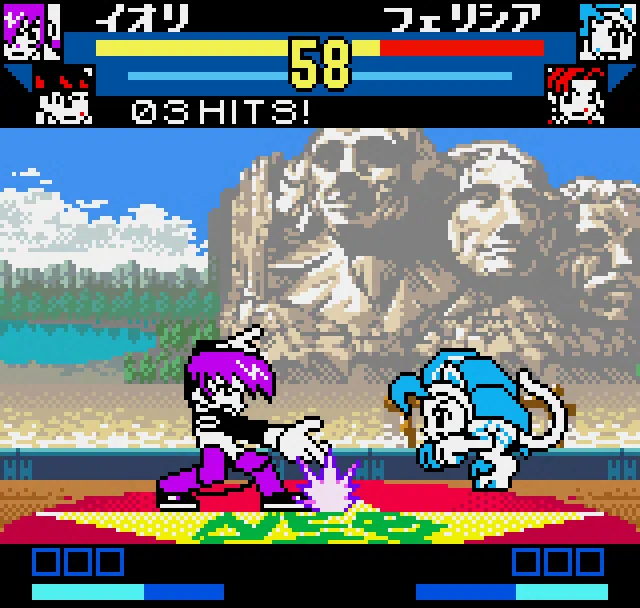
Iori against Felicia in front of Mount Rushmore — a crossover that makes sense only in the politics of a handheld truce. Match of the Millennium · SNK, 1999.
The game shipped. Famitsu gave it 30 of 40. IGN gave it a 10, and called it “the finest fighting game ever to grace a portable screen.” It became the best-selling Neo Geo Pocket Color title in Japan, with 75,000 copies sold. Seventy-five thousand copies is what winning looked like on this platform. Aruze acquired SNK in January 2000. In June they shut down SNK’s North American and European operations; by the end of the year, the handheld was discontinued overseas. In October 2001 the parent company filed for bankruptcy. The NGPC Color ended its life with a library of seventy-three games and a fighter-heavy back catalogue that Western players had been unable to buy legally for over a year.
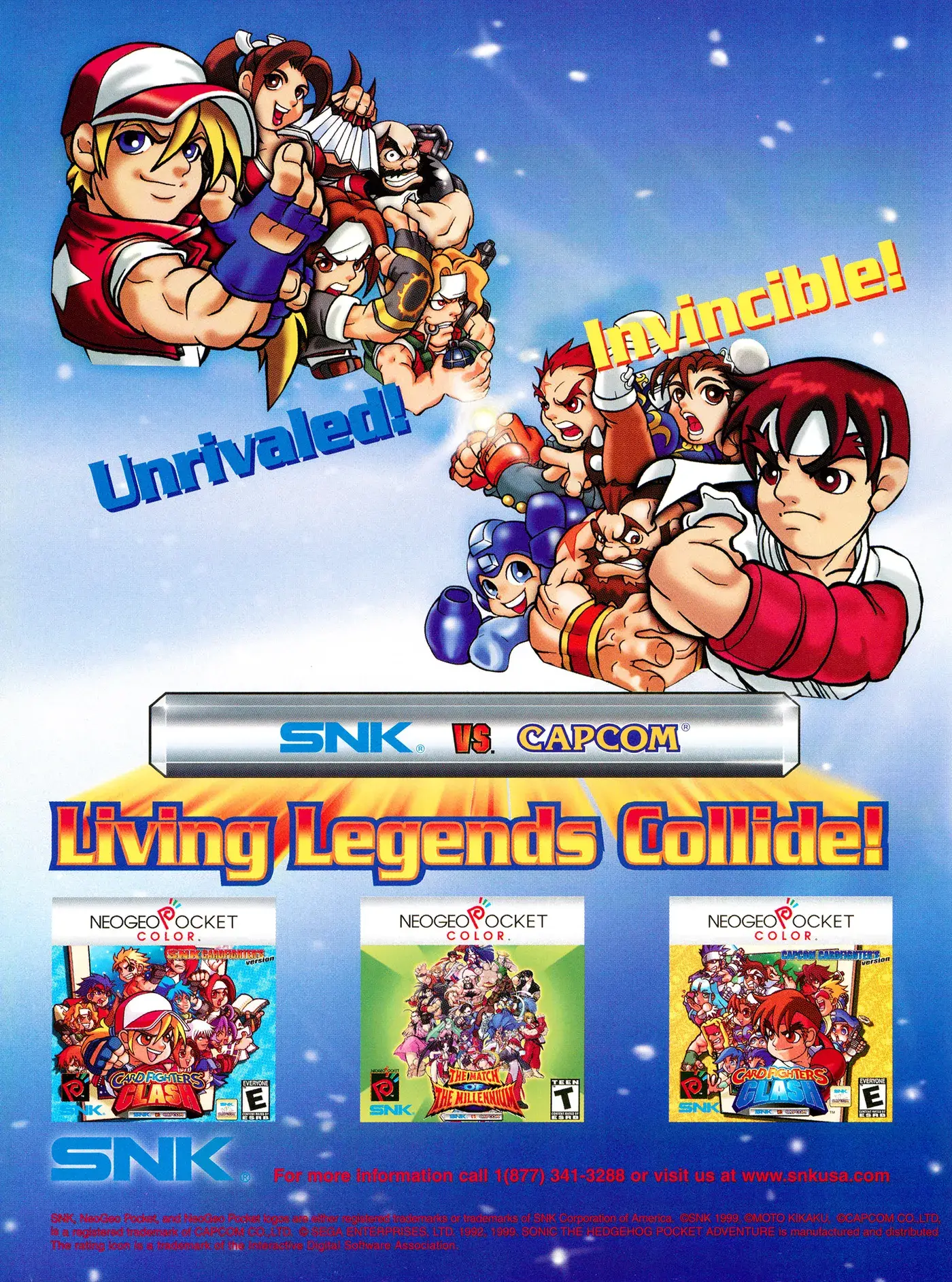
SNK’s US marketing leaned into the crossover it had just brokered — the campaign ran into a handheld already losing its shelf space. Print ad: SNK, 1999.
Capcom vs. SNK: Millennium Fight 2000 arrived in Japanese arcades in July 2000, seven months after the handheld. By 2003 there were four or five more crossovers on both sides of the ledger. The arcade entries are the ones most fighting-game fans remember; they are not the ones that brokered the peace. The Match of the Millennium is the first SNK-and-Capcom game anyone ever shipped, and its existence is the precondition for the rest. The quiet part is louder than the rest of the sentence. The treaty the two men who co-wrote Street Fighter signed in their last months at SNK was a handheld game, made in chibi, on a platform that died inside the year.
On Switch, Match of the Millennium now sits inside Neo Geo Pocket Color Selection Vol. 1, bundled with nine other exclusives — Last Blade: Beyond the Destiny, KOF R-2, Gals’ Fighters, both Metal Slug Missions. On Steam it runs standalone. On RetroArch or an Analogue Pocket it runs from the original cartridge image. Pick any of those paths and what you are buying is the moment two men went back for one more round together, in chibi scale, on a platform already being buried. That is the game. That is what was on sale.