// // import cathedralFightPoster from ”../../assets/images/guardian-heroes-1996-cathedral-fight-poster.jpg”; // deleted // deleted
// // import palaceBossPoster from ”../../assets/images/guardian-heroes-1996-palace-boss-poster.jpg”; // deleted // deleted
Every developer with a clear read of the market had pivoted to polygons. The Sega Saturn was losing, Sony’s PlayStation had arrived with a sleeker machine and the perception of the future, and the 2D sprite was being quietly euthanised by the industry that had built itself on it. In that environment, a small Tokyo studio called Treasure sat down to make the most technically ambitious 2D brawler ever created. When someone asked why they weren’t chasing 3D like everyone else, a Treasure representative gave a reply that tells you everything about the company: “Treasure has built up a tremendous knowledge of 2D sprite know-how. It’s an asset that we wish to continue using. No, we didn’t think it was risky. In fact, the risk is in trying to make a new game.”
The Game That Didn’t Care
That calm confidence produced Guardian Heroes, released in Japan on 26 January 1996. It didn’t sell particularly well. The Saturn was already haemorrhaging its install base, and a 2D brawler—a genre critics were already writing off as exhausted—had no commercial logic behind it. But the people who found it talked about it obsessively. Copies became scarce. Prices climbed. For over a decade, encountering Guardian Heroes in the wild felt like finding something that wasn’t supposed to exist.
”I was starting to feel like the kind of games I like weren’t being made anymore. Guardian Heroes was the result of my searching for what I personally still found fun about games.”
Tetsuhiko “HAN” Kikuchi, designer and project lead — Game Hihyou, 1996
Development began in June 1994 — meaning Treasure spent a year and a half making a game that, by all market logic, had no audience. The catchphrase Kikuchi gave the team at the start was “Exciting and Invigorating!” He originally wanted one hundred, possibly two hundred enemies on screen simultaneously. When he saw the Saturn’s actual specs, he scaled back. The RPG elements — experience points, branching paths, the karma system — emerged from that constraint, as ways to add variety to stages that couldn’t be packed with the raw enemy count he’d first imagined. What started as a limitation became the game’s distinguishing architecture.
Lead designer Kikuchi’s stated inspirations were Capcom’s Alien vs. Predator arcade game and Fill-in-Cafe’s Mad Stalker: Full Metal Force — not the obvious predecessors (Final Fight, Streets of Rage) that any other developer would have cited. He wanted something that could stand beside the fighting games of the era rather than merely imitate the brawlers that came before. The result was what the development team called a “fighting RPG” — their own term, and precisely accurate without being remotely sufficient.
A Brawler Built Like a Fighting Game
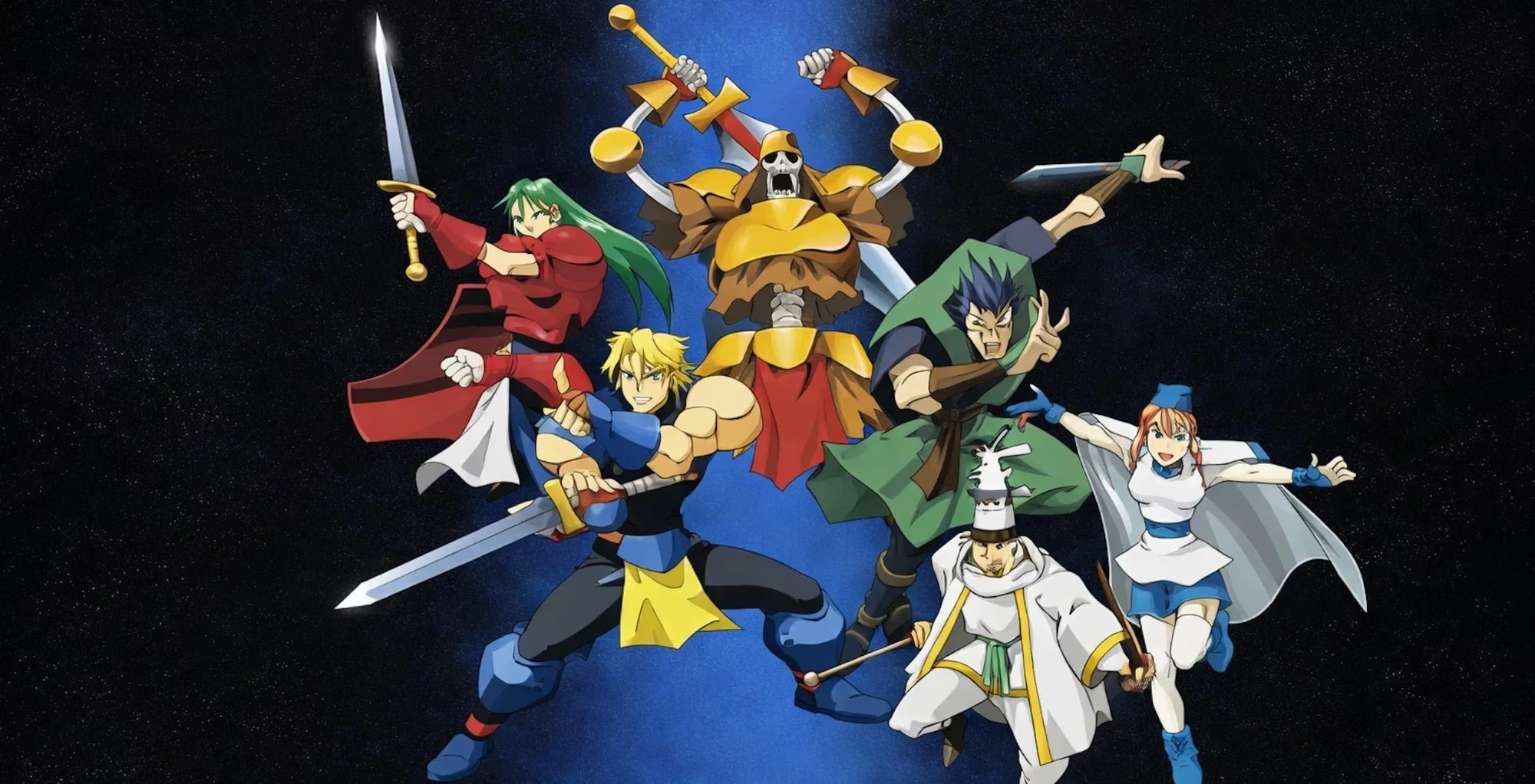
The combat operates on three horizontal planes, with light and heavy attacks, special moves executed through fighting game inputs, magical abilities, and a block. Characters earn experience points at the end of each stage, freely distributed across strength, speed, constitution, and magic resistance. A skilled player can choose to assign nothing — and fight the final encounter at Level 1. A new player can bank everything into constitution and survive on brute persistence. The architecture supports both, without condescending to either.
Take the moment in the third stage where you’re surrounded on two planes simultaneously — a soldier above, a knight below, a magic-casting adept behind you — and you switch planes mid-combo to break the encirclement. That movement, natural after a few hours, is fighting game thinking applied to a brawler’s space. The plane system isn’t just a visual layer; it’s a tactical dimension that rewards the same positional awareness Street Fighter II demanded of its players, applied here to crowds rather than opponents.
Forty Endings and What That Actually Means
The mechanic that has no equivalent elsewhere is the Karma system. Kill civilians — the non-combatants wandering the stages — and your karma shifts. Kill enemies who are already beaten, who have no fight left in them, and it shifts further. The game registers the moral texture of your choices and responds: different stages become accessible, different story branches open, different endings become reachable. The game launched in 1996 with a branching narrative containing over forty distinct outcomes.
To understand what that means concretely: a low-karma run that systematically eliminates civilians leads to stages where you fight alongside the demonic forces rather than against them, eventually arriving at a throne room where the enemy you’ve been told to oppose turns out to be the lesser of two evils. A high-karma run takes you to the celestial court of the Sky Spirits, where the moral calculus inverts again. The same opening — four adventurers, a magic sword, an imperial army — branches into stories about revolution, damnation, and transcendence, depending on how violently you treated the people who couldn’t fight back. Most studios with a hundred times Treasure’s resources still struggle to match that structural ambition.
In the 1996 interviews Kikuchi gave to the Japanese gaming press, he made a philosophical case for what Guardian Heroes was trying to do. He was tired of competitive fighting games — not because they were badly designed, but because of what they demanded of the people playing them. “There’s already more than enough competition in the world these days. When there are two players in a competition, must they become enemies? I want a game where the players don’t have to be enemies, a game where you feel no bitterness or ill will afterwards.”
This is not a trivial design concern. It produced the versus mode, in which up to six players can battle simultaneously using any character from the full roster — warriors, bosses, unlockable civilians, creatures. Kikuchi had built an earlier version of this thinking into Yū Yū Hakusho: Makyō Tōitsusen for the Mega Drive, and Guardian Heroes was his attempt to push further: “We did want to keep that fun aspect of Yu Yu Hakusho, which was more about having a blast with your friends rather than winning and losing.” The versus mode functions more as a shared spectacle than a competitive arena, and that distinction is deliberate.
”A skilled player could decide to not assign any XP, and fight the final boss at Level 1. I think that breadth is the selling point for Guardian Heroes. Anyone can clear the game — though that’s not to say we want it to be a game you play only once.”
Tetsuhiko “HAN” Kikuchi — Sega Saturn Magazine, 1995
The Undead Hero — the skeletal warrior who accompanies the player through story mode, commandable via simple orders — embodies that whole philosophy in a single character. He can be ordered to attack, defend, follow, or simply go berserk, in which case he fills the screen with energy and destroys everything in reach, which is sometimes exactly what a struggling player needs. He cannot be killed. He is not a guest who disappears at a story beat. He is there for the whole game, on your side, and the narrative is structured around his resurrection — the sword that summons him, the question of what he was in life, the eventual revelation that the most imposing figure in the cast is the one who fights beside you. According to Kikuchi’s design notes, the Undead Hero weighs three hundred pounds, which is quite an accomplishment for a skeleton.
The Score Nobody Talks About
The soundtrack of Guardian Heroes is its least discussed extraordinary feature. The score was composed by Nazo² Suzuki and Norio Hanzawa, and synthesizer operation was handled by Hideki Matsutake — known in Japanese music circles as the “fourth member” of Yellow Magic Orchestra, the group whose influence on electronic music ran from Ryuichi Sakamoto to virtually every ambient and synth-pop act that followed. The YMO connection is not decorative. Matsutake served with the band from 1978 to 1982, and his sense of texture and space is audible throughout. Because Guardian Heroes was Treasure’s first CD-ROM title — their previous work had been on Mega Drive cartridges — the composers were freed from the constraints of cartridge sound hardware for the first time. The result incorporates electric guitar, saxophone, and the full electronic range that Matsutake had spent two decades learning to command.
Electronic Gaming Monthly awarded the game their Side-Scrolling Game of the Year for 1996, then ranked it number 66 on their list of the 100 best games ever made the following year. That critical recognition didn’t translate to sales in a market that had already moved on. The Saturn was fading. The brawler was declared dead. Guardian Heroes sold to the audience it could find, became impossible to obtain, and waited.
The Recovery
When Sega and Treasure prepared a remastered version for Xbox Live Arcade in 2011, they discovered that all the source code for the Saturn original had been archived on DAT cassettes. Treasure no longer owned equipment capable of reading them. The team had to borrow playback hardware from various divisions within Sega, constructing an environment capable of retrieving the source before any remastering work could begin. The image of engineers piecing together obsolete machinery to recover a game that sold modestly on a console that lost the console war captures something essential about Treasure’s output in this period. They were making things that required excavation.
The 2011 XBLA release brought welcome additions — online multiplayer, HD presentation, an expanded 12-player versus mode — but it also rewrote portions of the script and renamed story elements that the Saturn version’s devotees considered essential. Both versions exist as arguments. The remaster is the more accessible entry point. The original is the truer one.
The controls take time. The first playthrough is a partial map of something larger. Kikuchi built it that way deliberately: he wanted a game that couldn’t be experienced passively, one where the player was searching for ways to play rather than waiting for the game to deliver itself. The Karma mechanic creates genuine decisions in a way that most contemporary games still struggle to replicate. The versus mode, if you can gather the players, remains singular. And the branching structure means no two complete playthroughs cover the same ground.
Thirty years on, what the game built in 1996 still has no real successor. The things that made it unusual — a brawler with forty endings, a karma system that registers the moral weight of your choices, a design philosophy embedded in every system — remain unusual. Treasure built this on a losing platform, in a dying genre, for an audience that mostly didn’t find it at the time. The audience came later. So can you.