// import garageTagsPoster from ”../../assets/images/jet-set-radio-2000-garage-tags-poster.jpg”; // deleted
// import elephantBeachPoster from ”../../assets/images/jet-set-radio-2000-elephant-beach-poster.jpg”; // deleted
The premise is deceptively simple. You are a rudie — a rollerblading teenager in a near-future Tokyo governed by a corporate police state — and your weapons are inline skates and spray cans. You grind rails, tag walls, outrun the cops, and reclaim your neighbourhood one luminous brushstroke at a time. Jet Set Radio is a game about graffiti as an act of freedom, and what it figured out — which almost nothing since has matched — is that movement, music, space, and rebellion can be made to feel like the same thing.
What it gives a player today that most games still do not: a specific, intact sensation. The movement is expressive rather than merely efficient — linking grinds, jumps, wall-rides, and tags into a run that feels half-sport, half-performance. The city is built to be read as flow, its rails and rooftops resolving into routes as you learn them. The music does not decorate the action; it creates its pulse. And the act at the centre — marking space, claiming presence, escaping authority — still feels mischievous and alive in a way most games have never attempted.
A Game That Still Looks Like Itself
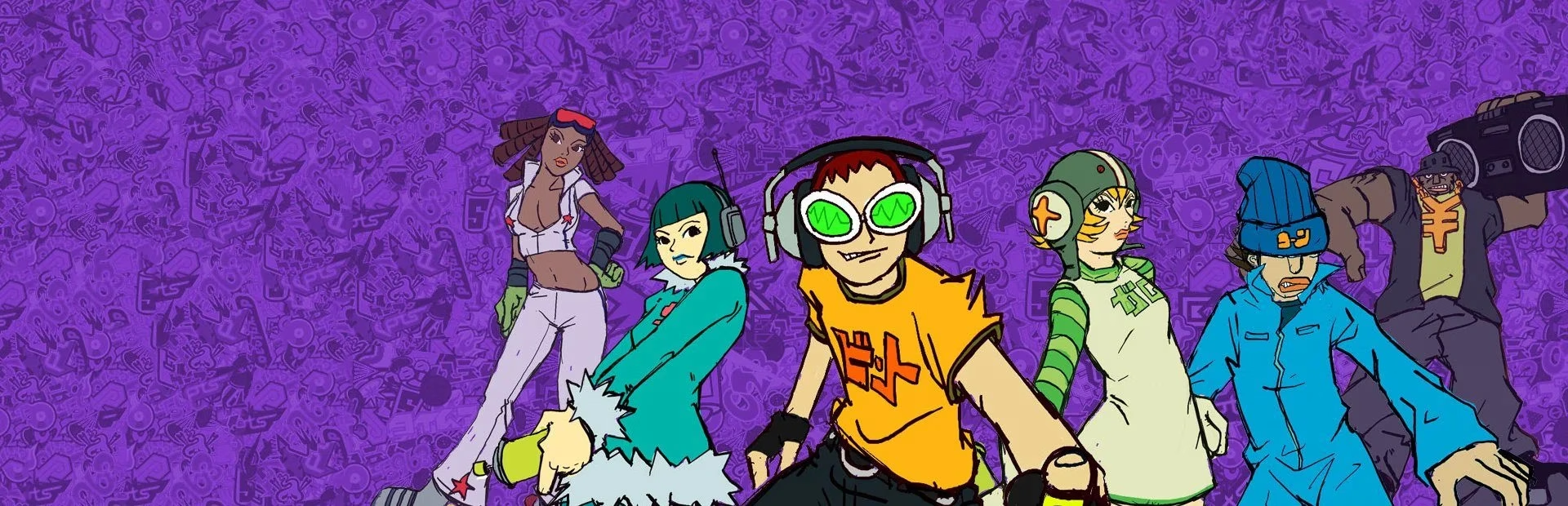
The game holds a Guinness World Record as the first to use cel-shaded graphics — a technique developed by Smilebit’s art director Ryuta Ueda in deliberate reaction against the photorealism trend consuming the industry. Thick black outlines, flat colours, exaggerated shapes: it looks like a moving comic panel, and the choice still reads instantly today. There is no decay here. Where photorealistic games from 2000 look like failed approximations of reality, Jet Set Radio looks exactly like itself. Smilebit even tried to make the game technically impossible to duplicate on PlayStation 2 — pushing the Dreamcast’s colour output past what Sony’s hardware could manage. The aesthetic was not decoration. It was ideology.
Smilebit was a development division within Sega, and Jet Set Radio was a hard turn from the studio’s previous work — largely sports titles — into something that had no obvious genre precedent. The Dreamcast was Sega’s final major hardware platform, launched in 1998 with genuine momentum before Sony’s PlayStation 2 announcement began draining it. The context matters: a creative team with latitude, a console whose window was closing, and a director who chose to spend that moment making something nobody had asked for. Masayoshi Kikuchi described the intent plainly.
”We wanted to construct something dealing with pop culture and something that was cool.”
— Masayoshi Kikuchi, director
Three Zones, One Argument
Tokyo-to — the game’s barely-fictionalised version of the city — is divided into contested districts: Shibuya-cho, Kogane-cho, and Benten-cho, each with its own visual register and its own gang staking claim to the surfaces. The GG’s, the crew you build from scratch across the game, push through each zone reclaiming walls, rails, and rooftops from rival outfits whose aesthetics are as specific as their territories. The Noise Tanks wire themselves into industrial technology. The Love Shockers run on electric-pink confrontation. Poison Jam occupies the harbour with grotesque masks and a refusal to be understood. Each gang is a pose. The game treats poses seriously.
Each rival crew also functions as a design brief for the district it holds. Shibuya-cho reads as consumer density, colour-saturated and legible. Kogane-cho is older and narrower, built from back alleys and rooftops that reward a lower, more improvisational line. Benten-cho at night is neon verticality, the route sheet pushed upward into signage and scaffolding. The GG roster expands by the same logic: you recruit a rival by besting them on the surfaces they know best, which turns each defeat into a tacit acknowledgement that their corner of the city belonged to them first. The crew you end the game with is not a starting party. It is an argument about territory.
The design premise is political without being didactic: the corporate power structure of the world is real, the police captain’s escalating response is real, and the act at the centre of every stage — covering a city’s surfaces with your mark before authority arrives to erase it — is framed as something that matters. The game never explains why it matters. It doesn’t have to. The feeling of skating away from a clean tag as the music syncs to your movement makes the argument directly, in the body, in a way that no cut-scene could.
The police response is the other half of that argument. What begins as baton-wielding beat cops escalates through riot gear, helicopters, and armoured carriers until, by the final stretches, the state is deploying a credible military response to the question of who is permitted to paint a wall. The escalation is funny and threatening at once — the joke of a tank arriving to stop a teenager with a spray can earns its punchline the first time a gunship ruins a clean run. It also keeps the tagging from feeling consequence-free. Spraying is the playful verb; outrunning what arrives to answer for it is how the game charges you for the privilege.
The City as Playground and Battleground
The influences were openly declared. The team cited PaRappa the Rapper, Fight Club, and 1980s American hip-hop graffiti culture. The in-game graffiti was designed by real artists — Eric Haze, who had created album art for the Beastie Boys and Public Enemy, among them. The settings were photographed from Shibuya and Shinjuku. These references matter not as trivia but because they shaped how the city feels: authored, specific, politically alive. You are not moving through a neutral obstacle course. You are contesting space that someone else claims to own.
The game’s friction is real and worth naming. The camera can be awkward on tight turns; tagging sequences sometimes break rhythm at the worst moment; the escalating police response — from beat cops to SWAT teams to a full military pursuit — can tip from thrilling to punishing without obvious cause. A modern player will feel these edges. But the friction is not incidental. It is part of the argument. The game earns its moments of pure flow by making you work for them, and the sensation of a clean run — lines, rails, walls, tags, evasion, all stitched together — is proportionally more satisfying for the resistance preceding it.
Let Mom Sleep
Composer Hideki Naganuma assembled a soundtrack that has no clean genre — hip-hop, J-pop, funk, acid jazz, trip-hop, arrangements that defy categorisation. It is the only word for what it does to the game: the music and the movement synchronise until the whole experience has a rhythm, a pulse, an attitude that belongs entirely to itself. Naganuma has said that Jet Set Radio and its sequel were his favourite projects of his career. In 2023 he revealed he had received multiple approaches to make a sequel — none came to fruition. “Maybe Sega knows,” he said. The wound runs deep even for those who made it.
The 2012 HD remaster removed two tracks for licensing reasons. It is a real loss for purists, but the remaining soundtrack still hits hard enough that the game holds. The Y2K aesthetic has returned as a cultural reference point, but this is not a museum piece to be visited for its era — it is the source of a sensibility that later games approximated without fully understanding. Wind Waker, Sly Cooper, Viewtiful Joe, and Sunset Overdrive all owe it a direct debt; the 2023 spiritual successor Bomb Rush Cyberfunk demonstrates, affectionately, how much of what made the original irreplaceable was never fully decoded.
What Survives the Platform
The Dreamcast was discontinued in 2001. Sega exited hardware entirely. Smilebit was absorbed and eventually dissolved. Jet Set Radio found no natural second home — the sequel, Jet Set Radio Future, arrived on Xbox in 2002 and took the series in its own direction rather than carrying the original forward. The HD remaster and Steam release eventually brought the game to a new audience, but years passed in which it existed mainly as a memory of a platform most players never owned.
The Dreamcast context makes that refusal sharper in hindsight. By 2000 Sega was a company losing altitude in public, and the console would be discontinued before JSR was two years old. Nothing inside the game behaves like a studio hedging. Smilebit shipped with the colour-output gambit intact, with a soundtrack dense enough to cause licensing trouble for later reissues, and with a world specific enough that the U.S. release was rebranded Jet Grind Radio rather than softened. Commercial anxiety would have rounded down. The game rounds up. That disjunction — a publisher in retreat, a team behaving as if they had nothing left to lose — is what the art style is arguing about. It is a game that believes the medium is worth the fight, released by a company that had largely already conceded.
What the game left behind was not a franchise but a feeling — a specific coalition of movement, music, and defiant visual identity that set the terms for everything that came after. The games that inherited from it did so imperfectly, each pulling out one part of the whole: the cel-shading, the soundtrack approach, the civic space politics, the kinetic movement system. None of them yet put all of it back together. That is what makes returning to the original feel less like archaeology and more like a benchmark. Not a record of what was possible in 2000, but a standard that the medium has been circling back toward ever since.
Pressing play on Let Mom Sleep still feels like someone opening a window in a city that needed the air. The game underneath that music is worth your time not because it was first, not because it was influential, but because it still does something very few games have bothered to attempt: it makes you feel like the city is yours.