// import soulReaverSpectralPlatformingPoster from ”../../assets/images/soul-reaver-2024-spectral-platforming-poster.jpg”; // deleted
// import soulReaverReaverSwingPoster from ”../../assets/images/soul-reaver-1999-reaver-swing-poster.jpg”; // deleted
// import soulReaverCathedralGlidePoster from ”../../assets/images/soul-reaver-2024-cathedral-glide-poster.jpg”; // deleted
Most PS1 action games of 1999 lived inside the interruption — a door, a corridor, a three-second fade to black. Soul Reaver refused the vocabulary outright. The game streams a seamless, interconnected world with no loading screens, holds two complete versions of every environment in memory simultaneously, and morphs the geometry of one into the other in real-time on a piece of consumer hardware that had no business doing any of it. Underneath the technical impossibility sits a piece of writing about predestination, false gods, and the cost of obedience that no other action game of the era was attempting. That all of this coheres at all is the strangest thing about it. Soul Reaver shipped without its ending, as a sequel it was never designed to be, carrying a Shakespearean spite it had no right to earn.
A Fallen Angel Becomes a Vampire
That cohesion is unlikely because the game began as a different game entirely. Crystal Dynamics had spent years building Shifter — a new IP about a fallen angel betrayed by his creator and cast into the spectral realm to hunt down his former brothers. The protagonist could shift between the material world and a twisted mirror of it. He glided on the tattered remnants of his wings. The world was built on Gnosticism: the idea that the cosmos is ruled by a malevolent false god who keeps souls cycling in a wheel of predestination, indifferent to the cost. Amy Hennig had the whole thing designed. Then Crystal Dynamics asked her to make it a Blood Omen sequel instead.
”There was a bit of consternation, but it actually worked out pretty well. The fallen angels became vampires, and Raziel emerged from the collision carrying both visions intact.”
— Amy Hennig
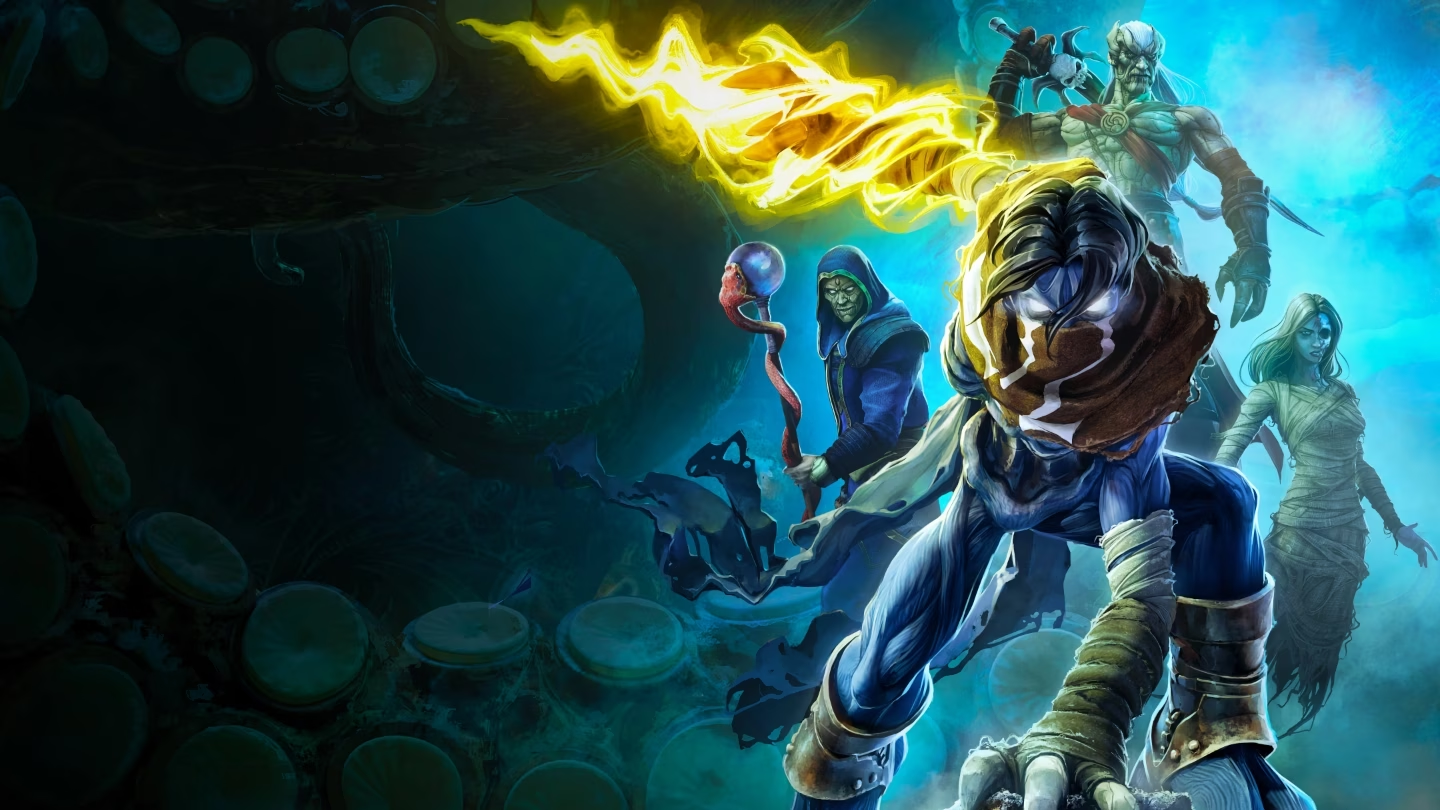
The fallen angels became vampires. Raziel — blue-skinned, jaw-missing, wing-broken — emerged carrying both Hennig’s mythological vision and the complexity of a world already doomed by its previous protagonist, Kain. The Gnostic structure survived almost completely intact. The Elder God who resurrects Raziel is no benevolent patron; he is a manipulator trading on grief. The game’s central irony is that Raziel believes himself an agent of justice when he is simply an instrument of something older and colder. Hennig cited Milton’s Paradise Lost as the inspiration, and the texture remains: a creature who falls, is remade by the thing that destroyed him, and must decide what loyalty to the dead self still means. That Blood Omen’s gothic-operatic register happened to be the only container in the medium capable of holding those themes is one of the more accidental compatibilities in the industry’s history. The graft took because the donor and recipient were, at the level of mood, already the same organism.
The Engine Nobody Thought Would Work
While the writing evolved, the programmers attempted the impossible. Soul Reaver was designed as a seamless, interconnected open world with no loading screens. On a PlayStation 1. Hennig has said the data-streaming engine that made this possible still wasn’t working correctly two months before the game shipped.
The solution subdivided the world into hundreds of small rooms, each loaded and discarded as Raziel moved through them. The player experienced the world as continuous. This was not a technical flex; it was a storytelling commitment, chosen to preserve the cinematic tone of the opening cutscene across every moment that followed. Most PS1 action games lived inside the interruption — a door, a corridor, a three-second fade to black. Soul Reaver refused the vocabulary outright.
The plane-shifting mechanic complicated this further. Soul Reaver maintains two complete versions of every environment simultaneously: the material realm and the spectral — a warped, expressionistic reflection where geometry twists and time stops. The engine had to hold both states in memory and morph the geometry in real-time. That it works on a PS1 disc without loading remains one of the era’s greatest technical achievements, and it works because Crystal Dynamics built the world backwards — designing the spectral geometry first, then layering the material world over it.
Nowhere is the ambition more visible, or more haunted by its own incompletion, than in the Silenced Cathedral. Intended as the game’s late-stage masterstroke, the structure was built to house the Zephonim clan — a vampire lineage whose evolution had pulled them halfway into the shape of giant spiders. In the original design, the Cathedral was more than a dungeon: it was a sprawling, industrial instrument, meant to be the site of the climax. Raziel was supposed to use its pipe organ as a weapon of genocide — a sonic purge that would have wiped out the vampire plague across Nosgoth. In the version that shipped, the Cathedral remains a stunning piece of gothic-industrial architecture, but it feels hollow. That hollowness works. You explore the fossilised remains of a grand design, much as Raziel explores the fossilised remains of his own history. The verticality strained the PS1’s ordering-table sorting to its limit, and Raziel glides across gaps the hardware had no business rendering.
A Soundtrack That Shifts With You
To match the visual morphing of the world, Kurt Harland and Jim Hedges built a dynamic music system radical for 1999. In most games of the era, music looped statically. In Soul Reaver, the soundtrack is as mutable as the geometry.
When Raziel shifts from the material plane to the spectral, the music doesn’t just change tracks — it deforms. The industrial, percussion-heavy themes of the physical world melt away; ambient, shimmering, often dissonant versions of the same melody take their place. Harland’s multi-track system swapped instrument banks on the fly as Raziel crossed between planes. The result is a sensory experience of wrongness. The spectral realm sounds like the ghost of the material; the familiar is still there, but the edges are rubbed raw, an uneasy drone replacing harmony where harmony used to live. Shifting feels physically taxing, as if the very air has turned to liquid. This is rare. Even now, most games treat music as scenery. Soul Reaver treats it as matter — a second skin the world wears differently on each side of the veil.
The Puppet and the Puppeteer
Beyond the technical wizardry lies Soul Reaver’s true subject: the Demiurge. In Gnosticism, the Demiurge is an artisan-like figure who fashioned the material world and, in many readings, a false god who traps souls in matter.
Tony Jay’s Elder God — a multi-eyed, subterranean mass of tentacles — is a perfect Demiurge. He presents himself as the Wheel of Fate, the natural order of the world. He tells Raziel that the vampires are parasites stalling the flow of souls. As the game progresses, the player begins to realise the Elder God isn’t interested in justice; he is interested in consumption. He needs souls to keep the wheel turning so he can feed. The game never states this. It simply lets the voice acting curdle, lets the same speech about “balance” repeat one too many times, and lets the player reach the conclusion on their own.
This creates a meta-commentary on the nature of the quest in video games. The player, like Raziel, follows the instructions of the booming voice because that is what the game demands. We kill our brothers because the Elder God tells us it is righteous. By the time the cliffhanger arrives, the horror isn’t that the story is unfinished — it is the realisation that Raziel, and by extension the player, has been a puppet for a parasite. This is the Shakespearean spite the deck promises: the game weaponises our desire for progression against us. It is also why the Elder God never once leaves his chamber. He doesn’t need to. The machinery of the genre does the work for him, and Raziel carries the blade.
The Ending That Wasn’t There
Soul Reaver shipped in August 1999 without its conclusion. Eidos wanted the game that summer, and Hennig’s team cut the final levels — the confrontation with the vampire-lord Turel, the original Cathedral climax, the full reveal at the Chronoplast chamber — to make the ship date. The game ends with a “To Be Continued” text crawl that left players furious.
Hennig later called it a blessing, arguing the compressed ending opened better story options for the sequels. This works better than it should, because Raziel’s arc is already, structurally, incomplete. He is a creature in the middle of becoming something else, still mid-transformation when the credits try to roll, and the abrupt cut mirrors his condition more honestly than any completed third act would have. The deadline’s accident and the character’s logic collapsed into each other, and what remained was, against expectation, sufficient. The missing pieces — the Chronoplast, the true nature of the Reaver, the Elder God’s endgame — became the engine of four sequels and the single most ambitious narrative the PS1 and PS2 eras ever attempted. Few franchises in the medium have converted a production failure into a thirty-year narrative asset so completely, and none have done so by accident.
The 2024 Aspyr remaster handles the original code with care. The camera, which in 1999 required saint-like patience, behaves itself. The toggleable high-definition graphics let the original expressionistic handling of shadow and decay remain the default. More usefully, the remaster functions as a museum of the Lost Worlds: it restores the intended day-night cycle and maps the rooms Eidos’s deadline amputated. What Soul Reaver still has, twenty-five years later, is a world with genuine weight. Nosgoth is not a backdrop; it is a place with a history Raziel can partially read. The evolved vampire clans are not enemy types; they are the consequence of a millennium of isolation and biological divergence. The game began as a cancelled project, absorbed a franchise it was never designed to inhabit, and shipped without its ending. It remains one of the most thoughtfully constructed games of the PS1 era. Hennig built a game about a creature whose nature refuses to resolve into a single plane, and every mechanic — from the morphing walls to the dissonant music — enforces that reading. Soul Reaver makes its argument and stops. The argument is still good.