World 1-3 of The Lost Levels hands you a poison mushroom in its second screen. In 1986 you didn’t know that, because the Famicom Disk System sequel gave you only the wind and the empty rooftops and the slow accumulation of nerve. You touched the mushroom because mushrooms had always meant growth. Big Mario shrank. Small Mario died. The wind came back, and the afternoon shortened.
Super Mario All-Stars, in 1993, lets you walk back into 1-3 from a stage select. The poison mushroom still kills you. The hour does not.
That trade — the bite preserved, the punishment for studying it removed — is what makes the anthology argue with itself thirty-three years later. Nintendo did not soften the four games inside it. They softened the cost of looking closely. Once you notice the difference, All-Stars stops being a remake and becomes the first time Nintendo treats its NES decade as a body of work rather than a backlog.
World 1-1, repainted
The most famous level in games starts the same way in All-Stars as it started in 1985. The Goomba walks out from the right edge of the screen, the question block sits four tiles in, the pipe at the end takes a long jump or a short hesitation depending on how you have entered the world. None of that has moved. What has moved is the room.
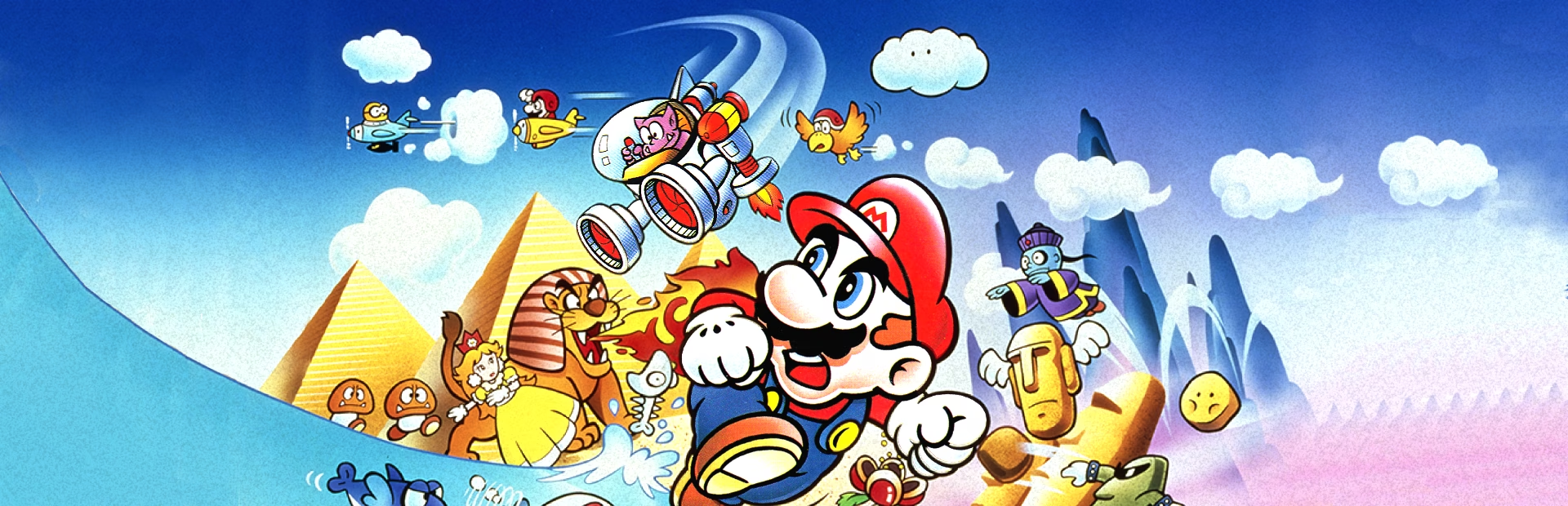
The Super Famicom paint is the first thing you notice. The bricks have bevels. The hills smile. The sky is the saturated, slightly toy-coloured blue that Super Mario World taught the cartridge to make. The Goomba has eyes now, drawn rather than implied. The 1-up mushroom in the second screen reads as a piece of fruit instead of a glyph. Everything that was diagrammatic on the NES has been illustrated.
But the level itself is older than the paint. Press jump on the first Goomba and the arc still has that familiar stubbornness — weight at the start, lift in the middle, a tiny argument with momentum on the way down. Small Mario still slides into one-tile gaps with the clipped urgency the NES did so cleanly. The castle jump at the end of 1-1 still asks for commitment before it shows you the landing. The remake redrew the pipe, sweetened the cloud, and cushioned the music. It could not move the invisible hinge under the button. If it had, the whole cartridge would have become costume rather than restoration.
That refusal is the contract All-Stars signs in its first level. Everything after it — the Lost Levels wind, the Mario 2 turnip, the Mario 3 airship — is the same trade scaled up.
Lost Levels at five lives
The pipe is half a pixel taller than the gap suggests; the Piranha is the one that decides. The Lost Levels keeps Famicom timing under SNES paint. Screenshot: Super Mario All-Stars · Nintendo EAD / SNES, 1993.
The Famicom Disk System sequel was always the most exposed of the four games. Super Mario Bros. taught Japan to jump in 1985, and The Lost Levels assumed that lesson had landed. It writes in the second voice: backwards warps in 3-1, poison growths in 1-3, a wind in 5-3 that lifts Mario off platforms he has correctly cleared. It is a game for players who have already absorbed the grammar and now want to be argued with.
At full Famicom price that argument is brutal. Three lives, one continue, every stage from 1-1 when the continues run out. The Japanese audience had a small social context — a hand-passed cartridge, a Nintendo Power tip, a friend who had reached 8-4 and could draw the wind in a notebook. International players, when they finally got the game, did not have that scaffolding.
All-Stars gives them five lives and a cartridge that remembers. Not in the kind way modern remakes are kind: no rewind, no checkpoint generosity, no enemy nerf. The save just records which world-stage pair you have cleared, and the cleared stages stay cleared. The cruelty becomes legible. You stop fighting the run and start fighting the design.
This is the most useful sentence anyone can write about Lost Levels in 2026: it is a great game once you can study a single stage in isolation. The wind levels parse. The fake warp in 3-1 lands as a wink rather than a betrayal. The 9-world phantom set, unlocked only after eight clean clears, becomes something a curious player might actually see. Mario’s body is unchanged — he still slides off ice by a tile too far, still gets eaten by Piranhas that look two pixels clear of the pipe lip — but the room you study him in has finally been lit.
The decisions Nintendo did not make
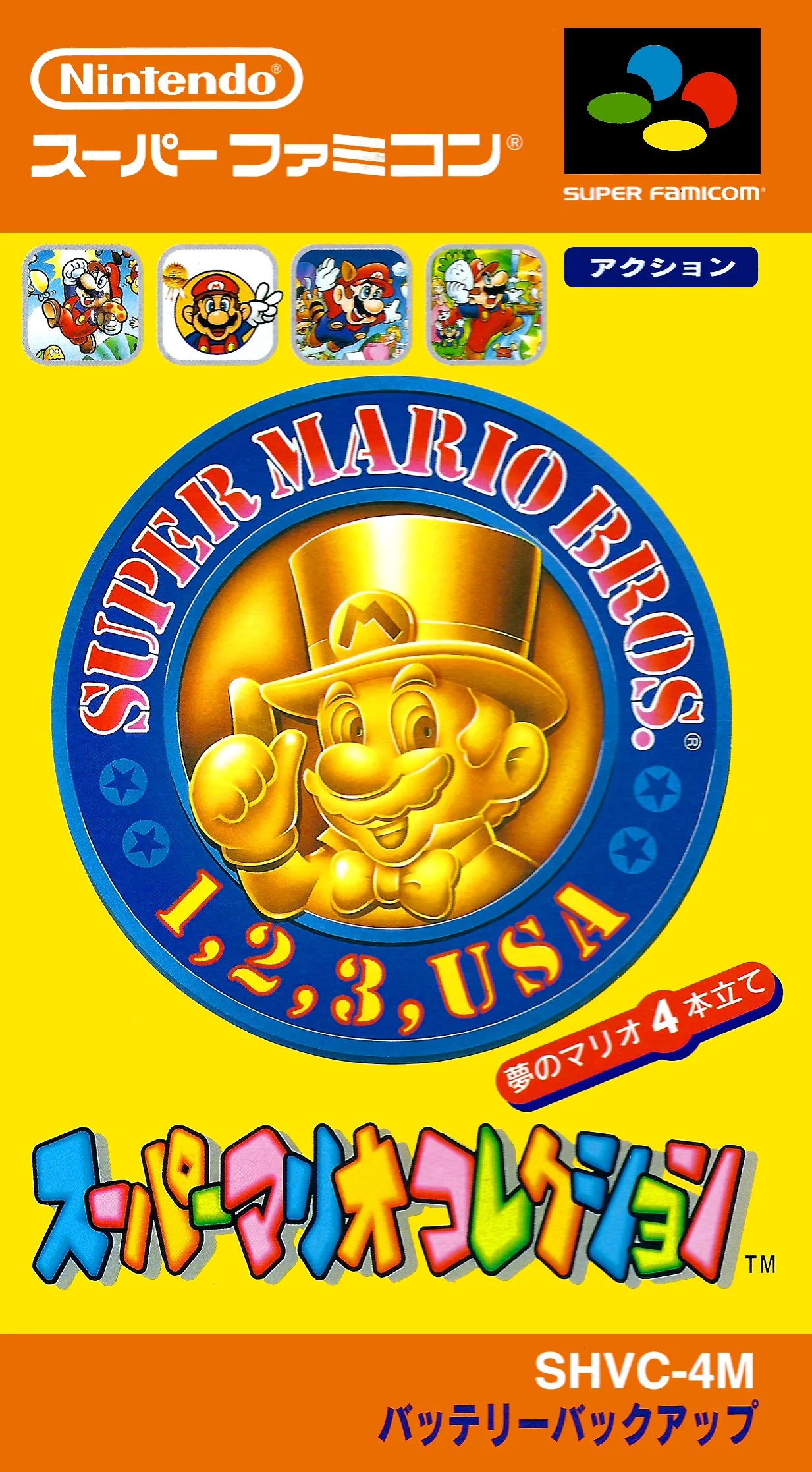
The Japanese title is the honest one: Super Mario Collection. A gold medallion, four small portraits, a birthday object for the Famicom decade.
When Tadashi Sugiyama and Naoki Mori sat down to remake the four games, they were doing the most modest kind of work in 1993 Nintendo. Super Mario Kart had shipped. Star Fox was in production. Donkey Kong Country was a year out. The Mario Collection brief, as Sugiyama remembers it in the Iwata Asks interview, was a value pack — something generous enough to keep the Mario name visible between new releases. Birthday-shelf software. A way to dress the Famicom decade in Super Famicom colours.
The interesting thing is what they refused. Super Mario Bros. could have been re-tuned to the slightly bouncier physics of Super Mario World; it was not. Super Mario Bros. 2 could have been edged closer to Mushroom Kingdom orthodoxy, its borrowed Doki Doki Panic roots tidied away; it was not. Mario 3 could have absorbed the cape glide; it was not. Sugiyama and Mori describe checking each stage by hand against the originals, comparing block placement, enemy timing, the small frictions of movement. The art borrowed up from the SNES generation. The games did not.
That refusal is rarer than it looks. Twenty-seven years later, Super Mario 3D All-Stars would ship as raw emulation under a soft polish — Nintendo had stopped trusting itself to touch the surface at all. All-Stars is what trust used to look like. The studio gave itself permission to decorate every wall in the museum and denied itself permission to move a single exhibit.
Kondo, in a larger room
Koji Kondo’s NES themes were written for hard edges — square waves, short loops, bass lines that had to cut through household noise and small television speakers. All-Stars gives those melodies a different posture. The underground theme breathes. The water music turns glassier. The Super Mario Bros. 3 overworld keeps its theatrical quick-changes and gains a brighter percussion bed, as if the curtain machinery has been cleaned and oiled.
The risk in that change is real. The NES often used harshness as information. A coin sound pierced. A stomp snapped. The Famicom palette let danger feel like a diagram, and a flatter timbre is sometimes the right one to teach a player which sound to listen for. The SNES arrangements occasionally blur that edge. They are prettier, and now and then too polite.
The trade is worth noticing because it proves the remake has an opinion. All-Stars does not chase neutral fidelity. It chooses readability over austerity, warmth over bite, continuity over archival chill. The result can make Super Mario Bros. 3 feel less like a cartridge straining against the NES and more like an illustrated stage show that had always been waiting for enough colour to admit what it was.
Kondo’s themes survive because their jobs are so clear. The overworld music does not decorate movement; it teaches you to think in spring-loaded phrases. The underground theme does not ask for dread, only focus, each bass step pressing the ceiling lower. The larger room shows how architectural those melodies always were.
Mario 3, in series
Pull a turnip in Super Mario Bros. 2: the character’s body decides the timing more than the stick does. Screenshot: Super Mario All-Stars · Nintendo EAD / SNES, 1993.
Played alone, Super Mario Bros. 3 is the platformer everyone thinks they remember: a map, a wardrobe of suits, eight worlds of escalating mischief, the airship sequence that turned an NES cartridge into a small action film. Played at the end of All-Stars, after the other three, it becomes the answer the series was working toward.
The anthology’s secret mode is comparison. Move from Super Mario Bros. into The Lost Levels and the sequel stops being a cruel footnote — it becomes a study in how far one grammar can bend before it snaps. Move from there into Super Mario Bros. 2 and the American detour stops being a wrong turn — it becomes proof that Mario survives a new verb set.
That second game is the anthology’s quietest argument. Mario 2 runs on character weight rather than acceleration. Toad yanks turnips like uncorking a bottle; Peach’s dress catches air for the half-second that lets a vertical room read as a choice rather than a wall; Luigi loses his footing; Mario is the baseline. The remake keeps those differences exactly where they live — in the small delay between the button and the lifted object — and lets the SNES art make the dream logic feel intentional rather than apologetic. Shy Guys read like toys. Waterfalls thicken. Subcon becomes a place rather than a costume.
Mario 3 lands last, and arrives as a catalogue: tail, suit, boot, pipe, inventory, P-switch — each verb costed by the three games beneath it.
Then Mario 3 lands and everything you have been holding in your hands rearranges. The maps make space for the wardrobe; the wardrobe makes space for the fortresses; the fortresses make space for the airships. Tail, suit, boot, pipe, inventory, P-switch — the catalogue keeps unfolding because each of the previous three games has taught you what a single Mario verb costs. In any other anthology Mario 3 would be a victory lap. Here it is the conclusion of an argument made by the three games beneath it.
This is why All-Stars still earns a session. Not because these are the important Mario games — they are, but importance is not a reason to play. Not because the SNES art is definitive — it isn’t; the originals breathe a different air, and the Switch subscription puts them one menu away if you want to study the difference. The collection earns the time because it is the only place where the four NES cartridges sit in the same physical grammar and talk to each other. The conversation runs through your thumbs. You hear it by jumping.