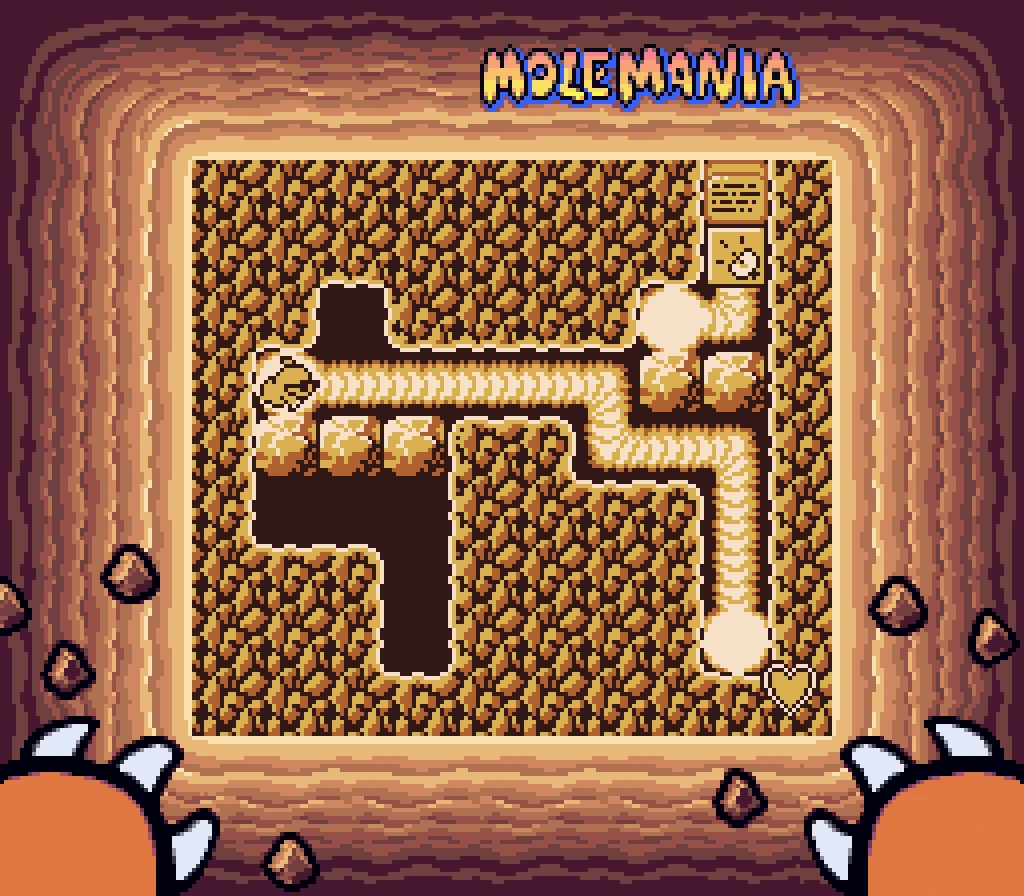
A mole digs into the soil and the puzzle above him changes shape. That single gesture — surface above, tunnel below, an iron ball to shove between — is the entire game, and for thirty years it has been one of the cleanest verbs Shigeru Miyamoto ever put his name to. Almost nobody played it.
The argument for Mole Mania is not that it was overlooked, or unlucky, or ahead of its time. It is that a Miyamoto-produced puzzle game exists on the original Game Boy, released the summer Nintendo was already quietly preparing to forget the Game Boy entirely, and the design inside it still reads like a miniature case study in how the man works. The hardware was ending. The producer was busy elsewhere. The game turned out better than it needed to.
One Verb, Folded Inward
Muddy Mole is above ground by default. Press a button, and he disappears below it. He can surface anywhere his tunnel will allow, emerging to find the screen unchanged except for the iron ball he was pushing a moment earlier, or the farmer who has walked into the lane he just vacated. The ball is the key: each puzzle is an enclosed single-screen room with a locked door at one edge, and that door only breaks when the ball hits it. You move the ball by pushing it, and you solve the puzzle by deciding where to push it from.
That is the whole ruleset. It is also, almost immediately, not enough, because the rooms begin doing things to you. A pond blocks the ball but not the mole. Earth squares can be tunnelled, but stone cannot. Patrolling enemies move in predictable arcs, so you learn to duck beneath them at the right second and emerge behind their backs in time to push again. The rhythm becomes percussive: above, below, push, hide, surface, push. One verb, iteratively folded, until by world three you are doing things that felt impossible in world one without having noticed you learnt them.
The most surprising decision is what Mole Mania does with failure. Leave a puzzle screen and re-enter it, and the room resets. No death, no restart menu, no lives lost from trying something stupid. Failure becomes research. You push a ball somewhere you probably shouldn’t, confirm you cannot retrieve it, walk out, walk back in, try again. In 1996 this was almost unheard of on a handheld, where the unwritten rule of a puzzle game was that every wrong move cost you something. Mole Mania treats every wrong move as information. It assumes, correctly, that the player is trying to understand the room rather than survive it.
Made While A Castle Was Being Built
The production credit lists Shigeru Miyamoto as producer, which was the same role he held that year on Super Mario 64 and on the prototype that would eventually become The Legend of Zelda: Ocarina of Time. 1996 was the biggest year Nintendo EAD had ever had, and the biggest year Miyamoto would personally ever have. Mario 64 alone rewrote what a video game looked like. He had, by any reasonable reading, no free hours.
The day-to-day work was handled by Pax Softnica, a small Tokyo studio that had been around Nintendo’s orbit since the late 1980s and had quietly done much of the heavy lifting behind Mother and EarthBound alongside HAL and Ape. They were the team Nintendo went to when it needed a small, good Game Boy project delivered on time. The Japanese title is Mogurānya — mogura, mole, with a drawn-out nya, the syllable Japanese cats make, stretched across the hyphen like a cartoon exhale. It reads on the page exactly the way the game plays: a single idea extended with deliberate cheerfulness across its own length.
Direction fell to Masayuki Kameyama, a level designer who had worked on the Game Boy Donkey Kong port and had just wrapped his first solo directorial credit on Wave Race for the same handheld. Sound was by Taro Bando, who turned the Game Boy’s four tiny channels into something playfully menacing — bouncing basslines under the farmer, gentle loops for the overworld, a distinct musical character for a score nobody asked him to give one.
His fingerprints are everywhere. The one-verb design, the toybox philosophy of letting a single idea suggest all its own variations, the refusal to let the ruleset become complicated rather than deep — these are the habits he has been articulating in interviews since Donkey Kong. Mole Mania plays like a compressed lecture in them, delivered on a machine Nintendo had already largely stopped caring about.
A Puzzle Game Designed Too Early
Almost everything in Mole Mania that feels modern now was unusual in 1996. The leave-and-reset rule is the most obvious example, but not the most interesting. More striking is how the game handles ambiguity. A puzzle screen often contains objects that are clearly relevant — the ball, the door, the pond — alongside objects that might not be. A flower patch that is purely decorative. A stone that cannot be moved but sits in a way that suggests it should. Red herrings, placed deliberately, because the act of recognising which elements matter is itself part of the challenge. The game is training you to read a room, not solve a formula.
Later levels take this further. Some puzzles have more than one valid solution. Some let you complete the exit but also collect optional cabbages for score, and the path that gets the door down is rarely the path that picks everything up. You can be elegant or you can be thorough. Most puzzle games of the period demanded a specific sequence of inputs; Mole Mania is loose enough that a second playthrough rewards finding a cleaner line than the one you used the first time. This is not a hobbyhorse feature. It is the Miyamoto habit of designing for replay, scaled down onto a two-tone handheld.
The difficulty curve earns its late-game teeth. Early worlds teach the ball mechanic in almost trivial rooms. The second act introduces enemies whose patterns conflict with the ball’s weight. By the final world, the puzzles require thinking three moves ahead, combining tunnelling, enemy timing, and ball placement in ways the opening levels could not have prepared you for except through the habits you have quietly built across the intervening hours. The game never feels unfair, because it never shows you something it has not already taught you.

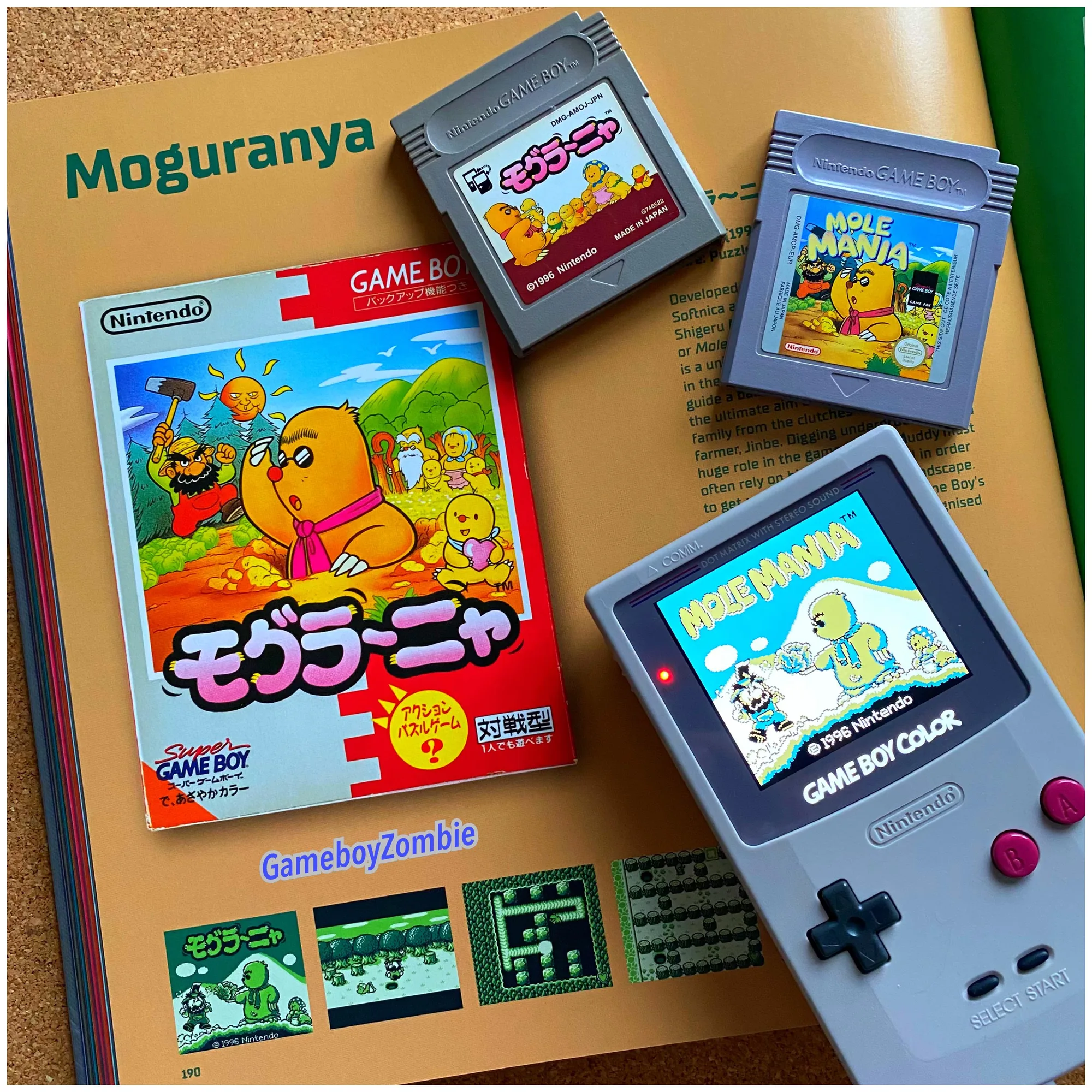
Three decades’ worth of Mole Mania in one frame: the Japanese Mogurānya box, both region cartridges, and a Game Boy Color running the 2025 DX fan patch. Photo: GameBoyZombie, via Reddit.
The Summer Nintendo Stopped Looking
Mole Mania shipped in Japan on 21 July 1996, alongside the launch of the Game Boy Pocket. It was meant as a flagship: Nintendo’s big first-party statement about the compact redesign of its seven-year-old handheld. In any other year it might have worked. But Pokémon Red and Green had been released five months earlier, and by July the entire population of Japanese children was busy trading Abras in the school playground. The Game Boy was no longer the machine Mole Mania had been made for. It was suddenly the machine Pokémon had been made for, and nothing else quite got in.
The North American release in February 1997 arrived into worse weather still. The Nintendo 64 had been out for four months. Every marketing dollar and every inch of retail attention sat behind Mario 64 and the seventy-dollar cartridges on the endcap. A small Game Boy puzzle game, produced by the same man but priced at a fraction of the attention, simply disappeared. The few reviews that did run — Nintendo Power issue 93 gave it a generous write-up — praised the design without quite conjuring an audience for it.
Nintendo never returned to the game. No Game Boy Color enhancement was ever released. No GBA port. For thirty years the canonical way to play Mole Mania was to track down an original cartridge and run it through a Super Game Boy to see the intended palette, which is a reasonable argument for the state of Nintendo’s handheld curation.
A Colour Thirty Years Late
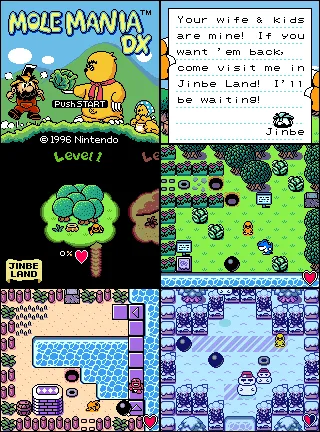
The job Nintendo never did was finally done in October 2025 by Marc Robledo, a Spanish developer whose previous hacks include unofficial colour patches for Link’s Awakening and Metroid II. Mole Mania DX is a ROM patch that runs on Game Boy Color hardware and emulators, replacing the original’s four greys with a full palette and redrawing the title screen, overworld, and every puzzle room to suit. It is not a remaster and not a restoration — there was no abandoned colour version to recover — but it is unusually careful work. The tree greens, cabbage purples, and iron-ball greys all read the way a first-party Nintendo DX release from 1998 would have read, because Robledo studied the house style and matched it. Farmer Jinbe now has a ruddy face. The mole children have small distinguishing shirts. None of it is flashy, and all of it is respectful of the thing underneath.
The patch does not fix the original game’s commercial problem, because that problem is unfixable thirty years after the fact. What it does is remove the last practical reason anyone might give for not playing it. Mole Mania in colour, on a real Game Boy Color or an accurate emulator, is the version the game quietly deserved the first time. That it exists at all is a small courtesy the community extended to a title its publisher chose not to.
The case for playing Mole Mania now is not sentimental and not historical. It is that the design earns scrutiny on its own terms. The verb remains clean. The rooms still read instantly. The reset rule still feels like a gift. A modern indie puzzle game could ship with this ruleset tomorrow and be praised for its elegance; it would not need to apologise for a single mechanical decision made in 1996.
What it would have to apologise for is the absence of its producer. There is no real way to encounter Mole Mania as a game Miyamoto made, because he did not make it in the hands-on sense. What you find instead is a game he produced at the edge of his biggest year, handed to a small studio whose habits aligned with his own, released into the worst possible commercial weather. The result is the clearest illustration available of what Miyamoto’s design philosophy looks like when the machine underneath it is not the point.
That point outlasts the year. It outlasts the hardware. It outlasts the producer’s own attention. Muddy Mole digs, surfaces, pushes the ball, ducks under the farmer. You lose, walk out, walk back in, try again. The room teaches you to read it. Thirty years later, it still does.