The Zelda decomp scene had been working toward a Majora’s Mask PC port for six years. A programmer signing as Mr-Wiseguy shipped one in months, without the source code. His tool — N64Recomp, posted to GitHub alongside a playable sample build — translated the game’s binary directly into a native Windows and Linux executable, complete with widescreen, mouse-look gyro aiming, and a config menu.
The thing the tool did was not new in computer science. Static recompilation — translating a binary written for one CPU into a binary written for another, ahead of time — has existed since the 1990s, when DEC used it to migrate VAX software to Alpha. What was new was applying it to a Nintendo 64 ROM, hooking the result to a modern renderer, and shipping the executable as a finished consumer artefact. The technique had sat unused in the emulation community for a decade because nobody had built the toolchain. Mr-Wiseguy built it. Eighteen months later, the same approach had crossed to Xbox 360, jumped a console generation in a single weekend, and pulled Nintendo’s legal department into a EULA rewrite. Almost none of it was visible from outside the scene at the time.
A Third Path Between Two Old Ones
The story for the past decade has been told in a binary. Either you emulate the original hardware — accurate, slow, generic, the same translator running on every game — or you decompile the ROM into hand-readable C source code, line by matching line, and recompile that source for whatever platform you want. The second path produces a perfect native artefact. It also takes an organised volunteer team six years per game.
Super Mario 64 finished in 2019 after roughly three years of effort. Ocarina of Time followed in 2021. Both were the work of small specialised communities reverse-engineering MIPS assembly into C until every function compiled byte-for-byte identical to the original. The Ship of Harkinian PC port that grew out of Ocarina, shipped by the Harbour Masters team, did not arrive until 2022 — six years after the project’s first commit. Majora’s Mask, when its decomp finished in early 2023, was understood to be the next four-year wait.
Static recompilation refused that wait. Mr-Wiseguy’s tool reads the binary, translates each MIPS instruction into a corresponding C function, and produces a native executable that runs the game’s original logic without ever needing the source.
”It’s a technique that’s been around for a while, but hasn’t been explored much in the space compared to traditional emulation.”
— Mr-Wiseguy, Read Only Memo, 2024
The result is not a translator running underneath the game. It is the game’s own code, compiled for the host machine, calling out to a reimplemented graphics layer (RT64) where the original would have called the N64’s RDP. The processor isn’t being simulated. It has been replaced.
The performance gap is the clearest tell. A traditional emulator like Project64 spends most of its CPU budget translating MIPS instructions on the fly and policing the timing fence the original hardware enforced. The recompiled binary has neither task. “The code is being run natively, so it’s much faster,” Wiseguy explained, “since the emulator doesn’t have to translate the original CPU instructions while the game is running.” The freed budget is what pays for native widescreen, unlocked frame rates, ray-traced lighting through RT64, and a controller-mapping layer that reads gyro from a mouse instead of pretending to be a Rumble Pak.
What it cannot do is run any game ever made for the system. Every recomp port requires per-game work — patches for unusual code patterns, reimplementation of platform calls, audio mixing, save handling. “Traditional emulation will always have the advantage of being able to run everything without having to spend time on every individual game,” he conceded in the same interview. The trade is specificity for fidelity. A recompiled Majora’s Mask runs better than a near-perfect emulator does. Body Harvest still needs someone to do the work first.
What Mr-Wiseguy Made
The flagship release is the demonstration. Zelda 64: Recompiled landed on 12 May 2024 with a public Internet Archive build the same day. It supports per-game config, gyro aiming, autosave, a randomiser distributed as a mod, and a mod-management layer the project has been building out across 2025 with contributor Dario. Ocarina of Time support followed in later releases. The toolchain itself — N64Recomp — was published separately, freely licensed, with documentation that would let anyone capable of reading C build the next port.
That toolchain mattered most. Inside three months, other developers had picked it up. A Star Fox 64 port reached v1.0 by mid-2025; a Banjo-Kazooie port followed in early 2026; Dinosaur Planet — the cancelled Rare project that became Star Fox Adventures — got its own build by December 2025. Mario Kart 64, Bomberman 64, Mystical Ninja Starring Goemon, Quest 64, Dr. Mario 64: all native PC executables now, all produced by independent contributors, all built on Wiseguy’s tool. “I didn’t expect to get nearly this much attention,” he told the same interviewer.
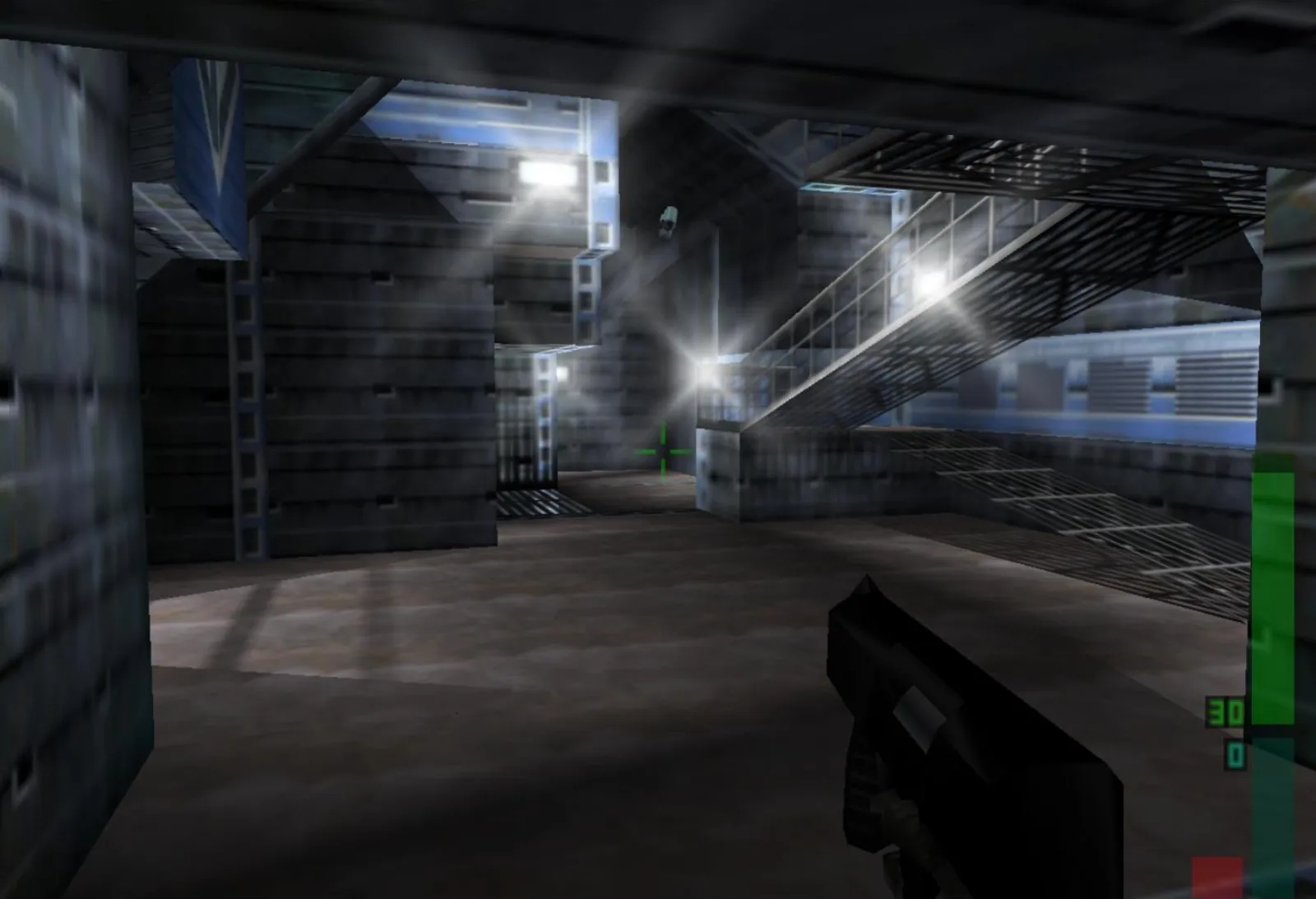
Perfect Dark — released to PC by decompilation in January 2026, twenty-six years after its N64 debut. Rare, 2000.
The decompilation projects did not stop. They have, if anything, accelerated. Mario Kart 64 reached 100% function-matching decomp in May 2025. Paper Mario rounded out across all regional revisions. Duke Nukem: Zero Hour — the obscurest possible target — was decompiled to byte-perfect C in October 2025 by a team led by Gillou68310. Animal Crossing on GameCube got near-complete decomp; FlyingMeta produced an early playable PC port. Both approaches are now being run on the same catalogue, in parallel, by overlapping communities.
Eighteen Months, Three Architectures
The point at which it stopped being an N64 story was 3 March 2025. On that day, two developers signing as Skyth and Sajid — operating under the hedge-dev banner — released Unleashed Recompiled, a PC port of Sonic Unleashed recompiled directly from its Xbox 360 binary. They had built two new tools, XenonRecomp and XenosRecomp, that did for PowerPC and Xenos shaders what N64Recomp did for MIPS: convert the original architecture’s executables and shader code into C++ and HLSL the host could compile natively. Mr-Wiseguy was credited as a contributor.
The lift was an order of magnitude. The N64’s MIPS R4300i CPU is a 64-bit RISC chip with a relatively tidy instruction set; the Xbox 360’s Xenon is a triple-core PowerPC system with a custom GPU built around unified shader architecture. Recompiling N64 software is a well-understood undertaking among reverse engineers. Recompiling Xbox 360 software was, in early 2024, considered theoretical.
“I was astonished,” one community comment ran in Time Extension’s coverage, “to see that we jumped from N64 static recompilation straight up to Xbox 360.” The astonishment was warranted. Microsoft’s own backwards-compatibility programme — the one that lets a Series X play Sonic Unleashed — had been built by an internal team using a custom compatibility layer Microsoft has never open-sourced. The hedge-dev port did the same thing, on the same hardware era, in months, with two people, on GitHub. The version that resulted runs at higher resolution, higher frame rate, with ultrawide support and bug fixes the original was never going to receive.
Other Xbox 360 recompiles followed quickly: Banjo-Kazooie: Nuts & Bolts (ReNut) and Viva Piñata: Trouble in Paradise (TiP-Recomp) both by April 2026. A PS2 framework — PS2Recomp — is in early development; whether it can crack the Emotion Engine’s vector-unit architecture, which has frustrated emulation accuracy for two decades, is the next real test. The OpenGOAL project, a parallel lineage reverse-engineering Naughty Dog’s GOAL bytecode rather than recompiling x86, has ported the entire Jak and Daxter trilogy to PC and Mac. PsyDoom, REDRIVER2, and Severed Chains shipped native PS1 ports of Doom, Driver 2, and The Legend of Dragoon by late 2025.
What started as a single tool for a single console has, in eighteen months, become a per-architecture cottage industry. The boundary between which old hardware a person can play on which new hardware is dissolving in real time, one tooling project at a time.
Nintendo Reads the Memo
Nintendo’s response is the part the trade press got mostly right and partly wrong. Through 2023 and early 2024, the company had spent legal energy taking down Switch emulators — the high-profile collapse of Yuzu, settled privately by Tropic Haze for $2.4 million; DMCAs against Citra, Ryujinx, and a wave of other projects on GitHub. The framing in coverage was that Nintendo wanted to argue emulation itself was illegal.
In January 2025, Nintendo’s deputy general manager of intellectual property, Koji Nishiura, gave a public lecture acknowledging that emulators are technically legal. The line video game writers picked up was the headline: Nintendo admits emulation is legal. The line that mattered was the qualification. Emulators violate the law, Nishiura explained, only when they bypass encryption, copy copyrighted firmware, or direct users to pirated material. The company was not arguing the technique was unlawful. It was reserving the right to decide which specific implementations were.
Four months later, the company updated its end-user licence agreement. The May 2025 revision, applied across Nintendo’s digital products, explicitly prohibits decompilation and reverse engineering. Both terms are, under existing intellectual-property law, legal. A EULA cannot make legal activity illegal — but it can give the company contractual grounds to terminate accounts, void warranties, and chase users who agreed to the agreement. Nintendo Life, covering the change, noted the obvious tension: “Nintendo is specifically prohibiting reverse engineering and decompilation in user agreements, things which legally are fair game.”
The rewrite is a tell. A company writing a new clause prohibiting decompilation in May 2025 is responding to something that has, by May 2025, become a much larger problem than it was eighteen months earlier. What had been a fringe of fan-made source ports — slow-moving, easy to ignore — has become a continuously productive reverse-engineering pipeline shipping consumer-quality PC ports of the company’s first-party catalogue every few weeks. The Yuzu settlement had drawn a line at emulators that played encrypted Switch ROMs. The new clause draws a line at the technique on which the entire post-Yuzu wave is built. It will not stop the work. The repos are mirrored, the contributors are pseudonymous, and the law is unchanged. But it does mark the moment the company concluded the recompiler scene had to be addressed at all.
What This Is Actually For
The instinct is to read this as a piracy story dressed up in technical clothes. It is not. The games being recompiled are, almost without exception, ones the rights-holders are choosing not to ship. Nintendo Switch Online’s N64 library is a curated thirty titles deep; the Xbox backwards-compatibility programme has been frozen since 2021; Sonic Unleashed has never received a PC release in any form. The catalogue the wave is rescuing is the catalogue the industry has decided is no longer worth re-releasing.
That is what makes it preservation in the strict Hackaday sense — “games can evolve as living documents while preserving their original form,” as the magazine framed it in June 2025. A recompiled binary is not an emulator running a ROM in a sandbox. It is the original code, compiled for new hardware, available to be modded, fixed, ported, and inherited by anyone who can read C. Mods the original developers could not have written — gyro aiming, ultrawide, randomisers, path-traced lighting — become possible because the game’s logic is, finally, available to be edited.
What separates this moment from the decade that produced Super Mario 64 on PC is speed. A six-year decomp produces one port. An eighteen-month recompiler tooling cycle produces a dozen, and seeds the architecture work for the next dozen. The catalogue Nintendo and Microsoft and Sega have chosen not to maintain is being maintained anyway, by named individuals — Mr-Wiseguy, Skyth, Sajid, Gillou68310, FlyingMeta, the Harbour Masters team — none of whom needed permission, and most of whom did the work because nobody else was going to.
The cabinet that the May 2025 EULA tried to close has no door. The technique, once written down, cannot be unwritten. What the next eighteen months will tell us is which architectures the toolchain reaches next, and which catalogue the rights-holders concede in the meantime. The answer, on current evidence, is most of them.