Spell it backwards. The name chosen for Sega’s long-running preservation brand is a palindrome of the company itself — AGES, SEGA — a word game hiding in plain sight since 1996. The team picked it because, as supervisor Yosuke Okunari later explained, the word evoked the image of telling the tale of Sega’s history. But a palindrome reads the same forwards and backwards, and the Sega Ages series spent twenty-four years proving that looking back and moving forward are the same act. The question was always how far you had to travel before you understood the difference.
The answer, it turned out, was four hardware generations, three development studios, one near-total quality collapse, and one woman whose final project became the thing the series had been trying to become from the start.
Thirteen Volumes and a Missed Opportunity
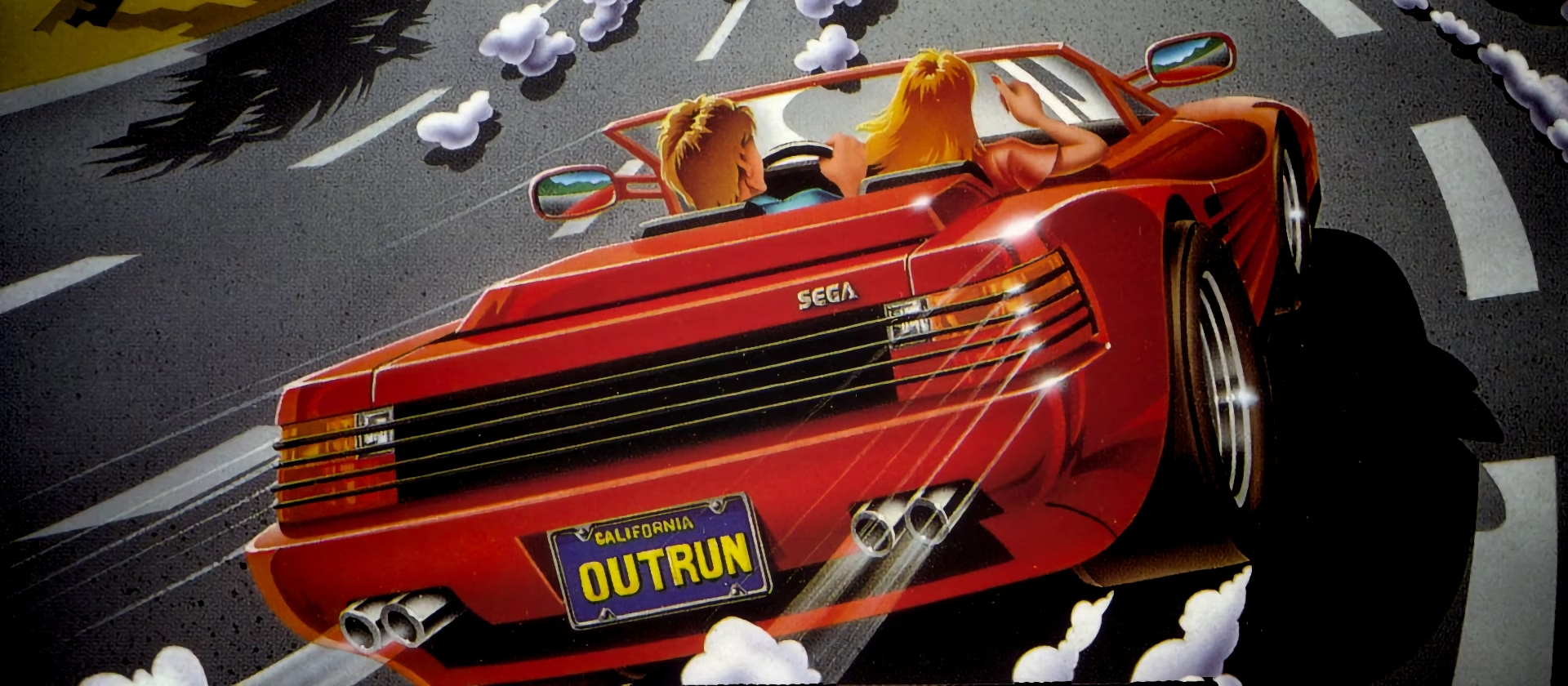
The original Sega Ages launched on the Sega Saturn in 1996 — thirteen volumes, developed by AM2, released almost exclusively in Japan. They were straight arcade ports: Space Harrier, OutRun, After Burner II, Galaxy Force II, Power Drift, Fantasy Zone. Faithful translations of coin-op boards to a home console that could, for the first time, run them without compromise. The Western world got exactly one release: a three-game compilation bundling Space Harrier, OutRun, and After Burner II, published in Europe by Sega and in North America by Working Designs under their SPAZ budget label. Working Designs gave it their customary embossed disc art and foil manual. Reviewers gave it a shrug.
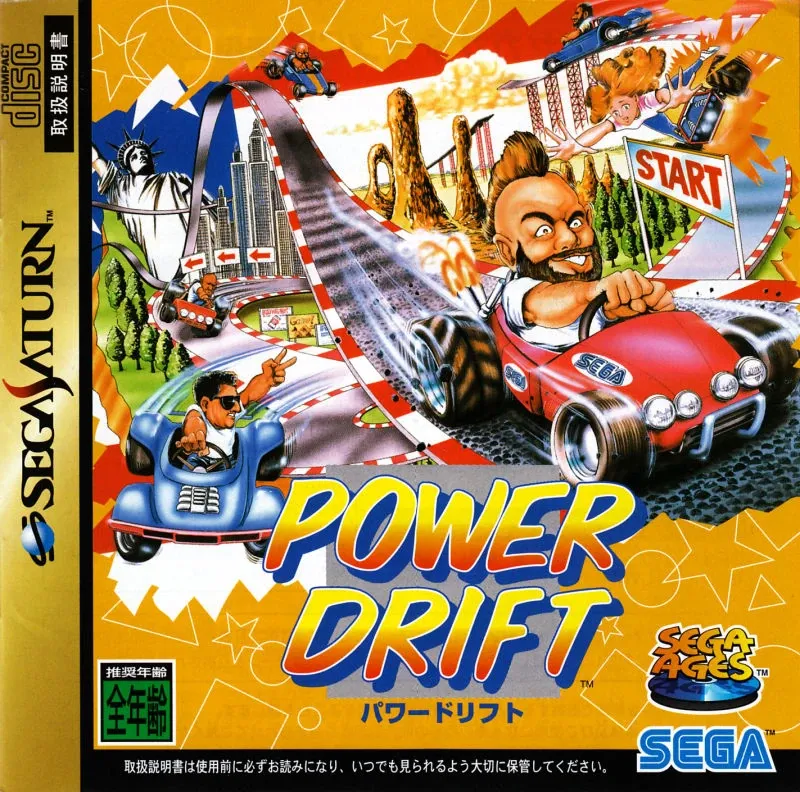
Power Drift on Saturn — one of thirteen AM2 arcade ports that arrived before the world was ready for retro gaming.
The timing was the problem. Retro gaming, as a commercial proposition, did not exist in 1996. The arcades that had birthed these games were still operating at scale across Japan. Presenting Space Harrier on a pedestal meant arguing that a game still earning coins was already a museum piece. AM2 had the technical chops — the ports were clean, responsive, accurate — but no one had yet made the case for why you would want your arcade in a Saturn case. The series ended in 1998 with a Phantasy Star compilation. It was a rehearsal for something nobody had written the play for yet.
The Name That Spelled Itself Backwards
Five years later, Sega tried again. The Sega Ages 2500 series launched on PlayStation 2 in 2003, each volume priced at ¥2,500 — hence the name. This time the ambition was different: not ports but remakes, classic games rebuilt in polygons for a new generation. To execute the plan, Sega formed a joint venture with D3 Publisher called 3D Ages. The company name was its own joke: reverse the characters and you get SEGA-D3.
The joke turned sour quickly. The first fifteen volumes, developed under the 3D Ages banner, ranged from well-intentioned to dismal. Golden Axe was remade as a clunky, sluggish brawler that looked like a first-generation PlayStation game released two hardware cycles too late. Phantasy Star Generation:1, a complete rebuild of the 1987 original, altered so many core systems in the name of accessibility that the fans it was built for rejected the changes. Space Harrier got a 3D facelift that nobody had asked for. The reviews were not kind, and the pre-order events were worse.
”Buyers unanimously commented that such an old game wouldn’t sell.”
— Yosuke Okunari, Time Extension, 2025
Yuji Naka, then still at Sega, intervened. The 3D Ages approach was not good enough. D3 Publisher departed the venture in 2004; 3D Ages was dissolved in September 2005 and absorbed back into Sega. The first act of the PS2 era had proved something important, though not what anyone intended: remaking a classic game is not the same as preserving it, and treating the back catalogue as a raw material to be reshaped is a way of saying you do not trust the original to hold.
M2 and the Complete Collection
What came next changed everything. Sega needed a new development partner for the remaining PS2 volumes, and the company they chose was M2 — a small studio in Chiyoda, Tokyo, founded by Naoki Horii partly to avoid crowded commuter trains and partly because he wanted to make what he loved. M2 had been doing contract porting work since the early 1990s, starting with Gauntlet and Gunstar Heroes. They were fans first and technicians second.
”It’s all love here. When I was young, the games I played on consoles and in the arcades were made by developers who were at Sega. The impact those titles had on me when I was younger is something I want to make sure gets carried into the next generation.”
— Naoki Horii, M2, Game Developer
M2’s first two Sega Ages 2500 volumes — Space Harrier II: Complete Collection and SDI & Quartet — shipped simultaneously in October 2005. The approach was the opposite of 3D Ages. Where the earlier volumes had rebuilt games in new engines, M2 collected every existing version: arcade, Master System, Mega Drive, Game Gear. Bundled them together. Eliminated input lag by rewriting the emulators from scratch. Packed the disc with scanned flyers, developer commentary, and period-accurate cabinet artwork. SDI alone contained nine distinct ROM variations.
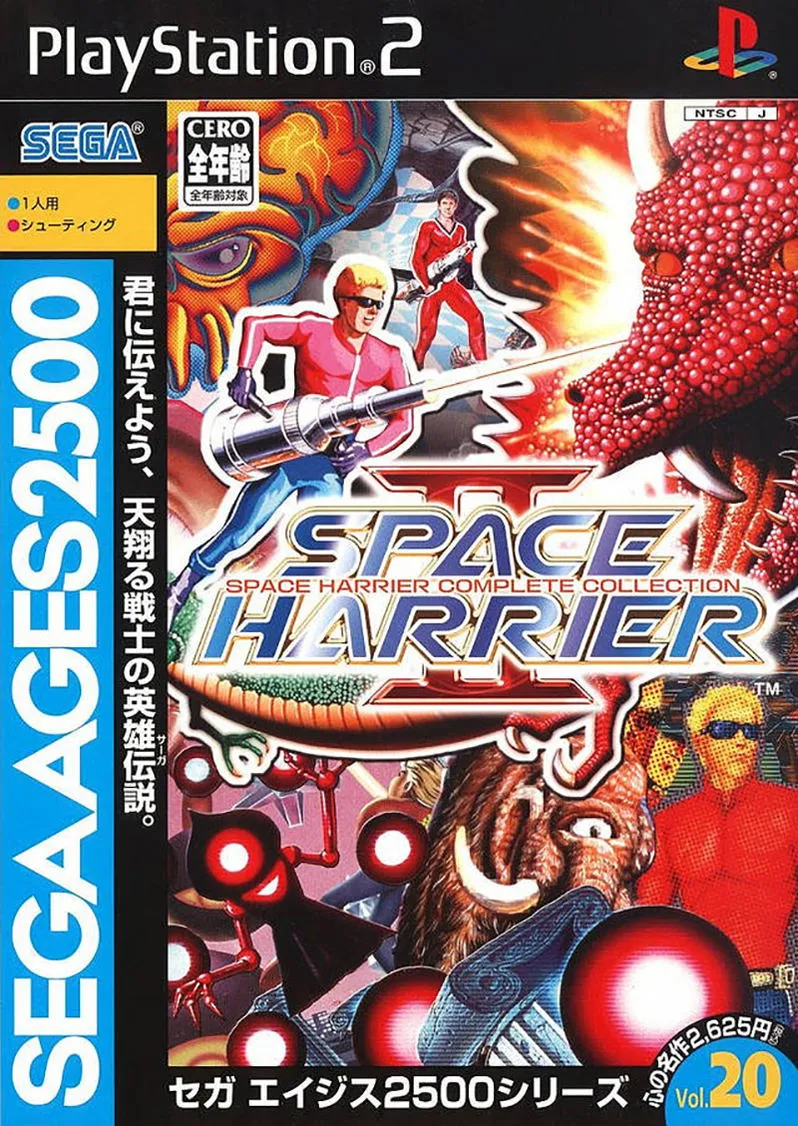
M2’s Space Harrier Complete Collection — every version of the game on a single PS2 disc, with scanned flyers and developer commentary.
Okunari, who had taken over as producer, pushed specifications far beyond what the budgets allowed. Galaxy Force II, pledged for three months of development, took nearly two years. The result was a series of volumes that treated Sega’s back catalogue as an archive rather than a quarry — not material to be reshaped, but artefacts to be presented with context and care. M2 even patented a “parallel play” feature that let players switch between the arcade and home console versions of a game mid-session, so you could feel the difference between what the hardware demanded and what the living room allowed.
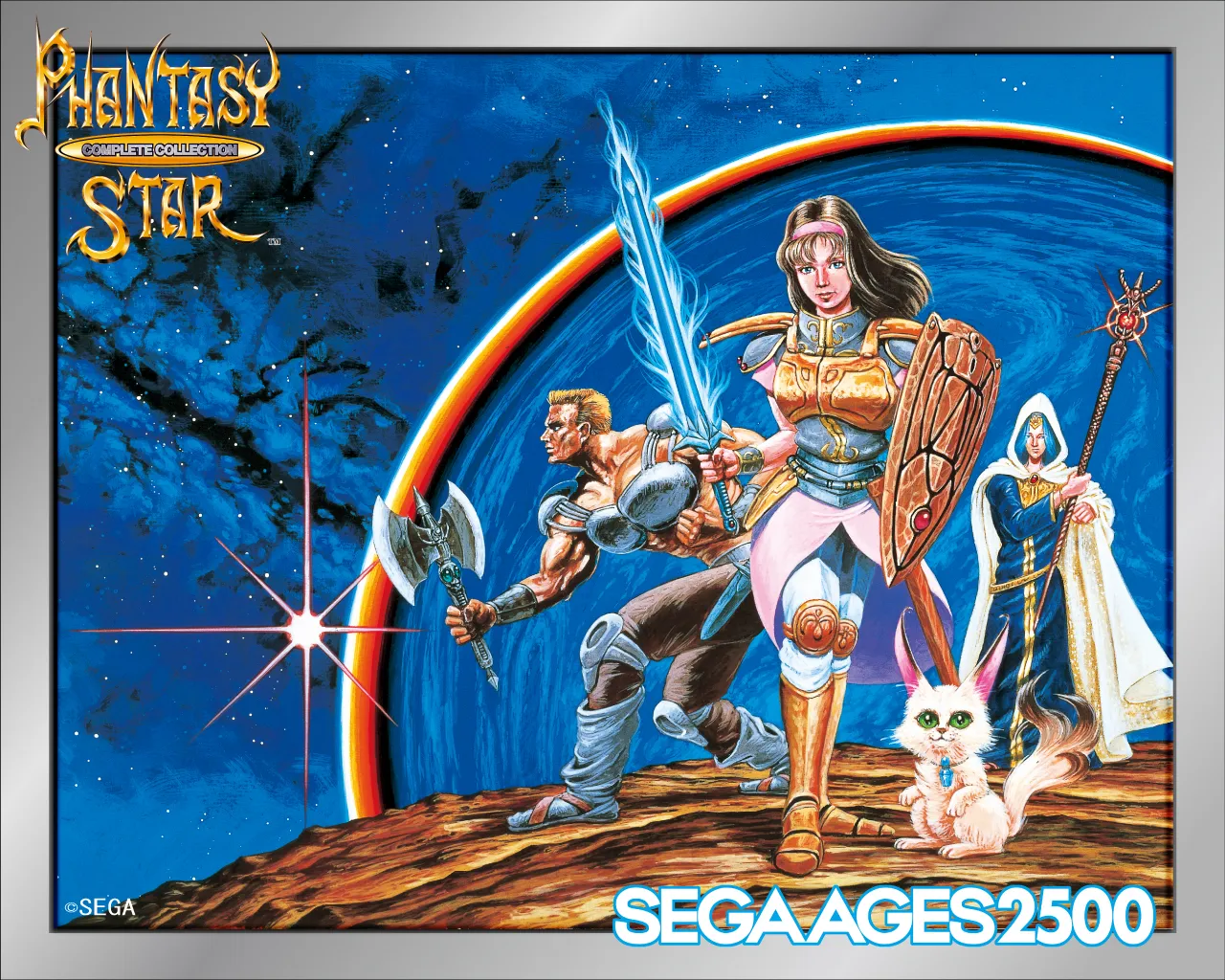
Phantasy Star Complete Collection on PS2 — M2’s volume gathered every version of the series, preserving 1987 artwork most Western players had never seen.
Nobody bought them. The volumes sold modestly in Japan and never reached the West individually. Sony’s regional rules blocked standalone PS2 releases outside Japan, so Sega packaged nine of the earlier 3D Ages remakes — not M2’s archival work — into a budget compilation called Sega Classics Collection for North America in 2005. Critics cringed at the Golden Axe remake. The irony was structural: the PS2 Sega Ages work that reached Western audiences was the work that deserved to be forgotten, and the work that deserved to be remembered never left Japan. M2’s complete collections — Fantasy Zone, Phantasy Star, Monster World — were the best retro compilations of their generation, and they existed in a language most of their natural audience could not read.
Okunari knew the cost of what he had built. Looking back years later, he described the PS2 era as a process of mutual strangulation — specifications that outstripped every budget, deadlines that broke against ambition. The volumes shipped, and they were good, and the market barely noticed. What survived was the method. M2 had proved that the right way to preserve a game was not to remake it but to surround it — with its own history, its own variations, its own context.
The Bridge and the Switch
A brief third act — Sega Ages Online, eleven titles for PS3 and Xbox 360, all released in 2012 — came and went in a year, the shortest-lived iteration. It was digital-only, collection-based, and unremarkable. The real bridge was happening on Nintendo 3DS, where M2 spent 2012 to 2016 building the Sega 3D Classics series: stereoscopic conversions of arcade games with the same obsessive attention that had defined the PS2 work. Fantasy Zone II got an entirely new arcade-accurate version that had never existed in coin-op form. When Horii mentioned to Okunari that he wished the game had been an arcade title, they built one.
By 2016, the 3DS project had exhausted its runway. Okunari asked M2 how long they would need to finish Virtua Racing on the handheld. The answer — about two more years — made the timeline impossible. The Switch was arriving, classic game enthusiasts were adopting it, and PlatinumGames’ Hideki Kamiya and even Masahiro Sakurai had publicly asked why Sega hadn’t brought the work to a home console. Senior producer Kagasei Shimomura ran a global poll across Sega’s Japanese, American, and European offices to choose a brand name. Sega Ages won the most votes, providing worldwide consistency for the first time.
Rieko Kodama signed on as lead producer. She had been at Sega since the mid-1980s — designer on Phantasy Star, director on Skies of Arcadia, one of the foremost women in the industry’s history, recipient of the GDC Pioneer Award in 2019. When M2’s team learned they were working with her on the Phantasy Star port, they were giddy. All of them had been fans of the game since childhood.
”It makes me feel so embarrassed to see what I drew back then. I pleaded with them not to use those illustrations, but…”
— Rieko Kodama, Game Watch, 2018
The logo was the subject of its own miniature production. Kodama oversaw roughly ninety design proposals from two artists, then put them to a vote across Sega’s global offices. The staff chose pixel art in Sega blue — not rainbow, not metallic — because it made them think of when the games first came out. The brand, for the first time, had a visual identity that matched its purpose.
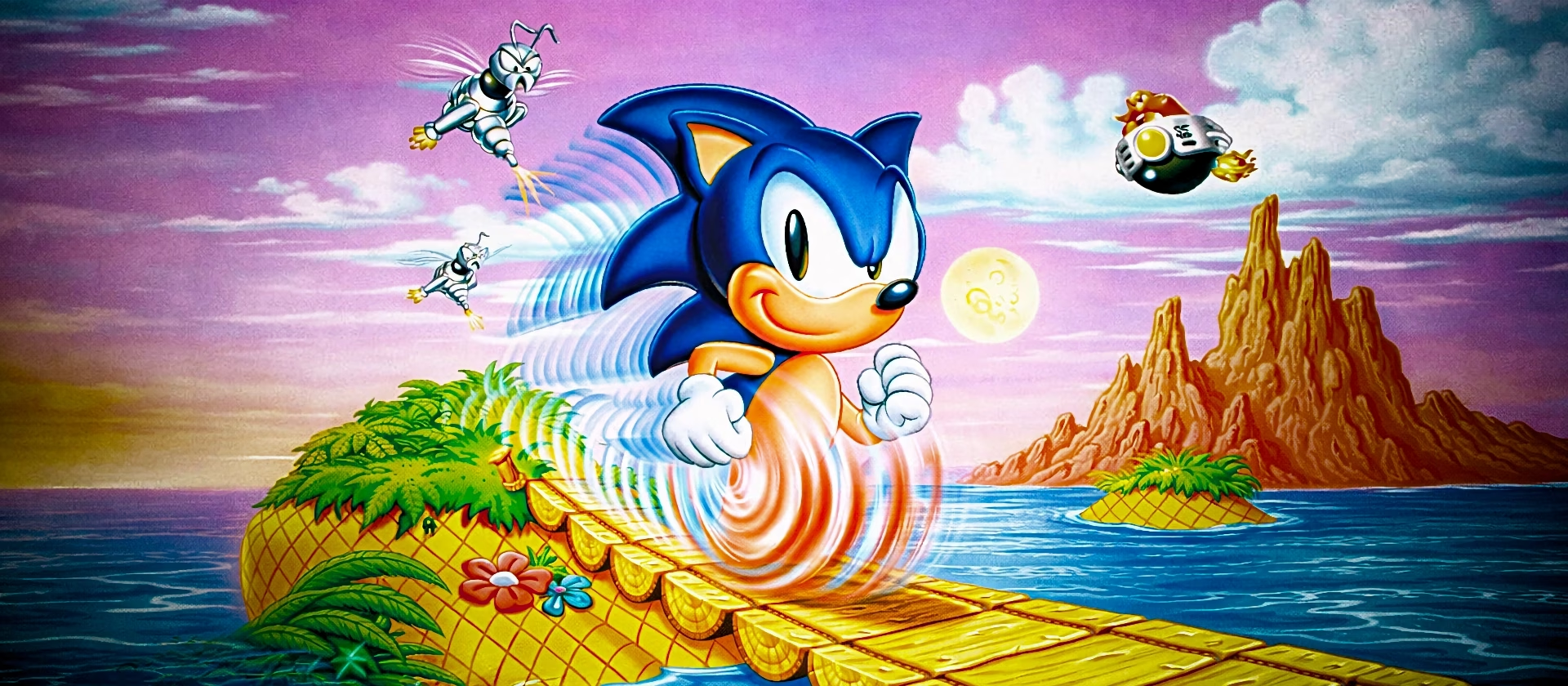
The Switch series ran from September 2018 to August 2020 — nineteen titles. Every one was emulation-first, with hand-crafted additions that enhanced without replacing. Phantasy Star gained an auto-map and a lower-difficulty mode for modern players. Sonic the Hedgehog included the previously unreleased Mega Play arcade version. Gain Ground offered a five-second rewind and the option to disable original bugs. Wonder Boy in Monster Land added a “money-hungry mode” that removed a known economy-breaking exploit — but kept the exploit available as an option, because it was part of the communal history. Space Harrier got vertical Joy-Con controls and a Komainu Barrier assist mode. Virtua Racing ran at 1080p and sixty frames per second with eight-player local multiplayer.
The Shinkansen and the Last Game
The attention to detail bordered on obsessive. Weeks before the G-LOC deadline, M2’s Tsuyoshi Matsuoka discovered authentic cabinet sound effects from the deluxe sit-down unit posted online. He decided the game needed the genuine sounds. The sound crew took the shinkansen to the Japan Game Museum, recorded the actual G-LOC DX cabinet, and shipped the results into the final build. For a game most players would experience on a handheld screen, the team had travelled across Japan to capture what the arcade had sounded like.
The Switch project was planned for six months. It took two years. Okunari would later describe the development as a process of over-specification that put enormous pressure on M2 and on himself.
Herzog Zwei shipped in August 2020 as the nineteenth and final Sega Ages title. A real-time strategy game from 1989, chosen as the series closer, bundled with a new “Herzog Academy” tutorial mode featuring a drill sergeant instructor who taught players the mechanics of a genre the original had essentially invented. It was a strange, perfect ending — a forgotten game, preserved and made legible to a generation that had never known it.
Kodama passed away on 9 May 2022, at the age of fifty-eight. Sega Ages had been her final project. The Mega Drive Mini 2, released later that year, carried an in-memoriam tribute in its credits. Okunari, writing about the series’ conclusion, noted that he, Kodama, and Shimomura had been at work on their next project before her death. He could not say whether M2 would be involved. Matsuoka, M2’s representative, had his own answer to what came next.
He wanted to re-release Sega’s entire history of interactive games.
The palindrome reads the same in both directions. Looking backward and moving forward were always the same thing. It took Sega Ages twenty-four years, four platforms, one failed subsidiary, and the work of a small studio in Chiyoda to prove it — but the archive, in the end, was the argument. Not what the games had been. What they still are.