// import skyPopPoster from ”../../assets/images/super-mario-land-1989-sky-pop-poster.jpg”; // deleted
// import dxMudaPoster from ”../../assets/images/super-mario-land-1989-dx-muda-poster.jpg”; // deleted
// import dxMarinePopPoster from ”../../assets/images/super-mario-land-1989-dx-marine-pop-poster.jpg”; // deleted
Every Mario game you have ever played traces, through some thread of authorship, back to Shigeru Miyamoto. Super Mario Land is the exception. It was made by the other team at Nintendo — Gunpei Yokoi’s R&D1, the engineers who had already built Metroid, Kid Icarus, and the Game Boy itself. Miyamoto signed off on the character and went back to finishing Super Mario Bros. 3. For one release, he gave Mario away.
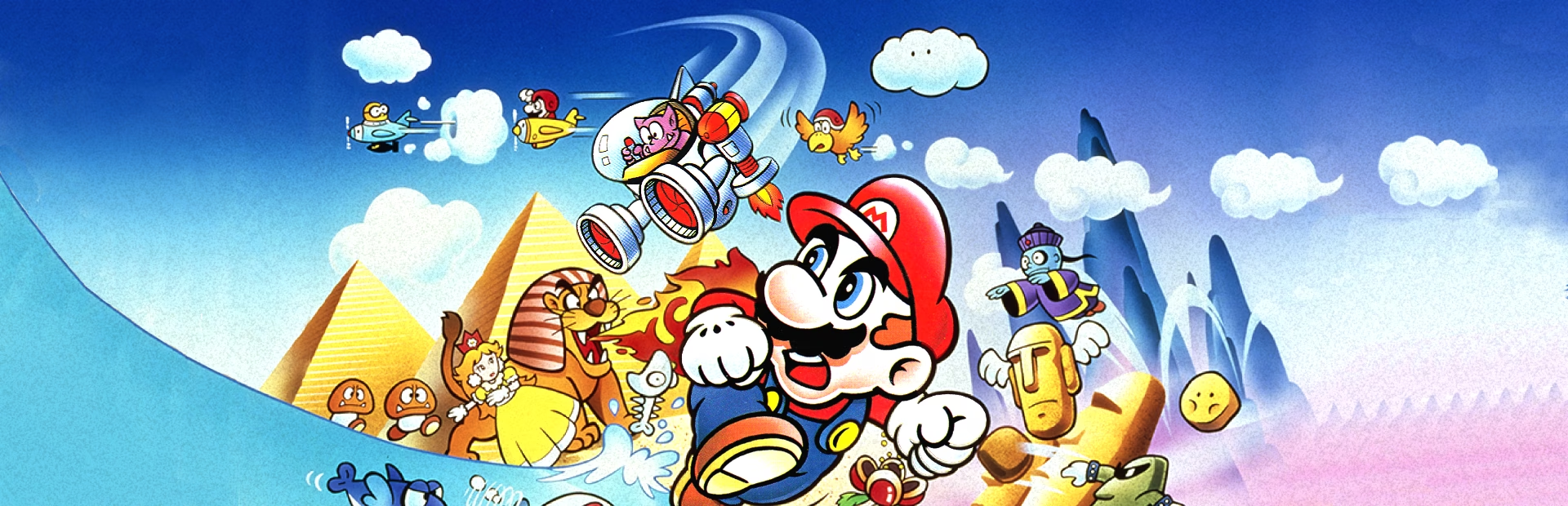
What came back was unrecognisable by almost every standard Miyamoto had set. The plumber walks into pyramids. Koopa shells detonate instead of sliding. The fireball is a rubber ball that bounces off walls at angles. Two late stages abandon platforming for Gradius-style auto-scrolling shooter segments in which Mario is no longer Mario but a pilot with missiles. The princess is a stranger called Daisy, the villain is an alien in a saucer, and the whole place is named Sarasaland because it isn’t the Mushroom Kingdom. Received wisdom reads all of this as a Game Boy compromise — a cute, smaller Mario flattened by the hardware. Played today, the opposite is true. The strangeness isn’t a symptom. It’s the signature of a different author, working in the only real gap he ever got in the franchise.
Mario, Handed to Someone Else
Hiroshi Yamauchi wanted a Mario ready for the Game Boy’s launch in April 1989. Miyamoto’s EAD team was deep in Super Mario Bros. 3, which would ship five months later and draw on almost every designer they had. Yamauchi turned to R&D1 — the division that had actually built the Game Boy — and handed them the character. Producer Gunpei Yokoi kept the day-to-day, as he had on Metroid; his deputy Satoru Okada took the director’s chair. Nobody involved had worked on a Mario game before.
Okada is the hidden auteur of Nintendo’s handheld era — the engineer who would co-design every Game Boy, Game Boy Color, Game Boy Advance, DS and DSi XL — and in 1989 he was already the director of record on Metroid and Kid Icarus. The designers he had on hand, Hirofumi Matsuoka and Masahiko Mashita, had spent the decade making sprite-dense action games for the NES. The programmers, Masao Yamamoto and Takahiro Harada, came out of the same tradition. When they opened the brief for Super Mario Land, they did not open a Miyamoto file. They opened the files they already had.
Yokoi’s philosophy sat above all of it. He called his method kareta gijutsu no suihei shikō — lateral thinking with withered technology — and the Game Boy was its purest expression. Given the choice between colour and monochrome in 1988, he chose monochrome on the grounds that imagination would do the rest. The same principle applied to Mario. Given the character and told to make a launch title, R&D1 did not try to miniaturise Super Mario Bros. They tried to make the kind of game they already knew how to make, and trust that the character would survive the translation.
A Kingdom Made of Other Places
Sarasaland has four kingdoms and each one is lifted from somewhere real. Birabuto is Egypt: pyramids, sphinxes, ankhs falling from defeated enemies. Muda is the Bermuda Triangle, a sequence of submerged causeways and stone heads in open water. Easton is Easter Island — whole stages of moai in perfect profile, which Matsuoka’s pixel art renders with a monument-like stillness nothing else in the Mario series has ever attempted. Chai is China: fortune-cookie bonuses, a ribbon-dragon finale, a final-world palette lift from the cover of a Shaw Brothers film.
None of this is negative space where the Mushroom Kingdom used to be. It is something with its own character, built by people who had no instinct to preserve an existing visual grammar. Princess Peach is absent. Bowser is absent. Koopa Troopas appear, but their shells explode after three seconds — stomp one and you start a timer. The reflex every Mario player has built since 1985, hit shell, use shell, becomes the wrong move. The Fire Flower is replaced by a Superball that caroms off every surface at forty-five degree angles and collects coins on the ricochet. The final boss is not a giant turtle; it is Tatanga, a purple alien hypnotising Sarasaland’s population from a flying saucer, and Mario fights him inside the Sky Pop — an airplane with unlimited missiles, over auto-scrolling clouds, in a dead-on lift of Konami’s Gradius.
The Only Mario That Shoots Back
The shooter stages are the single most telling thing in the game. They have never reappeared in a mainline Mario in the thirty-five years since, and they tell you exactly which team was in the room. World 2-3 is Marine Pop, a submarine auto-scroller beneath the Muda Kingdom. World 4-3 is Sky Pop, the Sarasaland sky at missile-height. Both use the forced scroll, the bullet hail, and the death-on-contact logic of a late-eighties Capcom or Konami shooter. R&D1 had not made a shmup, but they had made Metroid, and the instincts transfer — screen-wide enemy patterns, tight vertical dodge corridors, a protagonist with a projectile.
Played today, the shooter sections arrive as a genuine shock. You have spent twenty minutes in a recognisable — if peculiar — Mario platformer, and the game abruptly becomes something else, and then, once you have beaten Tatanga, becomes Mario again. It is the structural move of a team that does not feel the weight of the franchise. EAD would not have done it. EAD would have found a way to keep Mario on his feet. R&D1 put him in the cockpit and moved on.
One Composer, One Chip
Hirokazu Tanaka did three jobs on Super Mario Land at the same time. He composed the music. He programmed the sound driver. And he was one of the engineers designing the Game Boy’s audio hardware — the amplifier, the speaker tuning, the noise-channel spec. When he talks about it now, the staffing is still the thing he remembers.
”I was busy. Very busy. I was composing, programming, designing sound hardware inside the Game Boy console, and working on multiple other games. It was crazy.”
— Hirokazu Tanaka, Red Bull Music Academy, 2014
The three original themes he wrote for Sarasaland — the overworld, the underground, and the closing credits he calls his favourite piece of music he ever made — were built around a reggae and dub structure: rolling bass, drum patterns that keep changing, no chorus to burn out on during long play sessions. On a system with three channels, Tanaka composed music designed for a listener holding the thing for an hour at a time. He has been explicit about the method. “The more restrictions you place on me,” he told the same RBMA audience, “the more creative I get to be.”
The closing theme is the one Tanaka has gone on record calling his favourite piece of music he ever wrote. It plays over Daisy’s rescue and a slow pan across the four kingdoms — a ninety-second farewell cue in a soundtrack that otherwise loops through three-channel hooks under a minute long. Beat the game once and the melody sticks; it is the sound of the Sarasaland conceit resolving, a composer allowing himself the one moment of romance a sound chip he helped design could support.
The overworld theme had an afterlife nobody in R&D1 anticipated. In 1992, British producer Simon Harris sampled it, realised it sat exactly on a house tempo, added a rapper called MC Mario and put out “Supermarioland” under the name Ambassadors of Funk. It debuted at #14 on the UK Singles Chart that October, climbed to #8 two weeks later, and stayed in the top forty through to Christmas. Miyamoto personally approved the licence. Somewhere in a branch of British pop history most Mario players have never heard, Tanaka’s Game Boy cartridge music is a minor rave classic.
Why It Still Unsettles
Super Mario Land is about thirty-three minutes long if you know what you are doing — twelve levels across four worlds, no saves, a hard mode unlocked for a second run. That brevity reads today as a feature, not a limitation. The game is the length of a good album and it uses every minute. It does not have Mario’s baggage, because it was made before most of that baggage existed, by people who were not carrying it. You get the plumber, four made-up countries, a rubber ball, a submarine, a plane, and an alien. Then it ends.
What it leaves you with is an unsettling double vision. The controls are Mario’s controls — the jump arc, the run acceleration, the coin chime — but none of the logic wrapped around them is. Play it after forty years of Miyamoto-led Mario and you feel, viscerally, the shape of what a different author’s Mario might have been if the franchise had ever gone that way again. It never did. EAD took the character back in 1992’s Super Mario Land 2, handed it to a third team for Wario Land, and from Super Mario 64 onward kept every mainline entry in-house. R&D1 got one go at Mario. This is it.
Thirty years on, the preservation scene gave the game a second life it never had at launch. Toruzz’s 2019 Super Mario Land DX patch converts the ROM to a full Game Boy Color title — re-tuned palettes per kingdom, a playable Luigi with distinct physics, framerate fixes on Easton’s hard mode — and has become the most-played version of the game among anyone under forty.
The game’s reputation has always sat slightly off-centre. Famitsu’s 1989 Cross Review gave it 26/40, with three of the four reviewers complaining that the monochrome screen made the sprites “blurry” — they were comparing it to the NES Mario games it was never trying to be. Nintendo Power’s Ed Semrad and Donn Nauert called it, accurately, “easily the best Game Boy cart.” Eighteen million copies sold over the next thirty years, more than Super Mario Bros. 3, and almost nobody remembers it as a peak of the series. It isn’t. What it is, is the one Mario that plays like nothing else — because the one time Nintendo asked a different team to make one, they did.