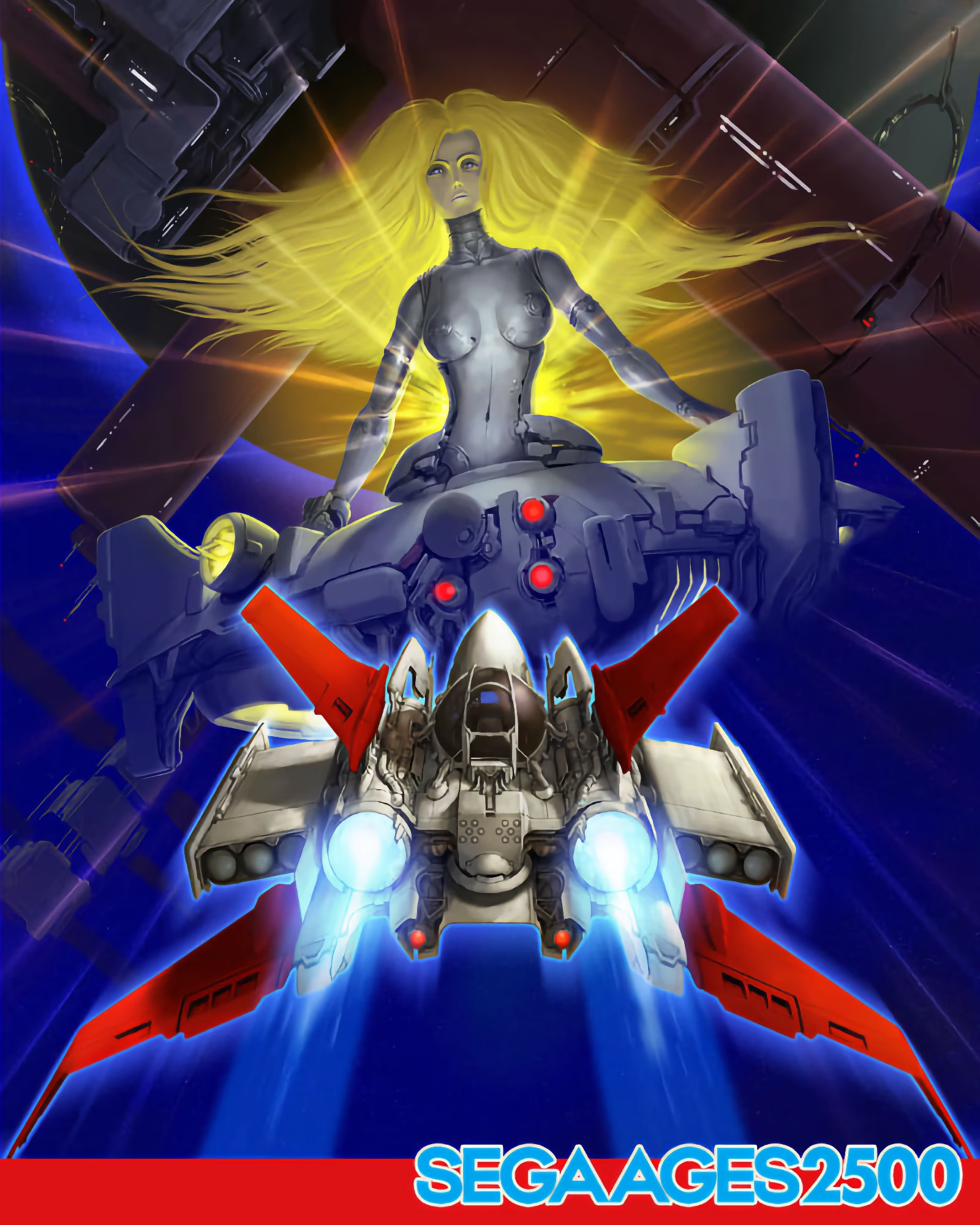
Digital Eclipse makes the most serious preservation work in video games. It also spent twelve years effectively dead.
The studio founded in Emeryville in 1992 was absorbed into a 2003 merger with ImaginEngine, disappeared inside the result — Backbone Entertainment — and existed for over a decade only on old box art. The name that now sits on Atari 50, The Making of Karateka, and Llamasoft: The Jeff Minter Story is Digital Eclipse on its third life.
What separates the third life from the first two is not a new emulator. It is the arrival, in sequence, of two journalists — and, eventually, of an editor. Frank Cifaldi joined in the early 2010s and coined the thesis: Digital Eclipse was going to be the Criterion Collection for video games. He left in 2020 to run the Video Game History Foundation full time. Chris Kohler arrived the same year with twenty-four years of journalism behind him and the title of Editorial Director — a role no other games studio has thought to create. What the two of them built together, and what Kohler is now stewarding alone, is a studio that works less like a developer and more like a magazine with a back catalogue.
Thirty Years Before the Voice Arrived
Digital Eclipse was founded in 1992 by four engineers — Andrew Ayre, Hans Kim, John Neil, and Howard Fukuda — in an Emeryville office a few blocks from the waterfront. The original business was pragmatic and technical: a proprietary emulation framework called the Eclipse Engine, designed to run arcade ROMs on consumer hardware, and contract work for publishers who owned the back catalogues nobody else could make run. Mike Mika, who would later become president, joined early as technical director and was primarily responsible for the engine.
The studio’s first-decade output is a map of what the games industry could be bothered to preserve in the 1990s, which was not much. A handful of arcade conversions for the Game Boy Color. Ports of Q*bert, Pac-Man, Frogger. Midway compilations for the original PlayStation.
The work was competent and mostly uncredited. When Namco farmed out the Namco Museum Pac-Man port to Japan System Supply, who handed it to a young programmer named Hideyuki Nakanishi, Digital Eclipse was doing the same thing a continent west — for the same kinds of clients, at the same level of anonymity. A contract shop emulating back catalogues for whoever signed the purchase order.
It ran out in 2003. Digital Eclipse merged with a children’s-software firm called ImaginEngine, became Backbone Entertainment, and the original name disappeared from the trade press. A faction of the engineering staff, unhappy with the direction of the merger, split off within the year to form Other Ocean Interactive. For a decade the Emeryville studio’s name existed only on old box art. Then, in 2015, Other Ocean bought the dormant brand back and relaunched it under the same marquee. The revived Digital Eclipse was, technically, the same studio. It was also a company starting over — twenty-three years after its founding, and with a vacancy where its editorial voice was about to go.
The Head of Restoration
The first journalist to walk in was Frank Cifaldi, and the thing he brought was a job title nobody in the industry had thought to invent. Cifaldi had spent the mid-2000s at 1UP and Gamasutra, writing retrospectives and tracking preservation failures, before crossing over to development at Other Ocean in the early 2010s. When Digital Eclipse was revived in 2015, he came in as Head of Restoration — a title Cifaldi himself noted was an industry first, because no one had previously thought restoration was a role that needed naming.
His contribution was not technical. The Eclipse Engine was already competent at running old ROMs. What Cifaldi added was the framing: Digital Eclipse’s work, he told interviewers across 2015 and 2016, was going to do for video games what the Criterion Collection did for film. The comparison was borrowed and half-aspirational, but it did something important — it declared the output a scholarly product rather than a cash-in. Preservation not as storage, but as interpretation.
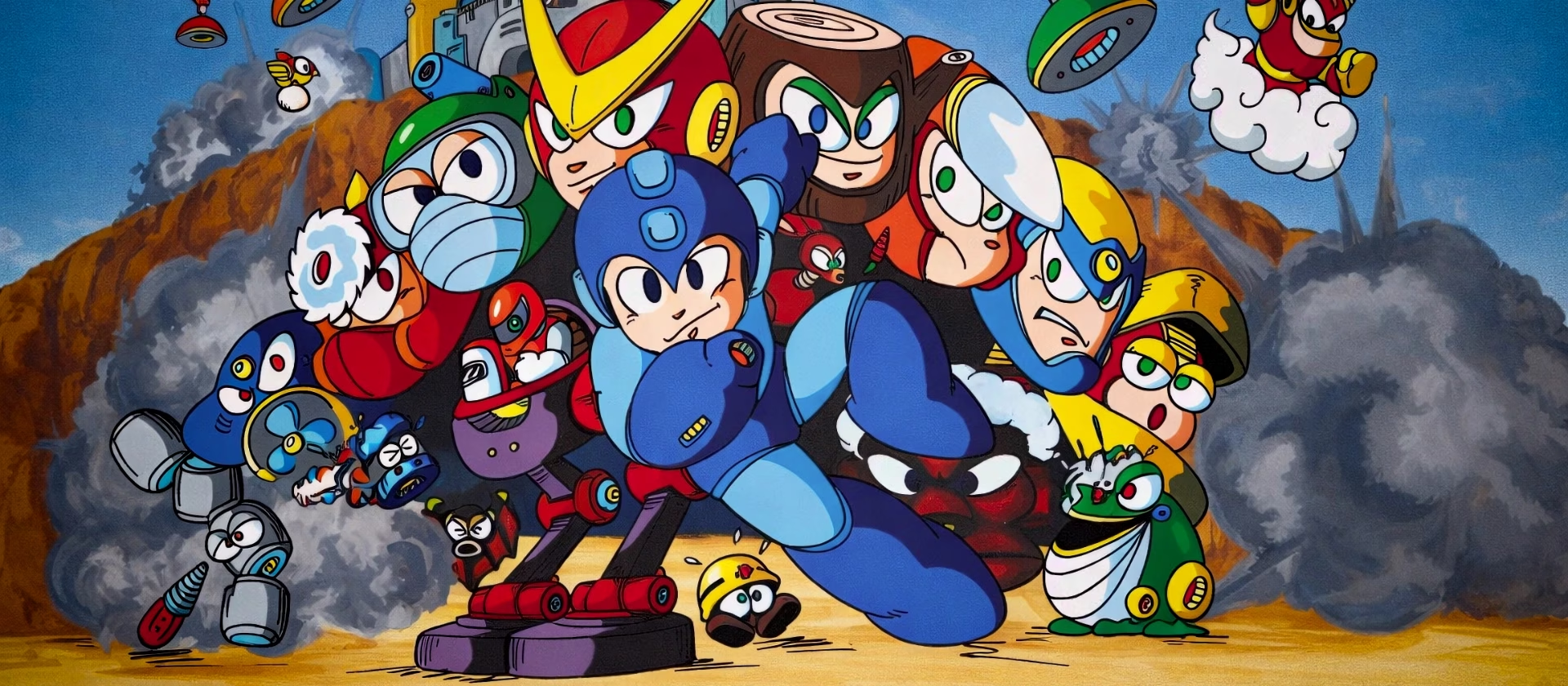
The first work under that framing was Mega Man Legacy Collection, shipped in August 2015. The ROMs themselves were clean. But the Rewind feature, the Museum mode packed with concept art and developer interviews, the note-perfect reproduction of cart labels and manuals, the Mega Man 6 audio actually in tune after a decade of shovelware had left it corrupted — all of that was Cifaldi’s argument in product form. Capcom, previously the poster child for broken compilations, had been publicly embarrassed into shipping something serious.
Across the next seven years, the framing hardened into method — Disney Afternoon, SNK 40th, Street Fighter 30th, and then Teenage Mutant Ninja Turtles: The Cowabunga Collection in 2022, the clearest statement of the era. Thirteen TMNT games, pixel-level interface facsimiles, extensive museum mode, box-scan minutiae rendered at the resolution of someone who cared. The shovelware compilation had been, by editorial force, retired.
And then, in 2020, Cifaldi left — the thesis in place, the method still to be built. The Video Game History Foundation, which he had founded in 2016 as a side project, had grown into something that required his full attention. Digital Eclipse, by his own account, had outgrown the head-of-restoration role. What it needed next was an editor.
The Editor Arrives
Chris Kohler had spent twenty-four years in games journalism when he took the call. Wired for most of it — launching and editing the Game|Life blog through the 2000s and 2010s — then Kotaku for two years as features editor. He had written a book on Japanese game design in 2004, Power-Up, that remained the closest thing English-language games writing had to a serious monograph. What he had never done was make a game. In July 2020, Digital Eclipse created the role of Editorial Director for him anyway. His first project was The Making of Karateka.
The move was strange by industry logic and sensible by any other. No other games studio has an editorial director — the role doesn’t exist because games studios are not publications. Digital Eclipse was betting that the work it now wanted to do was closer to long-form journalism than to software development: research the subject, interview the participants, structure the argument, build the product around it. What Cifaldi had proposed as a thesis, Kohler turned into a method. Every Digital Eclipse release after 2020 begins with a research phase and is shaped by an editor who decides what the argument of the thing is going to be.
Atari 50 in 2022 was the first full expression. The collection’s five-chapter timeline was not a menu; it was a narrative. The interviews were sourced, booked, filmed, and cut like a documentary film. The decision to include the worker-exploitation stories, the clueless-CEO anecdotes, the Jaguar as misfire rather than noble failure — those were editorial decisions, made because the story would be dishonest without them. Carolyn Petit, reviewing the compilation for Kotaku, noted the candour with an audible sigh of relief.
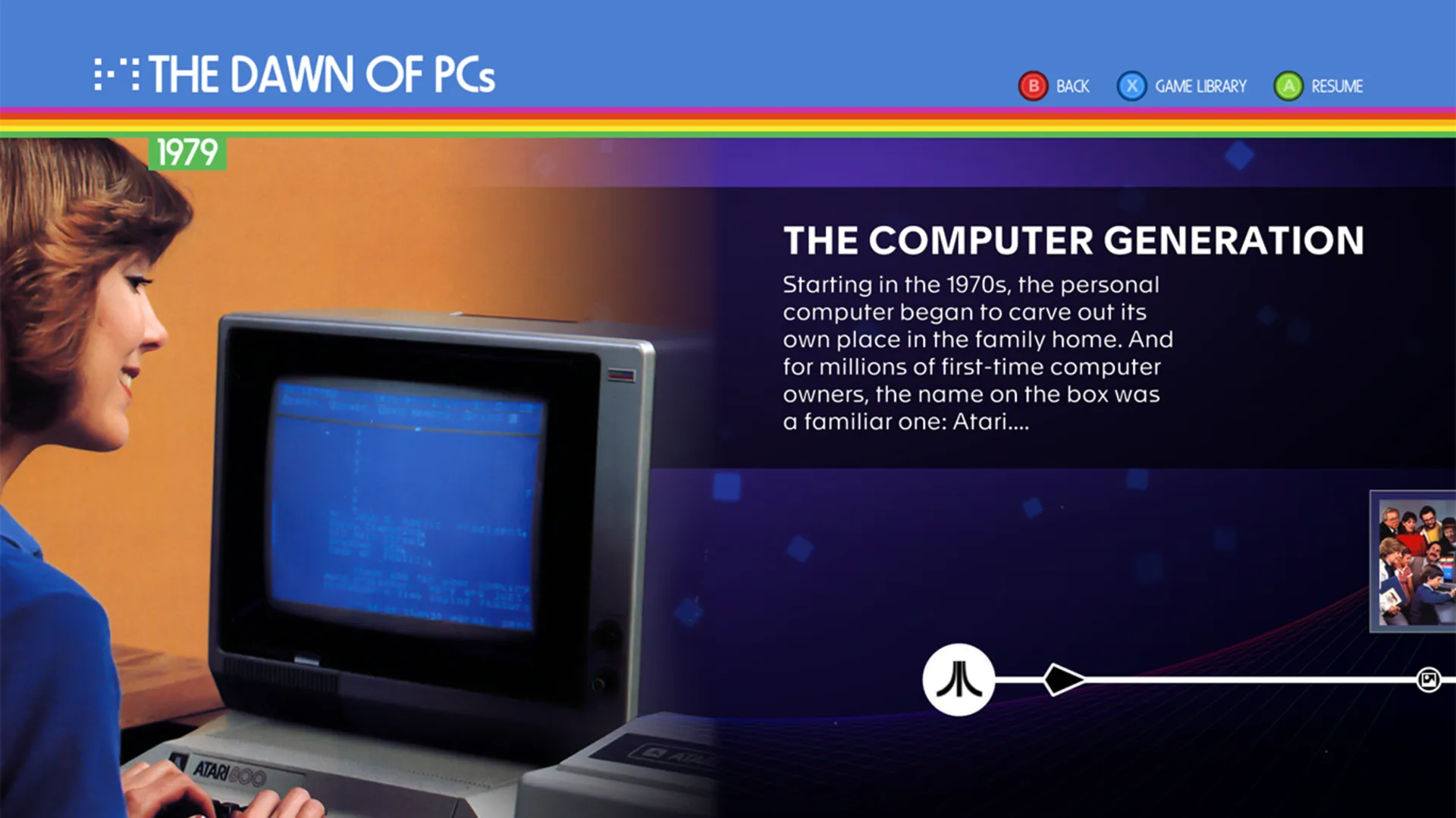
Atari 50: The Anniversary Celebration · Digital Eclipse / Atari, 2022. The five-chapter timeline — a narrative the games hang off, not a menu they sit inside.
”There’s always a danger … that what you’ll get is clean, shiny PR masquerading as history.”
— Carolyn Petit, Kotaku, 2022
What Petit was praising was not an emulation decision. It was an edit. Kohler has since described the underlying philosophy in a line that has hardened into the studio’s house quotation: “We don’t want it to be bonus materials; we want everything to be the main event.”
The Gold Master Method
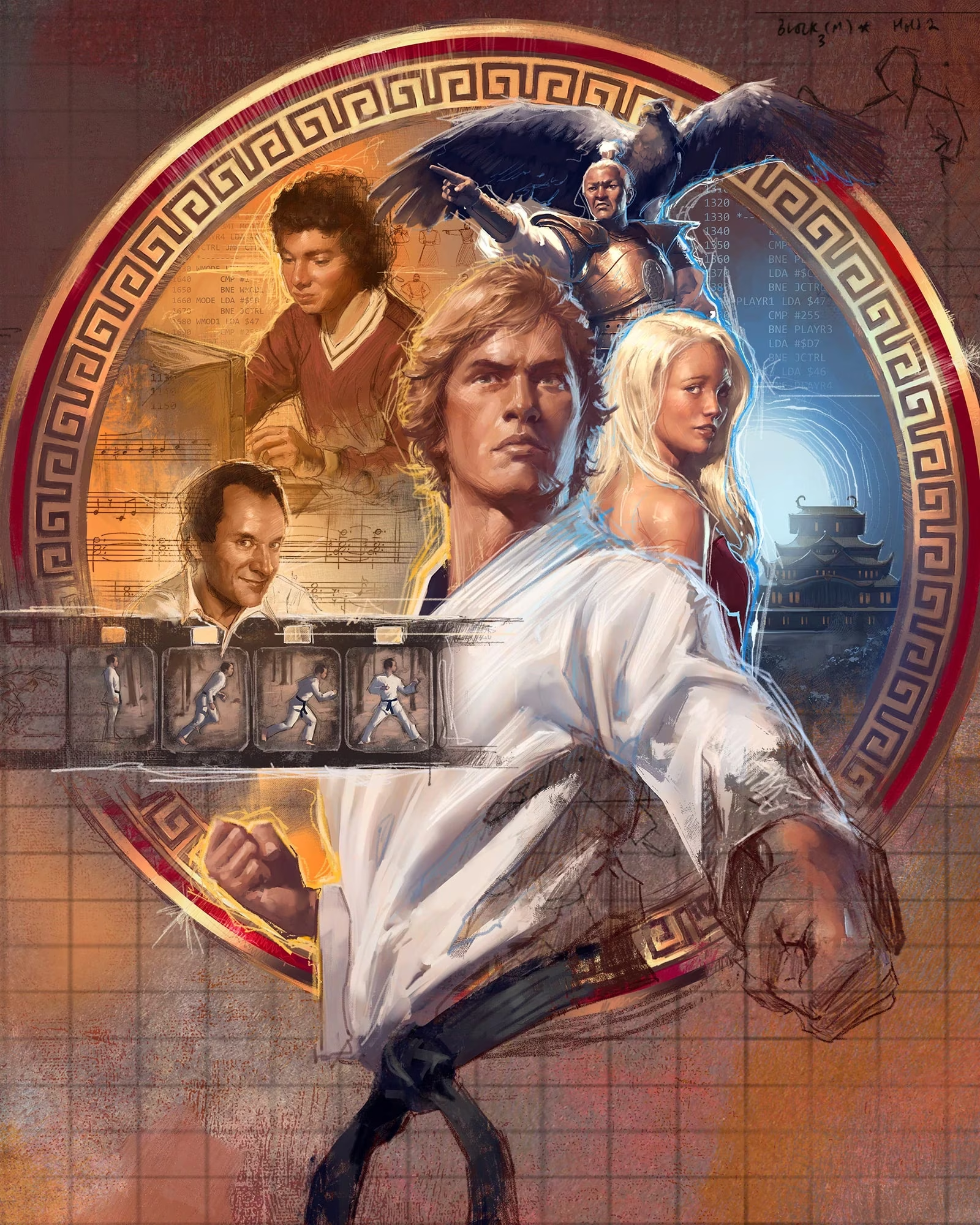
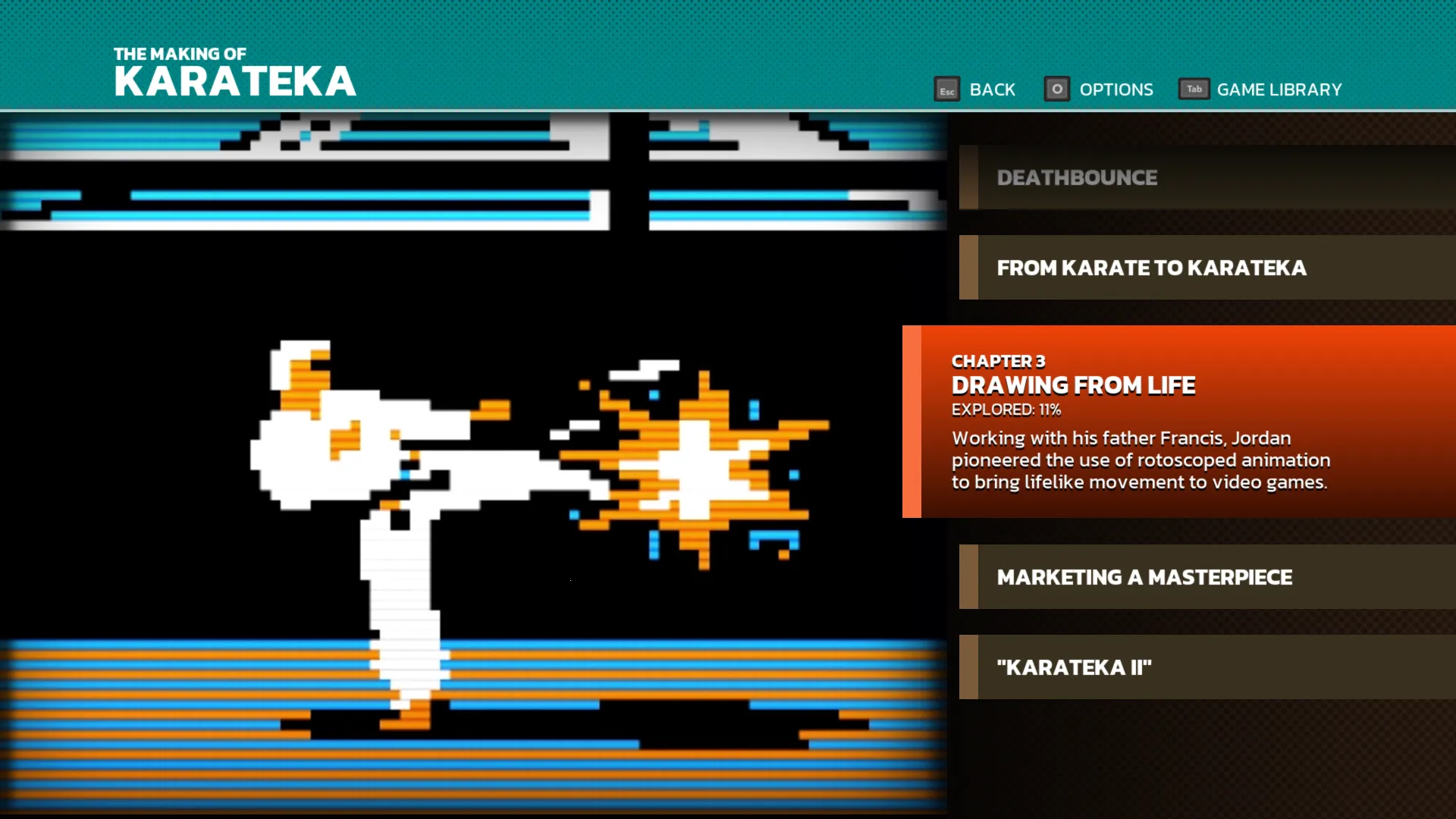
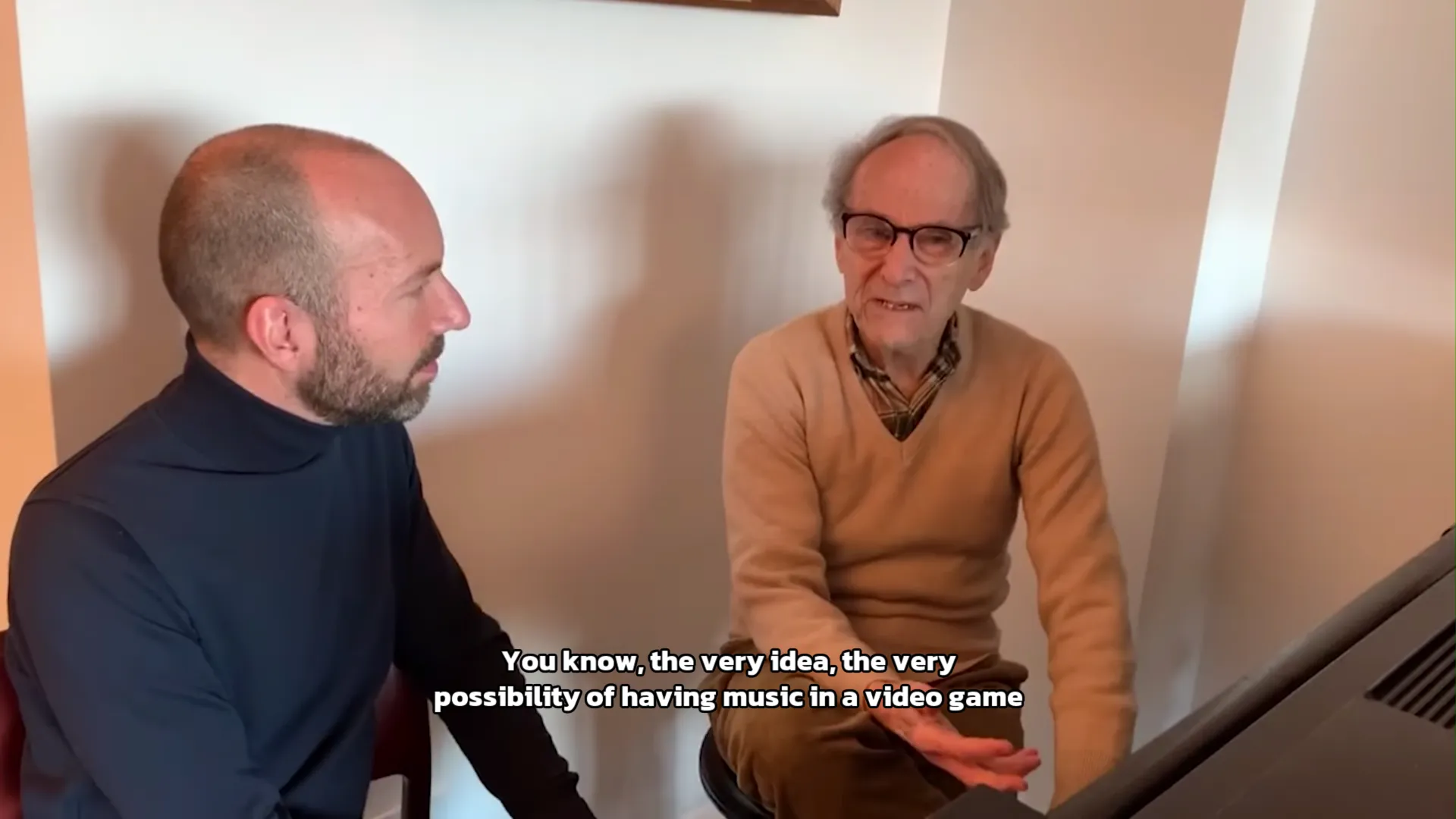
The Gold Master Series, named and launched in August 2023, is the editorial model formalised. Its first entry, The Making of Karateka, remains the purest example of what Digital Eclipse is now for. Jordan Mechner had published his father Francis’s score to the 1984 game — but had never released the attic-stored design documents, the cassette-taped dev diaries, the successive prototype builds that showed the game evolving toward its final form. Digital Eclipse asked for all of it.
The finished product presents Karateka as an editorial narrative, not a playable ROM. The reader moves through a timeline, watches new interview footage with Jordan and Francis, plays three distinct pre-release builds in sequence to feel the design converge toward itself, reads through scanned notebooks, and finally arrives at Karateka Remastered — a new version Digital Eclipse built incorporating cut content the original had been forced to drop. The research extended to Mechner’s unpublished projects: Deathbounce, a twin-stick shooter he had prototyped in 1983 and never finished, was rebuilt as Deathbounce: Rebounded and included in the package. No other games studio would think to do this; it is the exact inverse of IP strategy. The point was not to monetise the prototype. The point was to show what Mechner had made before he made Karateka, so the finished game could be read against it.
Llamasoft: The Jeff Minter Story followed in March 2024. Forty-two programs across eight platforms, ZX81 through Jaguar, stitched to a feature-length Paul Docherty documentary called Heart of Neon. The editorial decision that defined the piece was to treat Minter’s entire output — the flops, the hobby projects, the abandoned experiments — as equally worth preserving, because the argument was about an auteur’s whole practice rather than his greatest hits.
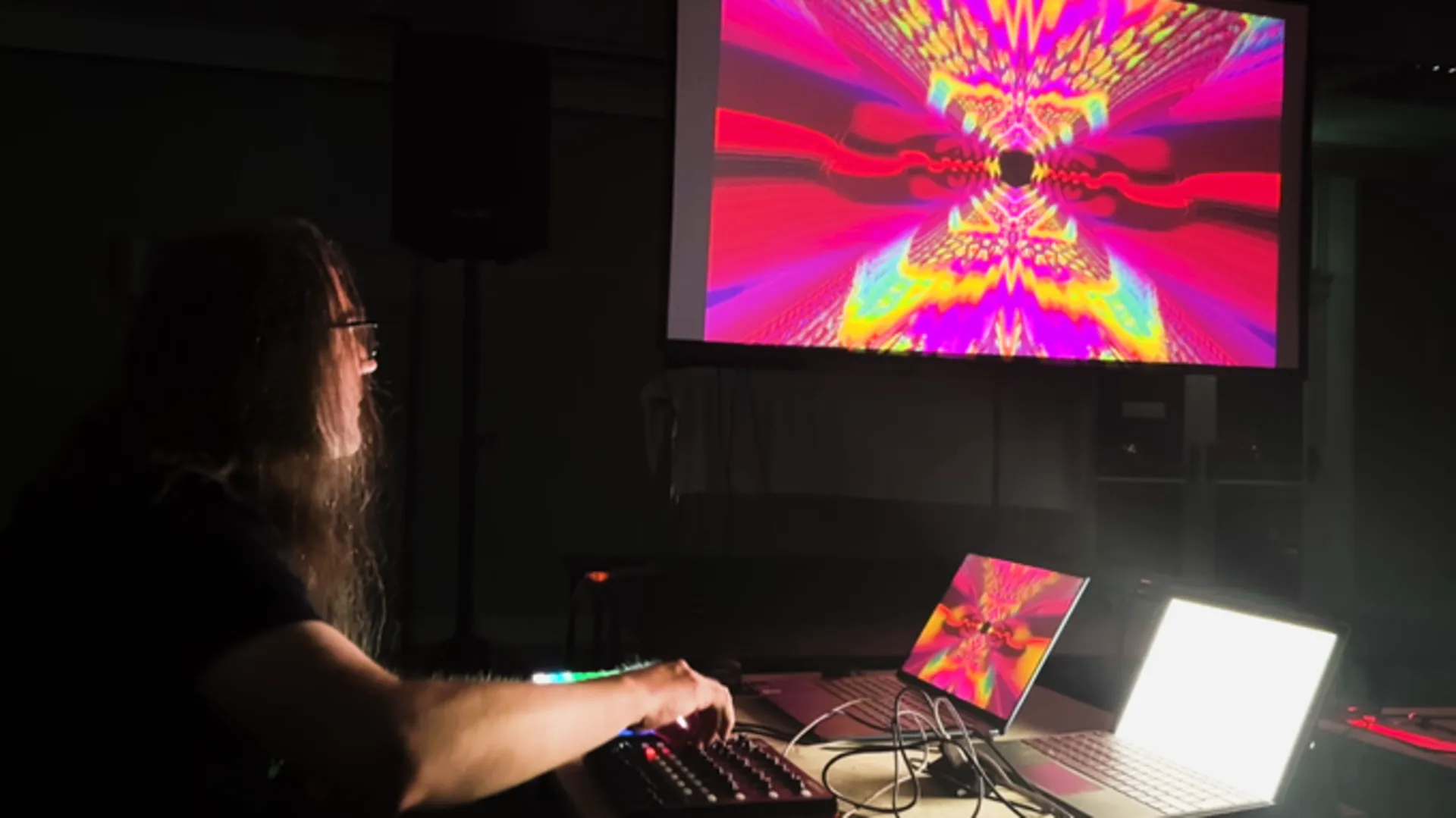
Jeff Minter at his Welsh farm rig — the working subject of Llamasoft: The Jeff Minter Story. Still: Heart of Neon · Paul Docherty, 2024.
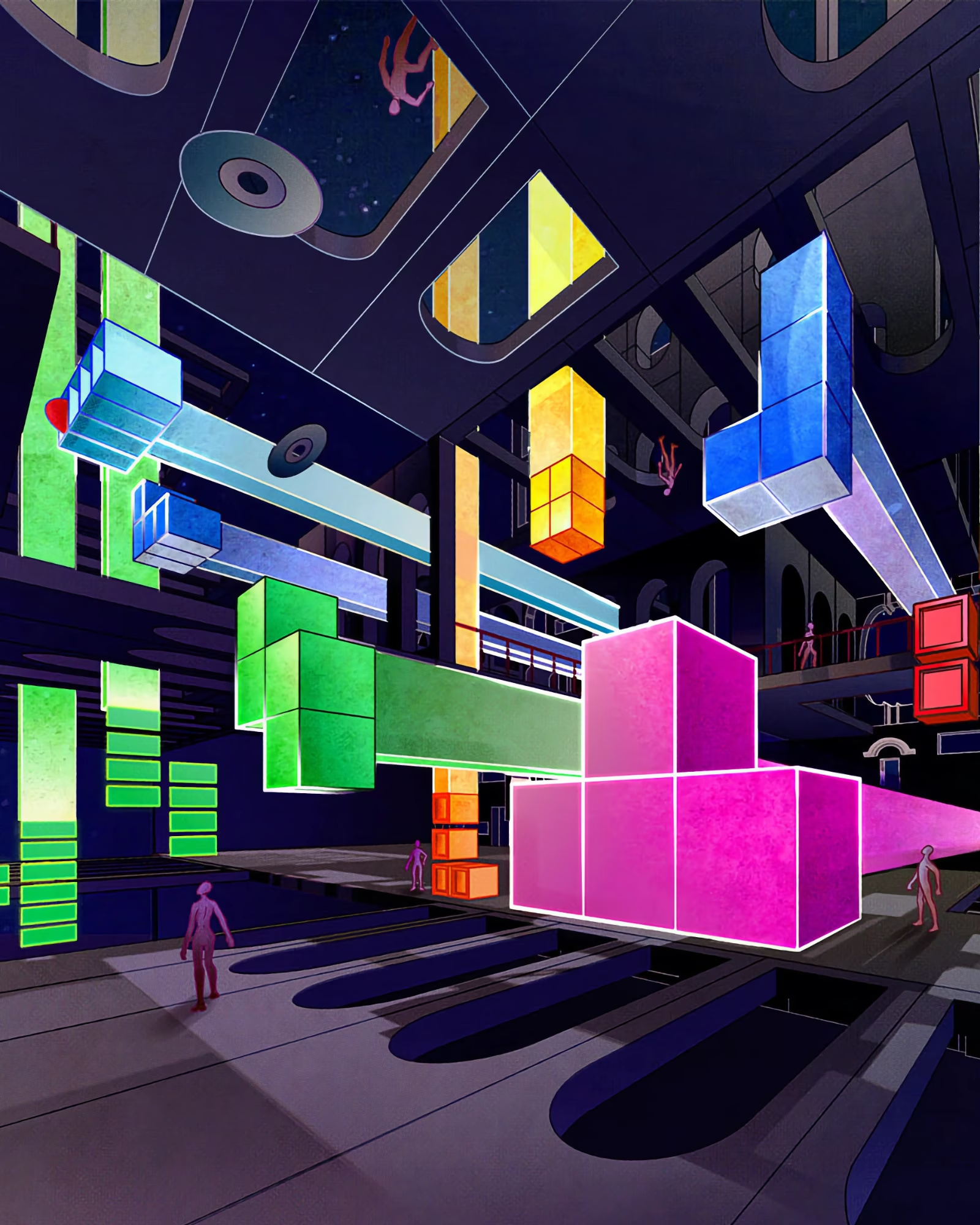
Tetris Forever · Digital Eclipse, 2024. The series as editorial chronology rather than compilation — Henk Rogers and the Tetris Company as primary sources.
Tetris Forever arrived later that year. The pattern held: a single subject, deeply researched, presented with editorial voice, the games themselves functioning as primary-source footage inside a larger argument.
The line that distinguishes this from every other preservation product in games is the editor’s presence. A Konami Anniversary Collection is assembled. A Gold Master release is edited. You can feel the hand on the material — choosing what to include, what to cut, what the story is going to be. That hand did not exist at Digital Eclipse before 2020.
The Problem of Being Owned
On 31 October 2023, Atari announced it was buying Digital Eclipse for up to $20 million — $6.5 million at close, $13.5 million deferred over a decade, contingent on performance targets. The announcement came eleven months after Atari 50 shipped. The studio’s most celebrated product had been, in effect, the flagship for the company it now belonged to.
The acquisition is what funds the ongoing work, and that matters. Tetris Forever shipped as an Atari-owned Digital Eclipse production. A fourth Gold Master entry is only plausible because the budget survives. But the Criterion analogy, always half-aspirational, breaks completely here. Criterion does not get bought by the studios whose films it distributes. The Library of America does not answer to Penguin Random House. Digital Eclipse is now a subsidiary of one of the rights-holders it has historically edited, and will increasingly edit going forward.
What remains uncertain is whether the editorial independence survives. The candour Petit praised in Atari 50 — the worker-exploitation stories, the clueless-CEO anecdotes, the Jaguar as failure — was produced by an independent studio filming former Atari employees, not an Atari subsidiary making decisions about its parent company’s reputation. The next piece of work about Atari’s history will not have the same structural freedom. Whether that matters depends on how Atari behaves as a corporate shareholder, and on whether Kohler’s editorial backbone can hold against the kind of soft pressure acquisitions produce. Cifaldi, watching from the Video Game History Foundation, now runs the only piece of this apparatus that will never be acquired — a charitable archive that ships no product, answers to no rights-holder, and exists precisely because studios eventually get bought.
The one thing Atari’s money cannot buy is the editor. Kohler is in the chair, still commissioning, still researching, still choosing what the argument is going to be. For now, the byline is intact. The question is whether it stays a byline, or becomes branding — and whether anyone will notice when it does.