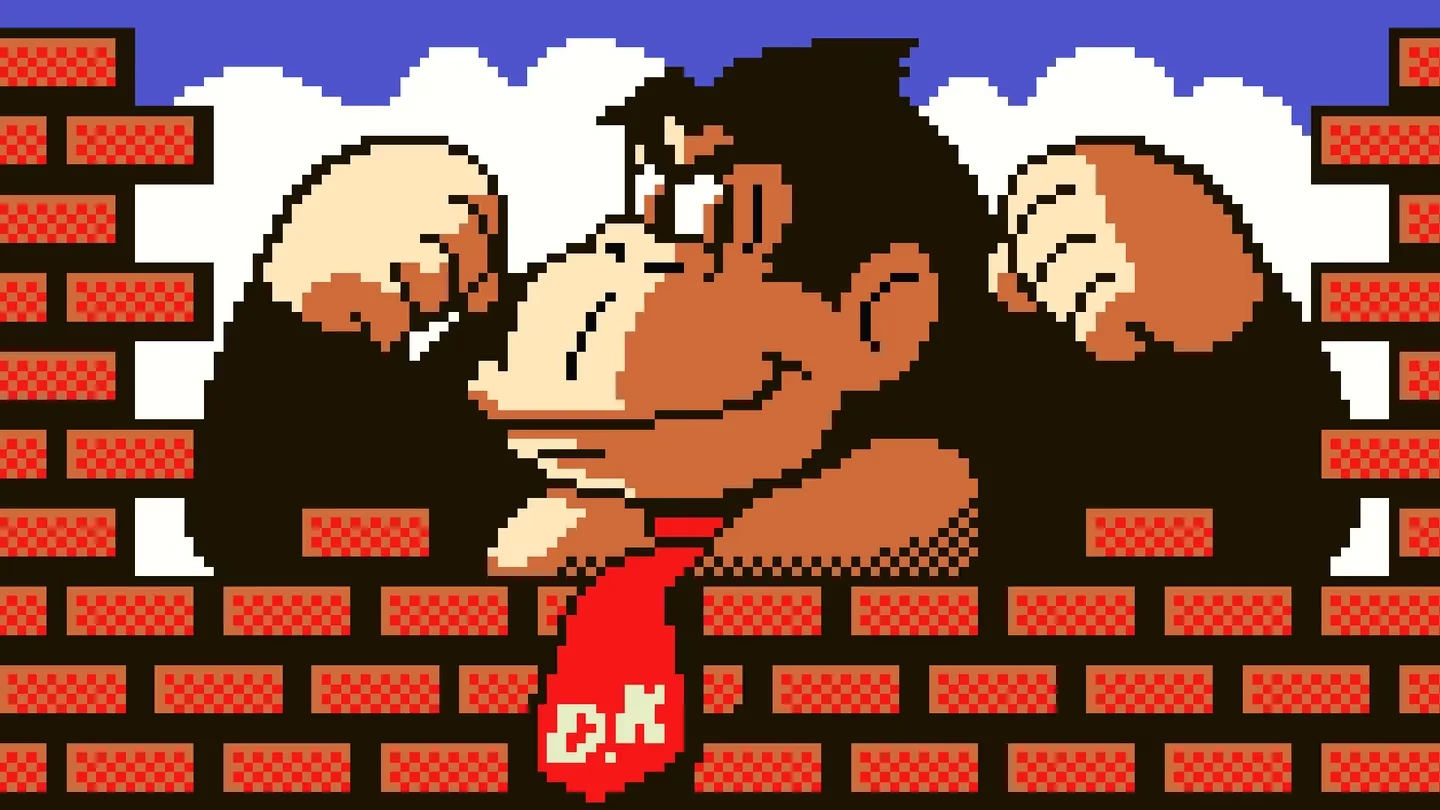
The game opens with a lie. The construction scaffolding, the rolling barrels, the hammer that turns Mario briefly invincible, Pauline calling from the top of the screen — every element in the opening minutes of Donkey Kong on Game Boy is lifted directly from the 1981 arcade original. The replica is precise enough that anyone who had spent their teenage years feeding the machine quarters would recognise each stage by reflex: 25m, 50m, 75m, 100m, four floors, a gorilla, a plumber. The game they already knew.
Then the player clears the top girder. Donkey Kong grabs Pauline and runs. The music shifts. A world map opens to reveal nine worlds and ninety-seven more stages — an entirely different game, which the arcade replica had been concealing — and the preceding ten minutes snap into focus as a calculated structural manoeuvre. Nintendo spent them establishing a contract so that the moment the contract breaks, the new terms land with force rather than confusion. Four stages is exactly the right length for a lie.
What follows is one of the most mechanically ambitious games the Game Boy produced, and one of the least credited for its influence. The puzzle-platformer design that expanded across those ninety-seven stages was not planned: it emerged from a hardware constraint Miyamoto set to keep Mario visible on a small screen. The two moves that would define Mario’s 3D era — the backflip and the triple jump — appeared here first, two years before Super Mario 64. And a programmer’s internal development tool, cut from the final game for being too complex, left its ghost in Nintendo’s codebase for twelve years before it finally shipped. None of this is widely known, because in November 1994 — five months after Donkey Kong arrived in shops — Donkey Kong Country reset what the franchise meant, and the game that had just been celebrated as the best on its platform was left without an era to belong to.
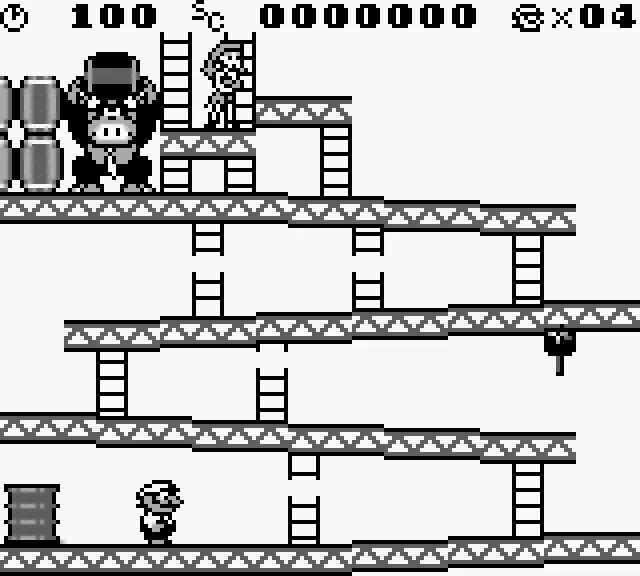
The four opening stages replicate the 1981 arcade game with precision — a deliberate contract set up to be broken. Donkey Kong · Nintendo / Game Boy, 1994.
The Budget That Couldn’t Scroll
The constraint behind the design was direct. The Game Boy’s hardware made it difficult for players to track fast-moving characters through long lateral stages — the smooth momentum that drove Super Mario World worked because the SNES had the resolution and processing speed to keep the screen readable in motion. The Game Boy didn’t. Miyamoto’s response was architectural: from the beginning, Donkey Kong would have a scroll range of roughly 1.5 screens. No fast lateral sweeps. The player, and everything relevant, stayed visible.
“I decided from the beginning that Donkey Kong would have a short scrolling distance of roughly 1.5 screens. Therefore, if you want to make the most out of such small stages, you need to adopt a high-density style of gameplay. The player has to really learn every little detail of the stage.”
— Shigeru Miyamoto, 1994
High-density meant every element had to justify its placement. Enemies couldn’t function as obstacles to be run past — they needed to interact with platforms, timing windows, and the key/door mechanic that governs almost every stage. The structure is simple in principle: carry a key across the stage to a locked door. In practice it is a pressure system, because the key reverts if held too long or dropped in the wrong place. Every stage is a puzzle with a timer embedded in its central prop.
The key mechanic also behaves differently as the worlds accumulate. The construction site stages feel closest to the arcade game — vertical, laddered, enemy patterns the player can read quickly. By the ship, jungle, and desert worlds, the puzzle vocabulary has expanded to include switches that move platforms, enemies that can be thrown to trip mechanisms, and objects that must be carried in sequence. Each world introduces new variable types without abandoning the framework. The game teaches itself in increments small enough to never announce themselves as a tutorial.
Designer Kenta Usui articulated the consequence: “Even within the same clear, there are beautiful methods and ugly methods. If you do it the ‘beautiful’ way, the action component is extraordinarily easy.” The depth the game asks of a skilled player is observational rather than reflexive — a stage mastered is a stage whose variables have been mapped and sequenced. That gap between surviving a stage and understanding it is the sign of design with room to spare.
The Tool Nobody Got to Use
The puzzle logic runs deeper than the key/door structure. During development, programmer Masayuki Hirashima built an internal map editor — a working stage creator that ran on Game Boy hardware itself, letting the team construct and iterate on levels away from a desk. Miyamoto wanted to put it in the final game. The concept was concrete: players would build stages on their Game Boy, share them with friends via link cable, and play each other’s designs. A community tool for portable stage creation, in 1994, a decade before the idea became a genre staple.
It was cut because the target audience — elementary school children — couldn’t operate it without more guidance than the game could provide. But the underlying logic didn’t disappear. Director Takao Shimizu converted the editor’s core mechanic into a playable object: collect the item, time stops, place a platform. The map editor became the edit items, and the edit items became the game’s foundational design philosophy — the reason stages are solvable rather than just survivable.
“Time stops when you collect them — that moment to think is something that isn’t present in typical action games, and it’s what led to the game taking the action-puzzle form you see today.”
— Takao Shimizu, 1994
Hirashima’s editor did not disappear from institutional memory. Nintendo announced a direct sequel in 2002 with a full level editor; the game was cancelled and relaunched the following year as Mario vs. Donkey Kong with the editor stripped. Community members found its code still inside the shipped cartridge, unlockable via a single memory byte. It appeared officially in Mario vs. Donkey Kong 2: March of the Minis in 2006 — twelve years after Hirashima built it on a Game Boy.
What Mario Learned Here First
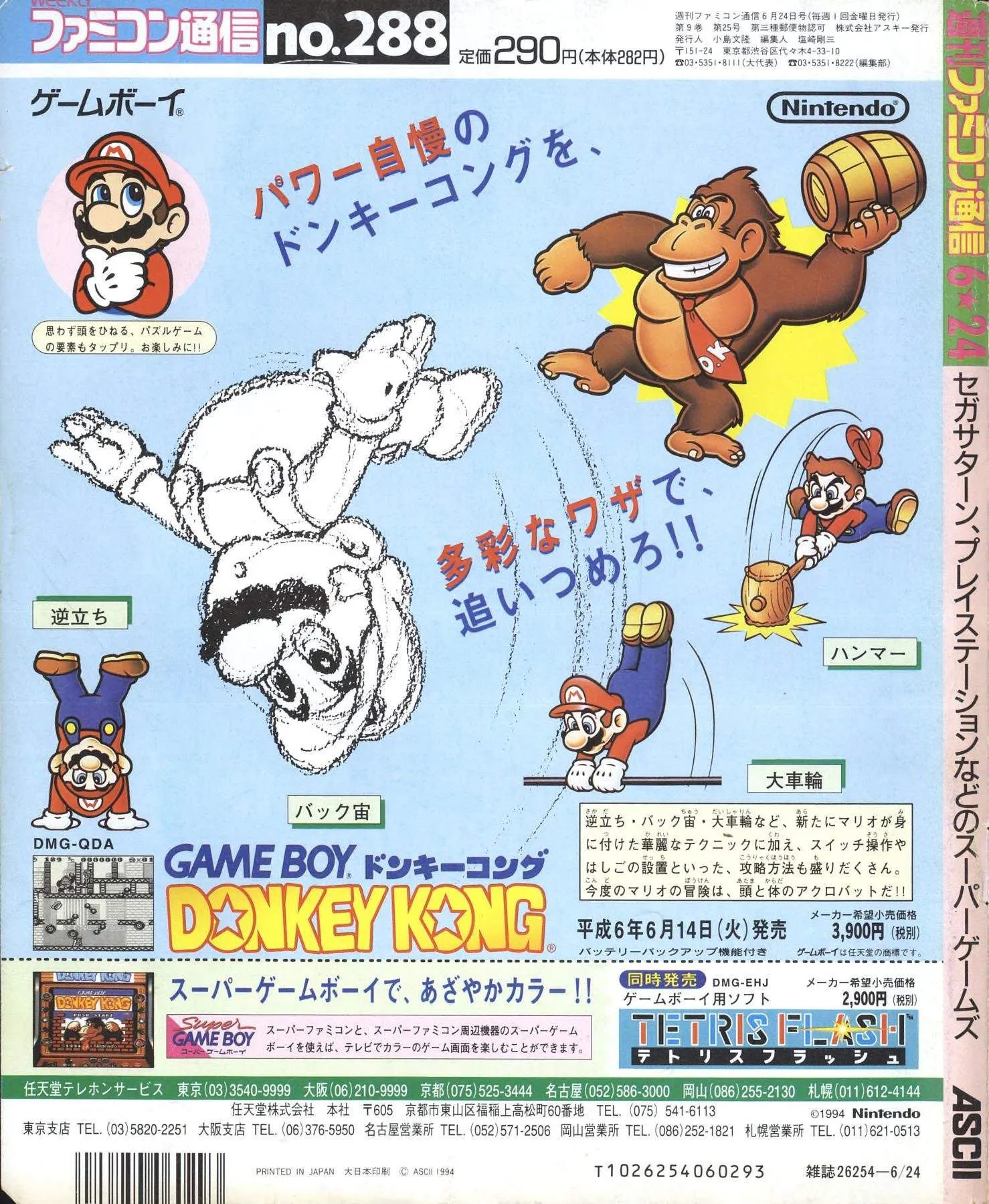
Famicom Tsushin no. 288, June 1994 — the launch advertisement itemising each new move by name. Nintendo.
The other legacy of Donkey Kong ‘94 is embedded in Mario’s body. The version of Mario in this game moves differently from every version that preceded it. He can backflip — a high-arc jump that clears vertical distances no standing jump can reach. He can perform a handstand, turning his feet into a deflection surface that sends falling objects skyward and opens a second upward jump from that position. He can grab ledges, chain these movements into sequences, and carry and throw objects both horizontally and upward. Miyamoto framed the philosophy plainly: “I think it’s especially important that simply moving the character with the controller is fun.” Director Shimizu described the backflip in two words: “a game-changer.”
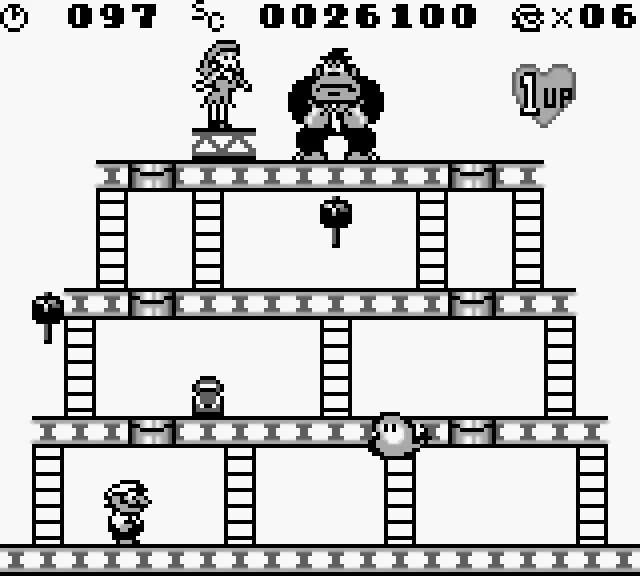
The boss format — DK at the summit, Mario climbing through puzzle layers to reach him — tests the full moveset against the game’s tightest design. Donkey Kong · Nintendo / Game Boy, 1994.
Every one of these movements appears here, in 1994, two years before Super Mario 64. The triple jump in Mario 64 — the three-step chain that became one of 3D platforming’s most recognisable mechanics — runs on exactly the logic of Donkey Kong ‘94’s handstand sequence: land from a jump into a handstand, push off, reach height that a standing jump can’t access. The 3D version removed the handstand requirement and refined the timing, but the fundamental idea — chained momentum arriving at the peak of a committed sequence — is Game Boy first. The development record around Mario 64 doesn’t confirm the lineage. It doesn’t need to.
The moveset that makes Donkey Kong ‘94 remarkable is also what makes it elusive to classify. It is not quite a platformer — the key/door mechanic gives every stage a clear logical objective beyond simply reaching the exit. It is not quite a puzzle game — the solutions require Mario’s physicality in ways that pure puzzle design doesn’t. It occupies a category it effectively created, which may be part of why the genre label arrived gradually and retroactively, applied after the fact by critics assembling a lineage rather than coined in June 1994 by the people who built it.
Six Weeks, Then Silence
When Donkey Kong shipped in June 1994, the critical response was immediate and warm. Electronic Gaming Monthly scored it 8.25 out of 10 and named it Game of the Month. GamePro awarded a perfect score. Nintendo Power put it at the top of the Game Boy chart for the year. Total! in the UK called it “one of the best platform games ever made, and a worthy sequel to the original Donkey Kong.” Multiple publications on three continents named it the decisive argument for the Super Game Boy — the SNES peripheral that let Game Boy cartridges run through a television with enhanced colour palettes and audio routing. The game was celebrated as a hardware showcase as much as a game.
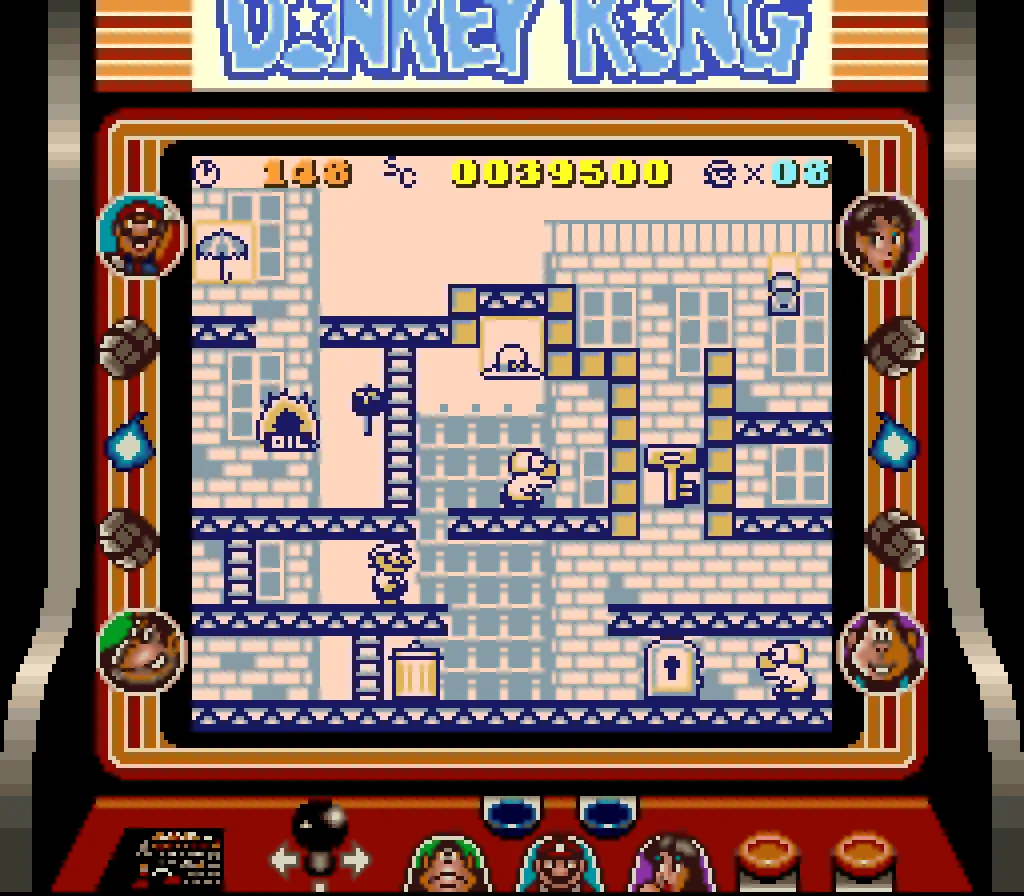
The Super Game Boy presentation — custom cabinet border, world-specific colour palettes, enhanced audio — dominated how reviewers framed the game’s appeal in 1994. Donkey Kong · Nintendo / Super Game Boy, 1994.
The Super Game Boy framing was not inaccurate. The development team spent considerable effort on the dual-format presentation. Designer Takaya Imamura handled the colour work across both Game Boy and SGB outputs; coordinator Masayuki Kameyama spent weeks calibrating the peripheral’s palettes. Pressing Pause and A during play switches the cabinet border between an upright arcade unit and a cocktail cabinet variant — two distinct border designs in one cartridge, a detail that suggests how seriously the team took the peripheral integration. That care was real, and reviewers noticed it.
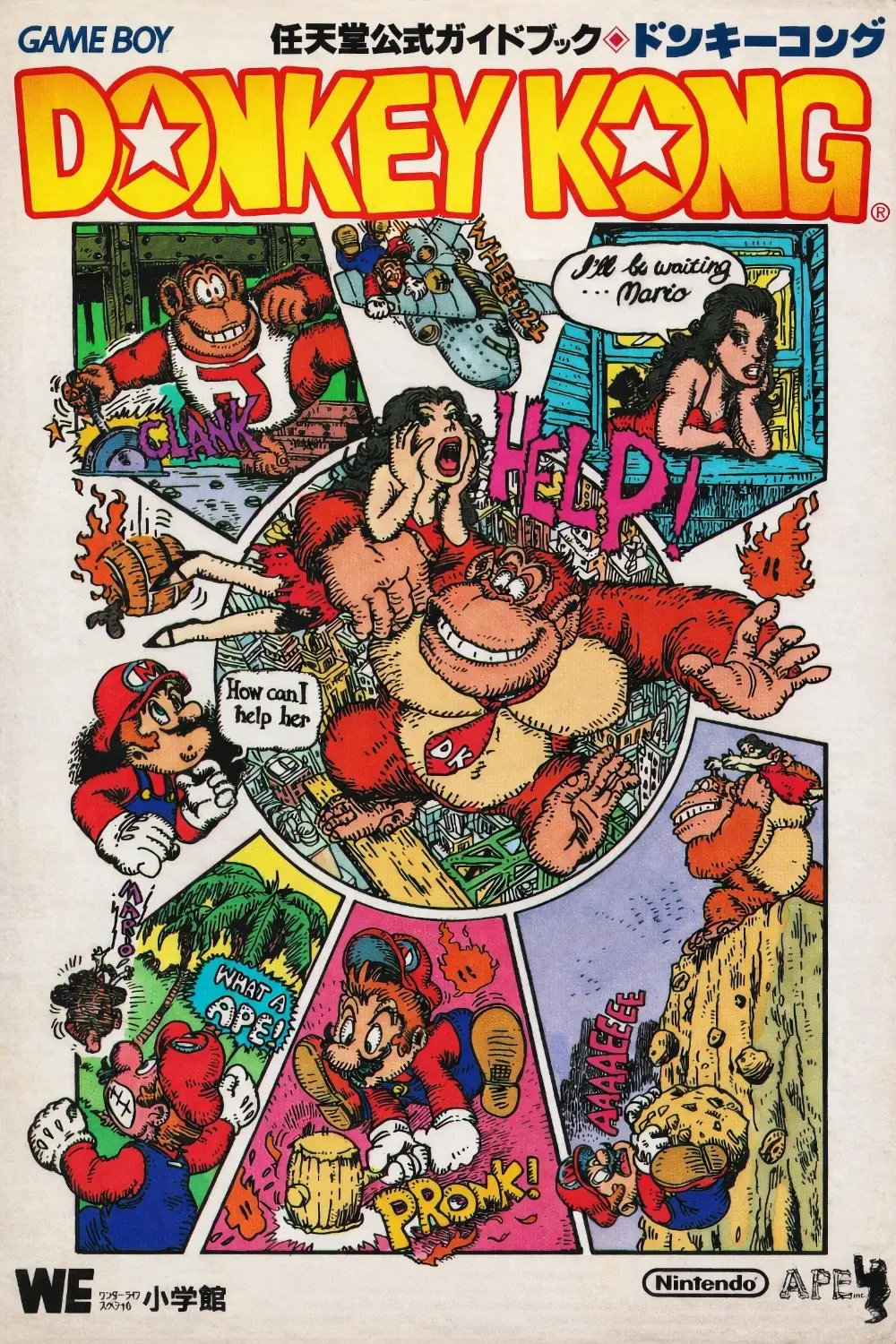
The Shogakukan Nintendo Official Guidebook, 1994 — the source of the Miyamoto and Shimizu interviews that underpin much of the documented design history. Shogakukan / APE inc.
What the SGB framing displaced was the design underneath. Critics who described Donkey Kong ‘94 as the peripheral’s killer app were not wrong, but the descriptor anchored the game’s value to the hardware accessory. Strip the peripheral, and the surface reading became: a very good Game Boy game. The depth below that surface — the origin of puzzle-platforming, the backflip, the ghost of a level editor still drifting through Nintendo’s codebase — sat beneath what a single page of 1994 review prose could easily address.
In November 1994, Donkey Kong Country arrived on SNES. Developed by Rare using Silicon Graphics workstations, it brought pre-rendered character models to a 16-bit console in a way that looked unlike anything the platform had produced. Donkey Kong Country sold nine million copies in its first year. In the space of one Christmas season, it reset what the Donkey Kong franchise meant — and in doing so made the Game Boy game look like a prologue to a story it hadn’t been part of writing.
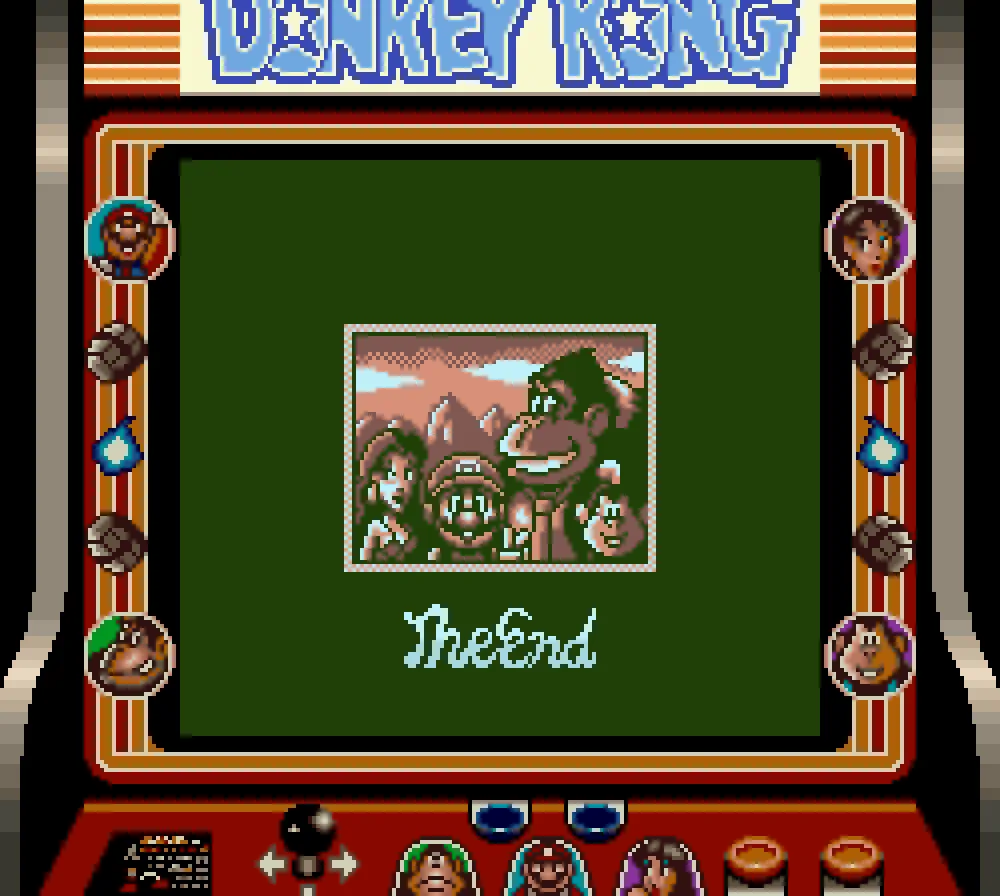
The ending screen in Super Game Boy mode — the cabinet border framing a game that had just been declared over. Donkey Kong · Nintendo, 1994.
Donkey Kong ‘94 sold 3.07 million copies and was not a commercial failure. But the critical conversation moved to Rare and pre-rendered graphics before the year ended, and the game that had just been named the best on its platform fell into the gap between two eras it had no place in. What it had built — the genre, the moves, the design philosophy encoded in a cut tool — travelled forward into the next decade’s work without the attribution that would have closed the loop. The game had opened with a calculated lie. History returned the courtesy.