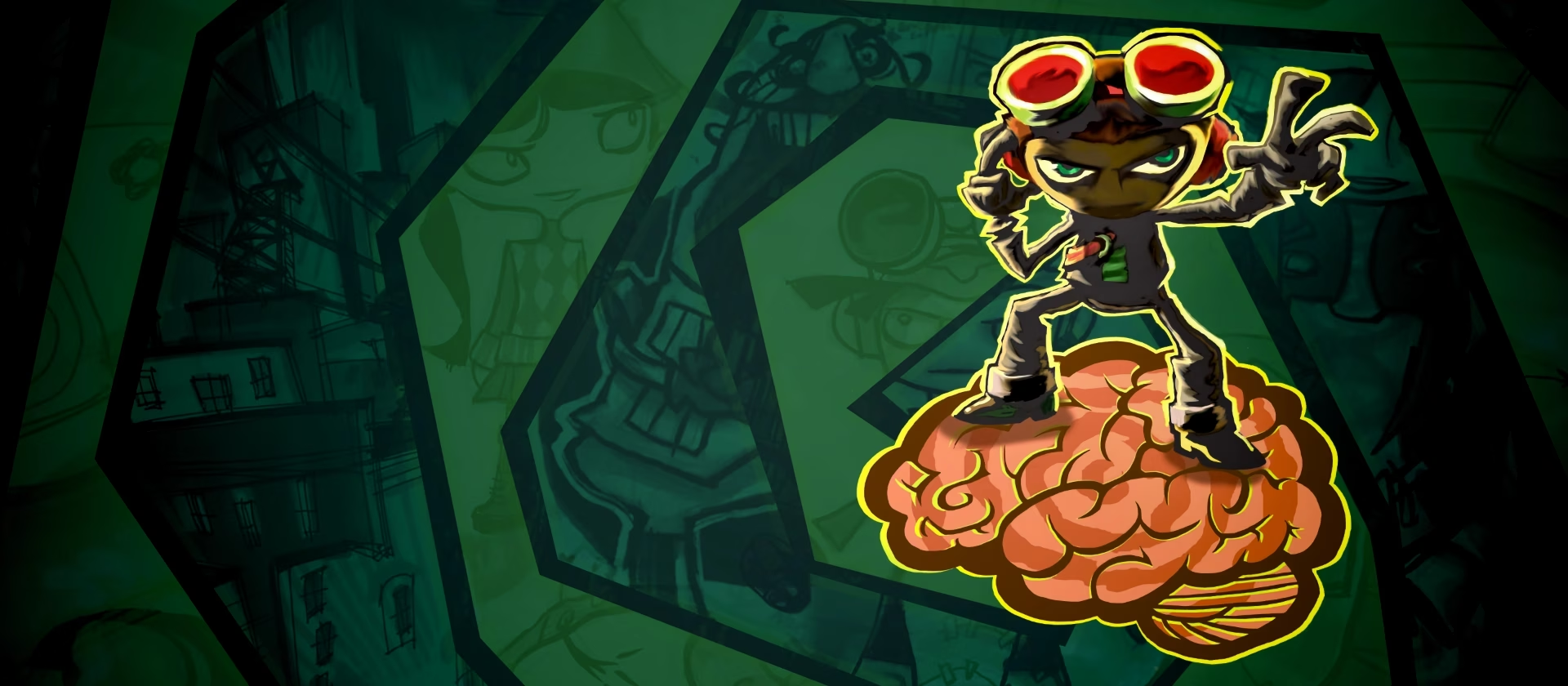
The central mechanic of Psychonauts — the one that makes it feel less like a platformer with jokes than a secret theatre of broken inner weather — came from a misunderstanding. Tim Schafer was pitching a game to someone, and they misheard him.
“They were like, ‘tell me about that game you’re making where you go into other people’s minds?’ And I was like, ‘no, no, you go into your own mind’ — and then I was like, wait a second, I like what you just said better.”
The game that resulted — in which a runaway circus psychic sneaks into a summer camp for psychic children and enters the mental landscapes of every damaged adult he can find — is built on an idea Schafer immediately stole from someone who got his pitch wrong. That this game survived the next four years of development to reach shelves at all is a story that belongs alongside the game itself. The two are inseparable: one strange premise, one stranger production, both held together by stubborn faith in the exact wrong commercial object.
Every Level Is a Different Game
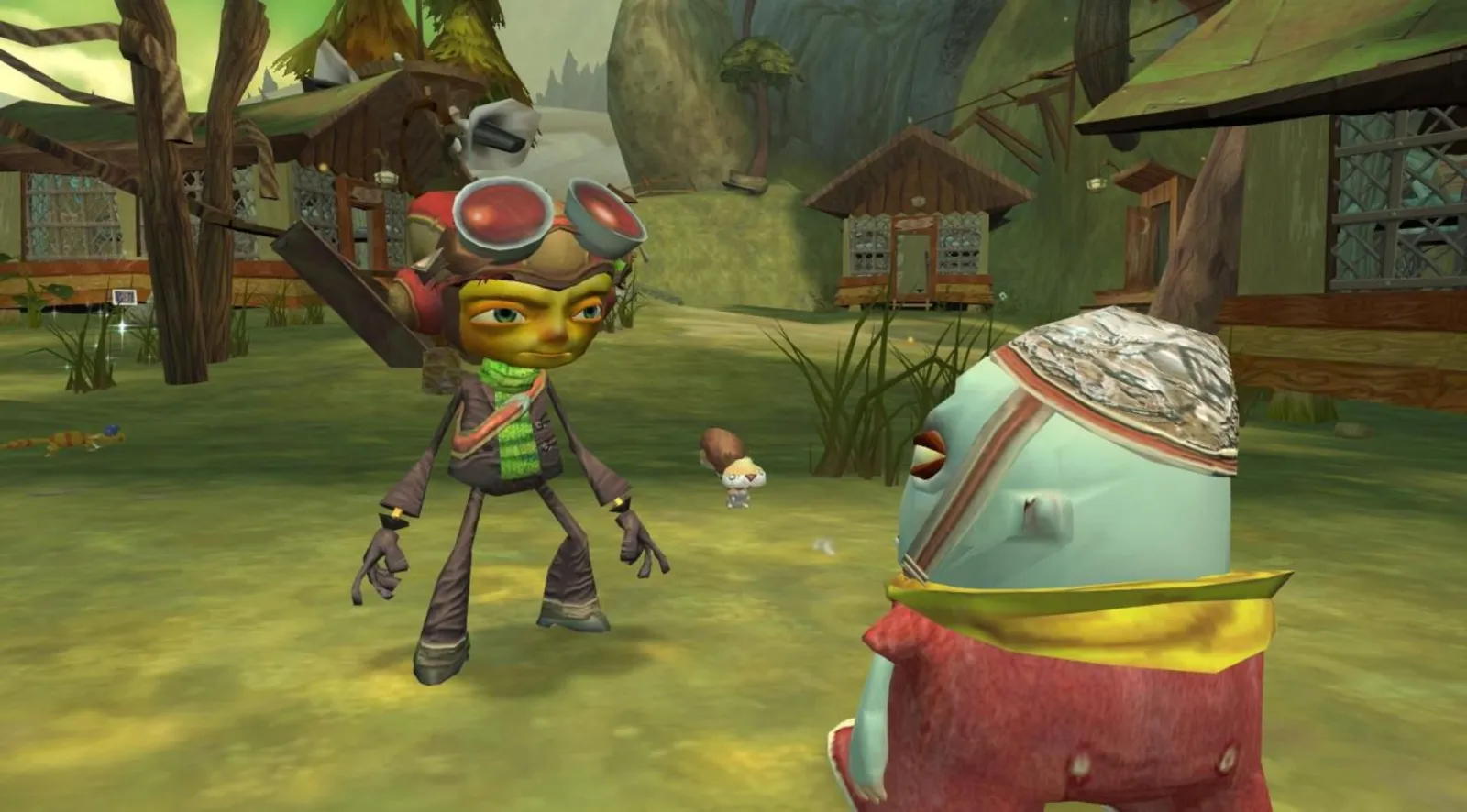
Whispering Rock — the only stable geography the game keeps returning to. The camp is the ruler the player measures every adult’s distortion against. Screenshot: Psychonauts · Double Fine, 2005.
What Schafer built with that misfired idea is a platformer in which every stage is structurally, visually, and mechanically distinct from the last — not as a tech showcase but as characterisation you can jump through. The mind of a retired military commander is a war-game diorama, toy soldiers and cardboard tanks moving across a suburban tabletop in miniature. A film actor’s psyche is a perpetually burning theatre, the architecture shifting with his suppressed melodrama. A hex-strategy board game levels the floor for an asylum orderly losing a battle of wills to a hallucinated Napoleon. The game’s most celebrated set piece is Boyd Cooper’s — a paranoid security guard whose mind becomes a 1950s suburb where the streets fold and recurve in on themselves, cameras erupt from mailboxes and birdbaths, and G-Men patrol the neighbourhood holding everyday props without knowing what they are.
The G-Men spout lines like “I cannot wait until the next payday” and “rhubarb is a controversial pie flavour,” dialogue written to sound like what an alien might calculate passes for human small talk. Schafer wrote it himself after his first choice, co-writer Erik Wolpaw, was unavailable. The dialogue is flat and nonsensical while carrying a thread of internal logic — Schafer noted that the rhubarb line specifically was rooted in the fact that rhubarb is poisonous if improperly prepared. Boyd’s suburb collapses normal spatial rules: gravity pulls the player onto walls and across impossible angles, the physical expression of a mind that can no longer find its bearings in ordinary reality. What the Gameological Society called “the first great example of game environment as characterisation” emerged not from a level designer’s brief about paranoia but from a joke someone told at a company dinner — a random utterance, “I am the milkman, my milk is delicious,” which Schafer recognised immediately as the foundation of something. The level was then built outward from that phrase, Schafer constructing a web of real conspiracy theories, film references, and dialogue from a man the studio paid to sweep the alley outside their office who turned out to hold elaborate beliefs about pelicans and plastics.
The premise is not metaphor in any soft sense. It is level design, applied with total commitment. The mechanisms of each stage — what you can do, how the space is organised, what counts as an obstacle — derive from the psychology of the person whose mind you are in. The game does not use the mental-landscape premise as a coat of paint over conventional structure. It lets every psyche vandalise the rulebook, then asks the player to learn the new handwriting.
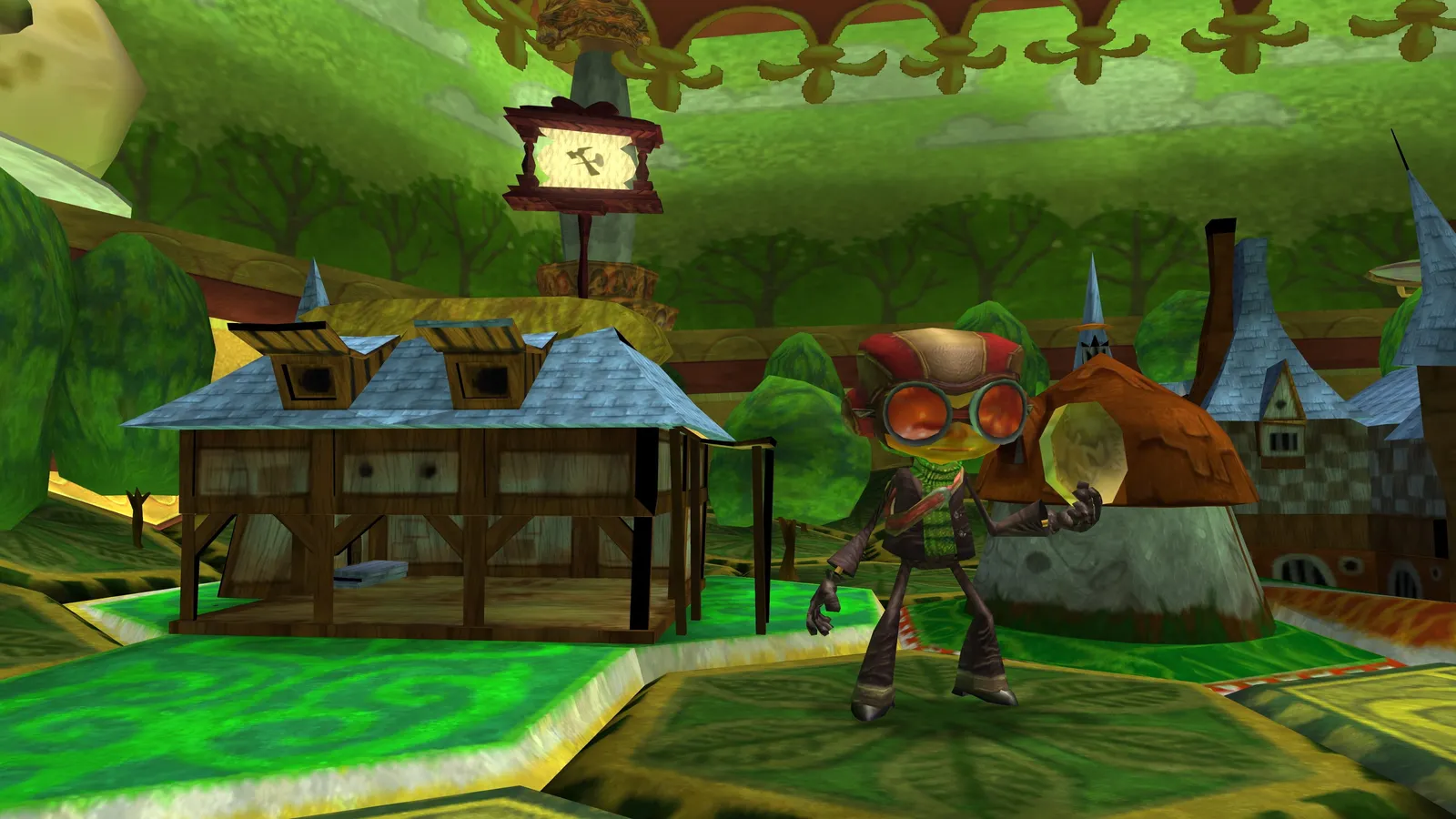
Waterloo World — the floor literally is the board game Fred Bonaparte is losing in his head. Topography as symptom; the character isn’t a backdrop but the rulebook. Screenshot: Psychonauts · Double Fine, 2005.
The Game That Nearly Didn’t Arrive
The conception of Psychonauts traces back to a sequence Schafer wanted to include in Full Throttle, in which the protagonist takes peyote and enters a psychedelic state. LucasArts rejected the idea on the grounds that it wasn’t family-friendly. Schafer kept it, developed it privately, and when he left LucasArts in January 2000 to found Double Fine alongside colleagues David Dixon and Jonathan Menzies, the idea came with him. Development began in 2001 in a warehouse on Clara Street, San Francisco — the only space the team could afford during the dot-com boom, large enough, Esmurdoc noted, to park cars next to the desks.
Psychonauts was originally under development for Microsoft as an Xbox exclusive. Ed Fries, then Vice President of Game Publishing, was the game’s champion inside the corporation. By 2003, the workflow had fractured: level designers and artists were overwriting each other’s work, leaving levels unplayable. The crisis prompted a drastic reorganisation — most of the level design team was dismissed, and the World Building team was restructured under lead designer Erik Robson. It was this reformed team that produced Black Velvetopia in a focused three-month sprint to prove to Microsoft that the game was working. Microsoft renewed the greenlight. Then, in February 2004, at what Esmurdoc described as the team’s peak productivity, Microsoft dropped the project anyway. Fries had just departed. The new management considered Double Fine expensive and late.
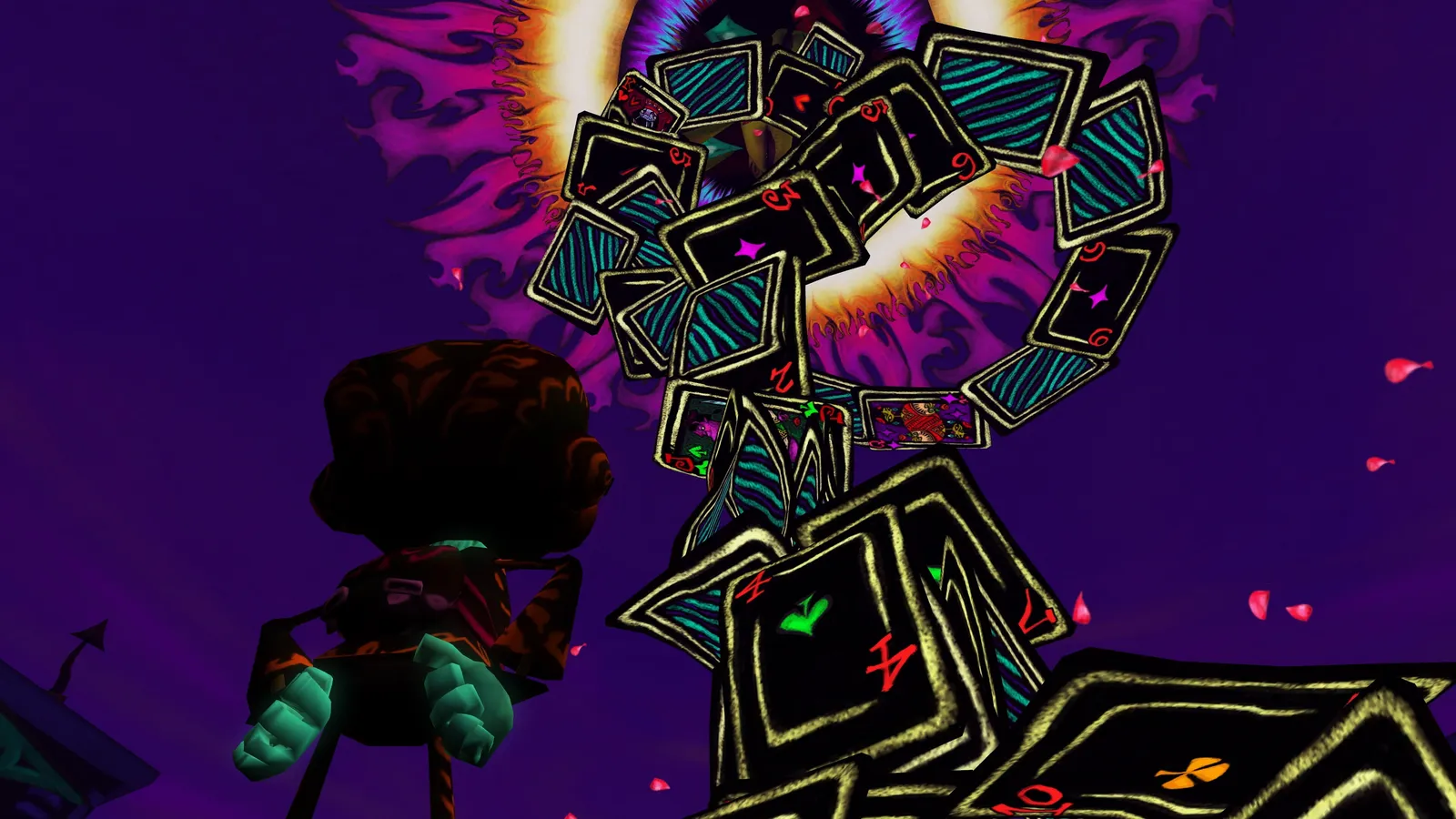
Black Velvetopia — the level built in twelve weeks to prove the game still had a pulse. Velvet-painting kitsch as proof of life: a luchador mythology rendered in matador colours, a thesis the studio could put on a Microsoft executive’s desk. Screenshot: Psychonauts · Double Fine, 2005.
What followed was months without a publisher, keeping development alive on internal funds. Schafer made a call he had been dreading. Will Wright, who had recently sold Maxis to Electronic Arts, was legally prevented from taking an equity stake in Double Fine by the terms of that deal. He gave Schafer the money anyway — an unconditional loan, no equity, no contract beyond what their lawyers could construct around it. Wright is credited by name in the finished game. By August 2004, Majesco Entertainment had signed Double Fine, but on terms that prevented additional hiring without any reduction in scope. What followed was, in Esmurdoc’s words, “the most insane crunch I have ever witnessed.” Two months later, a PS2 port was announced for external development by Budcat Creations, stretching Double Fine’s resources further.
The Publisher the Game Ruined
Psychonauts went gold in March 2005. The final budget was $11.5 million across 4.5 years of development, with a team of 42 full-time developers and additional contractors — though Esmurdoc noted that without the complications, the real creative development time was closer to two years. The game launched on April 19, 2005. Majesco positioned it as a children’s platformer. The game is a political thriller about memory, implanted identity, and the architecture of mental illness. PC Gamer awarded it their “Best Game You Didn’t Play” designation, noting in their citation that roughly 12,000 PC players had bought it. Majesco had sold approximately 100,000 copies in total. Within a month of launch, Majesco revised their fiscal year projections from an $18 million net profit to an $18 million net loss. The CEO resigned immediately. The publisher that saved Double Fine was subsequently ruined by the game it had saved.
The critical reception, by contrast, was nearly unanimous. Psychonauts won Best Writing at the Game Developers Choice Awards, a BAFTA for Best Screenplay, the E3 Game Critics’ Best Original Game, and end-of-year awards for art direction and writing from outlets including Computer Games Magazine. PC Gamer’s editors closed their citation with: “Okay, look, we gave it an Editors’ Choice award — that’s your cue to run out right now and buy Tim Schafer’s magnificent action/adventure game.” The awards and the sales figures were a perfect, terrible inversion of each other. The game had been recognised by everyone who played it and ignored by almost everyone who hadn’t, like a secret masterpiece trying to shout through the wrong box art.
The Score That Matched the Levels
Peter McConnell had scored Grim Fandango and Day of the Tentacle at LucasArts working alongside Schafer, and the collaboration carried across to Double Fine. At the time, McConnell was working from a cottage studio in Berkeley while Double Fine operated from what he recalled as a garage requiring developers to climb a scaffold past their own exhaust fumes to reach their desks. The score he produced mirrors the logic of the level design: each mental world has its own musical grammar derived from the character it inhabits. Boyd’s suburb draws on Cold War paranoia and the cues of 1960s spy cinema, channelled through something that evokes the Twilight Zone — watches ticking, strings fraying, rhythm slightly wrong. Gloria’s burning theatre runs in theatrical strings. Oleander’s war-game miniatures move to something between a toy march and a military drum pattern. The music does what the levels do — it builds each character from the inside out, sourcing its grammar from what that person is rather than what genre convention supplies.
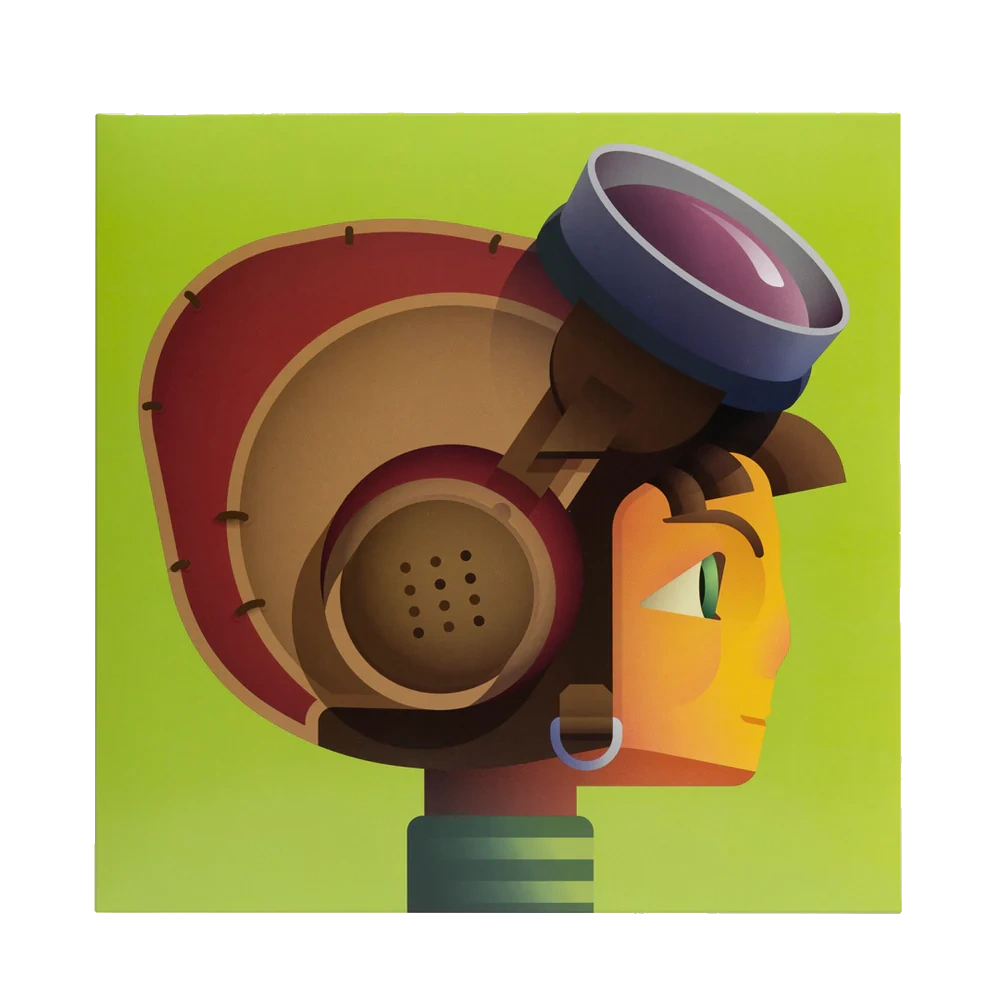
The score’s genre-hopping has become part of the game’s afterlife: iam8bit’s 20th Anniversary Edition presses the original soundtrack alongside the game’s cinematic score. Product image: iam8bit.
The two soundtracks McConnell produced — the in-game score released in 2005 and the cinematic score released the following year — document a game with more musical personality per level than most titles manage across their entire runtime. Even away from the controller, it sounds like rooms with thoughts of their own.
The Game Nobody Could Match
In June 2011, the publishing deal with Majesco expired and full rights reverted to Double Fine. Psychonauts was brought to Steam in October 2006, and the post-reacquisition release — updated for modern systems, available on Mac — began finding the audience that the original launch had missed. By December 2015, cumulative sales had reached nearly 1.7 million copies, the majority of them sold after Double Fine reacquired the rights — meaning the game had outsold its entire original run several times over. A game that finished its publisher went on to generate far more revenue in digital distribution than it had ever managed at retail.
The sequel arrived eventually, funded through Fig, then carried through development by Microsoft after their 2019 acquisition of Double Fine. Schafer had a ping-pong ball on his desk when he signed the acquisition paperwork — with an Xbox logo on it, the same one Ed Fries had given him at their first meeting nearly two decades earlier. The sequel is excellent and does not change what the original accomplished. What remains from 2005 is a game the industry spent fifteen years trying to build on without quite reaching. The level design — every world constructed from a specific character’s particular failure to think straight, every obstacle a projection of someone’s interior life — has not been matched by anything that came after it. The writing still lands. The colour of the sky in its world is still violently, beautifully wrong. The misheard pitch turned out to be the right one.