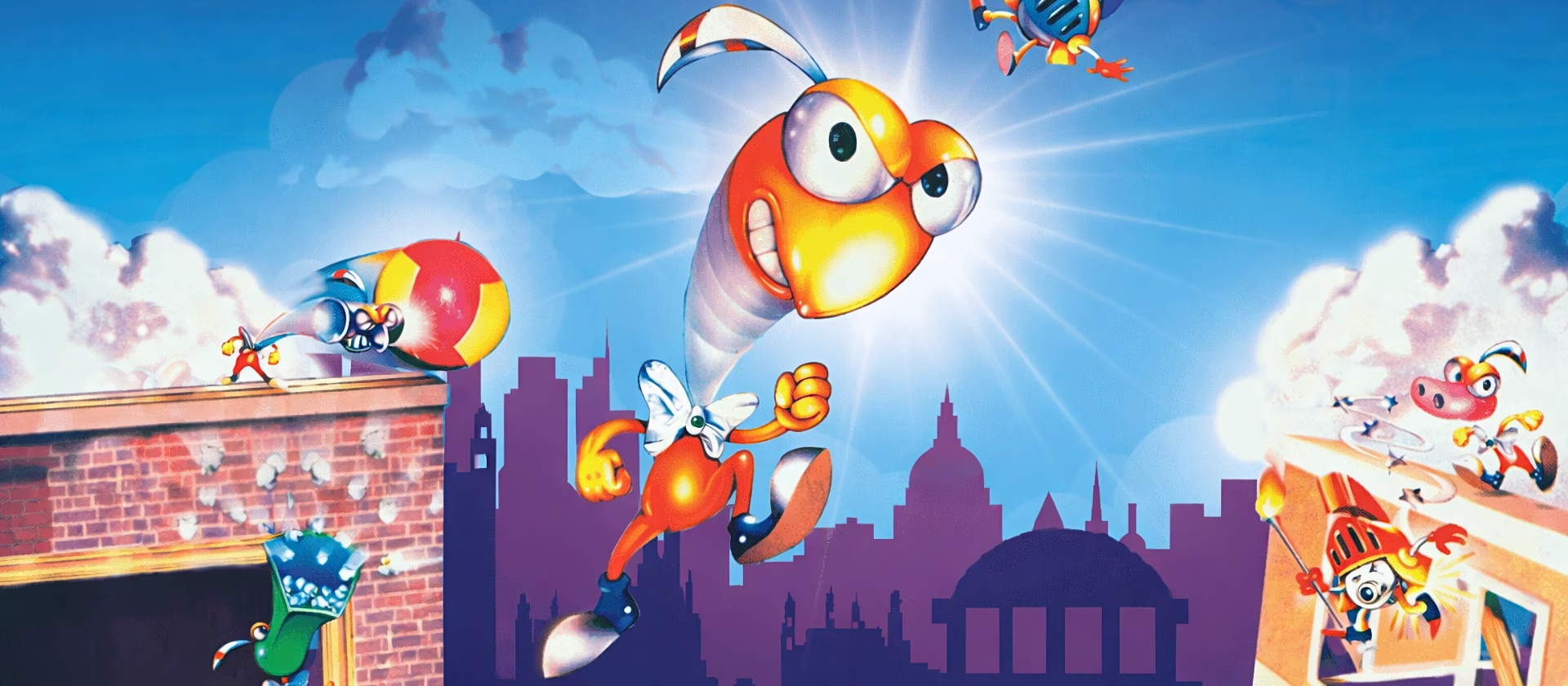
There is a particular kind of confidence that only Treasure had in the mid-1990s: the confidence to treat restraint as someone else’s problem. Dynamite Headdy does not merely introduce a mechanic and iterate on it. It throws a detachable head, a puppet-theatre frame, boss fights every few minutes, fake stage scenery, background gags, secret rooms, musical quotations, and constant tonal swerves at the player almost simultaneously, then behaves as though this is the most natural thing in the world. Most platformers ask you to settle into a rhythm. Dynamite Headdy keeps changing the stage around that rhythm and dares you to keep up.
What survives now is not just novelty. It is design pressure. Every few screens the game has another idea to spend, another visual joke to turn into a hazard, another boss entrance that changes the meaning of the room you were just standing in. Treasure made plenty of louder games, but few that reveal the studio’s habits this clearly: impatience with repetition, obsession with spectacle, and a belief that a platform game should feel like a live performance constantly threatening to go off-script.
A Mascot Game That Refuses Mascot Rules
On paper, Dynamite Headdy looks like capitulation. Here was Treasure, fresh off Gunstar Heroes, making a bright 16-bit platformer starring a cute character with a marketable silhouette in the exact historical window when every publisher seemed to want its own mascot. But the game does not behave like an attempt to imitate Sonic or Mario. Koichi Kimura’s central idea was stranger and more mechanical than commercial: a character who attacks with part of his own body, turning range, positioning, and movement into the same problem. Headdy’s head is a projectile, a grappling tool, a switch-activator, and occasionally an absurd temporary disguise. That one choice changes the whole texture of play.
Headdy does not simply jump on enemies. He stands off from them, angles attacks in eight directions, grabs hooks with his face, and yanks himself across gaps — combat that feels faintly like a shooter folded into a platformer. Treasure understood immediately that this was enough to carry the game mechanically. The replacement heads, the obvious headline feature, are secondary. The real substance is the ordinary head, the one that turns every encounter into an issue of spacing and timing.
That ordinary head is what gives the game its tempo. Every throw is a negotiation with the screen; every recall is a beat in the performance. The best levels are the ones where the stage is still moving beneath you, but the rhythm of that ordinary attack makes the motion legible. Dynamite Headdy is not a grab-bag platformer held together by power-ups. It is a very tightly made action platformer wearing the costume of a toybox.
The Theatre Is the Mechanic
The game’s great trick is that its theatrical framing is not just aesthetic. It structures the play. Curtains open. Stagehands wheel scenery in and out. Sets collapse. Props reveal themselves as enemies. Bosses enter like performers arriving for their scene late and overprepared. Even the stage names sound like acts in a production that keeps being hijacked by lunatics. This could easily have remained a visual wrapper around an otherwise conventional game. Treasure instead builds around it.
Rooms change function mid-performance. Backgrounds are forever pretending to be stable and then betraying that stability. A platform rotates in fake 3D because the game wants you to feel that the set itself is being manipulated in front of you. The pleasure of Dynamite Headdy is not just that it is inventive, but that its inventions are almost always staged. You are moving through a performance where the scenery has agency.
Treasure does not use the stage metaphor to justify set dressing. It makes the stage an active opponent. The game asks you to read the crowd — the flashing lamps, the grin on a prop, the timing of a drum hit — rather than just the platforms. That is a rare choice in a genre that usually treats environment as neutral ground. Think of Trouble Bruin’s entrances, each of which rewrites the proscenium before the fight begins, or the scene in which a giant hand reaches in from offstage to rearrange the floor beneath you. The antagonist, in moment after moment, is the show itself.
This is why the game’s excess rarely feels random. Treasure wants you to feel that nothing on the stage can be trusted to remain what it first appeared to be. Even the screen’s own framing is part of the trick: the apparent “foreground” reveals itself, at a decisive moment, to be scenery that can be pulled away, and what you took for background will often be the real floor. The result is one of the few 16-bit platformers whose chaos reads as authored rather than cluttered.
The Treasure Problem
The flaw is also a Treasure trademark: impatience. The studio was almost pathologically unable to leave a good idea alone for more than a few minutes. That restlessness is what makes the game memorable, but it also means Dynamite Headdy sometimes sacrifices coherence for surprise. Stages do not build patiently to a single thesis so much as sprint through several. Replacement heads appear as though they are about to become central, then vanish for long stretches. Bosses are brilliant so consistently that ordinary traversal can feel like connective tissue between set-pieces rather than the point itself.
And then there is the North American version, whose difficulty was infamously pushed upward at Sega of America’s request. Treasure complied, and complied enthusiastically. Dialogue was pared back, some visual detail changed, bosses took fewer hits to stagger and more to fell, and the exported version became noticeably less forgiving than the Japanese release. The result is still playable, but it is a worse-balanced expression of the game. What was already a busy, fast-changing platformer became one that asked for more memorisation and less delight. You can feel the commercial logic behind the change and the damage it does almost immediately. Sega of America in 1994 believed Western players would return a game they finished in an afternoon; the fix, as ever, was to make the game punish them instead of delighting them longer.
The localization changes did more than tighten the hit window. They also shaved away some of the game’s personality. What had felt like a ramshackle puppet revue in the Japanese release becomes, in the US version, a harder-edged sequence of obstacles. The version that feels closest to Treasure’s intentions is the one that keeps the show feeling improvised rather than rehearsed.
That matters because Dynamite Headdy is at its best when it is playful rather than punitive. Its brilliance lies in surprise, not attrition. Save states help. The Japanese version helps more.
The Late-16-Bit Problem
It also arrived at the wrong moment. By late 1994 the Mega Drive/Genesis platformer market was exhausted with mascots, and many of them were bad. To a quick glance, Dynamite Headdy looked like one more desperate animal-or-object-with-an-attitude game trying to force itself into the same shelf space. That glance was misleading, but commercially fatal. Treasure had made something too peculiar to read instantly and too busy to sell on a single screenshot.
What those screenshots could not communicate was the density. Treasure’s programmers fill the hardware with oversized sprites, collapsing scenery, rotating effects, and visual transitions that feel half-show-off, half-punchline. The art direction, reportedly shaped in part by Western animation and Terry Gilliam, refuses the clean mascot-house style that publishers usually wanted. The world is colourful, but it is not cuddly. It is theatrical, mechanical, unstable. The game keeps nudging itself toward parody without ever breaking the platforming underneath. The puppet cast is slightly wrong in a way the era’s other mascots never risked: Headdy’s face reads as friendly and uneasy at once, and the villains look less like licensable toys than like props that have escaped from a cheaper production next door.
That helps explain why it has aged unusually well. Many mascot platformers from the period feel like branding exercises attached to serviceable movement. Dynamite Headdy feels authored all the way down. Even when it is messy, it is messy for reasons that belong to it. And the studio’s later work makes the shape of those intentions clearer in retrospect. The collapsing-set logic that Dynamite Headdy pioneered turns up again, sharpened, in Alien Soldier and Mischief Makers — games that also refuse to let a room mean one thing for more than a few seconds. Seen in that lineage, Dynamite Headdy is less a commercial misfire and more the first full expression of how Treasure would design for the next decade.
What the Head Was For
The honest case for Dynamite Headdy now is not that it was overlooked, though it was. It is not even that it was technically impressive, though it clearly was. It is that it still delivers a kind of 2D action design most platformers avoid: one that values velocity, surprise, and formal instability over polish understood as calmness. Every time you think you understand its shape, it changes the stage, changes the boss, changes the joke, or tears down the room and builds another.
That can be exhausting. It is also why the game is worth playing. Few 16-bit games ask you to keep your fingers on the trigger and your attention on the scenery at the same time. That intrusive theatrical anxiety is not a bug in Treasure’s design; it is the thing the game is asking you to enjoy.
There are cleaner platformers on the Mega Drive. There are more iconic ones. But very few are as alive from moment to moment. Dynamite Headdy feels like a game made by people who were afraid you might get bored for even ten seconds and treated that fear as a design principle. Thirty years on, with the whole mascot era flattened behind us into one indistinct decade of animals with attitude, that restlessness has become the game’s clearest argument for itself. The stagehands never leave. They are always somewhere just out of frame, pulling the next backdrop into place.