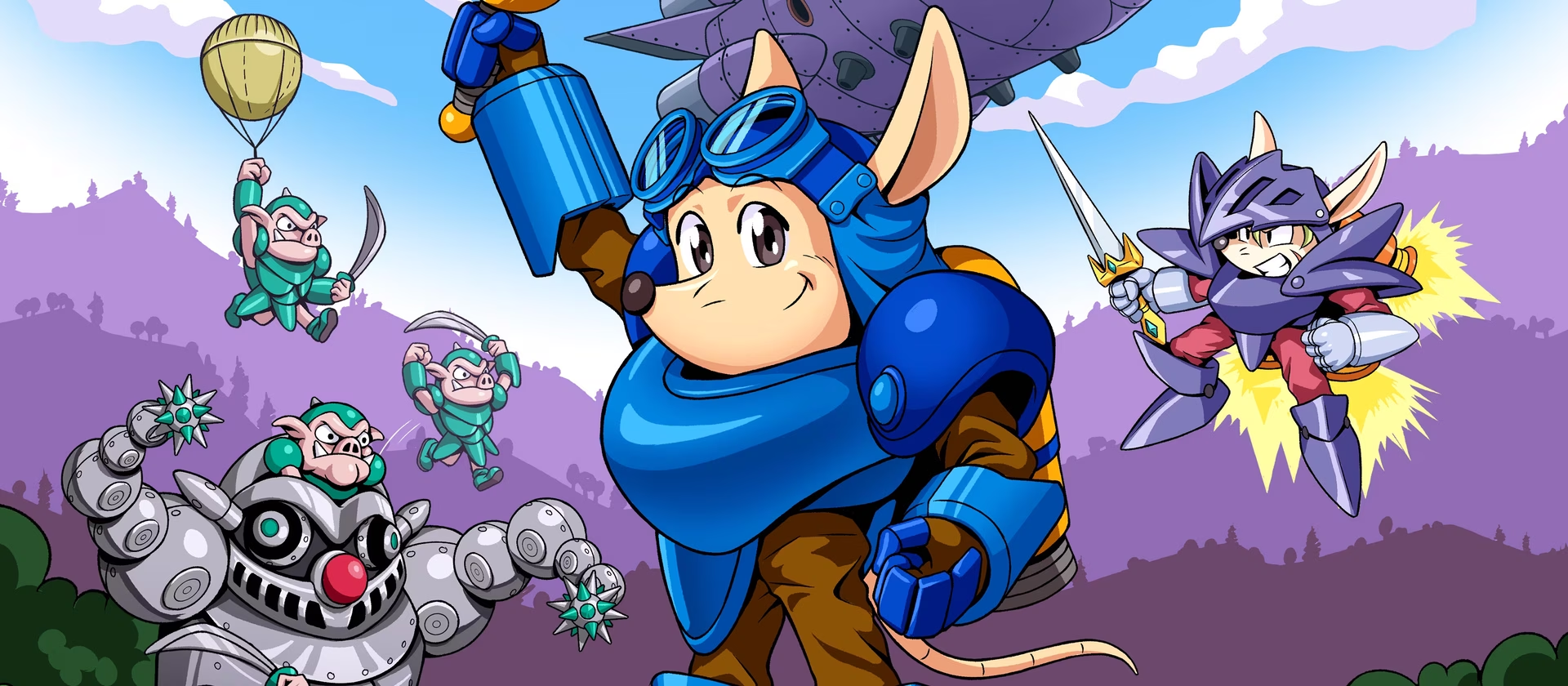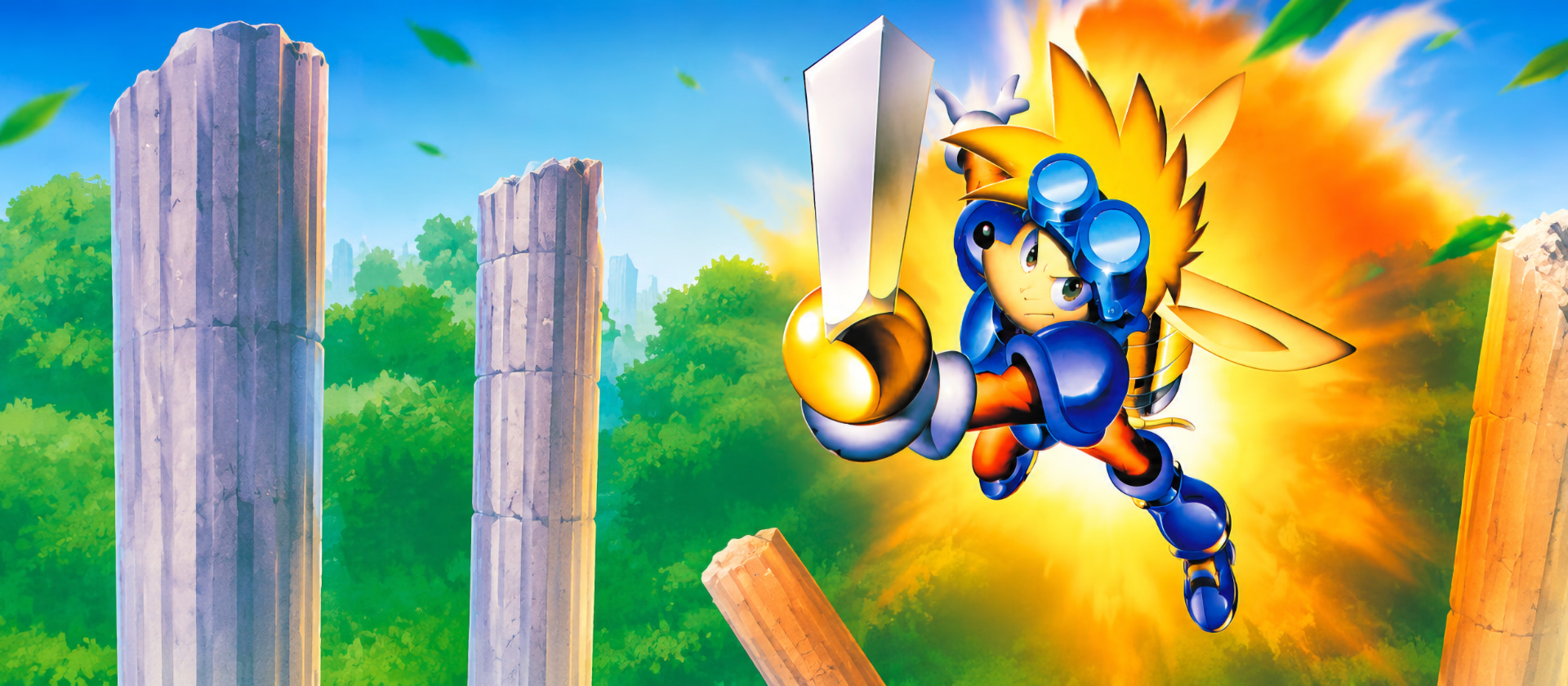
Two games called Sparkster shipped in Japan within eight days of each other in September 1994. Different teams. Different directors. Different consoles. The one on the Mega Drive carried a subtitle — Rocket Knight Adventures 2 — and the proper claim to canon. The one on the Super NES carried no number at all and was filed, then and now, as a spin-off. Konami’s numbering held up in Famitsu, where the Mega Drive sequel scored a point higher. It held up in the catalogues. It held up almost everywhere except the cartridges themselves.
Play them now, side by side, and the numbering inverts. The spin-off is the truer sequel. The one with the subtitle is the strange detour. The reason is in the credits: two directors with two completely different inheritances, both handed the same character at the same moment, both asked to make a follow-up to a game whose director had already moved on to Contra: Hard Corps.
Two Sequels, Eight Days Apart
Nobuya Nakazato directed the original Rocket Knight Adventures in 1993 — the Mega Drive cartridge that hid arcade Konami inside a marsupial suit. By 1994 he was elsewhere, building Contra: Hard Corps for the same platform. The Sparkster work fell to two other teams, working in parallel, on opposite sides of the 16-bit divide.
On the Mega Drive, the assignment went to Yasushi Takano, an artist promoted from inside the original Rocket Knight Adventures crew. The result was branded with the original’s subtitle and a numbered “2”, and Konami marketing in Japan treated it as the canonical continuation. On the Super NES, the assignment went to Hideo Ueda, who had directed the X68000 port of Akumajou Dracula in 1993 and, the year before that, Axelay. Konami Japan released his game eight days earlier — 15 September 1994, against 23 September for the Mega Drive — under the bare title Sparkster, with no subtitle, no number, and no editorial weight as a sequel.
It is hard to read this as anything other than Konami declaring its preference up front. The Mega Drive was where Sparkster came from. The Mega Drive was where the line was supposed to continue. The Super NES game was something else — a parallel work, a spin-off, the kind of release a publisher schedules to fill a slot. Then both shipped, and reviewers in Japan agreed: Famitsu’s Cross Review gave the Mega Drive sequel 31/40 and the Super NES game 27/40. The Western press inverted it. Electronic Gaming Monthly called the Super NES game Konami back to form, gave it 8.2/10, and named it Best Sound Effects of 1994; the Mega Drive sequel scored a more cautious 7.2. The territorial split has survived all the way into the bundled re-release thirty years on.
Ueda Came From Axelay
Open the Super NES cartridge and the first thing that registers is the charge meter. Hold the attack button, fill the bar, choose one of eight directions, and Sparkster fires himself across the screen. The pack does not refill automatically; the player commits to the window, lives with the consequences. The sword still throws a short projectile when uncharged. The first set of corridors is built around bouncing that projectile into corners and reading the ricochet. Anyone who finished the original Rocket Knight Adventures recognises the entire vocabulary in the first minute.
Ueda’s only real addition is the rolling dash on the L and R shoulder buttons: a short horizontal burst that costs nothing and recovers fast. It is the rare sequel mobility upgrade that extends the original toolkit rather than replacing it. The charge dash still does the big committed work; the L/R burst handles the small corrections the original asked the player to absorb. The stages then open out to make use of both. Vertical shafts. Long fall lines. Backgrounds that scroll because the camera has somewhere to chase. Kurt Kalata at Hardcore Gaming 101 writes that the SNES game has “more open stages, with larger vertical spaces that allow you to play around with the jetpack much more than its predecessor,” and the design reads as Ueda actually trusting the verb he was given.
The arcade-Konami detour is here too. Where the original Rocket Knight Adventures used a Gradius-shaped horizontal shooter for its Stage 6 reveal, the Super NES game drops a single top-down shooter section into its run. The Konami habit — break the side-scroller, dare the player to handle another genre for a few minutes — survived the platform transfer. The lineage explains the choice better than the credits do. Axelay in 1992 had been Konami’s last vertical scrolling shooter for the Super Famicom, a showpiece for the system’s Mode 7 hardware and the team’s reading of arcade design under cartridge constraint. Ueda came to Sparkster with that grammar still in his hands.
The ostrich-mountain stage is where the SNES game cashes the deposit. Sparkster rides a mechanical bird up a switchbacking peak at full tilt, scrolling past hazards faster than the rest of the game ever does. Playing With Super Power’s review — broadly cooler on the SNES game than the recent consensus — singles this stage out as the one that “maintains the most blistering pace in the game,” and that is the right word for it. Pace. The rest of the cartridge keeps the original’s rhythm of short, varied substages, each handed a different problem. The bird ride is the moment when the team’s restraint about speed pays off.
Takano Came From the Art Room
The Mega Drive sequel begins by retiring its inheritance. The charge meter no longer fills under the player’s control; it refills on its own, fast enough to let the player fly more or less indefinitely. There is no projectile sword — Sparkster’s swing, in Hardcore Gaming 101’s reading, is “pitifully sluggish,” and the original’s reflective-angle puzzle vocabulary disappears with it. The on-foot speed is lower. Enemies are dinosaurs and lizards rather than the pig empire. The shooter detours have become mech-pilot sections. A roulette mechanic, fed by jewels collected through the level, drops either a power-up or a bomb on the player’s head.
Each of these changes is defensible alone. Together they describe a different game. The original Rocket Knight Adventures asked the player to commit to a charge, choose an angle, accept the cost of being wrong. The Mega Drive sequel removes the commitment — the jetpack just refills — and then asks the player to track a small slot machine in the corner of the screen while threats appear at ground level. Stuart Gipp’s Retronauts review names the cost in passing: the roulette “forces players to monitor the HUD instead of focusing on ground-level threats.” The mechanic does not add a layer to the original design. It pulls attention sideways out of it.
The Mega Drive bosses get the worst of it. Where the original had multi-jointed contraptions whose segments could be read and learned, the sequel’s encounters — Retronauts again — are “primarily excruciating; either dull or annoying with no inbetween.” There is nothing wrong with most of the level design; the game is competent, well-drawn, fluently animated by a team that knew the hardware. What is missing is the original’s posture. Rocket Knight Adventures moved like arcade Konami in a marsupial suit. The Mega Drive sequel moves like a careful tribute, made by people who loved the original but did not direct it.
”The Super NES game may be frustrating, but I had way more fun working my way through it than the other one.”
— Kris Randazzo, Stone Age Gamer
Randazzo’s comparison piece runs the two games against each other category by category and gives the Super NES a 4–1 win. The frustration he names is real — the Super NES game’s harder difficulties lean on randomised boss patterns, and the camera on the vertical stages can put threats above the playfield faster than the player can climb to meet them. But the comparison ends where it starts: only the Super NES game still plays like the original.
Yamaoka and Yamane, Before the Names
The music is the place where the two games secretly agree. Both credit Michiru Yamane, three years before Castlevania: Symphony of the Night would make her name a shorthand for a certain kind of gothic-baroque score. Both credit Akira Yamaoka, four years before Silent Hill would do the same for industrial dread. In 1994 both were Konami staff composers writing children’s-action soundtracks. The Mega Drive game adds a separate roster of Konami arcade-and-NES veterans; the Super NES game adds Kazuhiko Uehara, Masahiro Ikariko, Minako Matsuhira. The point is the overlap. Most of the cues are the same. Stone Age Gamer’s comparison calls the tie honestly: “Most of the songs themselves are actually the same! This one all comes to down to instrumentation.”
The instrumentation is where the platforms speak in their own voices. The Mega Drive’s Yamaha FM synthesis sharpens the brass and gives the boss music a metallic snap. The Super NES’s sample-based audio softens the same melodic lines, foregrounds the lower registers, and — in the stages built around vertical motion — opens a low pad under the lead that the Mega Drive arrangement cannot reproduce. Neither is the better score. They are the same music played by two different bands, both of whom would soon become known for something darker.
This is the texture worth holding onto. Both games were made by Konami’s working composer rotation at the moment before its members became famous for their solo voices. Listening to either soundtrack now, you hear Yamane and Yamaoka in their Konami arcade-action register, before the labels stuck. EGM’s Best Sound Effects of 1994 award went to the Super NES game; the deeper musical interest is that the same two composers had spent that year writing the same melodies twice, for two teams who disagreed about almost everything else.
The Bundle Settles It
Until June 2024 you needed three cartridges to make the argument this piece has just made. Rocket Knight Adventures: Re-Sparked — Konami via Limited Run, Carbon Engine emulation, museum mode with concept art and box scans but no developer interviews — bundles the original and both sequels into one purchase. Rewind smooths the difficulty traps of the original North American Mega Drive cart. Save states make the Super NES game’s harder-mode boss randomness something you can practice rather than fear. And the comparison this article has spent fifteen hundred words building becomes a fifteen-minute experiment: load Sparkster (SNES), play the first vertical stage, swap to Sparkster: Rocket Knight Adventures 2, play the same character without the projectile sword and with the roulette spinning in the corner. The body knows the difference before the eye reads the HUD.
The bundle also makes the older verdict reversible. Famitsu in 1994 preferred the numbered sequel; Konami’s catalogue agreed; the Japanese retrospective consensus has continued to treat the Mega Drive game as the canonical line. The Western press in 1994 split the other way, and the past two years of English-language coverage — Gipp at Retronauts, Randazzo at Stone Age Gamer — has settled, by play and not by lineage, on the Super NES game. The bundle lets a reader run the experiment themselves and decide which territory was reading the carts correctly.
The choice does not have to be doctrinal. Both games are competent. The Mega Drive sequel has a more elaborate mechanic, a denser bestiary, a roster of bosses that some players will read as elaborate where this piece has called them excruciating. The Super NES game has the cleaner descendant of the original’s grammar — manual charge, projectile sword, vertical stages, a top-down detour that remembers Gradius — and the better claim to inheritance even though Konami filed it as a spin-off. The cartridges argue themselves. The eight days between them have been long enough.