// // import ggAlesteHomingWeaponPoster from ”../../assets/images/gg-aleste-1991-homing-weapon-poster.jpg”; // deleted // deleted
// // import ggAlesteStage7ColonyPoster from ”../../assets/images/gg-aleste-1991-stage7-colony-poster.jpg”; // deleted // deleted
Compile built great shooters because they understood exactly what they were doing. GG Aleste was built by someone who didn’t: a graphic designer with no console experience, operating on borrowed programming support and professional pride alone. The game’s character lives in that gap — the narrow space between what a Compile shmup was supposed to be and what this one could be, given who made it and what it ran on. In 1991 the Game Gear was new and sold nowhere outside Japan, and GG Aleste shipped on December 29th and went no further than that. The West had no mechanism to encounter it, let alone dismiss it. It simply never arrived. Thirty years later, M2 — the company that treats old hardware the way forensic archivists treat primary sources — thought the formula worth a new sequel: a real cartridge, on real Game Gear hardware, designed and sold in 2020. That is not a nostalgic impulse. That is a design endorsement.
The Takeover
Kengo Morita oversaw GG Aleste before it was a game. That year he was also building Puyo Puyo — the falling-block puzzle title that would outlast Compile itself, generating sequels, spinoffs, and a genre template that still runs today. At some point during development of the Game Gear shooter, the project changed hands. Hiroki Kodama, a graphic designer with experience making software for MSX computers and none making software for consoles, stepped in. Not because he was assigned. Because he was a Compile staffer, the project needed doing, and professional pride was sufficient justification.
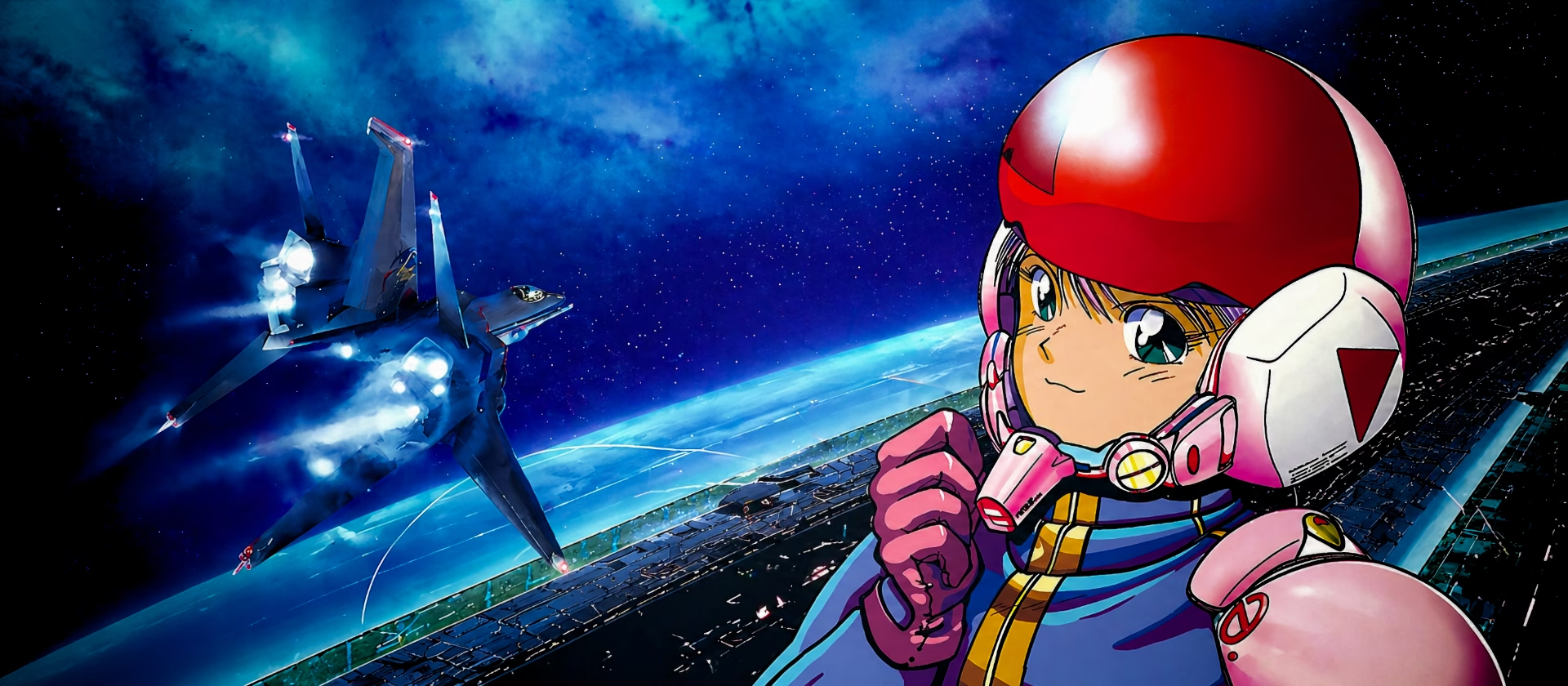
What Kodama inherited was a partial project. Ellinor Waizen — pilot of the Galvanic Gunner, the game’s protagonist in pink armour — was already designed. The platform was chosen. What wasn’t resolved was how a graphic designer with no console hardware knowledge was going to finish it. Kodama has spoken about developing GG Aleste without fully grasping the Game Gear’s specifications, working from what MSX had taught him while supervisor Takayuki Hirono handled the programming architecture that Kodama couldn’t reach. Boss designs went to concept adviser Kazuyuki Nakashima. Stage seven’s space colony setpiece came from programmer Yukinori Taniguchi’s suggestion. The game assembled from distributed contributions, working around one person’s gap, and cohered anyway.
This is not a story about incompetence papered over. It is a story about expertise distributed under pressure — and the result reflects that distribution’s intelligence. Kodama knew how to make things visible. Every design choice in GG Aleste — the enemy silhouettes, the stage environments established in a handful of tiles, the way each boss reads at a glance — reflects a graphic designer’s understanding of what an eye needs to track a scene at speed. He didn’t know console hardware. He knew composition. On a 160×144 pixel LCD screen, the difference matters less than you might expect.
Eight Weapons, One Screen
GG Aleste hands you eight secondary weapons and a forward-firing main shot, and asks you to choose. The laser burns through columns; the homing shot tracks anything on screen; the wave fans out ahead; the spread fills a wide cone; the shield orbits the ship, absorbing bullets and converting nearby enemies into points. Each can be powered up to level four by collecting P-chips from fallen enemies. Dying strips one power level — not the weapon, not the progress, just one notch down the scale. Unlimited continues mean no run ends in full reset. The game is asking you to learn, not punishing you for not knowing.
That generosity is structural, not accidental. The Game Gear’s LCD works against spatial reading: patterns compress, distances shrink, dense waves become harder to parse than on any fixed screen. GG Aleste designs to offset this. Enemy waves are readable within the constraints — patterns that resolve as patterns rather than noise, silhouettes that distinguish at a glance, approach angles that telegraph before they arrive. When slowdown occurs on busier stages, it registers as ambition pressing against hardware, not sloppiness. The trade is visible and honest.
The result is a game of clean decisions. Scan the screen, read the incoming pattern, select the weapon that fits — homing into a corridor of turrets, shield when the wave comes in close — then commit.
Seven stages shift what the screen asks for often enough to keep the cycle from becoming rote. Stage seven’s space colony, Taniguchi’s suggestion, is the game’s best sustained moment: a rotating structure approaching from depth, enemies launching from ports, the horizon pitching as you clear them. It is a small technical achievement and a compositional one, and it sits at the game’s end as a kind of summary. Here is what the people who built this understood about what a frame needs.
The Noise It Makes
Keiji Takeuchi and Toshiaki Sakoda compose for the Game Gear’s SN76489 sound chip: three square-wave tones and a noise channel, the same budget as the Master System, which means a very specific ceiling and a very specific set of decisions within it. GG Aleste’s music doesn’t pretend otherwise. The stage themes are short, looping, built from motifs that register within the first cycle and recede cleanly behind the action. They do what the best arcade music does: establish a room’s character in a few bars, then step back from what the player’s hands are doing.
Within that brief, Takeuchi and Sakoda find texture. The factory stage has a mechanical rhythmic drive — something churning and forward-moving that matches the industrial environment without being merely illustrative. Boss themes tighten and accelerate, correct choices when the action is at its most compressed and the screen most cluttered. None of this reaches for the complexity of Yuzo Koshiro’s work or the layered ambition of Compile’s own M.U.S.H.A. soundtrack on Mega Drive; GG Aleste’s music isn’t trying to be anything other than precisely functional and precisely present. On the Game Gear’s small speaker, or through headphones, it occupies exactly the space it is given. That is harder than it sounds.
The Constraint Argument
Every review of GG Aleste settles, eventually, on the same qualifier: impressive for the hardware. This framing does real damage. It asks the reader to discount before playing a minute, to grade on a curve, to receive whatever arrives as a pleasant surprise rather than as something that earns its own terms. GG Aleste doesn’t ask for a discount. It asks for attention.
The Game Gear’s limitations are not obstacles GG Aleste overcomes; they are, in part, what it achieves. A graphic designer working without full console expertise couldn’t fill the screen with competing systems and layered AI patterns. He could make the screen legible, the weapons distinct, each environment readable at 160×144. He did. The constraint stripped the Aleste formula of what the larger games — M.U.S.H.A. especially, the series’ acknowledged peak — could afford to carry: the density, the spectacle, the sheer visual noise of a 16-bit shooter at full capacity. What remained was the underlying architecture: a shoot ‘em up where weapon choice matters, where reading the screen is the actual skill, where the narrow gap between spotting a wave and responding to it is where the game happens. That architecture doesn’t require 16 bits. It requires design.
”Better made and more fun than thirty-year-old vertical shmups for 8-bit hardware have any right to be.”
— Nintendo Life, reviewing the Aleste Collection (2020)
GG Aleste II — the 1993 sequel Kodama also helmed, released in Europe as Power Strike II — is the better game. Faster, denser, more confident in its boss encounters, with enemy bullets coloured red and green to cut through the Game Gear’s notorious LCD afterimage. If you play one GG Aleste, play the sequel. But the original is where the argument was made, before Kodama had a full run at the platform and before the team had solved its hardware problems. It’s the version built on constraint alone: professional pride, borrowed knowledge, a 160×144 screen. It shows you what those three things, properly applied, are sufficient for.
M2 Agreed
M2 makes emulation systems. They also, occasionally, make games: new games, running on old hardware, authored with the care of people who have studied that hardware at the component level. In December 2020 they released GG Aleste 3 as part of the Aleste Collection for Nintendo Switch and PlayStation 4 — a new entry in the series, pressed onto an actual Game Gear cartridge with an official Sega product code, playing by the rules of 1991 rather than 2020. Critics called it “fast and cinematic and demanding.” One called it “an outstanding 8-bit shooter.” It was, by every account, good on its own terms.
M2 didn’t need to do it that way. They could have made a Switch game that gestured at Game Gear aesthetics from a distance. They chose not to, because what the original GG Aleste formula contains is worth preserving on its own terms — not as nostalgia but as a design argument that still functions when executed cleanly. The Aleste Collection treats the first game and its sequel as the canonical foundation of something that deserved continuation, not just archiving.
The collection is Japan-only, but the Switch is region-free. This matters because GG Aleste was unavailable in the West for thirty years — not rejected, simply unreachable. The sequel Compile released in 1993 made it to European shelves as Power Strike II. The original didn’t make it anywhere. That absence is a strange kind of reception: the game was never given the chance to be dismissed. M2’s collection is the first occasion Western players have had to encounter it in anything approaching an official context, and the terms are generous. Two GG Aleste games, the original Aleste, a new entry that knows exactly what the series was always doing. Start with the first. Play the second when it’s over. The third will show you that M2 understood both.