// import bossLightningPoster from ”../../assets/images/soldier-blade-1992-boss-lightning-poster.jpg”; // deleted
Most shoot ‘em ups want to occupy your evening. They build campaigns long enough to fill it, structure runs around continues and save points, ask for an investment that pays out across hours. Soldier Blade does almost none of that. A full clear runs about twenty-five minutes. The two score-attack modes pinned to the title screen run for two and for five. The implicit ask is not an evening but a loop — closer to a sport than to a story.
Hudson Soft built it that way on purpose. Soldier Blade is the third Star Soldier sequel on PC Engine, and consensus has called it the apex of the line since the cartridge landed in July 1992. What the consensus tends not to mention is that Hudson had to take its own series back to make it. Super Star Soldier was Kaneko’s. Final Soldier was Now Production’s. For two consecutive sequels Hudson licensed its brand out — then, on a six-month deadline that lost a third of its ROM in the back stretch, decided to make the next one itself.
Six months, four megabits
In a 2012 interview, the game’s designer — credited only by his nickname Uribo — laid out the conditions. The team was small and in-house. The schedule ran six months from start to ship. There were “little to no planning meetings,” he recalled, and instead everyone “threw their ideas out on the spot.” A pen, a sheet of grid paper, a corridor conversation; whatever stuck went into the cart.
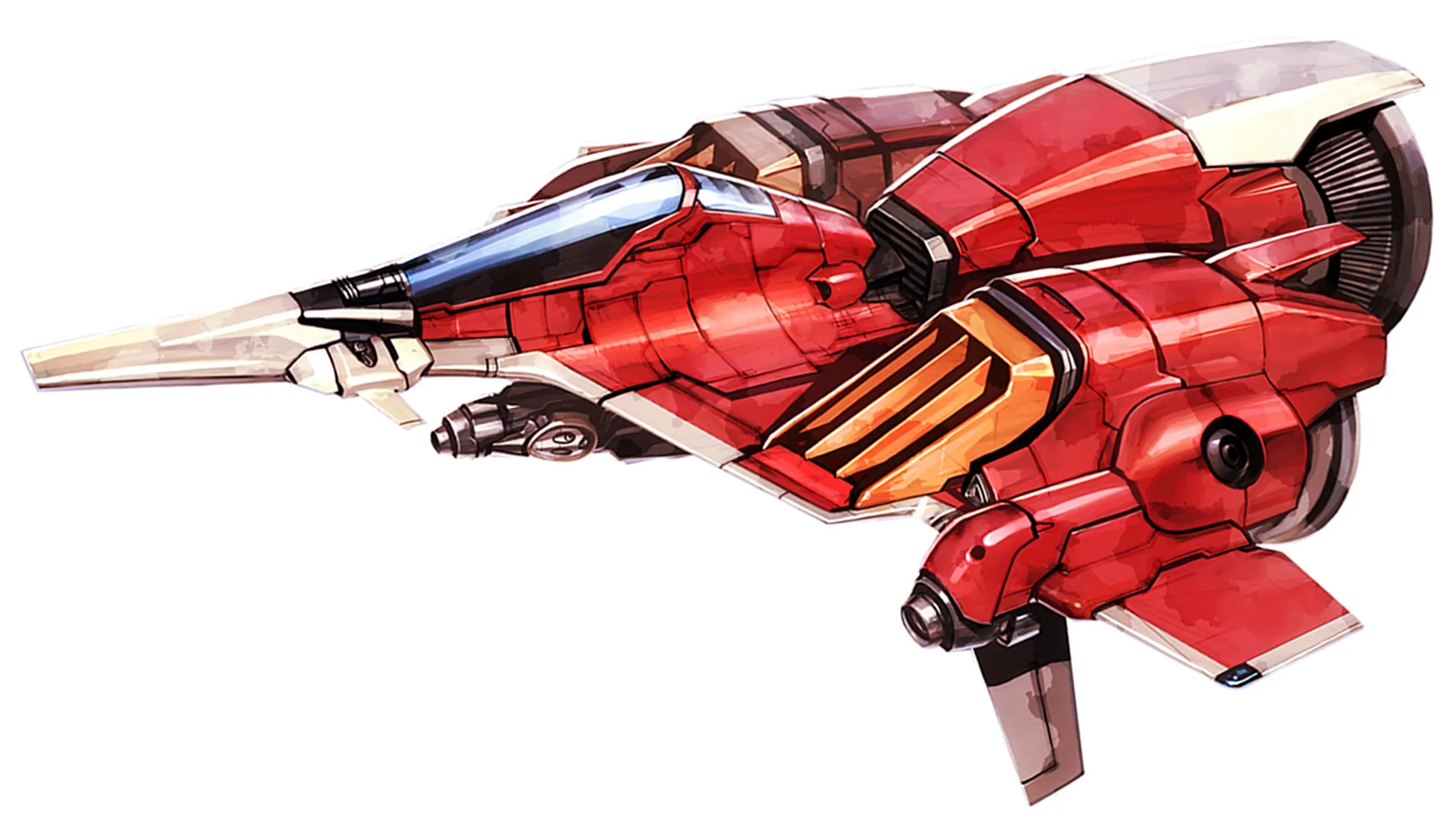
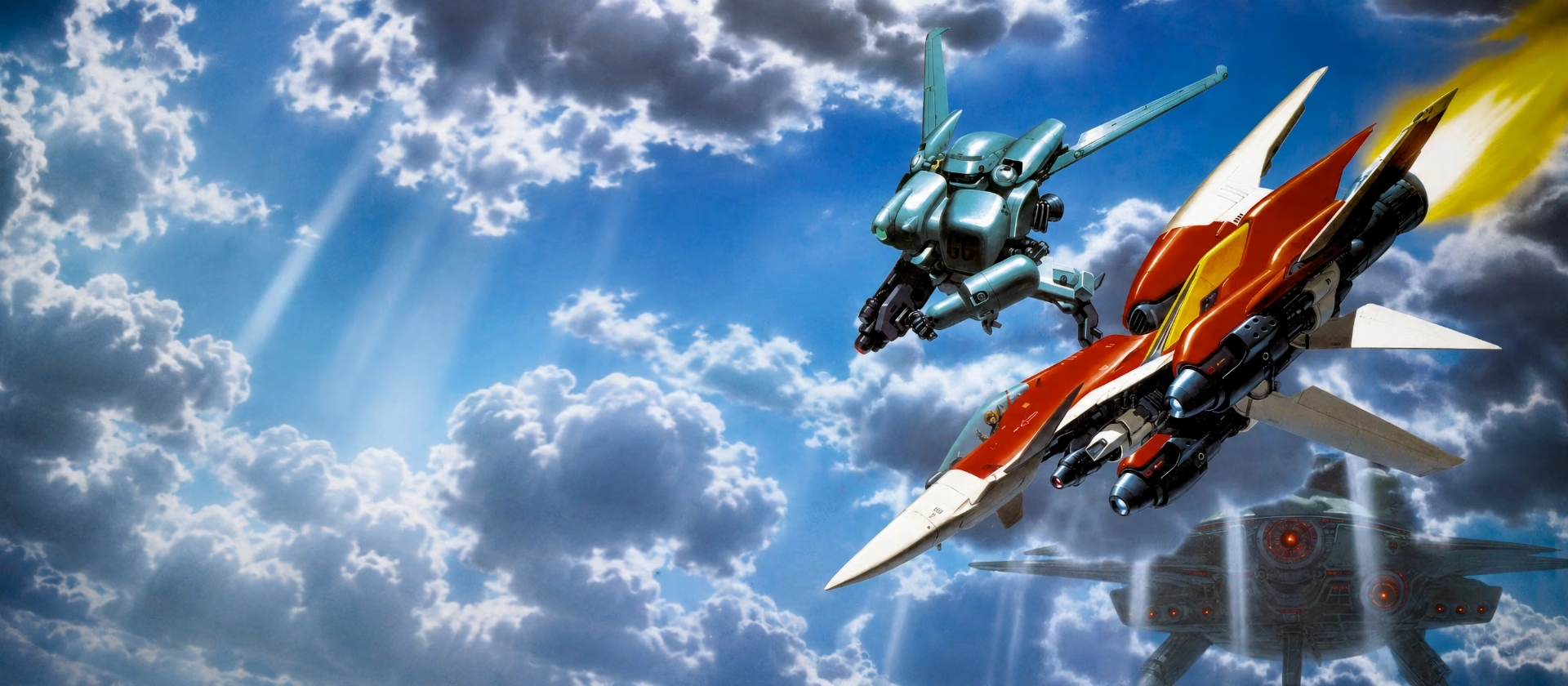
The player ship as Yuji Kaida painted it. Kaida — the Macross and Godzilla illustrator — gave a six-month emergency project the dignity of a Toho theatrical poster. Concept art: Soldier Blade · Hudson Soft, 1992.
The original ROM target was six megabits. By the time the Caravan deadline closed, Hudson had cut the cartridge to four. An asteroid-belt stage with diagonal scrolling was scrapped. A homing missile became a static one. A silhouette effect for the final boss was lost to memory. The cover painting — the player ship banking against red sky and chrome — came from Yuji Kaida, the illustrator who painted Macross and Godzilla; Hudson asked the kaiju guy to dignify a rush job.
”The biggest problem was the limited amount of time we had to meet the deadline for the caravan event: just 6 months.”
— Uribo, designer, Shmuplations interview (2012)
Everything about the production should have made the game worse than its predecessors. Kaneko had longer for Super Star Soldier. Now Production had longer for Final Soldier. Soldier Blade had less time, less ROM, and a team finding its design out loud as it built. What it had that the others did not was the studio’s own brand actually on the controller. The cuts read, in the finished game, as compression. The asteroid stage was scrapped because the seven stages that survived are denser than any in the series.
Three pods, one body
The system is the article. You fly with up to three weapon pods clipped to your ship — red Vulcan, blue Wave, green Laser — and the colour of the lead pod is your active fire. Cycle and your weapon changes mid-engagement; the laser punches a single target, the wave smears across the screen, the vulcan keeps a steady cone. The cycling is instant, with no animation lockout, so the choice of weapon is continuous rather than discrete.
Autofire is built into the ship by default — no rapid-tap reputation required — which throws the design weight onto positioning and weapon choice rather than the wrist economy that defines a lot of contemporary shooters. Where Toaplan or Compile asked players to manage their own fire rate, Hudson gave it away and spent the freed attention on the pods. A skilled run reads as constant micro-decisions about which colour suits the next ten seconds, not as the rhythm-game endurance the genre’s reputation usually suggests.
What turns the three-pod system into a design is what happens when you eject one. Detonating a pod fires a colour-keyed screen-clearing super — a Mighty Bomb in the series vocabulary, though Soldier Blade does not call it that — and the ship is invincible for the full animation. The pod is your bomb, your offensive variety, and your get-out clause, all the same pickup. There is no panic button on the controller because the panic button is also the offensive option. Deciding when to spend a pod is the same decision as deciding when to change your weapon, and the same decision as deciding whether to live.
In context this looks decades earlier than it is. The bomb-as-tactical-pause logic Cave shooters would lean on in the late nineties is already here in 1992, except as a pickup rather than a charge meter, and built into a 4Mb HuCard. The hook is that the system is legible without onboarding. A first-time player can run it on instinct in a single stage and still be reading new things into it on the tenth.
What the Caravan was selling
The strangest thing about Soldier Blade is that the campaign isn’t the main product. Boot the cartridge and the title screen offers three modes: the seven-stage Story, a 2-Minute, and a 5-Minute. The 2 and the 5 are the formal qualifying and final rounds of the Hudson Zenkoku Caravan — the touring score-attack tournament Hudson ran across Japan from 1985 to the mid-nineties, with Takahashi Meijin as its presiding celebrity. A yellow van crammed with monitors pulled into a city, two hundred and fifty kids queued up, and the format was the format.
”Qualifying matches would take two minutes, and final rounds would take five. But only 10 out of 250 people would be selected for the final rounds.”
— Takahashi Meijin, Shmuplations interview (2010)
The economics of that format are strange in retrospect. Hudson built each year’s flagship shooter so that thousands of kids across a national tour could fight each other for ten seats in a televised final, then sold the same cartridge to anyone who never went near a Caravan tent. The cartridge had to satisfy both audiences. Soldier Blade is shaped accordingly: a campaign you can finish in one sitting, two timed modes sized for spectatorship, and not a single design decision that belongs only to one mode.
The Star Soldier line had been built to fit the Caravan since 1986. By Soldier Blade the relationship had inverted: the home cartridge existed to ship the competitive modes home with you, and the campaign was the explanatory wrapper. Modern shooters frequently bolt on a Score Attack mode after the fact. Soldier Blade was designed score-first and structured a campaign over the top.
That logic explains the run length, the discipline of the boss patterns, and the absence of any narrative furniture. There are no cutscenes between stages. The framing fiction — three years after a reconnaissance fleet vanished into alien territory, you fly out to find what happened — survives only in the manual and the credit roll. The game itself is geometry and timing.
Hoshi’s medley
The score is by Keita Hoshi and Makiko Tanifuji, and the most telling detail about how it was made is small. Asked to compose for stages he had only seen in concept art — Uribo’s team gave their composers imagery, not levels — Hoshi delivered a soundtrack that runs the seven stages at a single propulsive register and then closes on a credit-roll medley that reprises every theme as one piece of music. The medley wasn’t standard for HuCard shooters, and it isn’t typical of Hudson’s other 1992 output. Uribo asked for it; Hoshi built it.
What the music does in play is unfussy. It accelerates with the action rather than swelling under it, holds the pulse for two-minute runs without monotony, and never asks for attention the bullet patterns also want. What sticks afterwards is unusual for the format — not a single hook from a single stage, but a sense of having heard one continuous piece of music broken into seven movements, which is closer to what Hoshi delivered and what the medley admits at the end. Listen to a Caravan run with the sound on and the game stops feeling like a campaign at all — it feels like a routine being performed against a beat. Which is closer to what it is.
The loop is the game
What this design refuses is worth naming. There is no checkpoint, no extended campaign, and a quirk in the scoring economy lets a careful player milk the blue weapon against the third-stage tank boss for an embarrassing run-up that competitive top-end scores rarely acknowledge. If you want a shooter that pretends to be a hundred-hour game, this isn’t it.
What’s left to argue is why this lands now. Long-form shooters aren’t in short supply; Cave, Treasure, M2 and the indies that learned from them have kept the genre populated for thirty years. What’s gone scarce is the design Soldier Blade exemplifies — the one-sitting shooter you replay, not the long shooter you finish. Most modern shmups assume you’ll loop them. Few were engineered so that the loop is the artifact.
Twenty-five minutes from cold start to credit. Two-minute and five-minute alternates baked into the same cartridge. A weapon system you can understand on the first run and still parse on the fiftieth. A bomb that isn’t a panic button. A campaign that doesn’t pretend to be a story. The cumulative effect is a shoot ‘em up that values your time the way a chess game values your time — not by length, but by what you do inside it.
Hudson never built another PC Engine shooter. Uribo’s team next started something called Knights of Fights, and the company moved off the platform. Star Soldier resurfaced on N64 in 1998 and WiiWare in 2008, both decent, neither this. The Caravan tour kept moving for a few more years on the back of Bomberman and one-off Hudson exclusives, but the format that had defined a decade of home shooters was effectively closed when this cartridge shipped. Soldier Blade is what it sounds like when a studio takes its own genre back, gets six months, and finishes the argument.