The Castlevania you remember is a memorisation gauntlet. Simon Belmont walks forward, plants his feet, swings his whip in the only direction available — forward — and gets thrown backwards down a staircase by a Medusa head he could see coming for half a second and could do nothing about. The friction is the point: every screen in the original Castlevania is a puzzle written in muscle memory, and the punishment is calibrated so that learning becomes the play. It is brilliant. It is also brutal, and a great many players bounced off it and never came back.
Super Castlevania IV, on the surface, looks like the polished continuation of that idea. Same hero, same castle, same Bach-quoting music, same descending staircase into Dracula’s chamber. The 1991 trade press treated it that way too. Nintendo Power gave it a column of fours and fours-and-a-halves; GamePro said in its November 1991 review that the game “improves everything.” Both were correct and both were missing what had actually happened. What Konami’s new SNES team had done — quietly enough that nobody at the time put a name to it — was rebuild the central verb. The whip aims in eight directions now. It can be brandished, held out and spun. It can be hung from rings in the ceiling and used to swing Simon over chasms. The screen still kills you, but for the first time in the series, the player gets to answer.
Whip in Eight Directions, Suddenly
The clearest place to feel the change is the staircase. In every previous Castlevania, a staircase is where the game tightens around you: enemies arrive at angles your whip cannot reach, knockback drops you a flight or two, the only correct response is to have memorised which step to stop on and which to keep climbing. In SCIV the staircase is still dangerous, but now you can whip up-and-to-the-right, down-and-to-the-left, straight up, straight down. The medusa-head rooms that defined the NES game — those long horizontal corridors where two snake-haired heads track you in floating sine waves — become rhythm exchanges instead of punishment chambers. Hold the attack button and Simon’s whip becomes a slow propeller blade. Projectiles bounce off it. The screen reads the same; the game underneath it has been rewired.
The whip’s new spatial grammar — diagonal arc, hold for a brandished spin. Mechanics the 1986 Famicom design sketched out and could not ship. Super Castlevania IV · Konami, 1991 · Super Famicom.
That eight-way whip is not a SNES novelty. By some accounts it had been on the original 1986 Castlevania design document for the Famicom Disk System and got cut for control and cartridge reasons — director Masahiro Ueno told Retro Gamer’s John Szczepaniak that what he was building was, “to some extent,” a remake of the original, the version the 1986 team would have shipped if the hardware had let them. Five years and a generation of console later, a different programmer (Mitsuru Yaida, credited as “Yaipon”) finally got Simon’s input handling into the shape the series had been reaching for. Ueno’s stated brief was modest: a pure action game in the spirit of the first Castlevania, with the player frustration sanded off. What he and his team actually shipped was the pivot the whole series turns on.
The Designer Who Wasn’t There
This was the first Castlevania of the post-Akamatsu era. Hitoshi Akamatsu had directed the three Famicom games — the one nobody can dislodge from the canon, the strange RPG-adjacent sequel that nobody quite forgives, and the third installment that most fans rate as the high-water mark of the eight-bit era — and then he stopped, somewhere around Bloodlines in 1994, and disappeared from the public record entirely. Szczepaniak tried to interview him for The Untold History of Japanese Game Developers and was politely declined. Super Castlevania IV is the first piece of work where Konami’s series gets to define what Castlevania is in his absence: a new programming team under Ueno, a hold-over audio team from Dracula’s Curse, and the cheerful, unsupervised conviction that the way to honour the original was to redo it correctly.
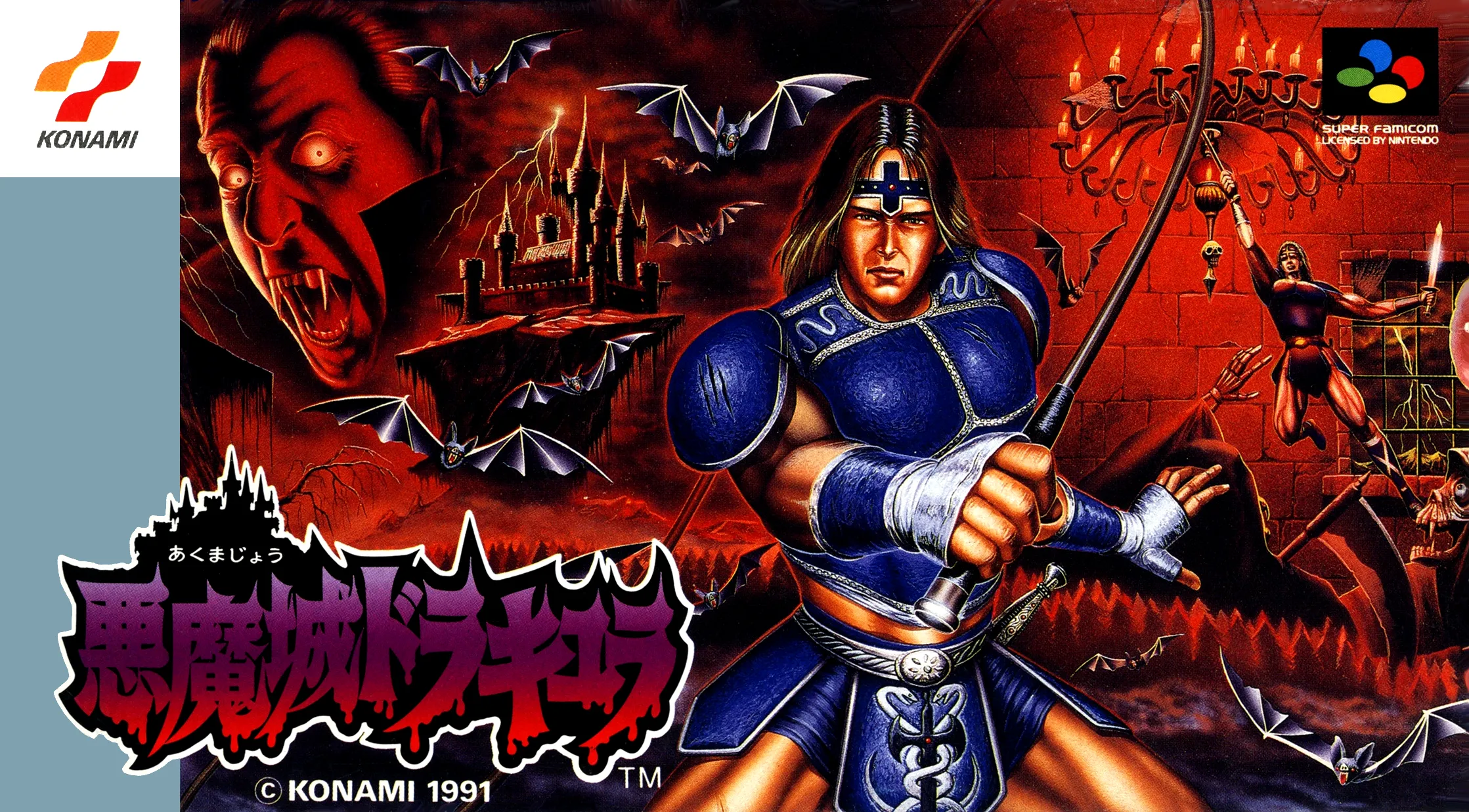
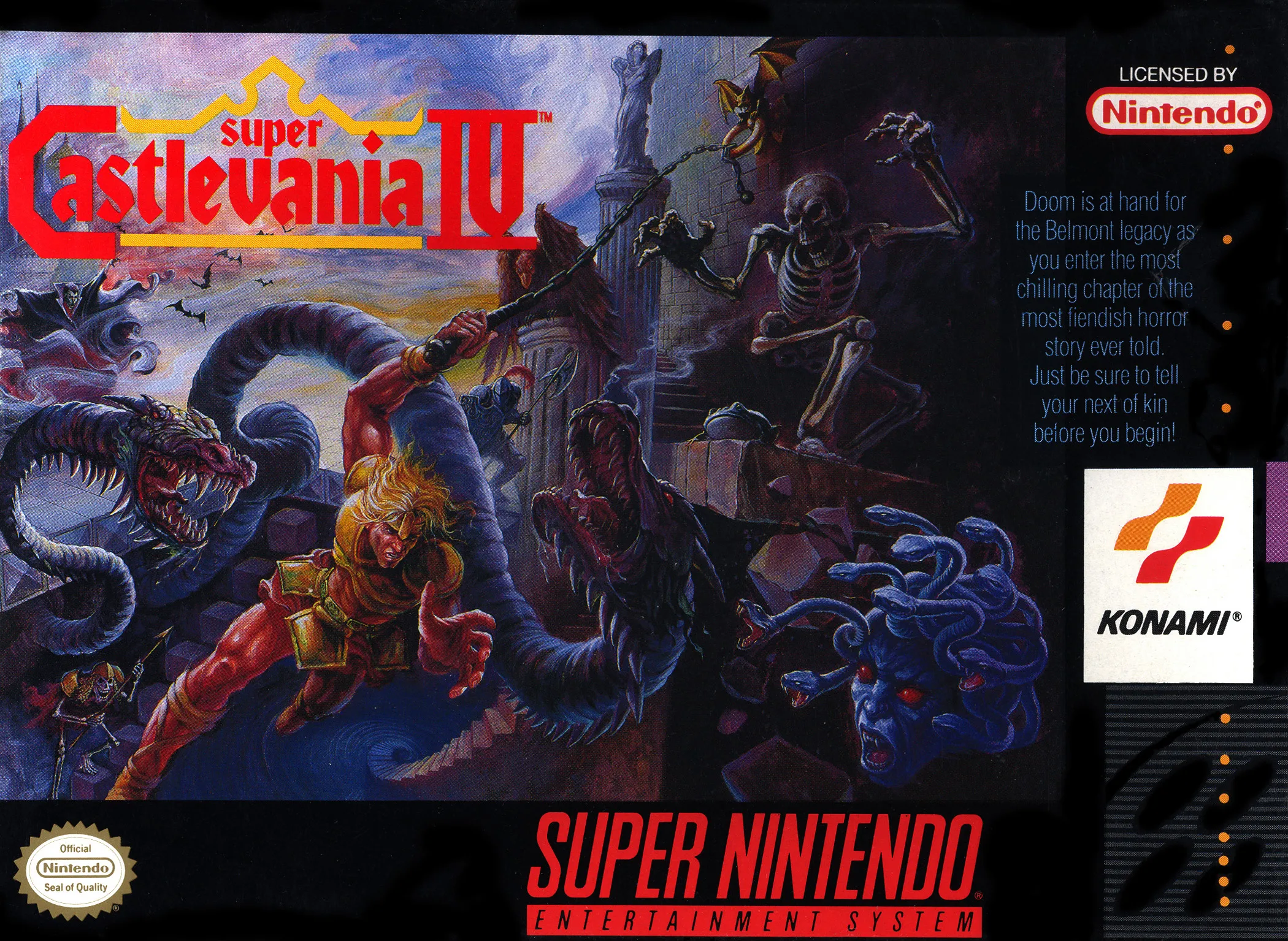
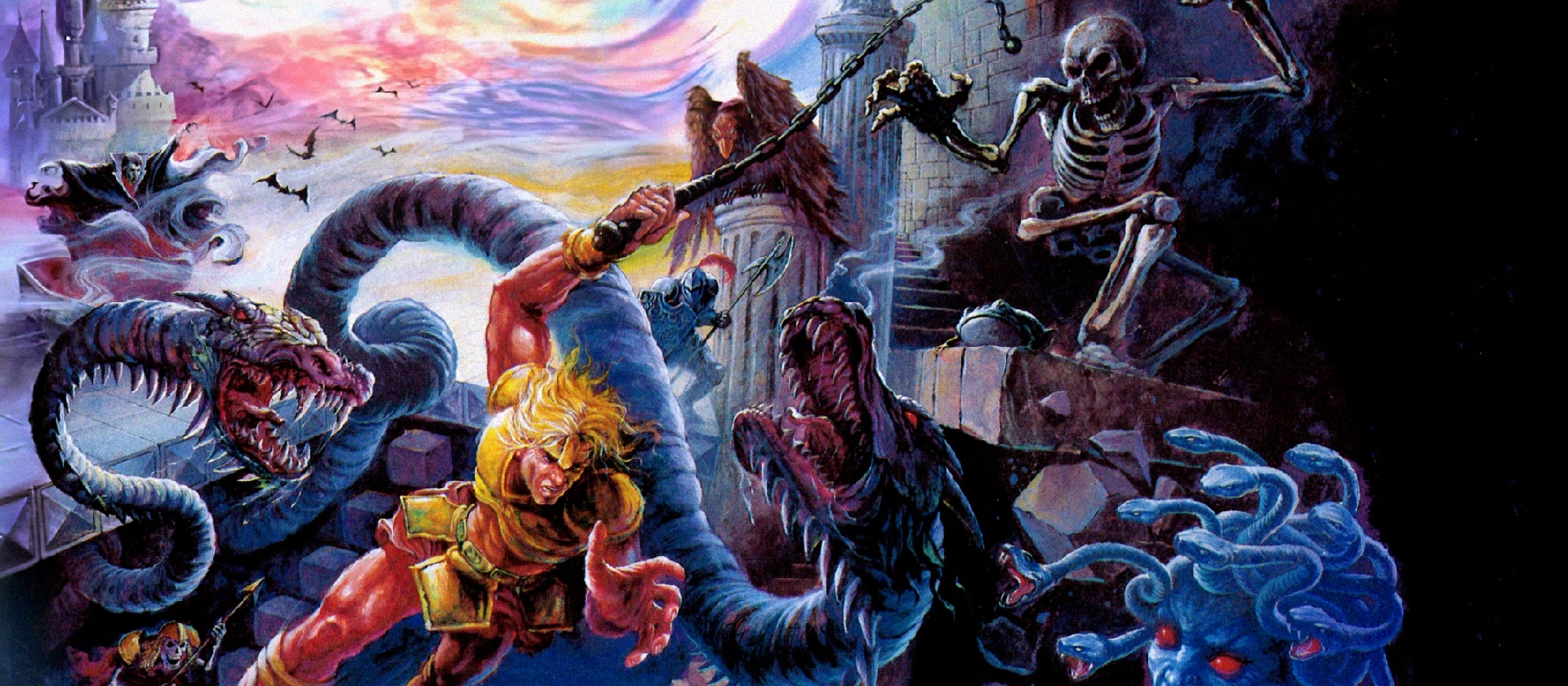
Two readings of the same cartridge: Konami Japan’s blue-cloaked Belmont and Tom DuBois’s painted American Simon. The packaging arrived ten years before the visual identity that Symphony of the Night would later give the series — and the games’ actual castle is closer to neither than to both. Akumajō Dracula (Japan) / Super Castlevania IV (North America) · Konami, 1991.
You can see that conviction in places the box art doesn’t. Konami of America (under Nintendo of America’s pressure) clothed the nude statues, repainted the Stage 8 dungeon’s blood-pools and ceiling-drip as green slime, and stripped the crucifixes out of every coffin and tombstone — even the one on the title screen. The Rosary item stayed; the religious iconography around it did not. The Japanese ROM is the design intent; the international ROM is the design intent with a Vatican filter. The Castlevania Anniversary Collection ships both and lets you toggle, which is most of the reason it remains the only legitimate way to play the game.
Mode 7 Around a Still Verb
The mid-game shows you why the redesigned whip mattered. Stage 4, “A Hidden Path of Stone,” is where Konami’s new team made their public case for what the SNES could do. The level rotates. Not in a racing-game sense, not as an intro flourish — the chamber itself, with Simon inside it, tilts and tips in real time, ceiling becoming floor while gravity gets pinned in place. By 1991 a few SNES games had used Mode 7 sparingly; this was an early use of the mode in service of a narrative idea, where the level animates around the player rather than the player animating around the level.
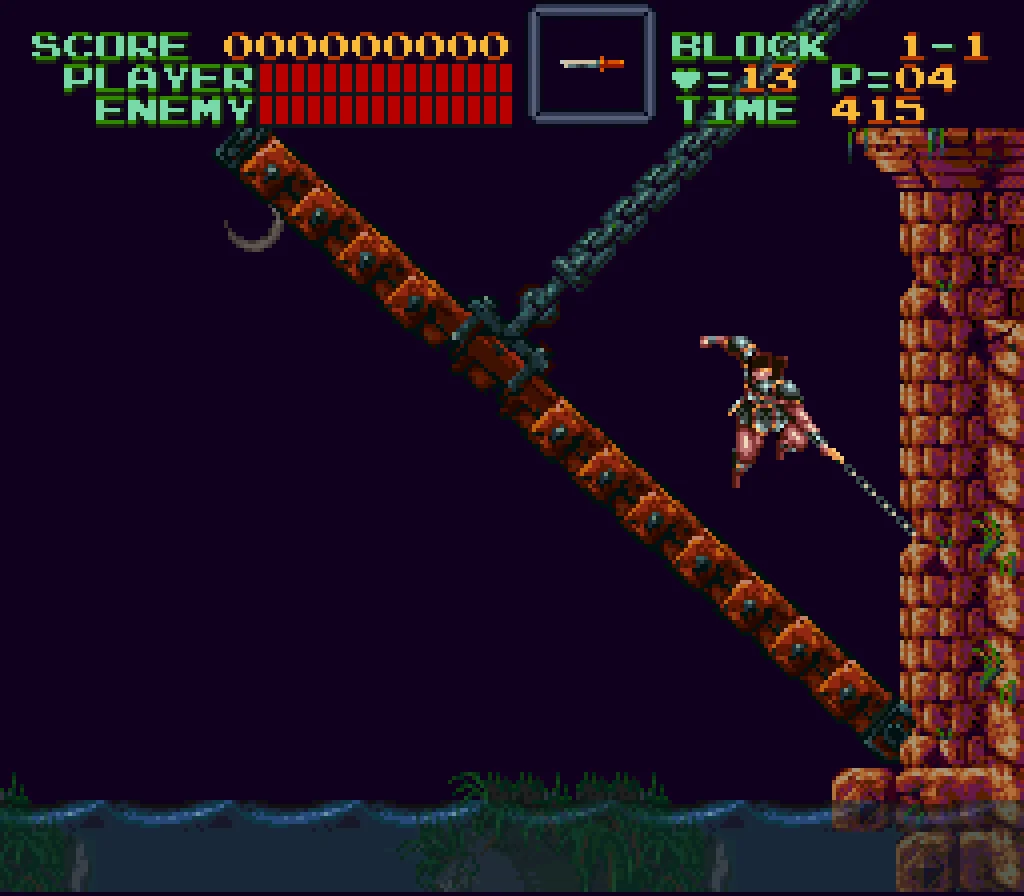
The chain bridge in Stage 4, twisting in real time as Simon hangs by his whip. The first place in the series where the room is the thing moving and the player is the still point. Super Castlevania IV · Konami, 1991.
That sequence only works because the eight-way whip exists. The grip — Simon hangs from a ring in the ceiling, the chamber begins to rotate, the whip becomes a static anchor while the geometry swings — is the new verb being asked to hold the new spectacle steady. Take Stage 4 out of Super Castlevania IV and you have a beautiful side-scroller. Leave it in and you have a thesis statement: the level is no longer a fixed surface to traverse; it is an object that can be inspected by an active player. Every Castlevania action game that followed — Rondo of Blood’s elastic stages, Aria of Sorrow’s soul-modulated playthroughs, the Dominus Collection’s recent canonisation of the whole sub-tree — is downstream of this room.
Adachi’s Techno, Briefly Hated
Composers Masanori Adachi and Taro Kudo were a hold-over from the Castlevania III team. What Adachi brought across to the new project was not strictly Castlevania and barely strictly game music. By his own account in a Video Game Music Online interview with Chris Greening, he had spent the back end of the eighties orbiting Voice Project, a Tokyo techno-and-ambient collective. He carried that into the SPC-700:
“At the time of Castlevania, I was working on techno and ambient music together with the people who ran a techno event called Voice Project. I think that turned out to be very influential.” — Masanori Adachi, VGMO
You can hear the influence cleanly in the lower-half-of-the-castle tracks — the cellar themes, the cave music, the long pulse-bass repetitions that sit underneath what most of the genre at this point treats as horror set-dressing. The cathedral pieces are still Bach-quoting; the underground pieces are something else. They are texture, not melody. They are what a club producer scored when handed a haunted-house brief, and they do not sound especially like 1991.
The trade press did not love them. Adachi is unusually frank about that, in the same interview: “Unfortunately, at the time the reception to the soundtrack had been extremely negative.” The vindication came slowly, in scattered pieces — Edge magazine eventually came around, Mondo pressed it to vinyl decades later, the Spotify reissue is presumably how most people now first hear it — and Adachi’s own line on the most-remembered cue is fittingly modest: “As for Simon’s Theme, I had no idea that the track would become so iconic.” The score is what it is partly because nobody told its author that “Castlevania soundtrack” was already a fixed genre. It is the same shape as the game’s design pivot: a 1991 reception that called it correct without ever describing what was actually new.
What the Whip Still Reaches
A modern player who only knows the recent metroidvania-shaped Castlevania will find Super Castlevania IV tighter, more deliberate, and shorter. Five to six hours of main story, ninety minutes to the rotating room, then the late game pulls back toward the NES design vocabulary it spent the rest of the game distancing itself from. Stage A’s pendulum-platform run is genuinely hard, and the multi-form Dracula at the end of Stage B takes the new player verbs and asks them to be applied with no error margin. Simon’s commitment to attack frames is still rooted; knockback on hit is still preserved. The friction the rest of the series sanded off is back in the room for the last forty minutes, and reasonable modern players bounce off it. That is the game being honest about what it is — a Castlevania with the eight-way whip, not a Symphony of the Night with the Belmont sprite.
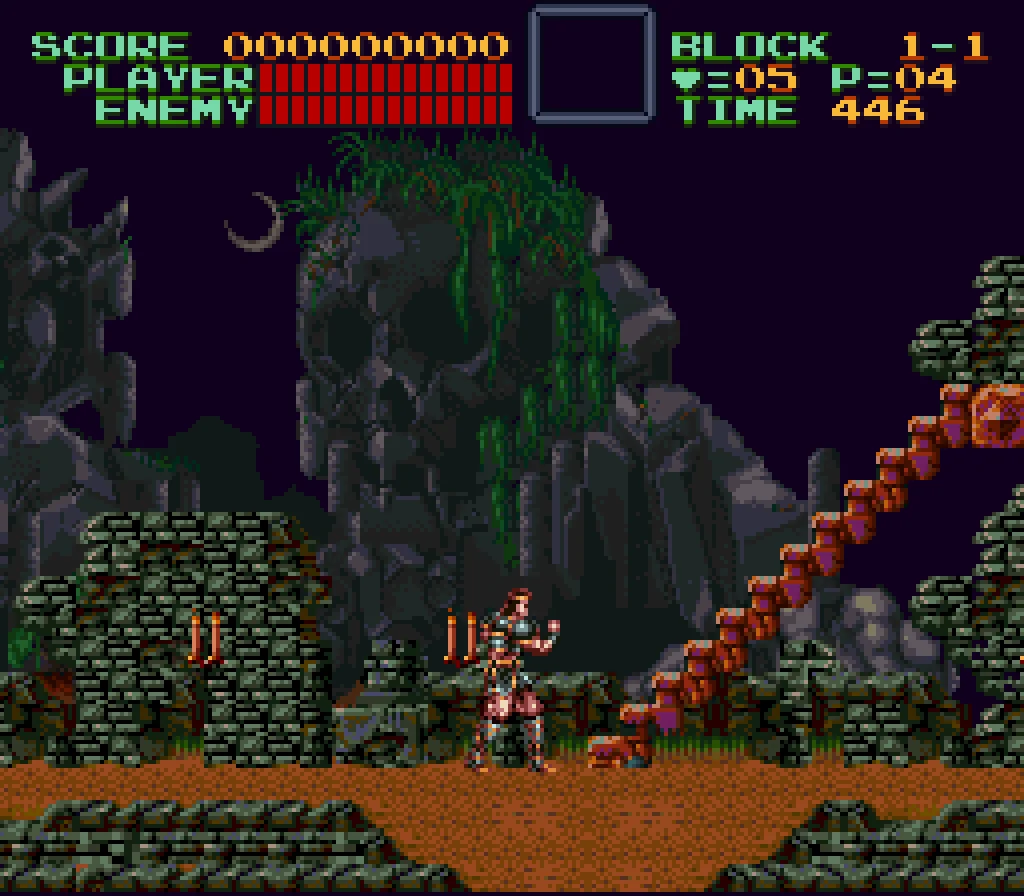
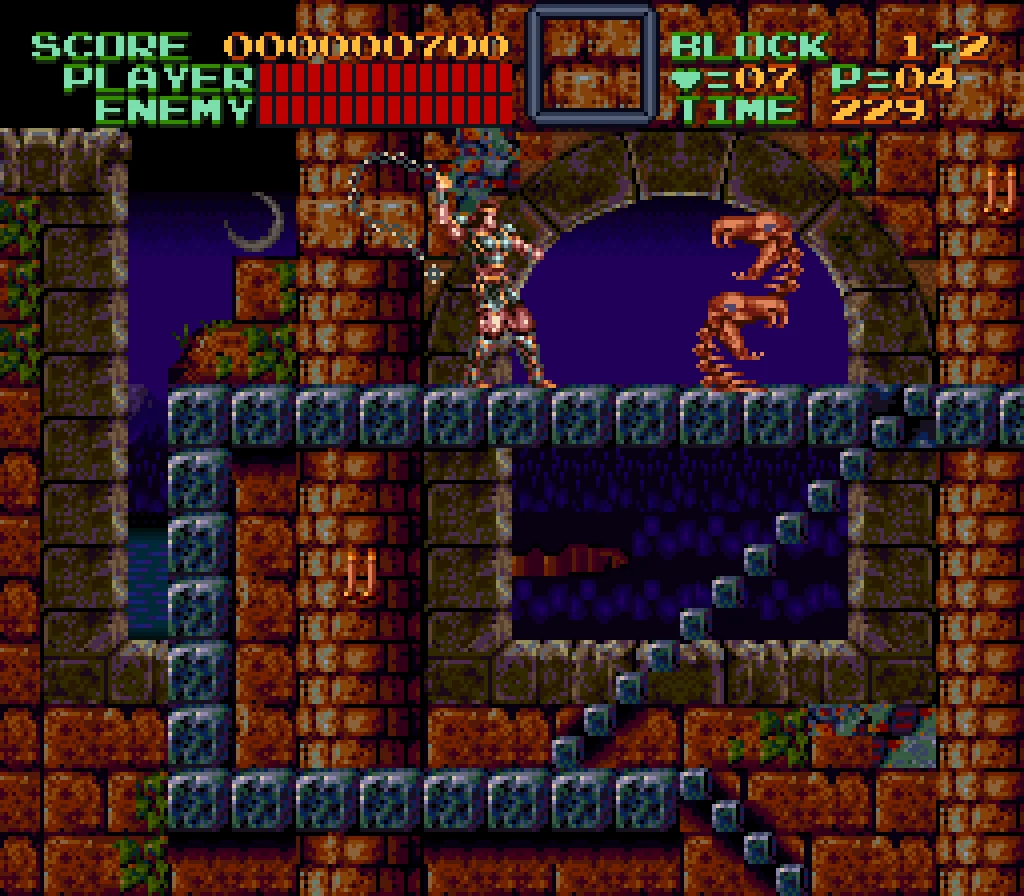
Block 1 exterior — the slow burn before the new vocabulary gets tested. The painted backgrounds run two-and-three planes deep; the score underneath is still ambient pulse. Super Castlevania IV · Konami, 1991.
What it gives you that the obvious peers do not is the moment of overlap — Mega Man still asking memorisation, Symphony of the Night still six years away, this game caught in the middle handing the whip to the player while the level design hasn’t quite admitted what that change implies yet. The friction is the older Castlevania; the answer is the newer one. The cartridge holds both, and the rotating room in the middle is what the series was building toward without knowing.
The Castlevania Anniversary Collection is the route. Toggle the JP ROM the first time through — Stage 8 is a torture chamber, not an acid bath, and the difference is what the team designed. Skip the green slime entirely. The blood was always the point.