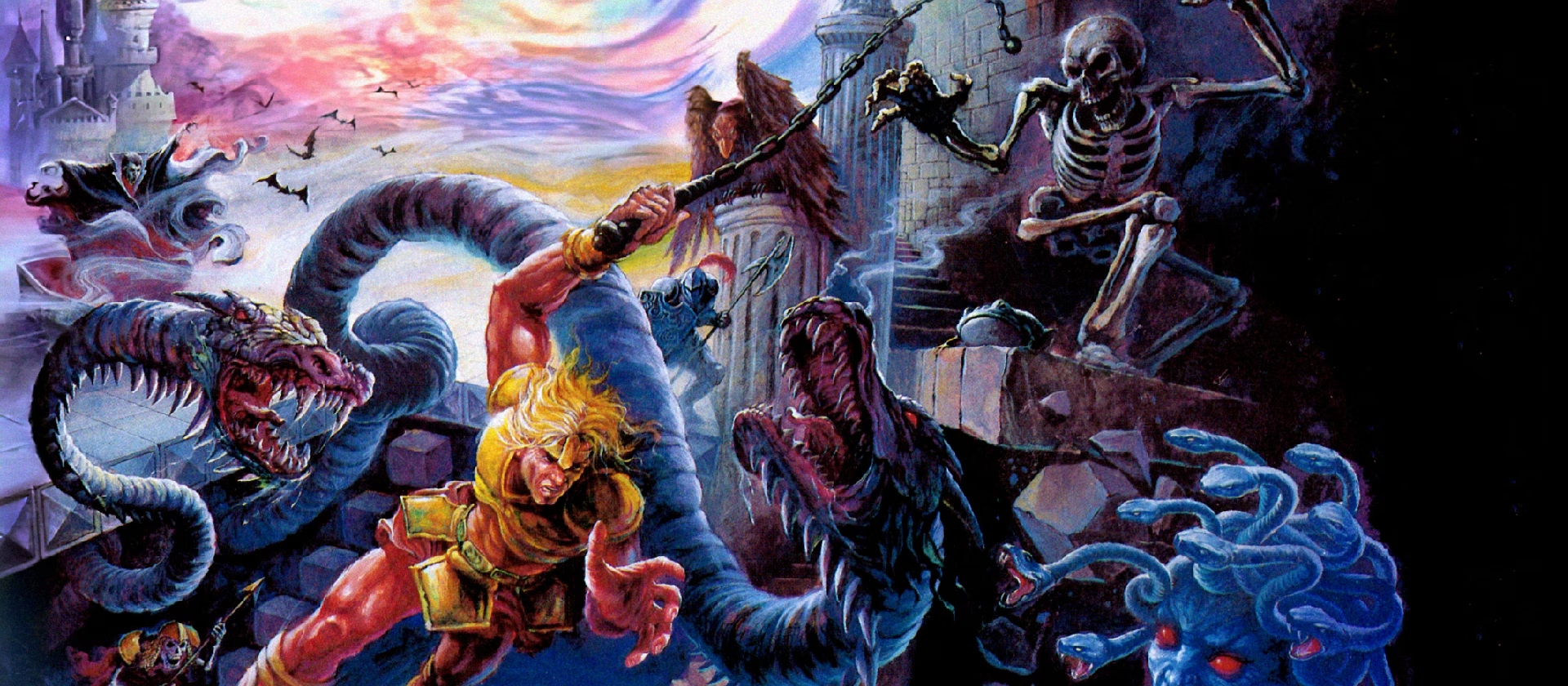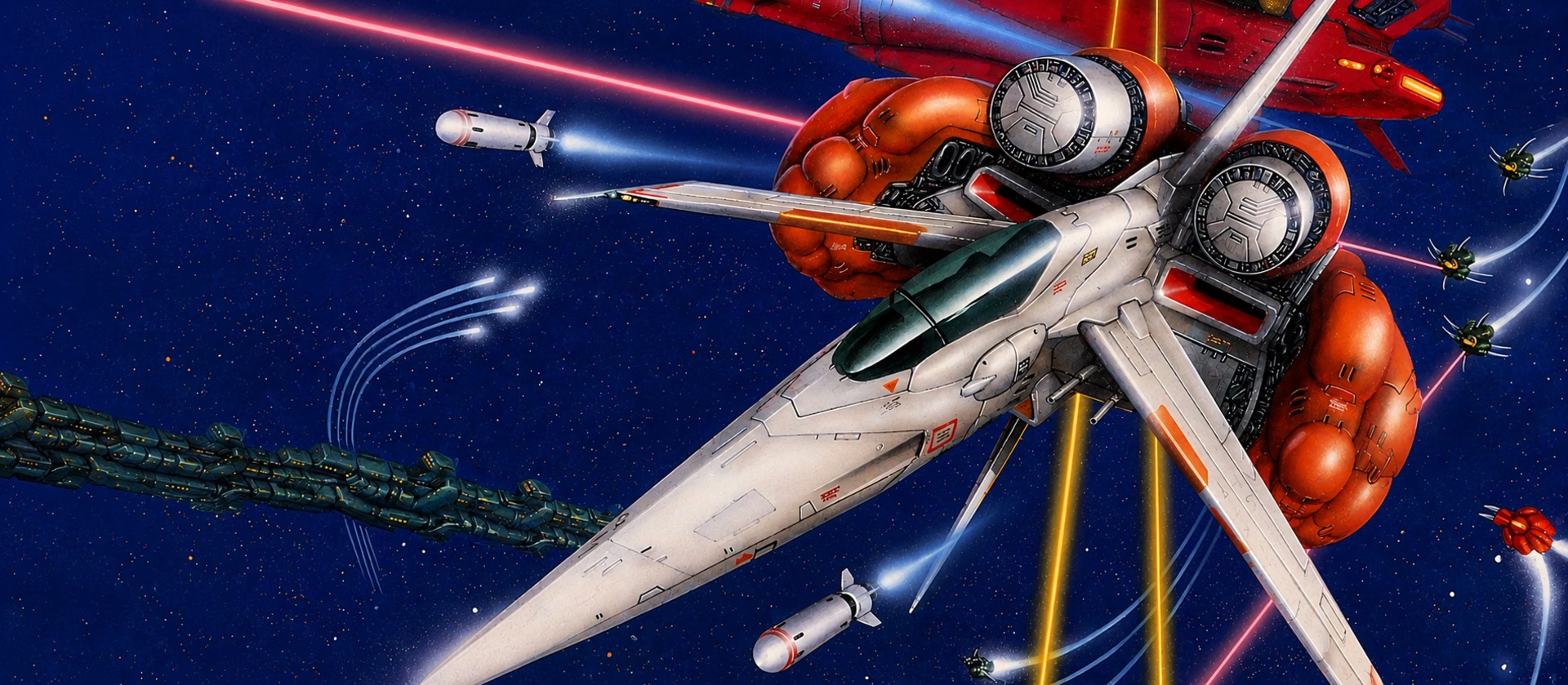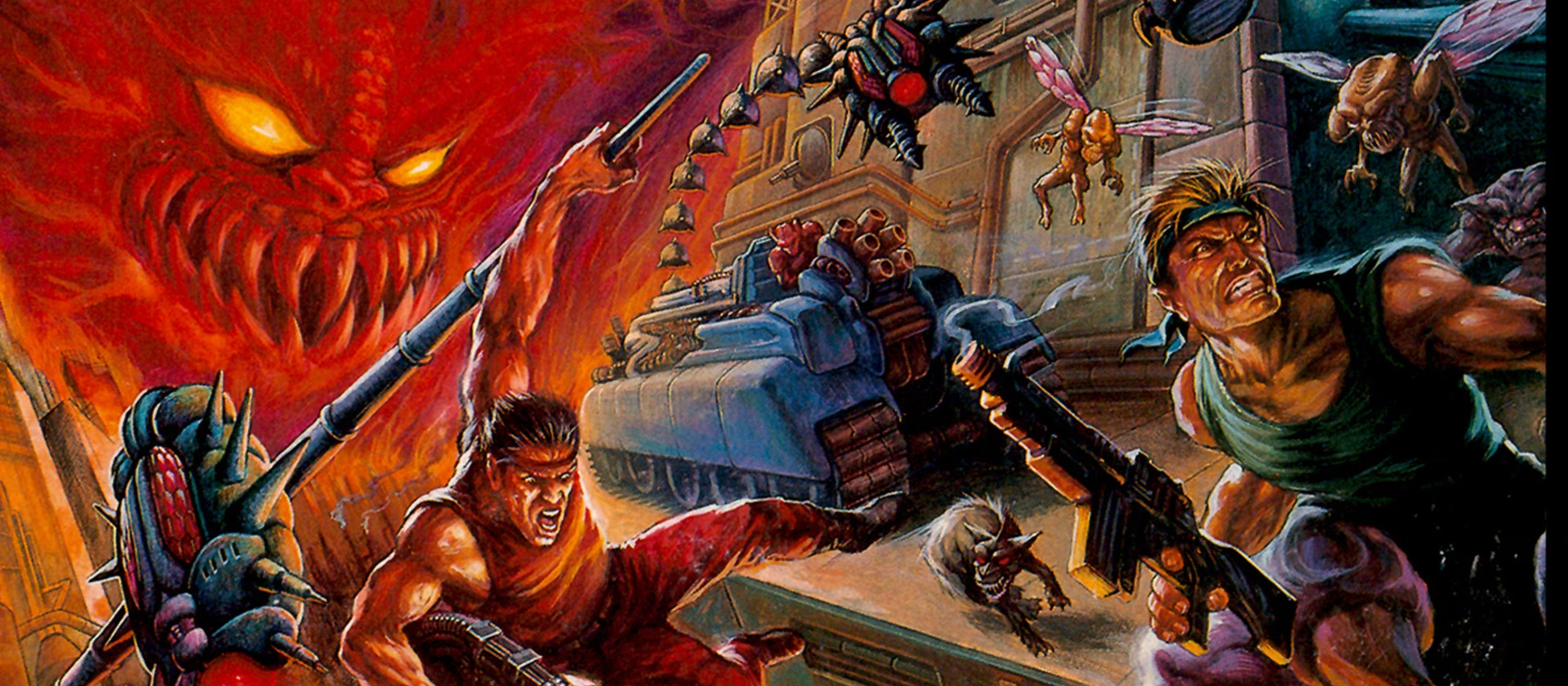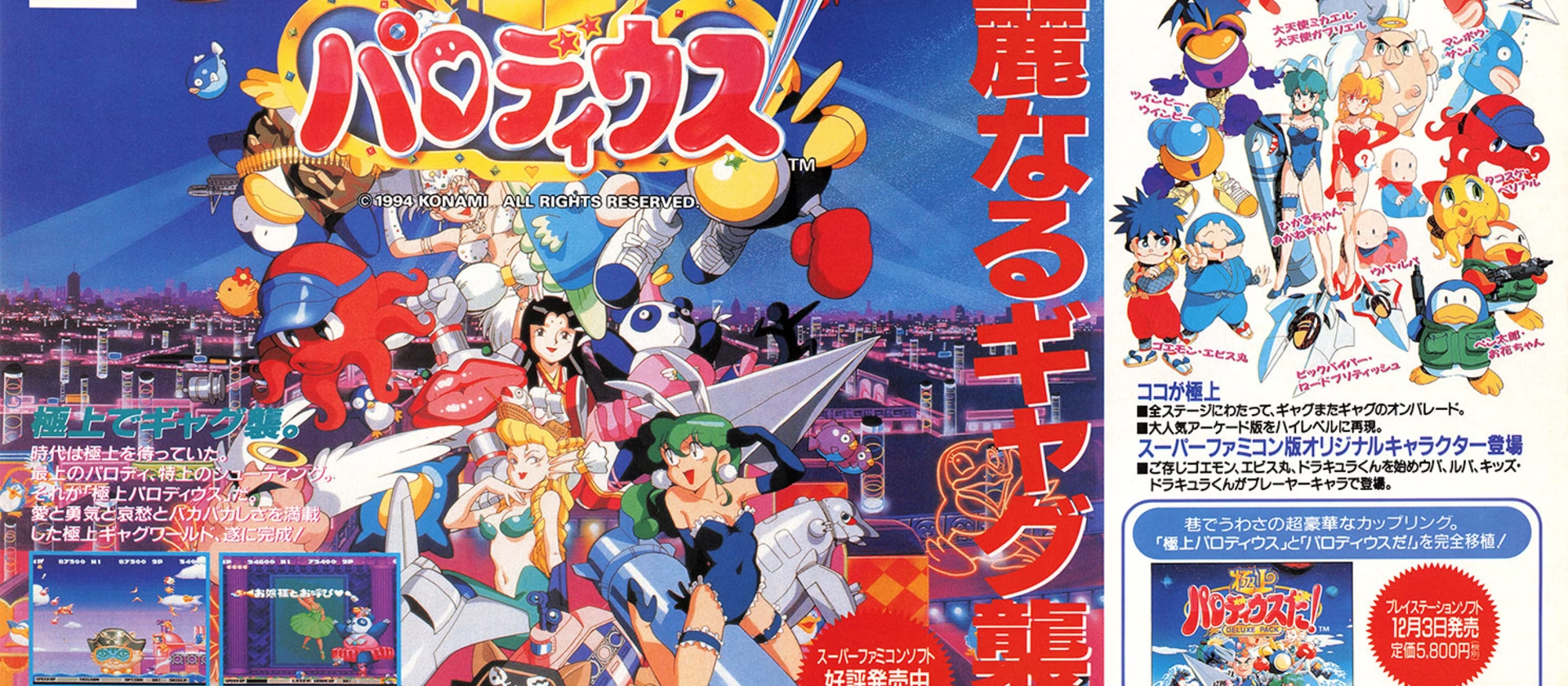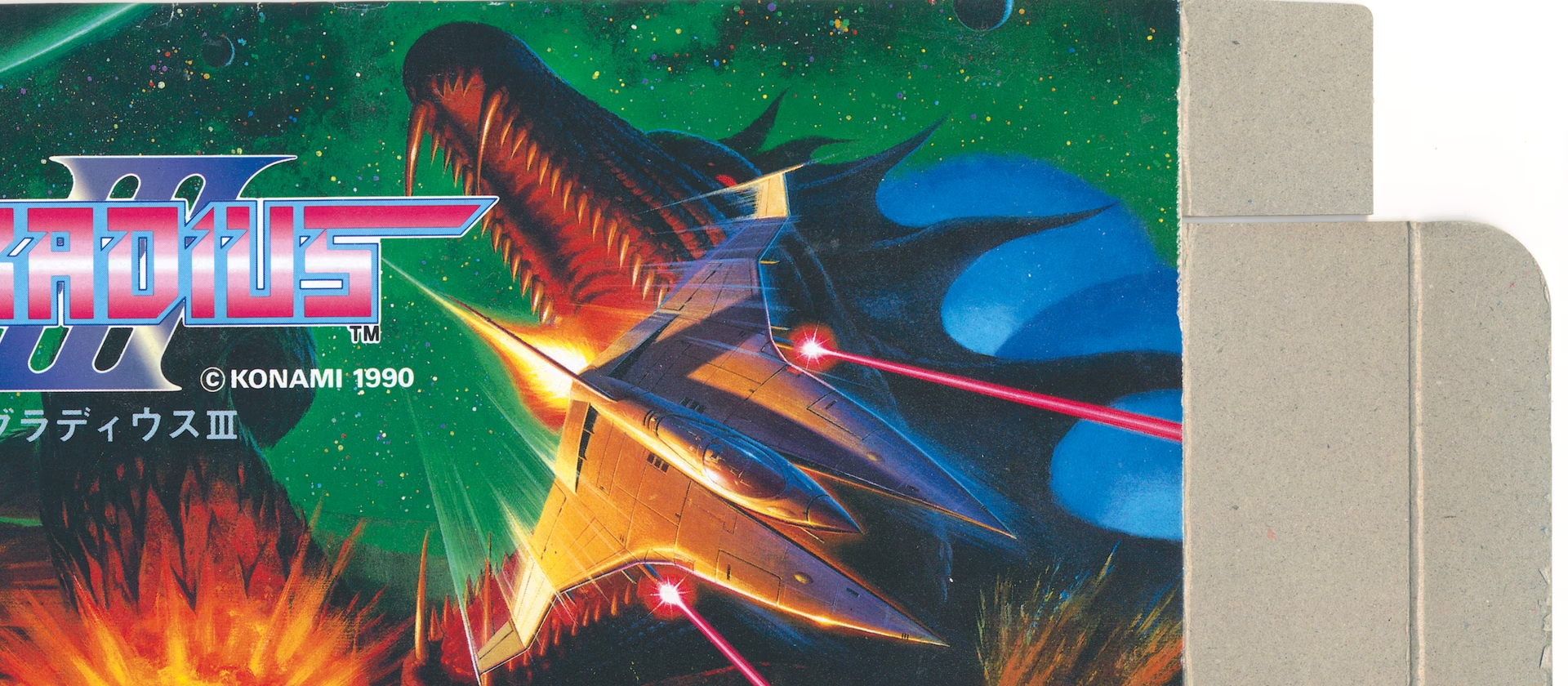
The cartridge carried a quiet confession. It shipped in December 1990, eight weeks after the Super Famicom launched, porting an arcade game Hiroyasu Machiguchi’s team had meant to put Gradius down with — a 10-stage maximalist set-piece its own designers could barely clear. Then the arcade door closed for a decade. The next new Gradius in a cabinet would not arrive until 1999. Everything in between happened at home, and most of it began with this cart: the SNES launch shmup that became, for everyone west of Japan, the first Gradius they had ever played.
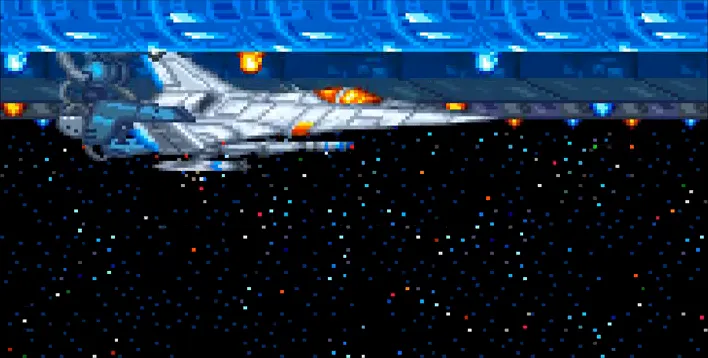
The first thing the SNES cart shows is a wide cinematic flyby — a piece of console-era branding the arcade ROM never bothered with, telling players this was Gradius for the living room, not a coin-op port. Gradius III · Konami, 1990 (SFC).
The Japanese subtitle is the giveaway. Densetsu kara Shinwa e — “From Legend to Myth” — is what you call something you mean to end. Konami’s English boxes never carried it. The team thought they were filing the brand. The hardware market would prove them right by silencing the arcade lineage for ten years, and prove them wrong by handing the cartridge to a brand-new audience that had no idea any of this had happened.
The Sequel Designed to End the Series
The Edit Mode is the first thing the box screen offers, and it is also the first sign that Gradius III was a designer’s swan song. For the first time in the series the player picks the entire loadout — Speed Up, Missile or Vertical drop, Twin Laser or the chargeable C.Laser, F.Option or R.Option, the empty ? slot, the Mega Crush button — before Vic Viper has fired a shot. Both arcade and SNES versions open with this grid. The previous two games made the player power up through a fixed canon. The third one lets you write your own.
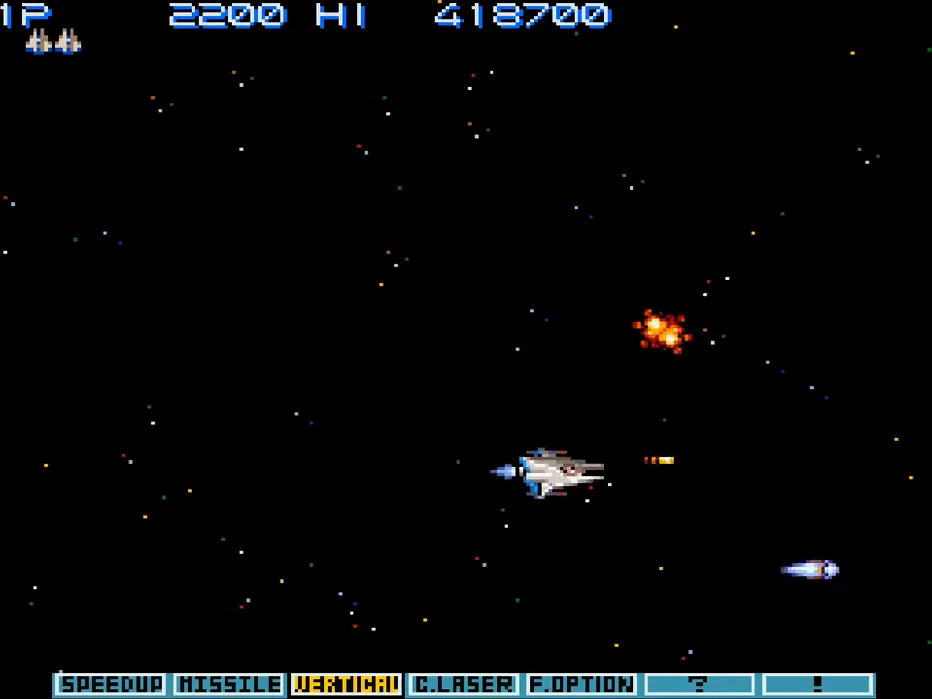
The Edit Mode bar — Konami’s first Gradius to expose the whole power-up grammar at once. Below the prose column it looks like a HUD strip; in design terms it’s the moment the series stops being a canon and starts being a sandbox. Gradius III · Konami, 1990 (SFC).
That sandbox was load-bearing for a reason the dossier surfaces only between two interviews. Yoshitaka Itou, the arcade programmer, told Konami’s Portable Guide in 2006 that Gradius III was meant to be the conclusion of the Gradius series. Takemasa Miyoshi, the designer, told the same panel that the location-test response to the difficulty was “pretty critical, so we added [Beginner mode] to appease them” — and that the new mode trimmed the stage count without softening a single enemy pattern. The team was so sure this was the last word that they could not bring themselves to make a kinder version. Maicon BASIC Magazine reported in July 1990 that only two members of the development team had ever cleared a single loop. The “couldn’t beat it” anecdote is everywhere on the internet because the team put it in the press themselves.
The maximalism then becomes legible. Ten stages — the most in the series — opened the cabinet to the deepest weapon menu it had ever offered, gave the deepest menu the meanest enemies it had ever written, and let the result loose on coin-fed players who would have to start over from the title screen the first time the wall of cubes ended their credit. The arcade game flopped. Konami did not announce it; the silence was the announcement. The next arcade Gradius shipped in 1999.
The Bubble Stage Was Five Years Late
In a 1999 Game Hihyou interview, Machiguchi answered a question about recurring stage ideas with the kind of detail a tired veteran offers. Some of those couldn’t be accomplished due to hardware limitations, but we brought them back for Gradius II and III. The fast scrolling stage and the ice stage in Gradius II, and the bubble stage in Gradius III are examples. The Cell Stage that arrives near the end of the SNES port — pulsating green tissue running floor-to-ceiling, sacs of red pustules clustered into terrain, alien architecture slow enough to feel and fast enough to swallow — is a 1985 idea Konami had wanted to make since Gradius I and only built five years later when the silicon would carry it.
The Cell Stage Machiguchi had wanted since Gradius I. Brought back from the cutting-room when Konami’s new hardware would finally hold a screen this organic, then routed to the SNES port as the closer the home version needed. Gradius III · Konami, 1990 (SFC).
”Some of those couldn’t be accomplished due to hardware limitations, but we brought them back for Gradius II and III. The fast scrolling stage and the ice stage in Gradius II, and the bubble stage in Gradius III are examples.”
— Hiroyasu Machiguchi, director, Game Hihyou, September 1999
The line reframes the whole project. Gradius III is not a sequel reaching for new ideas — it is the directory of every idea the series had not yet been able to ship, dumped into one cabinet by a team that did not think there would be another chance. The Bubble Stage is the cleanest example because the design seam is visible. Nothing else in the game looks like it. The team brought it home before they brought it back home.
The Score That Joined Suikoden’s Future
The composer credit on the cart is a roster the magazines did not really pause to notice. Junichirō Kaneta leads with three Konami staffers underneath whose later work would each define a different franchise. Miki Higashino’s name lands here four years before she would compose the Suikoden main theme; Mutsuhiko Izumi would write Rocket Knight Adventures and the brass-heavy chase music of Castlevania: Bloodlines; Seiichi Fukami and Kōzō Nakamura sat at the same desk for the next decade of Konami’s shmup output. Five composers, one short cartridge, almost no track over two minutes long — and the writing is denser than Gradius II, even when Hardcore Gaming 101 is right that the percussion is thinner.
The texture is the SNES sound chip held to a single idea: that Gradius music is mechanical. The opening theme sits on a stuttering arpeggio and lets the bass walk under it; the Cell Stage cue drops to a sequencer pulse the player counts against the ricocheting enemies; the boss cues stop carrying melody and let an attack-decay synth lead do the work alone. There is no swelling string motif, no faked guitar heroism. Konami’s Kukeiha Club had the tools, demonstrated elsewhere; on Gradius III they used a quarter of them on purpose. The score is a metronome with a thesis: lock the player to the beat, never push, never explain, let the choreography breathe.
The Edit Mode They Finally Trusted
Sit with the SNES port today and the Edit Mode is the design idea that has aged the most cleanly. Pick Twin Laser and the screen fills with rifled parallel beams that strip cluster enemies before they spread; pick C.Laser, hold the button, and Vic Viper carries a chargeable energy lance that punches single bosses where the spread shot wastes ammunition. F.Option spreads four satellite drones in a vertical line for top-and-bottom defence; R.Option (SNES-exclusive) rotates them around the ship for radial pressure. The Mega Crush button — also a SNES addition, sitting in the ! slot — clears the screen once per stage at the cost of every other power-up tier you have accumulated. The bar at the bottom of the HUD stops being a status read and becomes a personal dialect.
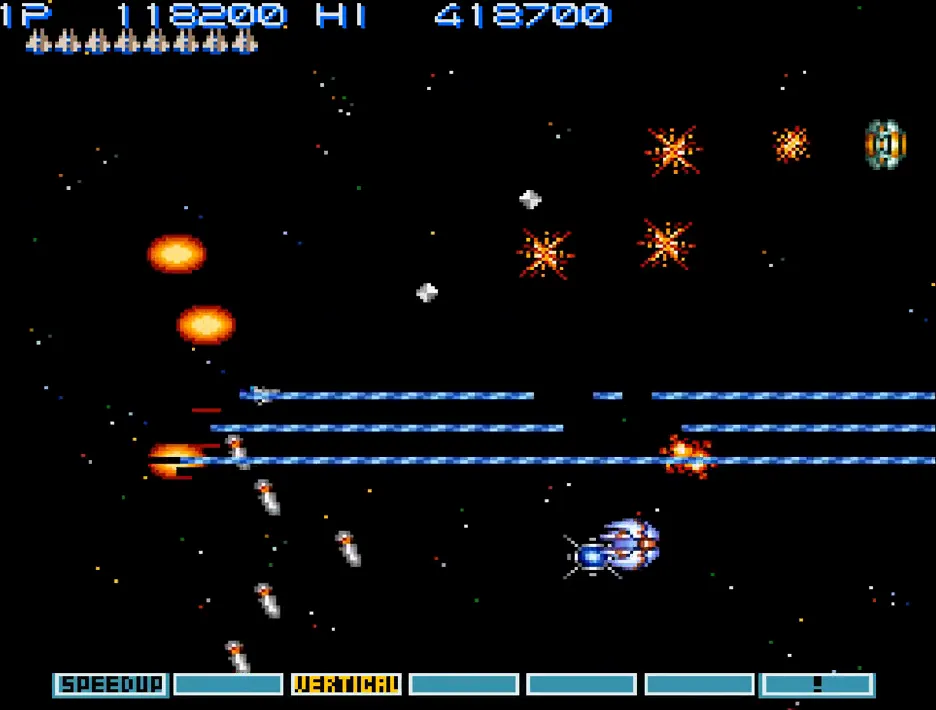
A C.Laser sweep with R.Option rotation — the loadout the previous two Gradius games refused to let the player combine, exposed here as a customisation grid. The play-spine of the cart is the Edit Mode menu, not the stage list. Gradius III · Konami, 1990 (SFC).
The PSP Gradius Collection in 2006 would unlock an “Extra Edit” mode for arcade Gradius III that descends directly from the choices made on the SNES cart. The 2025 Gradius Origins compilation hands the same Edit Mode to a modern training mode that finally lets a player tune restart points and loop counts around it. The cartridge’s contribution to the series is not a stage or a boss; it is the moment the loadout became personal. Everything after — Gradius IV, Gaiden, V, the 2006 Portable — uses the grammar this cart printed.
A Slowdown the Future Couldn’t Fix
The slowdown the SNES port is famous for is also load-bearing, and the fix proved it. In May 2019, the romhacker Vitor Vilela released an SA-1 patch that reroutes the workload to the 10.74 MHz enhancement chip and runs the cart at the frame rate Konami’s team never reached. GIGAZINE’s headline at the time read: the degree of difficulty rose to impossible level. The slowdown was, accidentally, the SNES port’s quiet difficulty-management layer — when the Cell Stage threw too much at the player, the console gasped, and the player got a beat of usable time the arcade ROM never gave anyone. The cartridge ran below spec, and that is partly how it survived an audience the arcade ROM was not built for.
The arcade ROM kept stages the SNES could not.
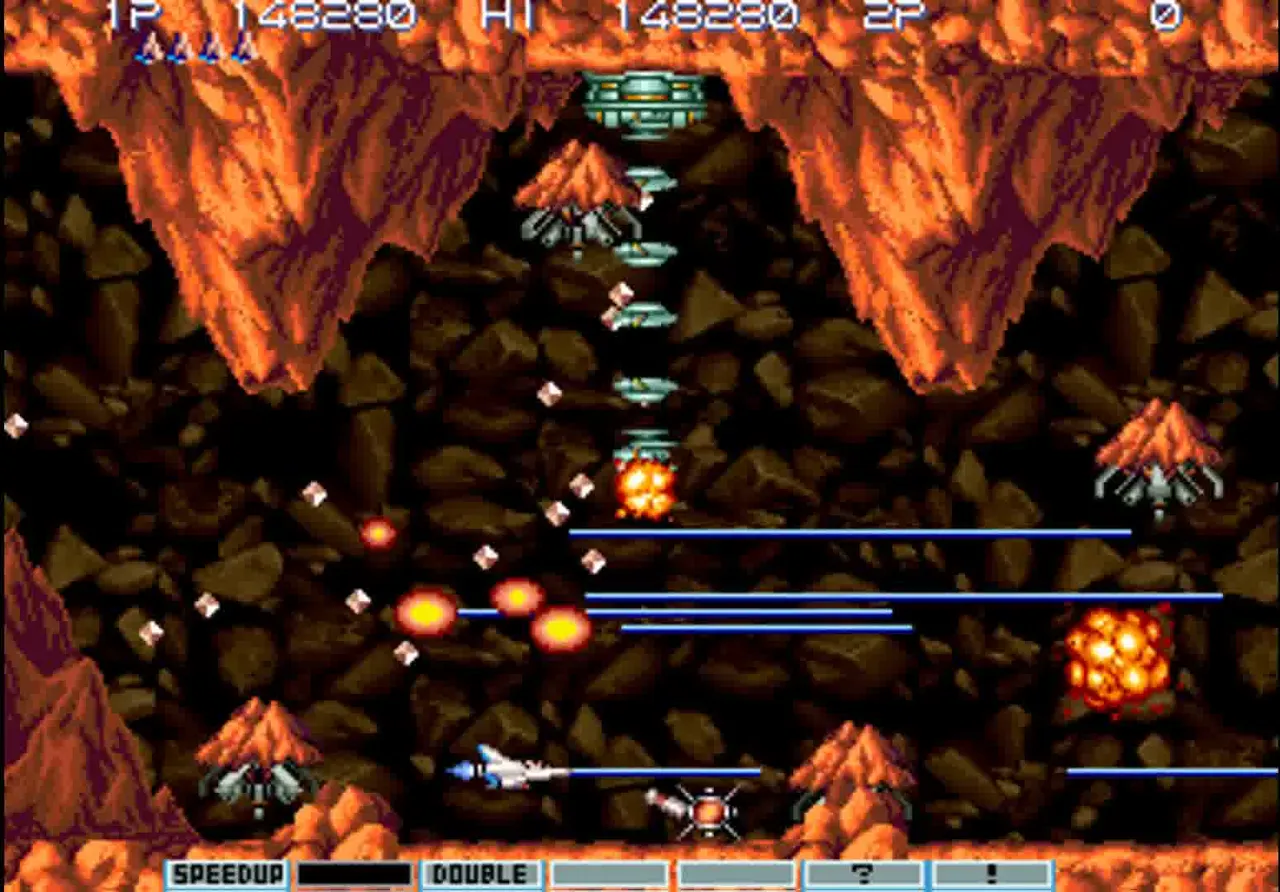
The arcade-only Volcanic Planet stage — full-screen vertical rock canyons in saturated orange, parallel blue laser sweep, enemy density the SNES port had no choice but to cut. The arcade ROM kept stages, palettes, and densities the cartridge silicon could not carry. Gradius III · Konami, 1989 (Arcade, GX945).
The North American release dressed the secret as a private joke. Enter the Konami Code on the SNES port with the joypad and Vic Viper self-destructs; enter it with the L and R triggers substituting for Left and Right, and the full power-up still arrives. The cheat that defined the Konami of America era of Gradius and Life Force now punished the same hands that had typed it for years. The English manual renamed Vic Viper M.A.X. The SNES box made Gradius sound like a marketing line for a console launch, not the third chapter of an arcade story the West had not seen. None of those choices were accidents. The version that became Nintendo’s first Gradius was built to be its own object, and the cart’s slowdown — the part Game Developer would later call a poster child for the SNES’ reputedly slow CPU — was the cost of that translation.
What it asks of a modern player is honest: a credit-run is brutal cold, and the unpatched SNES port misrepresents the arcade design to anyone parachuting in for the first time. The Origins collection in 2025 is the cleanest first contact — arcade ROM, SFC cart, the rediscovered AM Show 1989 prototype, save states, training mode. The PSP Collection still works for portables, and the SA-1 patch is the canonical romhack for a flashcart. The original NA SNES cart is the historical object. None of the modern routes erases the cartridge that made this game a household one; they all let you choose, finally, which Gradius III you wanted to meet.